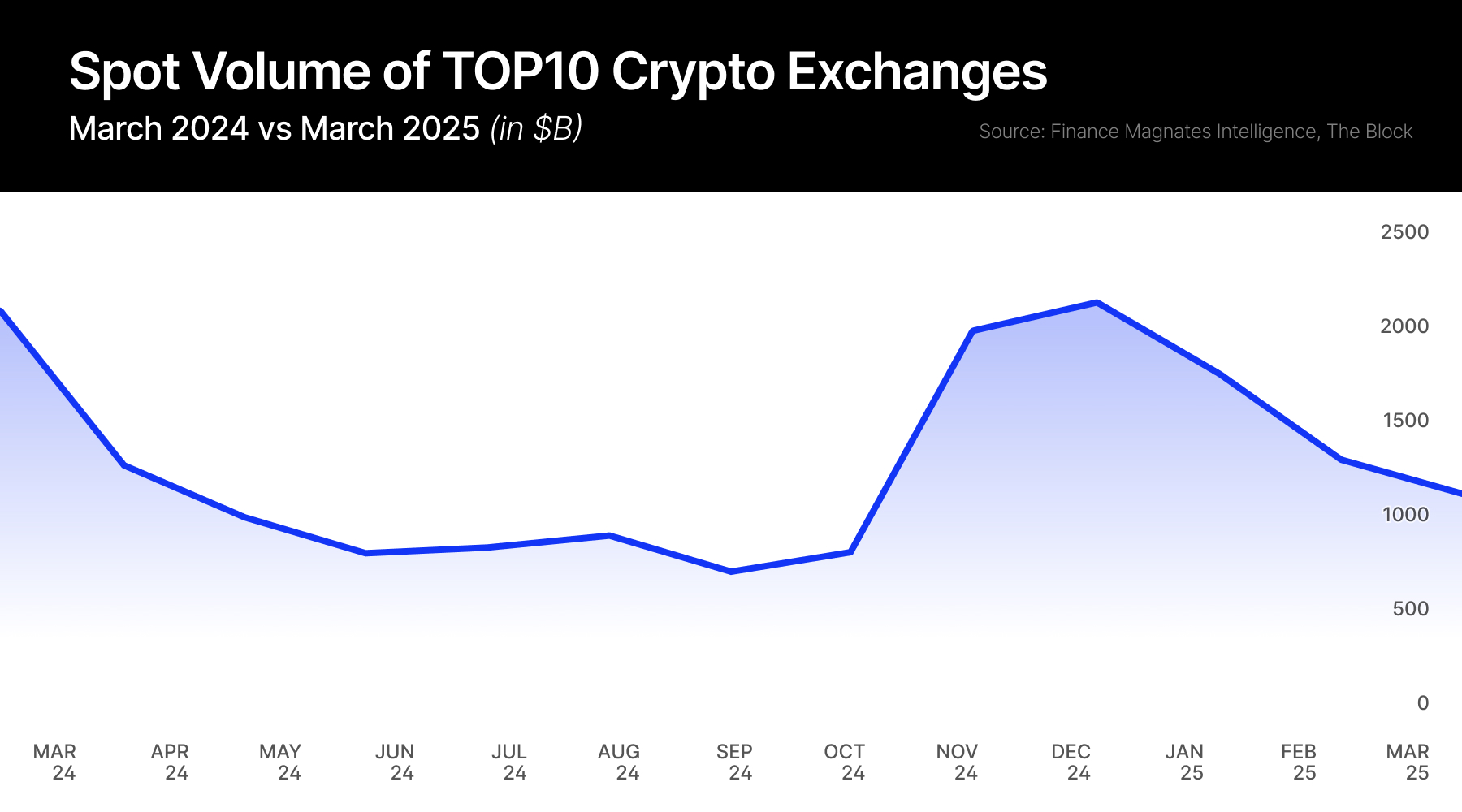
Cryptocurrency exchange trading volumes fell 15.4% in March 2025 to $1.13 trillion, continuing a downward trend from December's peak.
The declines coincided with a continued sell-off in Bitcoin, which last month tested levels below the $80,000 mark.
Some analysts have even forecast that BTC's price could drop to as low as $10,000 in the coming months.
Cryptocurrency
exchange trading volumes decreased by 15% in March 2025 compared to the
previous month, marking the third consecutive monthly decline in trading
activity across major platforms.
The
declines coincided with Bitcoin’s weakening performance. Although its price
contracted by only 2% last month, it briefly fell to $75,000 — the lowest level
since November.
Crypto Exchange Trading
Volumes Fall in March 2025
According
to data from Finance Magnates Intelligence and The Block, total
trading volume across the top ten cryptocurrency exchanges fell to $1.13
trillion in March from
$1.33 trillion in Februaryc, reflecting cooling market sentiment after the
robust trading activity seen in late 2024 and early 2025.
Despite the
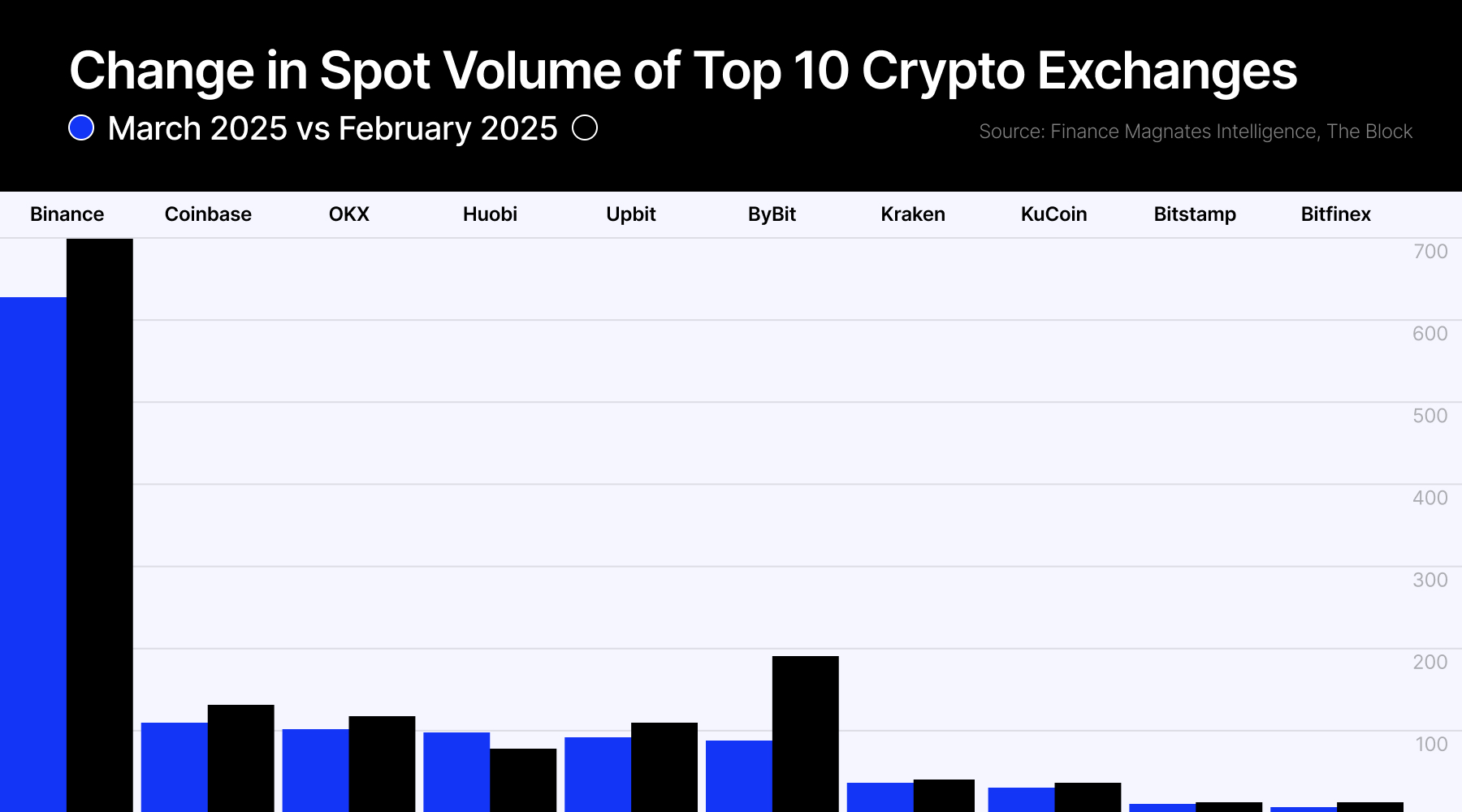
overall market contraction, Binance maintained its dominant position with a
51.8% market share, though its trading volume dropped 10.4% month-over-month to
$583.5 billion. The exchange also showed year-over-year slump of 48% compared
to March 2024.
OKX
maintained its third position with $96.8 billion in trading volume, down 10.8%
from February and down 43% year-over-year.
Conditions are certainly unfavorable at the moment, and according to Dr. Kirill Kretov of CoinPanel, they’re unlikely to improve anytime soon. “We are deep in a risk-off environment with geopolitical stress, shaky economies, and drained liquidity across the board,” he told FinanceMagnates.com.
“The chaos coming out of the new U.S. administration—one vague statement or policy tease is enough to rattle even traditional markets. In crypto, which is far thinner and more reactive, that kind of uncertainty hits like a sledgehammer.”
Huobi Bucked The Downward
Trend
The most
notable performer was Huobi, which bucked the downward trend with a 27.5%
increase in trading volume compared to February, reaching $92.6 billion. This
also represented a 12% growth compared to March 2024, allowing Huobi to climb
to fourth place in the rankings.
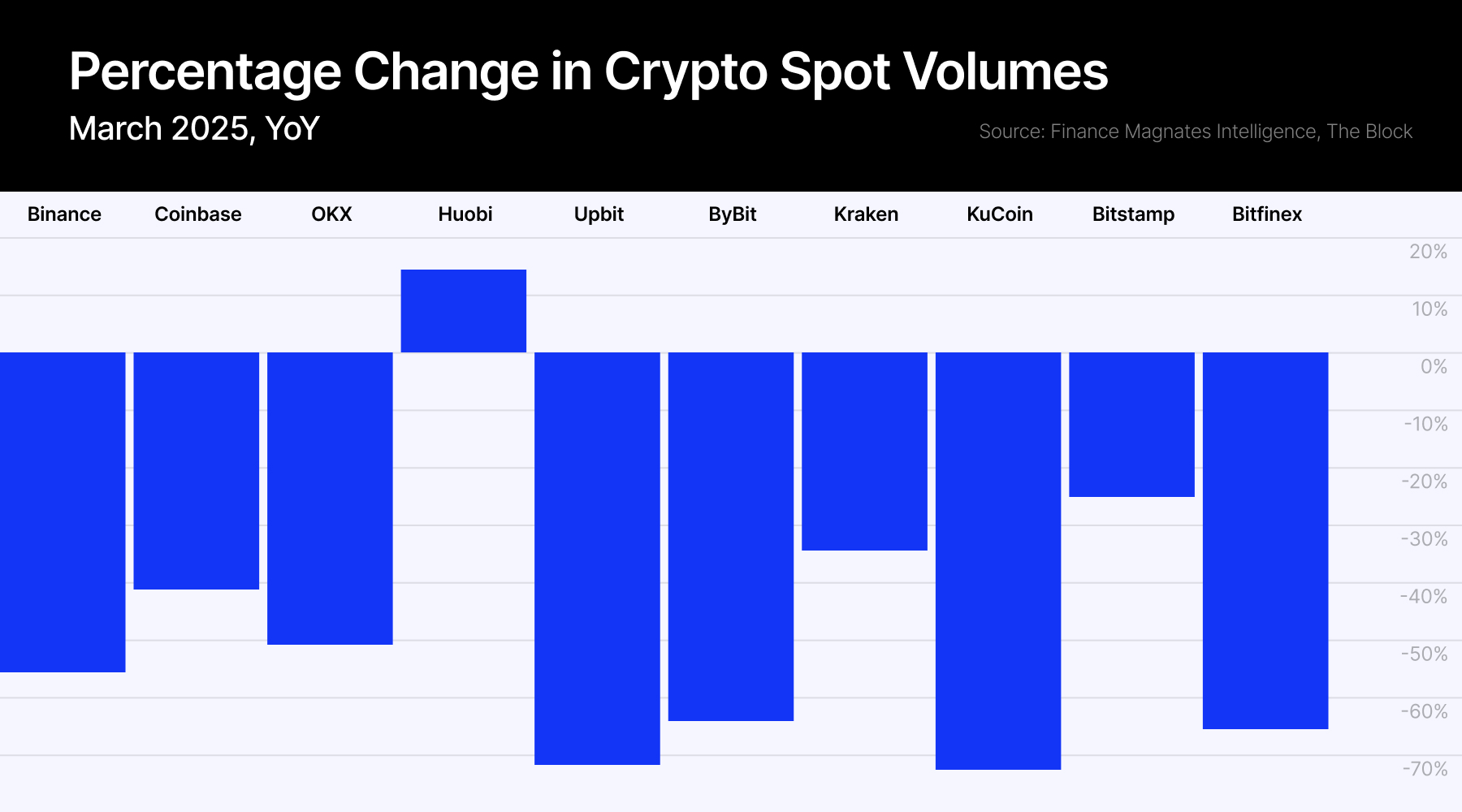
Meanwhile,
ByBit experienced the steepest decline among major exchanges, with volumes
falling 52.4% month-over-month to $84.3 billion, and -55% compared to the same
period last year.
The data
reveals a significant cooling from the peak trading period observed in late
2024, when monthly volumes exceeded $2 trillion in November and December.
March's $1.13 trillion total represents a 47.4% decrease from December 2024's
high of $2.14 trillion.
Bitcoin’s
downward trend is continuing, with prices falling below the $80,000
threshold and testing key support levels around $74,500 this month. This latest
drop follows a steep decline from the year’s peak of $109,000, signaling
mounting pressure on the cryptocurrency market amid broader economic headwinds.
Bloomberg
Senior Commodity Strategist Mike McGlone has issued a stark warning,
forecasting that Bitcoin could plunge as low as $10,000. Drawing
comparisons to the early 2000s dot-com crash, McGlone points to speculative
excess, macroeconomic tightening, and the loss of Bitcoin’s "digital
gold" narrative as factors that could trigger a deep market correction.
What does HODL stand for? Everyone's in for the long-term, as long as it's going up. Did not know how #Bitcoin was going to get to $100,000 from $10,000 in 2020, but the trends showed up. Now, I see the reversion path back toward $10,000. The technology is awesome as evidenced by…
“In 2020,
Bitcoin was at 10,000. It was only a few years ago. I think it’s going back
there,” McGlone said in a recent interview. This bold prediction raises
important questions: How low can Bitcoin go? What’s driving this potential
plunge? And how should you protect your portfolio?
While some
analysts remain optimistic about Bitcoin’s long-term prospects, McGlone's
forecast stands out for its severity. He argues that the crypto space needs a
major reset and suggests that Bitcoin's return to $10,000 would be a reversion
to more sustainable valuation levels following years of speculative growth.
Cryptocurrency
exchange trading volumes decreased by 15% in March 2025 compared to the
previous month, marking the third consecutive monthly decline in trading
activity across major platforms.
The
declines coincided with Bitcoin’s weakening performance. Although its price
contracted by only 2% last month, it briefly fell to $75,000 — the lowest level
since November.
Crypto Exchange Trading
Volumes Fall in March 2025
According
to data from Finance Magnates Intelligence and The Block, total
trading volume across the top ten cryptocurrency exchanges fell to $1.13
trillion in March from
$1.33 trillion in Februaryc, reflecting cooling market sentiment after the
robust trading activity seen in late 2024 and early 2025.
Despite the
overall market contraction, Binance maintained its dominant position with a
51.8% market share, though its trading volume dropped 10.4% month-over-month to
$583.5 billion. The exchange also showed year-over-year slump of 48% compared
to March 2024.
OKX
maintained its third position with $96.8 billion in trading volume, down 10.8%
from February and down 43% year-over-year.
Conditions are certainly unfavorable at the moment, and according to Dr. Kirill Kretov of CoinPanel, they’re unlikely to improve anytime soon. “We are deep in a risk-off environment with geopolitical stress, shaky economies, and drained liquidity across the board,” he told FinanceMagnates.com.
“The chaos coming out of the new U.S. administration—one vague statement or policy tease is enough to rattle even traditional markets. In crypto, which is far thinner and more reactive, that kind of uncertainty hits like a sledgehammer.”
Huobi Bucked The Downward
Trend
The most
notable performer was Huobi, which bucked the downward trend with a 27.5%
increase in trading volume compared to February, reaching $92.6 billion. This
also represented a 12% growth compared to March 2024, allowing Huobi to climb
to fourth place in the rankings.
Meanwhile,
ByBit experienced the steepest decline among major exchanges, with volumes
falling 52.4% month-over-month to $84.3 billion, and -55% compared to the same
period last year.
The data
reveals a significant cooling from the peak trading period observed in late
2024, when monthly volumes exceeded $2 trillion in November and December.
March's $1.13 trillion total represents a 47.4% decrease from December 2024's
high of $2.14 trillion.
Bitcoin’s
downward trend is continuing, with prices falling below the $80,000
threshold and testing key support levels around $74,500 this month. This latest
drop follows a steep decline from the year’s peak of $109,000, signaling
mounting pressure on the cryptocurrency market amid broader economic headwinds.
Bloomberg
Senior Commodity Strategist Mike McGlone has issued a stark warning,
forecasting that Bitcoin could plunge as low as $10,000. Drawing
comparisons to the early 2000s dot-com crash, McGlone points to speculative
excess, macroeconomic tightening, and the loss of Bitcoin’s "digital
gold" narrative as factors that could trigger a deep market correction.
What does HODL stand for? Everyone's in for the long-term, as long as it's going up. Did not know how #Bitcoin was going to get to $100,000 from $10,000 in 2020, but the trends showed up. Now, I see the reversion path back toward $10,000. The technology is awesome as evidenced by…
“In 2020,
Bitcoin was at 10,000. It was only a few years ago. I think it’s going back
there,” McGlone said in a recent interview. This bold prediction raises
important questions: How low can Bitcoin go? What’s driving this potential
plunge? And how should you protect your portfolio?
While some
analysts remain optimistic about Bitcoin’s long-term prospects, McGlone's
forecast stands out for its severity. He argues that the crypto space needs a
major reset and suggests that Bitcoin's return to $10,000 would be a reversion
to more sustainable valuation levels following years of speculative growth.
Damian's adventure with financial markets began at the Cracow University of Economics, where he obtained his MA in finance and accounting. Starting from the retail trader perspective, he collaborated with brokerage houses and financial portals in Poland as an independent editor and content manager. His adventure with Finance Magnates began in 2016, where he is working as a business intelligence analyst.
From Chat to Stock: xStocks Puts Tokenized U.S. Equities Inside TON Wallet on Telegram
Featured Videos
Executive Interview | Charlotte Bullock | Chief Product Officer, Bank of London | FMLS:25
In this interview, we sat down with Charlotte Bullock, Head of Product at The Bank of London, previously at SAP and now shaping product at one of the sector’s most ambitious new banking players.
Charlotte reflects on the Summit so far and talks about the culture inside fintech banks today. We look at the pressures that come with scaling, and how firms can hold onto the nimble approach that made them stand out early on.
We also cover the state of payments ahead of her appearance on the payments roundtable: the blockages financial firms face, the areas that still need fixing, and what a realistic solution looks like in 2026.
In this interview, we sat down with Charlotte Bullock, Head of Product at The Bank of London, previously at SAP and now shaping product at one of the sector’s most ambitious new banking players.
Charlotte reflects on the Summit so far and talks about the culture inside fintech banks today. We look at the pressures that come with scaling, and how firms can hold onto the nimble approach that made them stand out early on.
We also cover the state of payments ahead of her appearance on the payments roundtable: the blockages financial firms face, the areas that still need fixing, and what a realistic solution looks like in 2026.
In this interview, we sat down with Charlotte Bullock, Head of Product at The Bank of London, previously at SAP and now shaping product at one of the sector’s most ambitious new banking players.
Charlotte reflects on the Summit so far and talks about the culture inside fintech banks today. We look at the pressures that come with scaling, and how firms can hold onto the nimble approach that made them stand out early on.
We also cover the state of payments ahead of her appearance on the payments roundtable: the blockages financial firms face, the areas that still need fixing, and what a realistic solution looks like in 2026.
In this interview, we sat down with Charlotte Bullock, Head of Product at The Bank of London, previously at SAP and now shaping product at one of the sector’s most ambitious new banking players.
Charlotte reflects on the Summit so far and talks about the culture inside fintech banks today. We look at the pressures that come with scaling, and how firms can hold onto the nimble approach that made them stand out early on.
We also cover the state of payments ahead of her appearance on the payments roundtable: the blockages financial firms face, the areas that still need fixing, and what a realistic solution looks like in 2026.
In this conversation, we sit down with Drew Niv, CSO at ATFX Connect and one of the most influential figures in modern FX.
We speak about market structure, the institutional view on liquidity, and the sharp rise of prop trading, a sector Drew has been commenting on in recent months. Drew explains why he once dismissed prop trading, why his view changed, and what he now thinks the model means for brokers, clients and risk managers.
We explore subscription-fee dependency, the high reneging rate, and the long-term challenge: how brokers can build a more stable and honest version of the model. Drew also talks about the traffic advantage standalone prop firms have built and why brokers may still win in the long run if they take the right approach.
In this conversation, we sit down with Drew Niv, CSO at ATFX Connect and one of the most influential figures in modern FX.
We speak about market structure, the institutional view on liquidity, and the sharp rise of prop trading, a sector Drew has been commenting on in recent months. Drew explains why he once dismissed prop trading, why his view changed, and what he now thinks the model means for brokers, clients and risk managers.
We explore subscription-fee dependency, the high reneging rate, and the long-term challenge: how brokers can build a more stable and honest version of the model. Drew also talks about the traffic advantage standalone prop firms have built and why brokers may still win in the long run if they take the right approach.
In this conversation, we sit down with Drew Niv, CSO at ATFX Connect and one of the most influential figures in modern FX.
We speak about market structure, the institutional view on liquidity, and the sharp rise of prop trading, a sector Drew has been commenting on in recent months. Drew explains why he once dismissed prop trading, why his view changed, and what he now thinks the model means for brokers, clients and risk managers.
We explore subscription-fee dependency, the high reneging rate, and the long-term challenge: how brokers can build a more stable and honest version of the model. Drew also talks about the traffic advantage standalone prop firms have built and why brokers may still win in the long run if they take the right approach.
In this conversation, we sit down with Drew Niv, CSO at ATFX Connect and one of the most influential figures in modern FX.
We speak about market structure, the institutional view on liquidity, and the sharp rise of prop trading, a sector Drew has been commenting on in recent months. Drew explains why he once dismissed prop trading, why his view changed, and what he now thinks the model means for brokers, clients and risk managers.
We explore subscription-fee dependency, the high reneging rate, and the long-term challenge: how brokers can build a more stable and honest version of the model. Drew also talks about the traffic advantage standalone prop firms have built and why brokers may still win in the long run if they take the right approach.
In this conversation, we sit down with Drew Niv, CSO at ATFX Connect and one of the most influential figures in modern FX.
We speak about market structure, the institutional view on liquidity, and the sharp rise of prop trading, a sector Drew has been commenting on in recent months. Drew explains why he once dismissed prop trading, why his view changed, and what he now thinks the model means for brokers, clients and risk managers.
We explore subscription-fee dependency, the high reneging rate, and the long-term challenge: how brokers can build a more stable and honest version of the model. Drew also talks about the traffic advantage standalone prop firms have built and why brokers may still win in the long run if they take the right approach.
In this conversation, we sit down with Drew Niv, CSO at ATFX Connect and one of the most influential figures in modern FX.
We speak about market structure, the institutional view on liquidity, and the sharp rise of prop trading, a sector Drew has been commenting on in recent months. Drew explains why he once dismissed prop trading, why his view changed, and what he now thinks the model means for brokers, clients and risk managers.
We explore subscription-fee dependency, the high reneging rate, and the long-term challenge: how brokers can build a more stable and honest version of the model. Drew also talks about the traffic advantage standalone prop firms have built and why brokers may still win in the long run if they take the right approach.
Executive Interview | Remonda Z. Kirketerp Møller| CEO & Founder Muinmos | FMLS:25
In this interview, Remonda Z. Kirketerp Møller, founder of Muinmos, breaks down the state of AI in regtech and what responsible adoption really looks like for brokers. We talk about rising fragmentation, the pressures around compliance accuracy, and why most firms are still in the early stages of AI maturity.
Ramanda also shares insights on regulator sandboxes, shifting expectations around accountability, and the current reality of MiCA licensing and passporting in Europe.
A concise look at where compliance, onboarding, and AI-driven processes are heading next.
In this interview, Remonda Z. Kirketerp Møller, founder of Muinmos, breaks down the state of AI in regtech and what responsible adoption really looks like for brokers. We talk about rising fragmentation, the pressures around compliance accuracy, and why most firms are still in the early stages of AI maturity.
Ramanda also shares insights on regulator sandboxes, shifting expectations around accountability, and the current reality of MiCA licensing and passporting in Europe.
A concise look at where compliance, onboarding, and AI-driven processes are heading next.
In this interview, Remonda Z. Kirketerp Møller, founder of Muinmos, breaks down the state of AI in regtech and what responsible adoption really looks like for brokers. We talk about rising fragmentation, the pressures around compliance accuracy, and why most firms are still in the early stages of AI maturity.
Ramanda also shares insights on regulator sandboxes, shifting expectations around accountability, and the current reality of MiCA licensing and passporting in Europe.
A concise look at where compliance, onboarding, and AI-driven processes are heading next.
In this interview, Remonda Z. Kirketerp Møller, founder of Muinmos, breaks down the state of AI in regtech and what responsible adoption really looks like for brokers. We talk about rising fragmentation, the pressures around compliance accuracy, and why most firms are still in the early stages of AI maturity.
Ramanda also shares insights on regulator sandboxes, shifting expectations around accountability, and the current reality of MiCA licensing and passporting in Europe.
A concise look at where compliance, onboarding, and AI-driven processes are heading next.
In this interview, Remonda Z. Kirketerp Møller, founder of Muinmos, breaks down the state of AI in regtech and what responsible adoption really looks like for brokers. We talk about rising fragmentation, the pressures around compliance accuracy, and why most firms are still in the early stages of AI maturity.
Ramanda also shares insights on regulator sandboxes, shifting expectations around accountability, and the current reality of MiCA licensing and passporting in Europe.
A concise look at where compliance, onboarding, and AI-driven processes are heading next.
In this interview, Remonda Z. Kirketerp Møller, founder of Muinmos, breaks down the state of AI in regtech and what responsible adoption really looks like for brokers. We talk about rising fragmentation, the pressures around compliance accuracy, and why most firms are still in the early stages of AI maturity.
Ramanda also shares insights on regulator sandboxes, shifting expectations around accountability, and the current reality of MiCA licensing and passporting in Europe.
A concise look at where compliance, onboarding, and AI-driven processes are heading next.
In this conversation, we speak with Aydin Bonabi, CEO and co-founder of Surveill, a firm focused on fraud detection and AI-driven compliance tools for financial institutions.
We start with Aydin’s view of the Summit and the challenges brokers face as fraud tactics grow more complex. He explains how firms can stay ahead through real-time signals, data patterns, and early-stage detection.
We also talk about AI training and why compliance teams often struggle to keep models accurate, fair, and aligned with regulatory expectations. Aydin breaks down what “good” AI training looks like inside a financial environment, including the importance of clean data, domain expertise, and human oversight.
He closes with a clear message: fraud is scaling, and so must the tools that stop it.
In this conversation, we speak with Aydin Bonabi, CEO and co-founder of Surveill, a firm focused on fraud detection and AI-driven compliance tools for financial institutions.
We start with Aydin’s view of the Summit and the challenges brokers face as fraud tactics grow more complex. He explains how firms can stay ahead through real-time signals, data patterns, and early-stage detection.
We also talk about AI training and why compliance teams often struggle to keep models accurate, fair, and aligned with regulatory expectations. Aydin breaks down what “good” AI training looks like inside a financial environment, including the importance of clean data, domain expertise, and human oversight.
He closes with a clear message: fraud is scaling, and so must the tools that stop it.
In this conversation, we speak with Aydin Bonabi, CEO and co-founder of Surveill, a firm focused on fraud detection and AI-driven compliance tools for financial institutions.
We start with Aydin’s view of the Summit and the challenges brokers face as fraud tactics grow more complex. He explains how firms can stay ahead through real-time signals, data patterns, and early-stage detection.
We also talk about AI training and why compliance teams often struggle to keep models accurate, fair, and aligned with regulatory expectations. Aydin breaks down what “good” AI training looks like inside a financial environment, including the importance of clean data, domain expertise, and human oversight.
He closes with a clear message: fraud is scaling, and so must the tools that stop it.
In this conversation, we speak with Aydin Bonabi, CEO and co-founder of Surveill, a firm focused on fraud detection and AI-driven compliance tools for financial institutions.
We start with Aydin’s view of the Summit and the challenges brokers face as fraud tactics grow more complex. He explains how firms can stay ahead through real-time signals, data patterns, and early-stage detection.
We also talk about AI training and why compliance teams often struggle to keep models accurate, fair, and aligned with regulatory expectations. Aydin breaks down what “good” AI training looks like inside a financial environment, including the importance of clean data, domain expertise, and human oversight.
He closes with a clear message: fraud is scaling, and so must the tools that stop it.
In this conversation, we speak with Aydin Bonabi, CEO and co-founder of Surveill, a firm focused on fraud detection and AI-driven compliance tools for financial institutions.
We start with Aydin’s view of the Summit and the challenges brokers face as fraud tactics grow more complex. He explains how firms can stay ahead through real-time signals, data patterns, and early-stage detection.
We also talk about AI training and why compliance teams often struggle to keep models accurate, fair, and aligned with regulatory expectations. Aydin breaks down what “good” AI training looks like inside a financial environment, including the importance of clean data, domain expertise, and human oversight.
He closes with a clear message: fraud is scaling, and so must the tools that stop it.
In this conversation, we speak with Aydin Bonabi, CEO and co-founder of Surveill, a firm focused on fraud detection and AI-driven compliance tools for financial institutions.
We start with Aydin’s view of the Summit and the challenges brokers face as fraud tactics grow more complex. He explains how firms can stay ahead through real-time signals, data patterns, and early-stage detection.
We also talk about AI training and why compliance teams often struggle to keep models accurate, fair, and aligned with regulatory expectations. Aydin breaks down what “good” AI training looks like inside a financial environment, including the importance of clean data, domain expertise, and human oversight.
He closes with a clear message: fraud is scaling, and so must the tools that stop it.
Exness expands its presence in Africa: Inside our interview with Paul Margarites in Cape Town
Finance Magnates met with Paul Margarites, Exness regional commercial director for Sub-Saharan Africa, during a visit to the firm’s office opening in Cape Town. In this talk, led by Andrea Badiola Mateos, Co-CEO at Finance Magnates, Paul shares views on the South African trading space, local user behavior, mobile trends, regulation, team growth, and how Exness plans to grow in more markets across the region. @Exness
Read the article at: https://www.financemagnates.com/thought-leadership/exness-expands-its-presence-in-africa-inside-our-interview-with-paul-margarites/
#exness #financemagnates #exnesstrading #CFDtrading #tradeonline #africanews #capetown
Finance Magnates met with Paul Margarites, Exness regional commercial director for Sub-Saharan Africa, during a visit to the firm’s office opening in Cape Town. In this talk, led by Andrea Badiola Mateos, Co-CEO at Finance Magnates, Paul shares views on the South African trading space, local user behavior, mobile trends, regulation, team growth, and how Exness plans to grow in more markets across the region. @Exness
Read the article at: https://www.financemagnates.com/thought-leadership/exness-expands-its-presence-in-africa-inside-our-interview-with-paul-margarites/
#exness #financemagnates #exnesstrading #CFDtrading #tradeonline #africanews #capetown
Finance Magnates met with Paul Margarites, Exness regional commercial director for Sub-Saharan Africa, during a visit to the firm’s office opening in Cape Town. In this talk, led by Andrea Badiola Mateos, Co-CEO at Finance Magnates, Paul shares views on the South African trading space, local user behavior, mobile trends, regulation, team growth, and how Exness plans to grow in more markets across the region. @Exness
Read the article at: https://www.financemagnates.com/thought-leadership/exness-expands-its-presence-in-africa-inside-our-interview-with-paul-margarites/
#exness #financemagnates #exnesstrading #CFDtrading #tradeonline #africanews #capetown
Finance Magnates met with Paul Margarites, Exness regional commercial director for Sub-Saharan Africa, during a visit to the firm’s office opening in Cape Town. In this talk, led by Andrea Badiola Mateos, Co-CEO at Finance Magnates, Paul shares views on the South African trading space, local user behavior, mobile trends, regulation, team growth, and how Exness plans to grow in more markets across the region. @Exness
Read the article at: https://www.financemagnates.com/thought-leadership/exness-expands-its-presence-in-africa-inside-our-interview-with-paul-margarites/
#exness #financemagnates #exnesstrading #CFDtrading #tradeonline #africanews #capetown
Finance Magnates met with Paul Margarites, Exness regional commercial director for Sub-Saharan Africa, during a visit to the firm’s office opening in Cape Town. In this talk, led by Andrea Badiola Mateos, Co-CEO at Finance Magnates, Paul shares views on the South African trading space, local user behavior, mobile trends, regulation, team growth, and how Exness plans to grow in more markets across the region. @Exness
Read the article at: https://www.financemagnates.com/thought-leadership/exness-expands-its-presence-in-africa-inside-our-interview-with-paul-margarites/
#exness #financemagnates #exnesstrading #CFDtrading #tradeonline #africanews #capetown
Finance Magnates met with Paul Margarites, Exness regional commercial director for Sub-Saharan Africa, during a visit to the firm’s office opening in Cape Town. In this talk, led by Andrea Badiola Mateos, Co-CEO at Finance Magnates, Paul shares views on the South African trading space, local user behavior, mobile trends, regulation, team growth, and how Exness plans to grow in more markets across the region. @Exness
Read the article at: https://www.financemagnates.com/thought-leadership/exness-expands-its-presence-in-africa-inside-our-interview-with-paul-margarites/
#exness #financemagnates #exnesstrading #CFDtrading #tradeonline #africanews #capetown