Exchange group sees growth in multi-asset class integration and innovation with purchase of FX trading platform and blockchain stake.
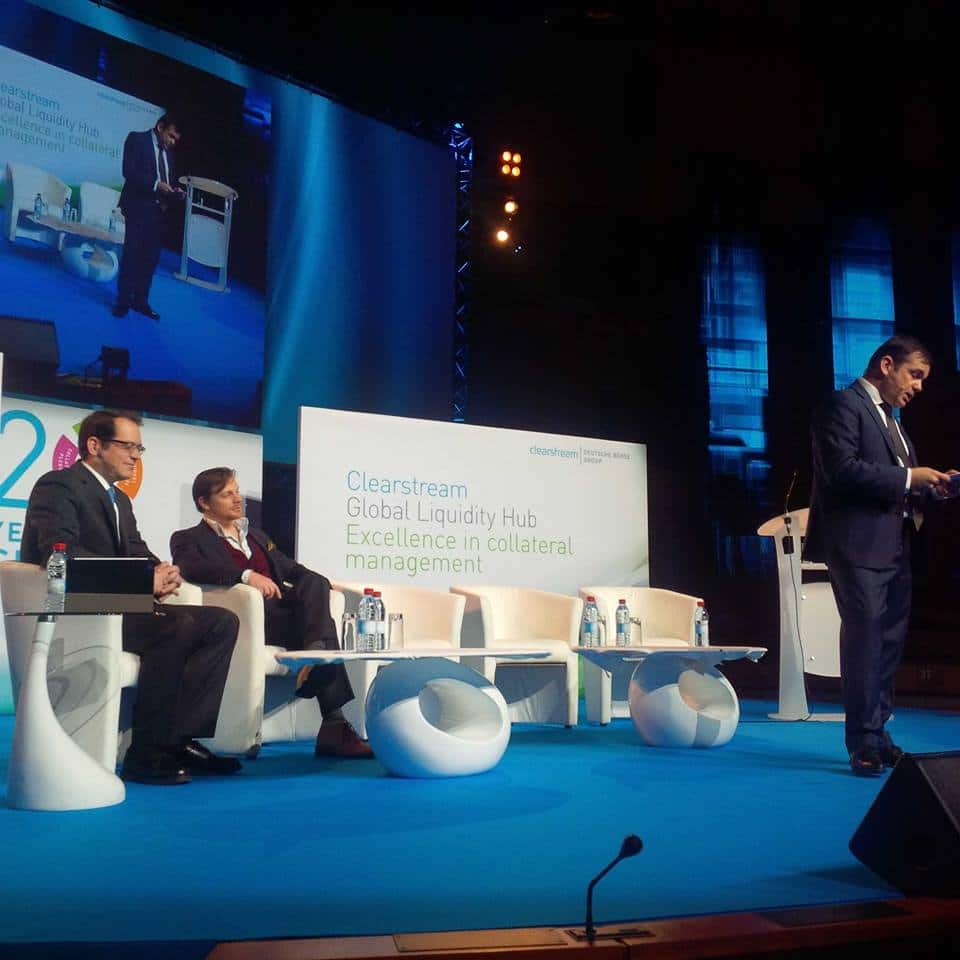
Clearstream's GSF Summit ran Jan 27 to 28, 2016 in Luxembourg
As the new asset class in the Group, 360T is fitting its OTC background into the on-exchange environment.
It seems that getting the ‘right balance’ between innovation and stability has people ‘living, breathing and working on it on a daily basis’, according to Carlo Kölzer, 360T Group’s CEO and Global Head of FX for DB, speaking at Clearstream’s annual Global Securities Finance (GSF) Summit held in Luxembourg in late January.
How the platform integrates within the whole group is a work in progress, and in an earlier statement, derivatives were floated as a ‘potential’ instrument to add to spot FX, though a spokeswoman declined to comment on the stage of development.
You cannot start early enough to invest and also to test new technologies.
In the "German speaking world", 360T has market penetration of between 80% and 90% for FX trading, so coordinating with Clearstream means making it easy for corporates to trade repos, a type of short-term borrowing.
“The advantage here is electronically traded, straight through processing…and this is an advantage for corporates which have only a small team, information straight away (is) put into the treasury management systems,” said Nicole Sattinger, who handles GSF sales and relationship for Clearstream.
On the buy side, FX is getting more and more focus amid a trend towards active management, said 360T’s Kölzer. Part of that is because of ‘credit sensitivity’ in the aftermath of the SNB crisis, when Switzerland's central bank unpegged the Swiss franc from the euro in January 2015.
Carlo Kölzer, CEO of 360T Group, Global Head of FX of Deutsche Börse Group
Jean Robert-Wilkin, Executive Director, Head of Product Management at Clearstream, added that the acquisition is part of an evolution as banks and broker-dealers move away from balance sheet intensive activities in an era of deleveraging, and pointed to the benefit of the “fantastic distribution network they offer the Group, with many different clients which we have no access to so far”.
Technology challenges
The biggest challenge, Kölzer said, is keeping up with tectonic shifts in technology and being prepared for changes across multiple organizational layers in a tough economic environment. Digital finance is on his radar in particular.
“You cannot start early enough to invest and also to test new technologies,” Kölzer added.
CEO of Clearstream, Jeffrey Tessler, pointed to DB’s recent investment in Digital Asset Holdings, the blockchain start up, as part of a strategy to “explore developments in the Fintech space”.
And there’s no doubt that technology is shaking up the established order, with five specific areas of interest: big data and analytics; equity crowdfunding; social media mining; robotics; and blockchain.
“Blockchain technology is the big one,” said Robert Somogyi, Clearstream’s Director of Business Planning, adding that activities will be across the whole of the Group – including trading and clearing - in what is intended to be a holistic approach.
I suspect regulators are going to want to get rid of the obfuscation and risk pooling that clearing corporations very often create.
Somogyi said that aside from working with colleagues, DB has been assessing the technology and its potential uses, building prototypes and dealing with both internal and external parties on ideas and developments, investing in and joining the board of Digital Asset Holdings, as well as joined the Linux Foundation Hyperledger project. There is also constant dialogue with clients and regulators.
Blockchain skeptics
It was a skeptical audience however, and cynicism and questions about security were a dominant theme when it came to blockchain, albeit a subject that garnered huge interest.
Not to mention, that in a distributed ledger world trading, execution, clearing and settlement collapses into one function, which has major banks and custodians asking whether they are looking at disintermediating technology.
Nicole Sattinger, GSF Sales, Clearstream
That’s yet to be determined, but prime brokerage is the space to watch, said Edan Yago, CEO of Epiphyte, a firm providing blockchain-powered SaaS service for instant settlement and DVP (delivery versus payment) for financial trades.
“Prime brokers are going to be one of the most interesting places in terms of the changes that we are going to be seeing in the next few years, which is also why we are seeing them lead the charge into the market,” said Yago, pointing to the R3 coalition as a case in point.
Today, they are in a ‘privileged’ position allowing for bundled services, he explained: “They may be able to improve this position, be able to provide even deeper, even more of a cradle-to-grave service, from order to settlement, because now – if their clients give it to them – they have access to the entire trade cycle.
I don’t trust anyone. I trust the basic mathematical laws of the universe.
“On the other hand, this privileged position is no longer as pure, any other local bank can now begin to try and offer the same kind of services as these technologies become accessible and more easily used.”
Regulatory intervention, meanwhile, was somewhat dismissed. “I suspect regulators are going to want to get rid of the obfuscation and risk pooling that clearing corporations very often create,” said Yago. “The Bank of England, one of the things that they are most excited about is the fact that they can ask for, and demand, real time transparency for every single transaction happening in the market, and be able to see its entire history.”
Transparency and trading
Still, the industry has not yet sorted through the regulatory and legal topics around blockchain, and this will not only take time but distributed ledgers will also have to prove cost efficient, said Clearstream’s Somogyi.
“Blockchain would have to really have a huge major factor of savings in how long it takes to program something and get it to market to really compete with existing systems, that are extremely complex, in a very short amount of time,” he said. “And that may or may not happen.”
From L to R: Robert Somogyi, Clearstream; Edan Yago, Epiphyte; Pascal Morosini, Clearstream
And though transparency is great for the middle and back office, there’s a big question mark over the benefits for trading: “Having all of your positions on the ledger, which anyone in the market can derive is not necessarily good for trading strategies and for other market activities, so it will take time to get through all of these challenges.”
High frequency traders in particular can breathe easy because security of blockchain systems is often achieved by inefficiency, explained Epiphyte’s Yago. “We burn time in order to make sure that the transactions that go through are fully validated, so there’s no such thing as true real-time transactions on a distributed ledger…the more time you wait the more secure you are.”
One thing’s for sure, the issue of trust is turned on its head and the industry better get used to it.
“Today, finance has developed around trust in the intermediary, there is someone to sue,” Yago said. “The distributed ledger is based on an entirely different idea: I don’t trust anyone. I trust the basic mathematical laws of the universe.”
As the new asset class in the Group, 360T is fitting its OTC background into the on-exchange environment.
It seems that getting the ‘right balance’ between innovation and stability has people ‘living, breathing and working on it on a daily basis’, according to Carlo Kölzer, 360T Group’s CEO and Global Head of FX for DB, speaking at Clearstream’s annual Global Securities Finance (GSF) Summit held in Luxembourg in late January.
How the platform integrates within the whole group is a work in progress, and in an earlier statement, derivatives were floated as a ‘potential’ instrument to add to spot FX, though a spokeswoman declined to comment on the stage of development.
You cannot start early enough to invest and also to test new technologies.
In the "German speaking world", 360T has market penetration of between 80% and 90% for FX trading, so coordinating with Clearstream means making it easy for corporates to trade repos, a type of short-term borrowing.
“The advantage here is electronically traded, straight through processing…and this is an advantage for corporates which have only a small team, information straight away (is) put into the treasury management systems,” said Nicole Sattinger, who handles GSF sales and relationship for Clearstream.
On the buy side, FX is getting more and more focus amid a trend towards active management, said 360T’s Kölzer. Part of that is because of ‘credit sensitivity’ in the aftermath of the SNB crisis, when Switzerland's central bank unpegged the Swiss franc from the euro in January 2015.
Carlo Kölzer, CEO of 360T Group, Global Head of FX of Deutsche Börse Group
Jean Robert-Wilkin, Executive Director, Head of Product Management at Clearstream, added that the acquisition is part of an evolution as banks and broker-dealers move away from balance sheet intensive activities in an era of deleveraging, and pointed to the benefit of the “fantastic distribution network they offer the Group, with many different clients which we have no access to so far”.
Technology challenges
The biggest challenge, Kölzer said, is keeping up with tectonic shifts in technology and being prepared for changes across multiple organizational layers in a tough economic environment. Digital finance is on his radar in particular.
“You cannot start early enough to invest and also to test new technologies,” Kölzer added.
CEO of Clearstream, Jeffrey Tessler, pointed to DB’s recent investment in Digital Asset Holdings, the blockchain start up, as part of a strategy to “explore developments in the Fintech space”.
And there’s no doubt that technology is shaking up the established order, with five specific areas of interest: big data and analytics; equity crowdfunding; social media mining; robotics; and blockchain.
“Blockchain technology is the big one,” said Robert Somogyi, Clearstream’s Director of Business Planning, adding that activities will be across the whole of the Group – including trading and clearing - in what is intended to be a holistic approach.
I suspect regulators are going to want to get rid of the obfuscation and risk pooling that clearing corporations very often create.
Somogyi said that aside from working with colleagues, DB has been assessing the technology and its potential uses, building prototypes and dealing with both internal and external parties on ideas and developments, investing in and joining the board of Digital Asset Holdings, as well as joined the Linux Foundation Hyperledger project. There is also constant dialogue with clients and regulators.
Blockchain skeptics
It was a skeptical audience however, and cynicism and questions about security were a dominant theme when it came to blockchain, albeit a subject that garnered huge interest.
Not to mention, that in a distributed ledger world trading, execution, clearing and settlement collapses into one function, which has major banks and custodians asking whether they are looking at disintermediating technology.
Nicole Sattinger, GSF Sales, Clearstream
That’s yet to be determined, but prime brokerage is the space to watch, said Edan Yago, CEO of Epiphyte, a firm providing blockchain-powered SaaS service for instant settlement and DVP (delivery versus payment) for financial trades.
“Prime brokers are going to be one of the most interesting places in terms of the changes that we are going to be seeing in the next few years, which is also why we are seeing them lead the charge into the market,” said Yago, pointing to the R3 coalition as a case in point.
Today, they are in a ‘privileged’ position allowing for bundled services, he explained: “They may be able to improve this position, be able to provide even deeper, even more of a cradle-to-grave service, from order to settlement, because now – if their clients give it to them – they have access to the entire trade cycle.
I don’t trust anyone. I trust the basic mathematical laws of the universe.
“On the other hand, this privileged position is no longer as pure, any other local bank can now begin to try and offer the same kind of services as these technologies become accessible and more easily used.”
Regulatory intervention, meanwhile, was somewhat dismissed. “I suspect regulators are going to want to get rid of the obfuscation and risk pooling that clearing corporations very often create,” said Yago. “The Bank of England, one of the things that they are most excited about is the fact that they can ask for, and demand, real time transparency for every single transaction happening in the market, and be able to see its entire history.”
Transparency and trading
Still, the industry has not yet sorted through the regulatory and legal topics around blockchain, and this will not only take time but distributed ledgers will also have to prove cost efficient, said Clearstream’s Somogyi.
“Blockchain would have to really have a huge major factor of savings in how long it takes to program something and get it to market to really compete with existing systems, that are extremely complex, in a very short amount of time,” he said. “And that may or may not happen.”
From L to R: Robert Somogyi, Clearstream; Edan Yago, Epiphyte; Pascal Morosini, Clearstream
And though transparency is great for the middle and back office, there’s a big question mark over the benefits for trading: “Having all of your positions on the ledger, which anyone in the market can derive is not necessarily good for trading strategies and for other market activities, so it will take time to get through all of these challenges.”
High frequency traders in particular can breathe easy because security of blockchain systems is often achieved by inefficiency, explained Epiphyte’s Yago. “We burn time in order to make sure that the transactions that go through are fully validated, so there’s no such thing as true real-time transactions on a distributed ledger…the more time you wait the more secure you are.”
One thing’s for sure, the issue of trust is turned on its head and the industry better get used to it.
“Today, finance has developed around trust in the intermediary, there is someone to sue,” Yago said. “The distributed ledger is based on an entirely different idea: I don’t trust anyone. I trust the basic mathematical laws of the universe.”
ASX Faces $150M Capital Charge After Scathing Inquiry Finds Years of Neglect
Featured Videos
Executive Interview | Charlotte Bullock | Chief Product Officer, Bank of London | FMLS:25
In this interview, we sat down with Charlotte Bullock, Head of Product at The Bank of London, previously at SAP and now shaping product at one of the sector’s most ambitious new banking players.
Charlotte reflects on the Summit so far and talks about the culture inside fintech banks today. We look at the pressures that come with scaling, and how firms can hold onto the nimble approach that made them stand out early on.
We also cover the state of payments ahead of her appearance on the payments roundtable: the blockages financial firms face, the areas that still need fixing, and what a realistic solution looks like in 2026.
In this interview, we sat down with Charlotte Bullock, Head of Product at The Bank of London, previously at SAP and now shaping product at one of the sector’s most ambitious new banking players.
Charlotte reflects on the Summit so far and talks about the culture inside fintech banks today. We look at the pressures that come with scaling, and how firms can hold onto the nimble approach that made them stand out early on.
We also cover the state of payments ahead of her appearance on the payments roundtable: the blockages financial firms face, the areas that still need fixing, and what a realistic solution looks like in 2026.
In this interview, we sat down with Charlotte Bullock, Head of Product at The Bank of London, previously at SAP and now shaping product at one of the sector’s most ambitious new banking players.
Charlotte reflects on the Summit so far and talks about the culture inside fintech banks today. We look at the pressures that come with scaling, and how firms can hold onto the nimble approach that made them stand out early on.
We also cover the state of payments ahead of her appearance on the payments roundtable: the blockages financial firms face, the areas that still need fixing, and what a realistic solution looks like in 2026.
In this interview, we sat down with Charlotte Bullock, Head of Product at The Bank of London, previously at SAP and now shaping product at one of the sector’s most ambitious new banking players.
Charlotte reflects on the Summit so far and talks about the culture inside fintech banks today. We look at the pressures that come with scaling, and how firms can hold onto the nimble approach that made them stand out early on.
We also cover the state of payments ahead of her appearance on the payments roundtable: the blockages financial firms face, the areas that still need fixing, and what a realistic solution looks like in 2026.
In this conversation, we sit down with Drew Niv, CSO at ATFX Connect and one of the most influential figures in modern FX.
We speak about market structure, the institutional view on liquidity, and the sharp rise of prop trading, a sector Drew has been commenting on in recent months. Drew explains why he once dismissed prop trading, why his view changed, and what he now thinks the model means for brokers, clients and risk managers.
We explore subscription-fee dependency, the high reneging rate, and the long-term challenge: how brokers can build a more stable and honest version of the model. Drew also talks about the traffic advantage standalone prop firms have built and why brokers may still win in the long run if they take the right approach.
In this conversation, we sit down with Drew Niv, CSO at ATFX Connect and one of the most influential figures in modern FX.
We speak about market structure, the institutional view on liquidity, and the sharp rise of prop trading, a sector Drew has been commenting on in recent months. Drew explains why he once dismissed prop trading, why his view changed, and what he now thinks the model means for brokers, clients and risk managers.
We explore subscription-fee dependency, the high reneging rate, and the long-term challenge: how brokers can build a more stable and honest version of the model. Drew also talks about the traffic advantage standalone prop firms have built and why brokers may still win in the long run if they take the right approach.
In this conversation, we sit down with Drew Niv, CSO at ATFX Connect and one of the most influential figures in modern FX.
We speak about market structure, the institutional view on liquidity, and the sharp rise of prop trading, a sector Drew has been commenting on in recent months. Drew explains why he once dismissed prop trading, why his view changed, and what he now thinks the model means for brokers, clients and risk managers.
We explore subscription-fee dependency, the high reneging rate, and the long-term challenge: how brokers can build a more stable and honest version of the model. Drew also talks about the traffic advantage standalone prop firms have built and why brokers may still win in the long run if they take the right approach.
In this conversation, we sit down with Drew Niv, CSO at ATFX Connect and one of the most influential figures in modern FX.
We speak about market structure, the institutional view on liquidity, and the sharp rise of prop trading, a sector Drew has been commenting on in recent months. Drew explains why he once dismissed prop trading, why his view changed, and what he now thinks the model means for brokers, clients and risk managers.
We explore subscription-fee dependency, the high reneging rate, and the long-term challenge: how brokers can build a more stable and honest version of the model. Drew also talks about the traffic advantage standalone prop firms have built and why brokers may still win in the long run if they take the right approach.
In this conversation, we sit down with Drew Niv, CSO at ATFX Connect and one of the most influential figures in modern FX.
We speak about market structure, the institutional view on liquidity, and the sharp rise of prop trading, a sector Drew has been commenting on in recent months. Drew explains why he once dismissed prop trading, why his view changed, and what he now thinks the model means for brokers, clients and risk managers.
We explore subscription-fee dependency, the high reneging rate, and the long-term challenge: how brokers can build a more stable and honest version of the model. Drew also talks about the traffic advantage standalone prop firms have built and why brokers may still win in the long run if they take the right approach.
In this conversation, we sit down with Drew Niv, CSO at ATFX Connect and one of the most influential figures in modern FX.
We speak about market structure, the institutional view on liquidity, and the sharp rise of prop trading, a sector Drew has been commenting on in recent months. Drew explains why he once dismissed prop trading, why his view changed, and what he now thinks the model means for brokers, clients and risk managers.
We explore subscription-fee dependency, the high reneging rate, and the long-term challenge: how brokers can build a more stable and honest version of the model. Drew also talks about the traffic advantage standalone prop firms have built and why brokers may still win in the long run if they take the right approach.
Executive Interview | Remonda Z. Kirketerp Møller| CEO & Founder Muinmos | FMLS:25
In this interview, Remonda Z. Kirketerp Møller, founder of Muinmos, breaks down the state of AI in regtech and what responsible adoption really looks like for brokers. We talk about rising fragmentation, the pressures around compliance accuracy, and why most firms are still in the early stages of AI maturity.
Ramanda also shares insights on regulator sandboxes, shifting expectations around accountability, and the current reality of MiCA licensing and passporting in Europe.
A concise look at where compliance, onboarding, and AI-driven processes are heading next.
In this interview, Remonda Z. Kirketerp Møller, founder of Muinmos, breaks down the state of AI in regtech and what responsible adoption really looks like for brokers. We talk about rising fragmentation, the pressures around compliance accuracy, and why most firms are still in the early stages of AI maturity.
Ramanda also shares insights on regulator sandboxes, shifting expectations around accountability, and the current reality of MiCA licensing and passporting in Europe.
A concise look at where compliance, onboarding, and AI-driven processes are heading next.
In this interview, Remonda Z. Kirketerp Møller, founder of Muinmos, breaks down the state of AI in regtech and what responsible adoption really looks like for brokers. We talk about rising fragmentation, the pressures around compliance accuracy, and why most firms are still in the early stages of AI maturity.
Ramanda also shares insights on regulator sandboxes, shifting expectations around accountability, and the current reality of MiCA licensing and passporting in Europe.
A concise look at where compliance, onboarding, and AI-driven processes are heading next.
In this interview, Remonda Z. Kirketerp Møller, founder of Muinmos, breaks down the state of AI in regtech and what responsible adoption really looks like for brokers. We talk about rising fragmentation, the pressures around compliance accuracy, and why most firms are still in the early stages of AI maturity.
Ramanda also shares insights on regulator sandboxes, shifting expectations around accountability, and the current reality of MiCA licensing and passporting in Europe.
A concise look at where compliance, onboarding, and AI-driven processes are heading next.
In this interview, Remonda Z. Kirketerp Møller, founder of Muinmos, breaks down the state of AI in regtech and what responsible adoption really looks like for brokers. We talk about rising fragmentation, the pressures around compliance accuracy, and why most firms are still in the early stages of AI maturity.
Ramanda also shares insights on regulator sandboxes, shifting expectations around accountability, and the current reality of MiCA licensing and passporting in Europe.
A concise look at where compliance, onboarding, and AI-driven processes are heading next.
In this interview, Remonda Z. Kirketerp Møller, founder of Muinmos, breaks down the state of AI in regtech and what responsible adoption really looks like for brokers. We talk about rising fragmentation, the pressures around compliance accuracy, and why most firms are still in the early stages of AI maturity.
Ramanda also shares insights on regulator sandboxes, shifting expectations around accountability, and the current reality of MiCA licensing and passporting in Europe.
A concise look at where compliance, onboarding, and AI-driven processes are heading next.
In this conversation, we speak with Aydin Bonabi, CEO and co-founder of Surveill, a firm focused on fraud detection and AI-driven compliance tools for financial institutions.
We start with Aydin’s view of the Summit and the challenges brokers face as fraud tactics grow more complex. He explains how firms can stay ahead through real-time signals, data patterns, and early-stage detection.
We also talk about AI training and why compliance teams often struggle to keep models accurate, fair, and aligned with regulatory expectations. Aydin breaks down what “good” AI training looks like inside a financial environment, including the importance of clean data, domain expertise, and human oversight.
He closes with a clear message: fraud is scaling, and so must the tools that stop it.
In this conversation, we speak with Aydin Bonabi, CEO and co-founder of Surveill, a firm focused on fraud detection and AI-driven compliance tools for financial institutions.
We start with Aydin’s view of the Summit and the challenges brokers face as fraud tactics grow more complex. He explains how firms can stay ahead through real-time signals, data patterns, and early-stage detection.
We also talk about AI training and why compliance teams often struggle to keep models accurate, fair, and aligned with regulatory expectations. Aydin breaks down what “good” AI training looks like inside a financial environment, including the importance of clean data, domain expertise, and human oversight.
He closes with a clear message: fraud is scaling, and so must the tools that stop it.
In this conversation, we speak with Aydin Bonabi, CEO and co-founder of Surveill, a firm focused on fraud detection and AI-driven compliance tools for financial institutions.
We start with Aydin’s view of the Summit and the challenges brokers face as fraud tactics grow more complex. He explains how firms can stay ahead through real-time signals, data patterns, and early-stage detection.
We also talk about AI training and why compliance teams often struggle to keep models accurate, fair, and aligned with regulatory expectations. Aydin breaks down what “good” AI training looks like inside a financial environment, including the importance of clean data, domain expertise, and human oversight.
He closes with a clear message: fraud is scaling, and so must the tools that stop it.
In this conversation, we speak with Aydin Bonabi, CEO and co-founder of Surveill, a firm focused on fraud detection and AI-driven compliance tools for financial institutions.
We start with Aydin’s view of the Summit and the challenges brokers face as fraud tactics grow more complex. He explains how firms can stay ahead through real-time signals, data patterns, and early-stage detection.
We also talk about AI training and why compliance teams often struggle to keep models accurate, fair, and aligned with regulatory expectations. Aydin breaks down what “good” AI training looks like inside a financial environment, including the importance of clean data, domain expertise, and human oversight.
He closes with a clear message: fraud is scaling, and so must the tools that stop it.
In this conversation, we speak with Aydin Bonabi, CEO and co-founder of Surveill, a firm focused on fraud detection and AI-driven compliance tools for financial institutions.
We start with Aydin’s view of the Summit and the challenges brokers face as fraud tactics grow more complex. He explains how firms can stay ahead through real-time signals, data patterns, and early-stage detection.
We also talk about AI training and why compliance teams often struggle to keep models accurate, fair, and aligned with regulatory expectations. Aydin breaks down what “good” AI training looks like inside a financial environment, including the importance of clean data, domain expertise, and human oversight.
He closes with a clear message: fraud is scaling, and so must the tools that stop it.
In this conversation, we speak with Aydin Bonabi, CEO and co-founder of Surveill, a firm focused on fraud detection and AI-driven compliance tools for financial institutions.
We start with Aydin’s view of the Summit and the challenges brokers face as fraud tactics grow more complex. He explains how firms can stay ahead through real-time signals, data patterns, and early-stage detection.
We also talk about AI training and why compliance teams often struggle to keep models accurate, fair, and aligned with regulatory expectations. Aydin breaks down what “good” AI training looks like inside a financial environment, including the importance of clean data, domain expertise, and human oversight.
He closes with a clear message: fraud is scaling, and so must the tools that stop it.
Exness expands its presence in Africa: Inside our interview with Paul Margarites in Cape Town
Finance Magnates met with Paul Margarites, Exness regional commercial director for Sub-Saharan Africa, during a visit to the firm’s office opening in Cape Town. In this talk, led by Andrea Badiola Mateos, Co-CEO at Finance Magnates, Paul shares views on the South African trading space, local user behavior, mobile trends, regulation, team growth, and how Exness plans to grow in more markets across the region. @Exness
Read the article at: https://www.financemagnates.com/thought-leadership/exness-expands-its-presence-in-africa-inside-our-interview-with-paul-margarites/
#exness #financemagnates #exnesstrading #CFDtrading #tradeonline #africanews #capetown
Finance Magnates met with Paul Margarites, Exness regional commercial director for Sub-Saharan Africa, during a visit to the firm’s office opening in Cape Town. In this talk, led by Andrea Badiola Mateos, Co-CEO at Finance Magnates, Paul shares views on the South African trading space, local user behavior, mobile trends, regulation, team growth, and how Exness plans to grow in more markets across the region. @Exness
Read the article at: https://www.financemagnates.com/thought-leadership/exness-expands-its-presence-in-africa-inside-our-interview-with-paul-margarites/
#exness #financemagnates #exnesstrading #CFDtrading #tradeonline #africanews #capetown
Finance Magnates met with Paul Margarites, Exness regional commercial director for Sub-Saharan Africa, during a visit to the firm’s office opening in Cape Town. In this talk, led by Andrea Badiola Mateos, Co-CEO at Finance Magnates, Paul shares views on the South African trading space, local user behavior, mobile trends, regulation, team growth, and how Exness plans to grow in more markets across the region. @Exness
Read the article at: https://www.financemagnates.com/thought-leadership/exness-expands-its-presence-in-africa-inside-our-interview-with-paul-margarites/
#exness #financemagnates #exnesstrading #CFDtrading #tradeonline #africanews #capetown
Finance Magnates met with Paul Margarites, Exness regional commercial director for Sub-Saharan Africa, during a visit to the firm’s office opening in Cape Town. In this talk, led by Andrea Badiola Mateos, Co-CEO at Finance Magnates, Paul shares views on the South African trading space, local user behavior, mobile trends, regulation, team growth, and how Exness plans to grow in more markets across the region. @Exness
Read the article at: https://www.financemagnates.com/thought-leadership/exness-expands-its-presence-in-africa-inside-our-interview-with-paul-margarites/
#exness #financemagnates #exnesstrading #CFDtrading #tradeonline #africanews #capetown
Finance Magnates met with Paul Margarites, Exness regional commercial director for Sub-Saharan Africa, during a visit to the firm’s office opening in Cape Town. In this talk, led by Andrea Badiola Mateos, Co-CEO at Finance Magnates, Paul shares views on the South African trading space, local user behavior, mobile trends, regulation, team growth, and how Exness plans to grow in more markets across the region. @Exness
Read the article at: https://www.financemagnates.com/thought-leadership/exness-expands-its-presence-in-africa-inside-our-interview-with-paul-margarites/
#exness #financemagnates #exnesstrading #CFDtrading #tradeonline #africanews #capetown
Finance Magnates met with Paul Margarites, Exness regional commercial director for Sub-Saharan Africa, during a visit to the firm’s office opening in Cape Town. In this talk, led by Andrea Badiola Mateos, Co-CEO at Finance Magnates, Paul shares views on the South African trading space, local user behavior, mobile trends, regulation, team growth, and how Exness plans to grow in more markets across the region. @Exness
Read the article at: https://www.financemagnates.com/thought-leadership/exness-expands-its-presence-in-africa-inside-our-interview-with-paul-margarites/
#exness #financemagnates #exnesstrading #CFDtrading #tradeonline #africanews #capetown