
Brokers are gearing up to make some adjustments ahead of the US Presidential election.
Bloomberg
Ahead of the upcoming US presidential elections scheduled for November 8, 2016, many brokerage firms are raising their margin requirements, while others warn to do, amid fears that voting on the next leader of the ‘free world’ could trigger market mayhem.
This article is designed to be an easy-to-understand guide that lists the margin and leverage changes across most of the key players in the trading industry.
You can find below a list of brokers that have updated their trading requirements or launched related initiatives, and more will be added as news comes in.
easyMarkets
CySEC-regulated forex broker easyMarkets has decided to go against the trend of limiting leverage being offered to trading clients. The broker has put out a note that it plans to maintain its 200:1 leverage plus offering free guaranteed stop loss and fixed spreads while negative balance protection will remain assured.
OANDA
Maximum leverage available on GBP pairs will be temporary lowered to 20:1 on Monday November 7th at 5:00 am EST.
EUR/GBP: from 2% (50:1) to 5% (20:1)
GBP/CAD: from 2% (50:1) to 5% (20:1)
GBP/NZD: from 2% (50:1) to 5% (20:1)
GBP/USD: from 2% (50:1) to 5% (20:1)
GBP/JPY: from 3% (33:1) to 5% (20:1)
GBP/AUD: from 3% (33:1) to 5% (20:1)
XM.COM
From 8:00 am (GMT+2) on Tuesday, 8th November 2016, the margin required for all positions will be temporarily increased for all instruments to:
1% (100:1 leverage) for all currency pairs, gold and silver and
4% (25:1 leverage) for all CFDs on equity indices and commodities.
This temporary measure will be waived and margin requirements will revert back to normal by Wednesday 9th November 2016.
ACM Group PLC (Alpha)
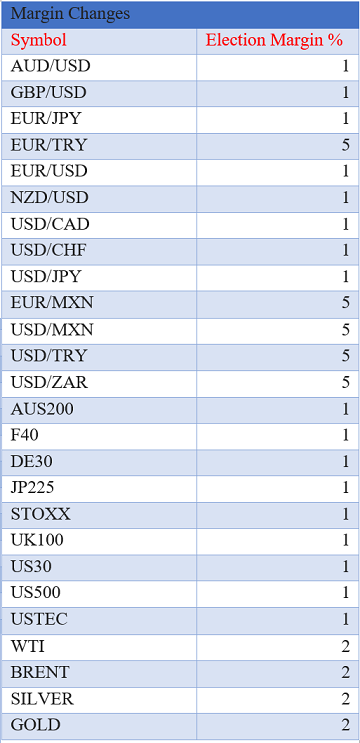
The London based FX and CFD institutional only, announced that it will be increasing margin requirements on select FX and CFD instruments. The new margin requirements will come into effect on the close of business Friday, November 4 and will remain in effect until at least Wednesday, November 9 at 22:00 GMT.
HotForex
The broker has informed its clients that it reserves the right to make a number of changes to the trading conditions without prior notice, which may include but is not limited to, increased margin requirements, Close only mode and volume restrictions.
FXCM
FXCM has announced that it will temporarily increase margin requirements from 1 percent to 2 percent for selected currency pairs with effect from Friday 4th November from 5.00pm EDT (21.00 GMT).
The company will reduce margin requirements back to pre-election levels as soon as market conditions permit. The thirteen currency pairs that will see higher margins of 2 percent include euro/USD, USD/JPY, GBP/USD and USD/CAD.
The USD/Mexican peso's margin requirements will rise from 4.6 percent to 10 percent, the USD/Swedish krona margin will increase from 3 percent to 6 percent and the USD/Norwegian krona will move from 1.5 percent to 3 percent.
Z.com
The UK-arm of the leading Japanese broker GMO Click informed its clients that from the opening of trading on November 7th until the close on November 11th, the margin ratio of all Forex and Spot Metals products be adjusted temporarily to 2% (1:50), and all Stock Indices and Energies and Soft Commodities products will be adjusted temporarily to 4% (1:25).
GKFX
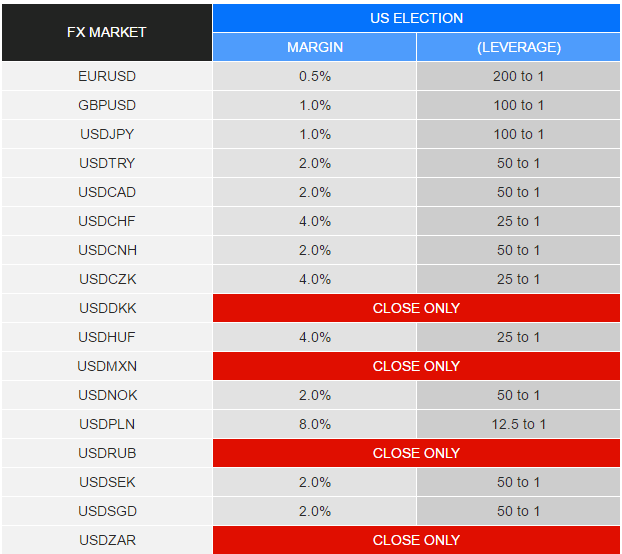
Effective Friday close, November 4th, margin requirements will be increasing on all instruments, as outlined in the table below.
Hantec Markets
Effective Sunday 6th November 2016, the Margin Requirement on ALL FX PAIRS will treble, whilst the margin requirement for all Indices and Commodities will double.
Capital Index
At 2pm (UK time) on Thursday 3rd November, the margin rates on all products will be raised to 2% with the exception of the below:
China50 5%
US Coffee 3%
Natural Gas 3%
Palladium 3%
There will be a further increase at 2pm (UK time) on Monday 7th November to 4% for all products with the exception of the below:
China50 5%
Dukascopy
Leverage on all CFD Indexes will be reduced to 1:10 on Monday 7 November, 14:00 GMT and will remain in place until further notice.
On Sunday 6 November, 22:00 GMT, the leverage on USD/MXN will be lowered to 1:10. On Tuesday 8 November at 10:00 GMT, the trading leverage on all currency pairs will be decreased till the level of the over-the-weekend leverage conditions on all trading accounts that have the balance over 30,000 USD or equivalent at the end of previous trading day (account balance on 7 November).
All other accounts (under USD 30,000 or equivalent) that experience a significant increase of equity due to profit or deposit on Tuesday 8 November will be treated on a case-by-case basis.
The leverage reduction is planned to be cancelled on Wednesday 9 November, 05:00 GMT. However, Dukascopy reserves the right to prolong it if found necessary.
AAAFx
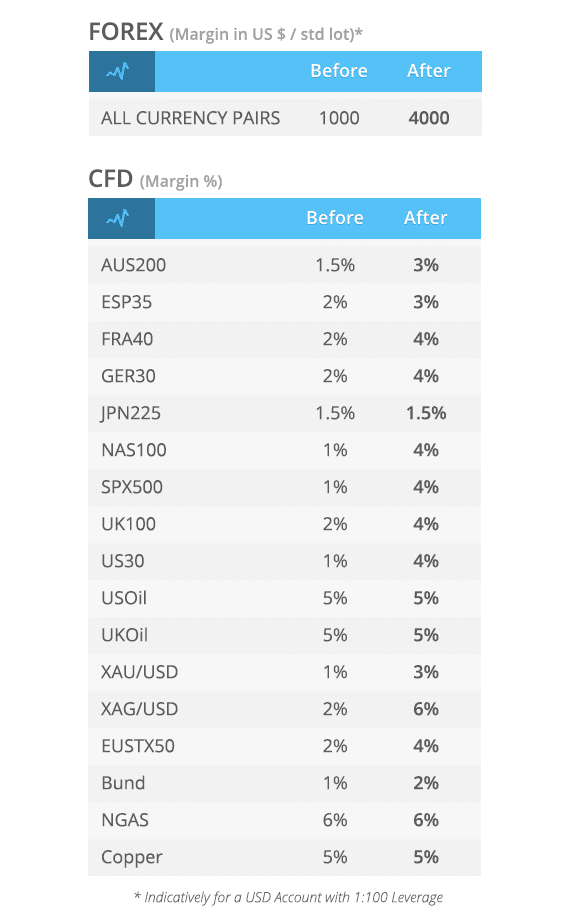
The company will temporarily increase the margin requirements in all of the following instruments before market opening on 6th November 2016.
Alpari
From 7th to 11th November, 2016, the following margin requirements will take place:
The maximum floating leverage will be set to; 1:100 for standard.mt4 and pamm.standard.mt4 accounts; 1:50 for ecn.mt4, pamm.ecn.mt4, pro.ecn.mt4, pamm.pro.ecn.mt4, ecn.mt5, and pamm.ecn.mt5 accounts.
For nano.mt4 accounts - the maximum order size will be 10 lots and the maximum leverage will be 1:100. For standard.mt4 and nano.mt4 accounts – the Limit & Stop Levels will be stablished equal to two spreads.
Effective Thursday open, November 3rd, margin requirements will be set to 3% for Forex pairs and 4% for Commodities and Indices. Under some liquidity circumstances the broker may move instruments to close only.
AxiTrader
Effective market close on the Thursday, 3rd November, the company will be increasing the margin requirements for all products. It will adjust the margin requirement, as a multiple of the client’s current margin requirement. For example, if your current leverage is 100:1 as an example, your new effective leverage would be:
Margin Multiple
Effective Leverage
2
50:1
3
33:1
5
20:1
OctaFX
From October 31 till November 14, leverage for US30, NAS100, SPX500 indices will be lowered from 1:50 to 1:10 on Metatrader 5 trading platform.
The company may increase margin requirements up to 5 times their normal level starting from November 3rd without prior notice.
FOREX.com also warned temporary changes to the clients’ accounts which may include, but are not limited to, updates to margin requirements in the days leading up to and after the vote.
CFI Markets has announced that volatility in the markets is expected to spike during the voting and after announcing the next US President and has decided to raise its margin requirements accordingly. The new margin requirements are listed on the company's website and will apply from Friday 4th November 2016, at 7pm CET until further notice. CFI Markets will further raise the margins if deemed necessary.
Ahead of the upcoming US presidential elections scheduled for November 8, 2016, many brokerage firms are raising their margin requirements, while others warn to do, amid fears that voting on the next leader of the ‘free world’ could trigger market mayhem.
This article is designed to be an easy-to-understand guide that lists the margin and leverage changes across most of the key players in the trading industry.
You can find below a list of brokers that have updated their trading requirements or launched related initiatives, and more will be added as news comes in.
easyMarkets
CySEC-regulated forex broker easyMarkets has decided to go against the trend of limiting leverage being offered to trading clients. The broker has put out a note that it plans to maintain its 200:1 leverage plus offering free guaranteed stop loss and fixed spreads while negative balance protection will remain assured.
OANDA
Maximum leverage available on GBP pairs will be temporary lowered to 20:1 on Monday November 7th at 5:00 am EST.
EUR/GBP: from 2% (50:1) to 5% (20:1)
GBP/CAD: from 2% (50:1) to 5% (20:1)
GBP/NZD: from 2% (50:1) to 5% (20:1)
GBP/USD: from 2% (50:1) to 5% (20:1)
GBP/JPY: from 3% (33:1) to 5% (20:1)
GBP/AUD: from 3% (33:1) to 5% (20:1)
XM.COM
From 8:00 am (GMT+2) on Tuesday, 8th November 2016, the margin required for all positions will be temporarily increased for all instruments to:
1% (100:1 leverage) for all currency pairs, gold and silver and
4% (25:1 leverage) for all CFDs on equity indices and commodities.
This temporary measure will be waived and margin requirements will revert back to normal by Wednesday 9th November 2016.
ACM Group PLC (Alpha)
The London based FX and CFD institutional only, announced that it will be increasing margin requirements on select FX and CFD instruments. The new margin requirements will come into effect on the close of business Friday, November 4 and will remain in effect until at least Wednesday, November 9 at 22:00 GMT.
HotForex
The broker has informed its clients that it reserves the right to make a number of changes to the trading conditions without prior notice, which may include but is not limited to, increased margin requirements, Close only mode and volume restrictions.
FXCM
FXCM has announced that it will temporarily increase margin requirements from 1 percent to 2 percent for selected currency pairs with effect from Friday 4th November from 5.00pm EDT (21.00 GMT).
The company will reduce margin requirements back to pre-election levels as soon as market conditions permit. The thirteen currency pairs that will see higher margins of 2 percent include euro/USD, USD/JPY, GBP/USD and USD/CAD.
The USD/Mexican peso's margin requirements will rise from 4.6 percent to 10 percent, the USD/Swedish krona margin will increase from 3 percent to 6 percent and the USD/Norwegian krona will move from 1.5 percent to 3 percent.
Z.com
The UK-arm of the leading Japanese broker GMO Click informed its clients that from the opening of trading on November 7th until the close on November 11th, the margin ratio of all Forex and Spot Metals products be adjusted temporarily to 2% (1:50), and all Stock Indices and Energies and Soft Commodities products will be adjusted temporarily to 4% (1:25).
GKFX
Effective Friday close, November 4th, margin requirements will be increasing on all instruments, as outlined in the table below.
Hantec Markets
Effective Sunday 6th November 2016, the Margin Requirement on ALL FX PAIRS will treble, whilst the margin requirement for all Indices and Commodities will double.
Capital Index
At 2pm (UK time) on Thursday 3rd November, the margin rates on all products will be raised to 2% with the exception of the below:
China50 5%
US Coffee 3%
Natural Gas 3%
Palladium 3%
There will be a further increase at 2pm (UK time) on Monday 7th November to 4% for all products with the exception of the below:
China50 5%
Dukascopy
Leverage on all CFD Indexes will be reduced to 1:10 on Monday 7 November, 14:00 GMT and will remain in place until further notice.
On Sunday 6 November, 22:00 GMT, the leverage on USD/MXN will be lowered to 1:10. On Tuesday 8 November at 10:00 GMT, the trading leverage on all currency pairs will be decreased till the level of the over-the-weekend leverage conditions on all trading accounts that have the balance over 30,000 USD or equivalent at the end of previous trading day (account balance on 7 November).
All other accounts (under USD 30,000 or equivalent) that experience a significant increase of equity due to profit or deposit on Tuesday 8 November will be treated on a case-by-case basis.
The leverage reduction is planned to be cancelled on Wednesday 9 November, 05:00 GMT. However, Dukascopy reserves the right to prolong it if found necessary.
AAAFx
The company will temporarily increase the margin requirements in all of the following instruments before market opening on 6th November 2016.
Alpari
From 7th to 11th November, 2016, the following margin requirements will take place:
The maximum floating leverage will be set to; 1:100 for standard.mt4 and pamm.standard.mt4 accounts; 1:50 for ecn.mt4, pamm.ecn.mt4, pro.ecn.mt4, pamm.pro.ecn.mt4, ecn.mt5, and pamm.ecn.mt5 accounts.
For nano.mt4 accounts - the maximum order size will be 10 lots and the maximum leverage will be 1:100. For standard.mt4 and nano.mt4 accounts – the Limit & Stop Levels will be stablished equal to two spreads.
Effective Thursday open, November 3rd, margin requirements will be set to 3% for Forex pairs and 4% for Commodities and Indices. Under some liquidity circumstances the broker may move instruments to close only.
AxiTrader
Effective market close on the Thursday, 3rd November, the company will be increasing the margin requirements for all products. It will adjust the margin requirement, as a multiple of the client’s current margin requirement. For example, if your current leverage is 100:1 as an example, your new effective leverage would be:
Margin Multiple
Effective Leverage
2
50:1
3
33:1
5
20:1
OctaFX
From October 31 till November 14, leverage for US30, NAS100, SPX500 indices will be lowered from 1:50 to 1:10 on Metatrader 5 trading platform.
The company may increase margin requirements up to 5 times their normal level starting from November 3rd without prior notice.
FOREX.com also warned temporary changes to the clients’ accounts which may include, but are not limited to, updates to margin requirements in the days leading up to and after the vote.
CFI Markets has announced that volatility in the markets is expected to spike during the voting and after announcing the next US President and has decided to raise its margin requirements accordingly. The new margin requirements are listed on the company's website and will apply from Friday 4th November 2016, at 7pm CET until further notice. CFI Markets will further raise the margins if deemed necessary.
Prop Firms and Brokers Form a Perfect Synergy: One Offers Access, the Other Capital
Featured Videos
Executive Interview | Charlotte Bullock | Chief Product Officer, Bank of London | FMLS:25
In this interview, we sat down with Charlotte Bullock, Head of Product at The Bank of London, previously at SAP and now shaping product at one of the sector’s most ambitious new banking players.
Charlotte reflects on the Summit so far and talks about the culture inside fintech banks today. We look at the pressures that come with scaling, and how firms can hold onto the nimble approach that made them stand out early on.
We also cover the state of payments ahead of her appearance on the payments roundtable: the blockages financial firms face, the areas that still need fixing, and what a realistic solution looks like in 2026.
In this interview, we sat down with Charlotte Bullock, Head of Product at The Bank of London, previously at SAP and now shaping product at one of the sector’s most ambitious new banking players.
Charlotte reflects on the Summit so far and talks about the culture inside fintech banks today. We look at the pressures that come with scaling, and how firms can hold onto the nimble approach that made them stand out early on.
We also cover the state of payments ahead of her appearance on the payments roundtable: the blockages financial firms face, the areas that still need fixing, and what a realistic solution looks like in 2026.
In this interview, we sat down with Charlotte Bullock, Head of Product at The Bank of London, previously at SAP and now shaping product at one of the sector’s most ambitious new banking players.
Charlotte reflects on the Summit so far and talks about the culture inside fintech banks today. We look at the pressures that come with scaling, and how firms can hold onto the nimble approach that made them stand out early on.
We also cover the state of payments ahead of her appearance on the payments roundtable: the blockages financial firms face, the areas that still need fixing, and what a realistic solution looks like in 2026.
In this interview, we sat down with Charlotte Bullock, Head of Product at The Bank of London, previously at SAP and now shaping product at one of the sector’s most ambitious new banking players.
Charlotte reflects on the Summit so far and talks about the culture inside fintech banks today. We look at the pressures that come with scaling, and how firms can hold onto the nimble approach that made them stand out early on.
We also cover the state of payments ahead of her appearance on the payments roundtable: the blockages financial firms face, the areas that still need fixing, and what a realistic solution looks like in 2026.
In this conversation, we sit down with Drew Niv, CSO at ATFX Connect and one of the most influential figures in modern FX.
We speak about market structure, the institutional view on liquidity, and the sharp rise of prop trading, a sector Drew has been commenting on in recent months. Drew explains why he once dismissed prop trading, why his view changed, and what he now thinks the model means for brokers, clients and risk managers.
We explore subscription-fee dependency, the high reneging rate, and the long-term challenge: how brokers can build a more stable and honest version of the model. Drew also talks about the traffic advantage standalone prop firms have built and why brokers may still win in the long run if they take the right approach.
In this conversation, we sit down with Drew Niv, CSO at ATFX Connect and one of the most influential figures in modern FX.
We speak about market structure, the institutional view on liquidity, and the sharp rise of prop trading, a sector Drew has been commenting on in recent months. Drew explains why he once dismissed prop trading, why his view changed, and what he now thinks the model means for brokers, clients and risk managers.
We explore subscription-fee dependency, the high reneging rate, and the long-term challenge: how brokers can build a more stable and honest version of the model. Drew also talks about the traffic advantage standalone prop firms have built and why brokers may still win in the long run if they take the right approach.
In this conversation, we sit down with Drew Niv, CSO at ATFX Connect and one of the most influential figures in modern FX.
We speak about market structure, the institutional view on liquidity, and the sharp rise of prop trading, a sector Drew has been commenting on in recent months. Drew explains why he once dismissed prop trading, why his view changed, and what he now thinks the model means for brokers, clients and risk managers.
We explore subscription-fee dependency, the high reneging rate, and the long-term challenge: how brokers can build a more stable and honest version of the model. Drew also talks about the traffic advantage standalone prop firms have built and why brokers may still win in the long run if they take the right approach.
In this conversation, we sit down with Drew Niv, CSO at ATFX Connect and one of the most influential figures in modern FX.
We speak about market structure, the institutional view on liquidity, and the sharp rise of prop trading, a sector Drew has been commenting on in recent months. Drew explains why he once dismissed prop trading, why his view changed, and what he now thinks the model means for brokers, clients and risk managers.
We explore subscription-fee dependency, the high reneging rate, and the long-term challenge: how brokers can build a more stable and honest version of the model. Drew also talks about the traffic advantage standalone prop firms have built and why brokers may still win in the long run if they take the right approach.
In this conversation, we sit down with Drew Niv, CSO at ATFX Connect and one of the most influential figures in modern FX.
We speak about market structure, the institutional view on liquidity, and the sharp rise of prop trading, a sector Drew has been commenting on in recent months. Drew explains why he once dismissed prop trading, why his view changed, and what he now thinks the model means for brokers, clients and risk managers.
We explore subscription-fee dependency, the high reneging rate, and the long-term challenge: how brokers can build a more stable and honest version of the model. Drew also talks about the traffic advantage standalone prop firms have built and why brokers may still win in the long run if they take the right approach.
In this conversation, we sit down with Drew Niv, CSO at ATFX Connect and one of the most influential figures in modern FX.
We speak about market structure, the institutional view on liquidity, and the sharp rise of prop trading, a sector Drew has been commenting on in recent months. Drew explains why he once dismissed prop trading, why his view changed, and what he now thinks the model means for brokers, clients and risk managers.
We explore subscription-fee dependency, the high reneging rate, and the long-term challenge: how brokers can build a more stable and honest version of the model. Drew also talks about the traffic advantage standalone prop firms have built and why brokers may still win in the long run if they take the right approach.
Executive Interview | Remonda Z. Kirketerp Møller| CEO & Founder Muinmos | FMLS:25
In this interview, Remonda Z. Kirketerp Møller, founder of Muinmos, breaks down the state of AI in regtech and what responsible adoption really looks like for brokers. We talk about rising fragmentation, the pressures around compliance accuracy, and why most firms are still in the early stages of AI maturity.
Ramanda also shares insights on regulator sandboxes, shifting expectations around accountability, and the current reality of MiCA licensing and passporting in Europe.
A concise look at where compliance, onboarding, and AI-driven processes are heading next.
In this interview, Remonda Z. Kirketerp Møller, founder of Muinmos, breaks down the state of AI in regtech and what responsible adoption really looks like for brokers. We talk about rising fragmentation, the pressures around compliance accuracy, and why most firms are still in the early stages of AI maturity.
Ramanda also shares insights on regulator sandboxes, shifting expectations around accountability, and the current reality of MiCA licensing and passporting in Europe.
A concise look at where compliance, onboarding, and AI-driven processes are heading next.
In this interview, Remonda Z. Kirketerp Møller, founder of Muinmos, breaks down the state of AI in regtech and what responsible adoption really looks like for brokers. We talk about rising fragmentation, the pressures around compliance accuracy, and why most firms are still in the early stages of AI maturity.
Ramanda also shares insights on regulator sandboxes, shifting expectations around accountability, and the current reality of MiCA licensing and passporting in Europe.
A concise look at where compliance, onboarding, and AI-driven processes are heading next.
In this interview, Remonda Z. Kirketerp Møller, founder of Muinmos, breaks down the state of AI in regtech and what responsible adoption really looks like for brokers. We talk about rising fragmentation, the pressures around compliance accuracy, and why most firms are still in the early stages of AI maturity.
Ramanda also shares insights on regulator sandboxes, shifting expectations around accountability, and the current reality of MiCA licensing and passporting in Europe.
A concise look at where compliance, onboarding, and AI-driven processes are heading next.
In this interview, Remonda Z. Kirketerp Møller, founder of Muinmos, breaks down the state of AI in regtech and what responsible adoption really looks like for brokers. We talk about rising fragmentation, the pressures around compliance accuracy, and why most firms are still in the early stages of AI maturity.
Ramanda also shares insights on regulator sandboxes, shifting expectations around accountability, and the current reality of MiCA licensing and passporting in Europe.
A concise look at where compliance, onboarding, and AI-driven processes are heading next.
In this interview, Remonda Z. Kirketerp Møller, founder of Muinmos, breaks down the state of AI in regtech and what responsible adoption really looks like for brokers. We talk about rising fragmentation, the pressures around compliance accuracy, and why most firms are still in the early stages of AI maturity.
Ramanda also shares insights on regulator sandboxes, shifting expectations around accountability, and the current reality of MiCA licensing and passporting in Europe.
A concise look at where compliance, onboarding, and AI-driven processes are heading next.
In this conversation, we speak with Aydin Bonabi, CEO and co-founder of Surveill, a firm focused on fraud detection and AI-driven compliance tools for financial institutions.
We start with Aydin’s view of the Summit and the challenges brokers face as fraud tactics grow more complex. He explains how firms can stay ahead through real-time signals, data patterns, and early-stage detection.
We also talk about AI training and why compliance teams often struggle to keep models accurate, fair, and aligned with regulatory expectations. Aydin breaks down what “good” AI training looks like inside a financial environment, including the importance of clean data, domain expertise, and human oversight.
He closes with a clear message: fraud is scaling, and so must the tools that stop it.
In this conversation, we speak with Aydin Bonabi, CEO and co-founder of Surveill, a firm focused on fraud detection and AI-driven compliance tools for financial institutions.
We start with Aydin’s view of the Summit and the challenges brokers face as fraud tactics grow more complex. He explains how firms can stay ahead through real-time signals, data patterns, and early-stage detection.
We also talk about AI training and why compliance teams often struggle to keep models accurate, fair, and aligned with regulatory expectations. Aydin breaks down what “good” AI training looks like inside a financial environment, including the importance of clean data, domain expertise, and human oversight.
He closes with a clear message: fraud is scaling, and so must the tools that stop it.
In this conversation, we speak with Aydin Bonabi, CEO and co-founder of Surveill, a firm focused on fraud detection and AI-driven compliance tools for financial institutions.
We start with Aydin’s view of the Summit and the challenges brokers face as fraud tactics grow more complex. He explains how firms can stay ahead through real-time signals, data patterns, and early-stage detection.
We also talk about AI training and why compliance teams often struggle to keep models accurate, fair, and aligned with regulatory expectations. Aydin breaks down what “good” AI training looks like inside a financial environment, including the importance of clean data, domain expertise, and human oversight.
He closes with a clear message: fraud is scaling, and so must the tools that stop it.
In this conversation, we speak with Aydin Bonabi, CEO and co-founder of Surveill, a firm focused on fraud detection and AI-driven compliance tools for financial institutions.
We start with Aydin’s view of the Summit and the challenges brokers face as fraud tactics grow more complex. He explains how firms can stay ahead through real-time signals, data patterns, and early-stage detection.
We also talk about AI training and why compliance teams often struggle to keep models accurate, fair, and aligned with regulatory expectations. Aydin breaks down what “good” AI training looks like inside a financial environment, including the importance of clean data, domain expertise, and human oversight.
He closes with a clear message: fraud is scaling, and so must the tools that stop it.
In this conversation, we speak with Aydin Bonabi, CEO and co-founder of Surveill, a firm focused on fraud detection and AI-driven compliance tools for financial institutions.
We start with Aydin’s view of the Summit and the challenges brokers face as fraud tactics grow more complex. He explains how firms can stay ahead through real-time signals, data patterns, and early-stage detection.
We also talk about AI training and why compliance teams often struggle to keep models accurate, fair, and aligned with regulatory expectations. Aydin breaks down what “good” AI training looks like inside a financial environment, including the importance of clean data, domain expertise, and human oversight.
He closes with a clear message: fraud is scaling, and so must the tools that stop it.
In this conversation, we speak with Aydin Bonabi, CEO and co-founder of Surveill, a firm focused on fraud detection and AI-driven compliance tools for financial institutions.
We start with Aydin’s view of the Summit and the challenges brokers face as fraud tactics grow more complex. He explains how firms can stay ahead through real-time signals, data patterns, and early-stage detection.
We also talk about AI training and why compliance teams often struggle to keep models accurate, fair, and aligned with regulatory expectations. Aydin breaks down what “good” AI training looks like inside a financial environment, including the importance of clean data, domain expertise, and human oversight.
He closes with a clear message: fraud is scaling, and so must the tools that stop it.
Exness expands its presence in Africa: Inside our interview with Paul Margarites in Cape Town
Finance Magnates met with Paul Margarites, Exness regional commercial director for Sub-Saharan Africa, during a visit to the firm’s office opening in Cape Town. In this talk, led by Andrea Badiola Mateos, Co-CEO at Finance Magnates, Paul shares views on the South African trading space, local user behavior, mobile trends, regulation, team growth, and how Exness plans to grow in more markets across the region. @Exness
Read the article at: https://www.financemagnates.com/thought-leadership/exness-expands-its-presence-in-africa-inside-our-interview-with-paul-margarites/
#exness #financemagnates #exnesstrading #CFDtrading #tradeonline #africanews #capetown
Finance Magnates met with Paul Margarites, Exness regional commercial director for Sub-Saharan Africa, during a visit to the firm’s office opening in Cape Town. In this talk, led by Andrea Badiola Mateos, Co-CEO at Finance Magnates, Paul shares views on the South African trading space, local user behavior, mobile trends, regulation, team growth, and how Exness plans to grow in more markets across the region. @Exness
Read the article at: https://www.financemagnates.com/thought-leadership/exness-expands-its-presence-in-africa-inside-our-interview-with-paul-margarites/
#exness #financemagnates #exnesstrading #CFDtrading #tradeonline #africanews #capetown
Finance Magnates met with Paul Margarites, Exness regional commercial director for Sub-Saharan Africa, during a visit to the firm’s office opening in Cape Town. In this talk, led by Andrea Badiola Mateos, Co-CEO at Finance Magnates, Paul shares views on the South African trading space, local user behavior, mobile trends, regulation, team growth, and how Exness plans to grow in more markets across the region. @Exness
Read the article at: https://www.financemagnates.com/thought-leadership/exness-expands-its-presence-in-africa-inside-our-interview-with-paul-margarites/
#exness #financemagnates #exnesstrading #CFDtrading #tradeonline #africanews #capetown
Finance Magnates met with Paul Margarites, Exness regional commercial director for Sub-Saharan Africa, during a visit to the firm’s office opening in Cape Town. In this talk, led by Andrea Badiola Mateos, Co-CEO at Finance Magnates, Paul shares views on the South African trading space, local user behavior, mobile trends, regulation, team growth, and how Exness plans to grow in more markets across the region. @Exness
Read the article at: https://www.financemagnates.com/thought-leadership/exness-expands-its-presence-in-africa-inside-our-interview-with-paul-margarites/
#exness #financemagnates #exnesstrading #CFDtrading #tradeonline #africanews #capetown
Finance Magnates met with Paul Margarites, Exness regional commercial director for Sub-Saharan Africa, during a visit to the firm’s office opening in Cape Town. In this talk, led by Andrea Badiola Mateos, Co-CEO at Finance Magnates, Paul shares views on the South African trading space, local user behavior, mobile trends, regulation, team growth, and how Exness plans to grow in more markets across the region. @Exness
Read the article at: https://www.financemagnates.com/thought-leadership/exness-expands-its-presence-in-africa-inside-our-interview-with-paul-margarites/
#exness #financemagnates #exnesstrading #CFDtrading #tradeonline #africanews #capetown
Finance Magnates met with Paul Margarites, Exness regional commercial director for Sub-Saharan Africa, during a visit to the firm’s office opening in Cape Town. In this talk, led by Andrea Badiola Mateos, Co-CEO at Finance Magnates, Paul shares views on the South African trading space, local user behavior, mobile trends, regulation, team growth, and how Exness plans to grow in more markets across the region. @Exness
Read the article at: https://www.financemagnates.com/thought-leadership/exness-expands-its-presence-in-africa-inside-our-interview-with-paul-margarites/
#exness #financemagnates #exnesstrading #CFDtrading #tradeonline #africanews #capetown