In reference to the results, figures for MB Trading are our estimates as finalized data could not be sourced before publishing. Also, in Q4 2014, the results for InteractiveBrokers were incorrectly reported. Active accounts were understated by approximately 3,000 customers.
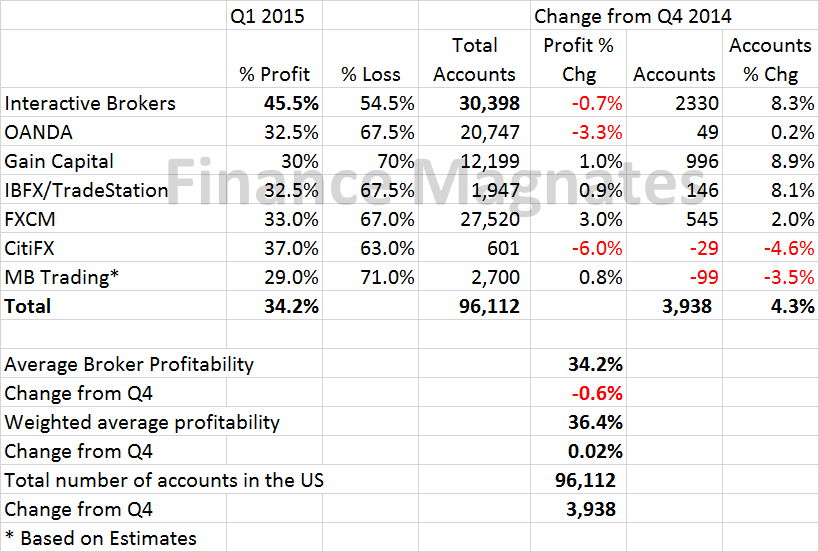
Turning to Q1’s figures, results from reporting brokers showed that the U.S. forex market grew by 3,938 or 4.3% to 96,112 active accounts traded during the quarter. Profitability also improved, with weighted averages revealing that 36.4% of US customers were in the black during Q1, compared to 36.2% in Q4 2014. Non-weighted averages that that don’t take a broker’s account numbers into consideration and count individual firms equally, showed that profitability for the average U.S. broker decreased by to 34.2% compared to 34.8% in Q4 2014.
Q1 2015 US Retail Forex Profitability report (source: Finance Magnates)
Among individual firms, two that are worth highlighting for contrasting reasons are InteractiveBrokers and OANDA. At OANDA, active account numbers remained firm, as they grew by 49 to 20,747, but profitability declined to 32.5% from 35.8%. As it is considered a low spread broker, OANDA has typically been ranked among brokers with more profitable customers in the U.S., topping the list during Q2 2014 with a 45.5% rate. However, they have also been reporting wider than average variances in profitability among their U.S. customers. In the past, OANDA has attributed this phenomenon as being U.S. specific due to domestic trader habits, and is not necessarily indicative of global customer performance.
In regards to InteractiveBrokers, the firm continues to hold onto its claim of having the most profitable traders, topping this quarter’s list at 45.5%. In addition, they reported the highest amount of active U.S. customers, with account growth of 8.3% to 30,398. The addition of 2,330 active accounts occurred even as rivals have struggled to meaningfully increase their U.S. businesses without acquisitions.
Speaking about their account growth and customer profitability, Andrew Wilkinson, Chief Market Analyst at InteractiveBrokers explained to Finance Magnates that they believe customers benefit from their low fees and tight spreads. He also attributed higher profitability to having a more experienced customer base, stating that the firm is “known for its technology among professional and savvy traders”.
As for customer growth, Wilkinson explained that the firm reported record new account openings in Q1 2015 for their multi-asset universal trading offering. He related that offering a variety of assets, makes it difficult to determine what drives forex specific business, but that all business lines benefit from the broker’s low costs to customers. In terms of specific areas of strength, Wilkinson noted they are experiencing growth internationally and in the advisor space.
When asked about the post Swiss franc crisis landscape for onboarding new customers, Wilkinson answered that the firm’s size and strong capital base may be helping them now, stating “New clients opening a Universal Account with Interactive Brokers have access to many trading products. This makes it difficult to state whether a new client is joining solely to trade currencies. That said, the SNB crisis may have even had a positive impact on account growth at IB, as clients of more vulnerable brokers looked to move their accounts elsewhere.”
Among other individual brokers, worth noting is FXCM’s account profitability improvement to 33% from 30% in Q1 2015. The broker has reported some of the poorest performances from their customers in the past, due in part to their wide spreads. However, the decision to decrease spreads at the U.S. unit at the end of 2014 appears to have assisted customers in performing better during Q1 2015. The higher profitability occurs, even as FXCM has reported that these same customers have been increasing their volumes substantially, over-trading often being a leading cause of losses for retail traders.
Also worth noting is the 8.9% improvement of active customers at GAIN Capital to a total of 12,199. Since peaking at 12,384 during Q1 2013 following their acquisition of GFT’s U.S. business at the end of 2012, active U.S. account numbers at GAIN had been trending lower. As such, the Q1 increase can be viewed as a sign of strength in the US for GAIN.
In reference to the results, figures for MB Trading are our estimates as finalized data could not be sourced before publishing. Also, in Q4 2014, the results for InteractiveBrokers were incorrectly reported. Active accounts were understated by approximately 3,000 customers.
Turning to Q1’s figures, results from reporting brokers showed that the U.S. forex market grew by 3,938 or 4.3% to 96,112 active accounts traded during the quarter. Profitability also improved, with weighted averages revealing that 36.4% of US customers were in the black during Q1, compared to 36.2% in Q4 2014. Non-weighted averages that that don’t take a broker’s account numbers into consideration and count individual firms equally, showed that profitability for the average U.S. broker decreased by to 34.2% compared to 34.8% in Q4 2014.
Q1 2015 US Retail Forex Profitability report (source: Finance Magnates)
Among individual firms, two that are worth highlighting for contrasting reasons are InteractiveBrokers and OANDA. At OANDA, active account numbers remained firm, as they grew by 49 to 20,747, but profitability declined to 32.5% from 35.8%. As it is considered a low spread broker, OANDA has typically been ranked among brokers with more profitable customers in the U.S., topping the list during Q2 2014 with a 45.5% rate. However, they have also been reporting wider than average variances in profitability among their U.S. customers. In the past, OANDA has attributed this phenomenon as being U.S. specific due to domestic trader habits, and is not necessarily indicative of global customer performance.
In regards to InteractiveBrokers, the firm continues to hold onto its claim of having the most profitable traders, topping this quarter’s list at 45.5%. In addition, they reported the highest amount of active U.S. customers, with account growth of 8.3% to 30,398. The addition of 2,330 active accounts occurred even as rivals have struggled to meaningfully increase their U.S. businesses without acquisitions.
Speaking about their account growth and customer profitability, Andrew Wilkinson, Chief Market Analyst at InteractiveBrokers explained to Finance Magnates that they believe customers benefit from their low fees and tight spreads. He also attributed higher profitability to having a more experienced customer base, stating that the firm is “known for its technology among professional and savvy traders”.
As for customer growth, Wilkinson explained that the firm reported record new account openings in Q1 2015 for their multi-asset universal trading offering. He related that offering a variety of assets, makes it difficult to determine what drives forex specific business, but that all business lines benefit from the broker’s low costs to customers. In terms of specific areas of strength, Wilkinson noted they are experiencing growth internationally and in the advisor space.
When asked about the post Swiss franc crisis landscape for onboarding new customers, Wilkinson answered that the firm’s size and strong capital base may be helping them now, stating “New clients opening a Universal Account with Interactive Brokers have access to many trading products. This makes it difficult to state whether a new client is joining solely to trade currencies. That said, the SNB crisis may have even had a positive impact on account growth at IB, as clients of more vulnerable brokers looked to move their accounts elsewhere.”
Among other individual brokers, worth noting is FXCM’s account profitability improvement to 33% from 30% in Q1 2015. The broker has reported some of the poorest performances from their customers in the past, due in part to their wide spreads. However, the decision to decrease spreads at the U.S. unit at the end of 2014 appears to have assisted customers in performing better during Q1 2015. The higher profitability occurs, even as FXCM has reported that these same customers have been increasing their volumes substantially, over-trading often being a leading cause of losses for retail traders.
Also worth noting is the 8.9% improvement of active customers at GAIN Capital to a total of 12,199. Since peaking at 12,384 during Q1 2013 following their acquisition of GFT’s U.S. business at the end of 2012, active U.S. account numbers at GAIN had been trending lower. As such, the Q1 increase can be viewed as a sign of strength in the US for GAIN.
CySEC Fines Wonderinterest €100K, Operator of CFD Brokers Zetano and Investago
Featured Videos
Executive Interview | Charlotte Bullock | Chief Product Officer, Bank of London | FMLS:25
In this interview, we sat down with Charlotte Bullock, Head of Product at The Bank of London, previously at SAP and now shaping product at one of the sector’s most ambitious new banking players.
Charlotte reflects on the Summit so far and talks about the culture inside fintech banks today. We look at the pressures that come with scaling, and how firms can hold onto the nimble approach that made them stand out early on.
We also cover the state of payments ahead of her appearance on the payments roundtable: the blockages financial firms face, the areas that still need fixing, and what a realistic solution looks like in 2026.
In this interview, we sat down with Charlotte Bullock, Head of Product at The Bank of London, previously at SAP and now shaping product at one of the sector’s most ambitious new banking players.
Charlotte reflects on the Summit so far and talks about the culture inside fintech banks today. We look at the pressures that come with scaling, and how firms can hold onto the nimble approach that made them stand out early on.
We also cover the state of payments ahead of her appearance on the payments roundtable: the blockages financial firms face, the areas that still need fixing, and what a realistic solution looks like in 2026.
In this interview, we sat down with Charlotte Bullock, Head of Product at The Bank of London, previously at SAP and now shaping product at one of the sector’s most ambitious new banking players.
Charlotte reflects on the Summit so far and talks about the culture inside fintech banks today. We look at the pressures that come with scaling, and how firms can hold onto the nimble approach that made them stand out early on.
We also cover the state of payments ahead of her appearance on the payments roundtable: the blockages financial firms face, the areas that still need fixing, and what a realistic solution looks like in 2026.
In this interview, we sat down with Charlotte Bullock, Head of Product at The Bank of London, previously at SAP and now shaping product at one of the sector’s most ambitious new banking players.
Charlotte reflects on the Summit so far and talks about the culture inside fintech banks today. We look at the pressures that come with scaling, and how firms can hold onto the nimble approach that made them stand out early on.
We also cover the state of payments ahead of her appearance on the payments roundtable: the blockages financial firms face, the areas that still need fixing, and what a realistic solution looks like in 2026.
In this conversation, we sit down with Drew Niv, CSO at ATFX Connect and one of the most influential figures in modern FX.
We speak about market structure, the institutional view on liquidity, and the sharp rise of prop trading, a sector Drew has been commenting on in recent months. Drew explains why he once dismissed prop trading, why his view changed, and what he now thinks the model means for brokers, clients and risk managers.
We explore subscription-fee dependency, the high reneging rate, and the long-term challenge: how brokers can build a more stable and honest version of the model. Drew also talks about the traffic advantage standalone prop firms have built and why brokers may still win in the long run if they take the right approach.
In this conversation, we sit down with Drew Niv, CSO at ATFX Connect and one of the most influential figures in modern FX.
We speak about market structure, the institutional view on liquidity, and the sharp rise of prop trading, a sector Drew has been commenting on in recent months. Drew explains why he once dismissed prop trading, why his view changed, and what he now thinks the model means for brokers, clients and risk managers.
We explore subscription-fee dependency, the high reneging rate, and the long-term challenge: how brokers can build a more stable and honest version of the model. Drew also talks about the traffic advantage standalone prop firms have built and why brokers may still win in the long run if they take the right approach.
In this conversation, we sit down with Drew Niv, CSO at ATFX Connect and one of the most influential figures in modern FX.
We speak about market structure, the institutional view on liquidity, and the sharp rise of prop trading, a sector Drew has been commenting on in recent months. Drew explains why he once dismissed prop trading, why his view changed, and what he now thinks the model means for brokers, clients and risk managers.
We explore subscription-fee dependency, the high reneging rate, and the long-term challenge: how brokers can build a more stable and honest version of the model. Drew also talks about the traffic advantage standalone prop firms have built and why brokers may still win in the long run if they take the right approach.
In this conversation, we sit down with Drew Niv, CSO at ATFX Connect and one of the most influential figures in modern FX.
We speak about market structure, the institutional view on liquidity, and the sharp rise of prop trading, a sector Drew has been commenting on in recent months. Drew explains why he once dismissed prop trading, why his view changed, and what he now thinks the model means for brokers, clients and risk managers.
We explore subscription-fee dependency, the high reneging rate, and the long-term challenge: how brokers can build a more stable and honest version of the model. Drew also talks about the traffic advantage standalone prop firms have built and why brokers may still win in the long run if they take the right approach.
In this conversation, we sit down with Drew Niv, CSO at ATFX Connect and one of the most influential figures in modern FX.
We speak about market structure, the institutional view on liquidity, and the sharp rise of prop trading, a sector Drew has been commenting on in recent months. Drew explains why he once dismissed prop trading, why his view changed, and what he now thinks the model means for brokers, clients and risk managers.
We explore subscription-fee dependency, the high reneging rate, and the long-term challenge: how brokers can build a more stable and honest version of the model. Drew also talks about the traffic advantage standalone prop firms have built and why brokers may still win in the long run if they take the right approach.
In this conversation, we sit down with Drew Niv, CSO at ATFX Connect and one of the most influential figures in modern FX.
We speak about market structure, the institutional view on liquidity, and the sharp rise of prop trading, a sector Drew has been commenting on in recent months. Drew explains why he once dismissed prop trading, why his view changed, and what he now thinks the model means for brokers, clients and risk managers.
We explore subscription-fee dependency, the high reneging rate, and the long-term challenge: how brokers can build a more stable and honest version of the model. Drew also talks about the traffic advantage standalone prop firms have built and why brokers may still win in the long run if they take the right approach.
Executive Interview | Remonda Z. Kirketerp Møller| CEO & Founder Muinmos | FMLS:25
In this interview, Remonda Z. Kirketerp Møller, founder of Muinmos, breaks down the state of AI in regtech and what responsible adoption really looks like for brokers. We talk about rising fragmentation, the pressures around compliance accuracy, and why most firms are still in the early stages of AI maturity.
Ramanda also shares insights on regulator sandboxes, shifting expectations around accountability, and the current reality of MiCA licensing and passporting in Europe.
A concise look at where compliance, onboarding, and AI-driven processes are heading next.
In this interview, Remonda Z. Kirketerp Møller, founder of Muinmos, breaks down the state of AI in regtech and what responsible adoption really looks like for brokers. We talk about rising fragmentation, the pressures around compliance accuracy, and why most firms are still in the early stages of AI maturity.
Ramanda also shares insights on regulator sandboxes, shifting expectations around accountability, and the current reality of MiCA licensing and passporting in Europe.
A concise look at where compliance, onboarding, and AI-driven processes are heading next.
In this interview, Remonda Z. Kirketerp Møller, founder of Muinmos, breaks down the state of AI in regtech and what responsible adoption really looks like for brokers. We talk about rising fragmentation, the pressures around compliance accuracy, and why most firms are still in the early stages of AI maturity.
Ramanda also shares insights on regulator sandboxes, shifting expectations around accountability, and the current reality of MiCA licensing and passporting in Europe.
A concise look at where compliance, onboarding, and AI-driven processes are heading next.
In this interview, Remonda Z. Kirketerp Møller, founder of Muinmos, breaks down the state of AI in regtech and what responsible adoption really looks like for brokers. We talk about rising fragmentation, the pressures around compliance accuracy, and why most firms are still in the early stages of AI maturity.
Ramanda also shares insights on regulator sandboxes, shifting expectations around accountability, and the current reality of MiCA licensing and passporting in Europe.
A concise look at where compliance, onboarding, and AI-driven processes are heading next.
In this interview, Remonda Z. Kirketerp Møller, founder of Muinmos, breaks down the state of AI in regtech and what responsible adoption really looks like for brokers. We talk about rising fragmentation, the pressures around compliance accuracy, and why most firms are still in the early stages of AI maturity.
Ramanda also shares insights on regulator sandboxes, shifting expectations around accountability, and the current reality of MiCA licensing and passporting in Europe.
A concise look at where compliance, onboarding, and AI-driven processes are heading next.
In this interview, Remonda Z. Kirketerp Møller, founder of Muinmos, breaks down the state of AI in regtech and what responsible adoption really looks like for brokers. We talk about rising fragmentation, the pressures around compliance accuracy, and why most firms are still in the early stages of AI maturity.
Ramanda also shares insights on regulator sandboxes, shifting expectations around accountability, and the current reality of MiCA licensing and passporting in Europe.
A concise look at where compliance, onboarding, and AI-driven processes are heading next.
In this conversation, we speak with Aydin Bonabi, CEO and co-founder of Surveill, a firm focused on fraud detection and AI-driven compliance tools for financial institutions.
We start with Aydin’s view of the Summit and the challenges brokers face as fraud tactics grow more complex. He explains how firms can stay ahead through real-time signals, data patterns, and early-stage detection.
We also talk about AI training and why compliance teams often struggle to keep models accurate, fair, and aligned with regulatory expectations. Aydin breaks down what “good” AI training looks like inside a financial environment, including the importance of clean data, domain expertise, and human oversight.
He closes with a clear message: fraud is scaling, and so must the tools that stop it.
In this conversation, we speak with Aydin Bonabi, CEO and co-founder of Surveill, a firm focused on fraud detection and AI-driven compliance tools for financial institutions.
We start with Aydin’s view of the Summit and the challenges brokers face as fraud tactics grow more complex. He explains how firms can stay ahead through real-time signals, data patterns, and early-stage detection.
We also talk about AI training and why compliance teams often struggle to keep models accurate, fair, and aligned with regulatory expectations. Aydin breaks down what “good” AI training looks like inside a financial environment, including the importance of clean data, domain expertise, and human oversight.
He closes with a clear message: fraud is scaling, and so must the tools that stop it.
In this conversation, we speak with Aydin Bonabi, CEO and co-founder of Surveill, a firm focused on fraud detection and AI-driven compliance tools for financial institutions.
We start with Aydin’s view of the Summit and the challenges brokers face as fraud tactics grow more complex. He explains how firms can stay ahead through real-time signals, data patterns, and early-stage detection.
We also talk about AI training and why compliance teams often struggle to keep models accurate, fair, and aligned with regulatory expectations. Aydin breaks down what “good” AI training looks like inside a financial environment, including the importance of clean data, domain expertise, and human oversight.
He closes with a clear message: fraud is scaling, and so must the tools that stop it.
In this conversation, we speak with Aydin Bonabi, CEO and co-founder of Surveill, a firm focused on fraud detection and AI-driven compliance tools for financial institutions.
We start with Aydin’s view of the Summit and the challenges brokers face as fraud tactics grow more complex. He explains how firms can stay ahead through real-time signals, data patterns, and early-stage detection.
We also talk about AI training and why compliance teams often struggle to keep models accurate, fair, and aligned with regulatory expectations. Aydin breaks down what “good” AI training looks like inside a financial environment, including the importance of clean data, domain expertise, and human oversight.
He closes with a clear message: fraud is scaling, and so must the tools that stop it.
In this conversation, we speak with Aydin Bonabi, CEO and co-founder of Surveill, a firm focused on fraud detection and AI-driven compliance tools for financial institutions.
We start with Aydin’s view of the Summit and the challenges brokers face as fraud tactics grow more complex. He explains how firms can stay ahead through real-time signals, data patterns, and early-stage detection.
We also talk about AI training and why compliance teams often struggle to keep models accurate, fair, and aligned with regulatory expectations. Aydin breaks down what “good” AI training looks like inside a financial environment, including the importance of clean data, domain expertise, and human oversight.
He closes with a clear message: fraud is scaling, and so must the tools that stop it.
In this conversation, we speak with Aydin Bonabi, CEO and co-founder of Surveill, a firm focused on fraud detection and AI-driven compliance tools for financial institutions.
We start with Aydin’s view of the Summit and the challenges brokers face as fraud tactics grow more complex. He explains how firms can stay ahead through real-time signals, data patterns, and early-stage detection.
We also talk about AI training and why compliance teams often struggle to keep models accurate, fair, and aligned with regulatory expectations. Aydin breaks down what “good” AI training looks like inside a financial environment, including the importance of clean data, domain expertise, and human oversight.
He closes with a clear message: fraud is scaling, and so must the tools that stop it.
Exness expands its presence in Africa: Inside our interview with Paul Margarites in Cape Town
Finance Magnates met with Paul Margarites, Exness regional commercial director for Sub-Saharan Africa, during a visit to the firm’s office opening in Cape Town. In this talk, led by Andrea Badiola Mateos, Co-CEO at Finance Magnates, Paul shares views on the South African trading space, local user behavior, mobile trends, regulation, team growth, and how Exness plans to grow in more markets across the region. @Exness
Read the article at: https://www.financemagnates.com/thought-leadership/exness-expands-its-presence-in-africa-inside-our-interview-with-paul-margarites/
#exness #financemagnates #exnesstrading #CFDtrading #tradeonline #africanews #capetown
Finance Magnates met with Paul Margarites, Exness regional commercial director for Sub-Saharan Africa, during a visit to the firm’s office opening in Cape Town. In this talk, led by Andrea Badiola Mateos, Co-CEO at Finance Magnates, Paul shares views on the South African trading space, local user behavior, mobile trends, regulation, team growth, and how Exness plans to grow in more markets across the region. @Exness
Read the article at: https://www.financemagnates.com/thought-leadership/exness-expands-its-presence-in-africa-inside-our-interview-with-paul-margarites/
#exness #financemagnates #exnesstrading #CFDtrading #tradeonline #africanews #capetown
Finance Magnates met with Paul Margarites, Exness regional commercial director for Sub-Saharan Africa, during a visit to the firm’s office opening in Cape Town. In this talk, led by Andrea Badiola Mateos, Co-CEO at Finance Magnates, Paul shares views on the South African trading space, local user behavior, mobile trends, regulation, team growth, and how Exness plans to grow in more markets across the region. @Exness
Read the article at: https://www.financemagnates.com/thought-leadership/exness-expands-its-presence-in-africa-inside-our-interview-with-paul-margarites/
#exness #financemagnates #exnesstrading #CFDtrading #tradeonline #africanews #capetown
Finance Magnates met with Paul Margarites, Exness regional commercial director for Sub-Saharan Africa, during a visit to the firm’s office opening in Cape Town. In this talk, led by Andrea Badiola Mateos, Co-CEO at Finance Magnates, Paul shares views on the South African trading space, local user behavior, mobile trends, regulation, team growth, and how Exness plans to grow in more markets across the region. @Exness
Read the article at: https://www.financemagnates.com/thought-leadership/exness-expands-its-presence-in-africa-inside-our-interview-with-paul-margarites/
#exness #financemagnates #exnesstrading #CFDtrading #tradeonline #africanews #capetown
Finance Magnates met with Paul Margarites, Exness regional commercial director for Sub-Saharan Africa, during a visit to the firm’s office opening in Cape Town. In this talk, led by Andrea Badiola Mateos, Co-CEO at Finance Magnates, Paul shares views on the South African trading space, local user behavior, mobile trends, regulation, team growth, and how Exness plans to grow in more markets across the region. @Exness
Read the article at: https://www.financemagnates.com/thought-leadership/exness-expands-its-presence-in-africa-inside-our-interview-with-paul-margarites/
#exness #financemagnates #exnesstrading #CFDtrading #tradeonline #africanews #capetown
Finance Magnates met with Paul Margarites, Exness regional commercial director for Sub-Saharan Africa, during a visit to the firm’s office opening in Cape Town. In this talk, led by Andrea Badiola Mateos, Co-CEO at Finance Magnates, Paul shares views on the South African trading space, local user behavior, mobile trends, regulation, team growth, and how Exness plans to grow in more markets across the region. @Exness
Read the article at: https://www.financemagnates.com/thought-leadership/exness-expands-its-presence-in-africa-inside-our-interview-with-paul-margarites/
#exness #financemagnates #exnesstrading #CFDtrading #tradeonline #africanews #capetown