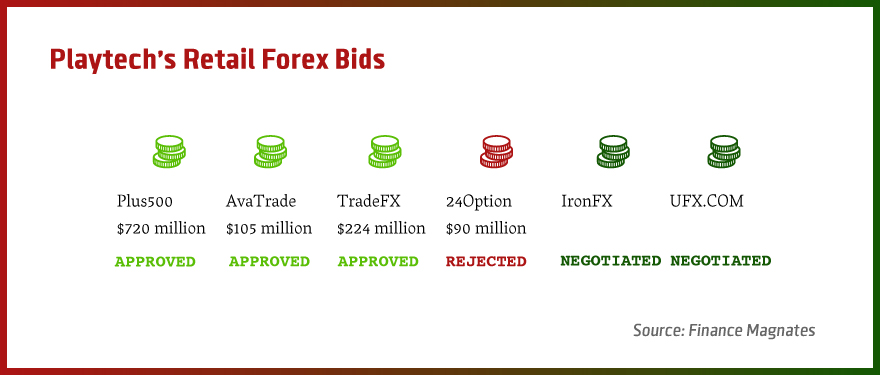
Omer Shvili explains that with the support of the gaming giant the brands have potential to attract a larger number of financial traders.
Playtech
Playtech's swift foray into the retail trading market may have come as a surprise to many industry insiders. But for the gaming giant, it was part of a clearly defined strategy. "Playtech has a stated strategy to acquire profitable, regulated, highly cash generative businesses with market-leading positions," says Ron Hoffman, Playtech veteran and newly appointed CEO of TradeFX.
These synergies are believed to be the future growth model for this business segment for the company. According to Hoffman, “The financial space is driven by the same core competencies, and therefore Playtech can leverage its expertise in the areas of technology, marketing and customer retention, and enjoy its extensive operational and financial backbone.”
“The recent acquisition of TradeFX has given Playtech immediate access to this vertical through scale and position and is a natural aggregator of businesses within this sector,” he elaborated.
Greasing Plus500's Marketing Machine
Ron Hoffman
The dramatic announcement about the bid for the ailing Plus500, including raising additional funds and acquiring a preliminary 9.36% stake of the firm, caught many off guard. Mr. Hoffman explains that on top of the above mentioned synergy and the opportunity created by the massive share drop, a major advantage for Playtech was its acquaintance with the Israeli-based FX and CFD broker.
“The team over at TradeFX has known Plus500 quite well for several years, and we had the advantage of being able to conduct extremely quick due diligence, which allowed us to take advantage of the unique opportunity that presented itself."
The team has known Plus500 quite well for several years, and we were able to conduct an extremely quick due diligence
In regards to the synergies with TradeFX, Mr. Hoffman cited, "While Plus500 has the industry leading marketing machine and mobile offering, TradeFX focused its technology development on CRM and retention tools." He added, "The combination of both technologies and products will create a best of breed offering, that will allow the group to out-convert all competitors, while maximizing customer lifetime value in the different markets it operates."
While seeing the two brokers' strongest capabilities as "complementary", Mr. Hoffman makes it clear that from a marketing perspective a fusion of them into a single mega-player will not make sense. "We see each of them having different market reach and intend to leverage the strength of these brands in their respective markets," he says.
One implication of this decision is the parallel high profile football partnerships of Markets.com and Plus500 (with Arsenal and Athletico Madrid respectively), the latter having just been extended. Despite the high profile and media attention these deals get, for Playtech the "vast majority of marketing spending is done, and will continue to be done, via online and mobile platforms, where the companies’ advanced technologies allow them to outperform the competition."
What Does Markets.com Brings to the Table?
Omer Shvili
The Markets.com brand has found a natural home under Playtech’s umbrella according to the broker’s founder, Omer Shvili. "Playtech’s ability to power retail financial businesses with the firm’s user acquisition and CRM capabilities, product expertise and scale, is putting the company into a position of strength," he said.
Our goal will always be on delivering shareholder value and would always look at the best possible way to maximize this
Elaborating on the broker's platform offering, Mr. Shvili commented on the Markets.com partnership with Leverate, “While it is still an available offering, it is becoming less relevant and supports only a small part of the activity as we are highly focused on our own in house solution.”
He also explained that forex has become less relevant when compared to the broad picture, as more clients have been interested in trading other asset classes such as commodities, indices, shares, etc. Mr. Shvili stated, “FX is still and will remain a key asset class going forward,” adding, "Our goal is to eventually offer CFDs on almost every available financial instrument that is quoted somewhere around the world. By increasing our product offering, we will make our service relevant to a bigger potential audience."
Is the Next IPO in the Making?
With the acquisition spree by Playtech turning heads across the industry and roll up of the multiple trading brands into one unit, it begs the question as to whether this is the prelude to a potential spinoff of the brokerage unit. Answering this, Mr. Hoffman explained that the company would rather focus on how to properly integrate the businesses it recently acquired to make use of the significant synergies that can be achieved throughout the process.
Nevertheless, Mr. Hoffman didn’t rule out anything, stating, “Our goal will always be on delivering shareholder value and would always look at the best possible way to maximize this.”
Future Synergies?
Looking at the future and in light of recent reports, Finance Magnates felt they had to ask Playtech’s executive about further deals in the pipeline. IronFX, struggling in the aftermath of a deposit withdrawals issue by numerous clients, was seen as a good fit for Playtech, which has committed to the retail financial trading industry.
We have already looked at several businesses on top of the ones we have made public, some of which have been picked up by the press
On this subject, Mr. Hoffman answered: "Following the recent acquisition of TradeFX, we would expect to be highly acquisitive as a natural aggregator in the Financials space, as evidenced by the recent offers for Plus500 and AvaTrade. We have already looked at several businesses on top of the ones we have made public, some of which have been picked up by the press, and we will continue to look at other similar businesses."
Playtech's swift foray into the retail trading market may have come as a surprise to many industry insiders. But for the gaming giant, it was part of a clearly defined strategy. "Playtech has a stated strategy to acquire profitable, regulated, highly cash generative businesses with market-leading positions," says Ron Hoffman, Playtech veteran and newly appointed CEO of TradeFX.
These synergies are believed to be the future growth model for this business segment for the company. According to Hoffman, “The financial space is driven by the same core competencies, and therefore Playtech can leverage its expertise in the areas of technology, marketing and customer retention, and enjoy its extensive operational and financial backbone.”
“The recent acquisition of TradeFX has given Playtech immediate access to this vertical through scale and position and is a natural aggregator of businesses within this sector,” he elaborated.
Greasing Plus500's Marketing Machine
Ron Hoffman
The dramatic announcement about the bid for the ailing Plus500, including raising additional funds and acquiring a preliminary 9.36% stake of the firm, caught many off guard. Mr. Hoffman explains that on top of the above mentioned synergy and the opportunity created by the massive share drop, a major advantage for Playtech was its acquaintance with the Israeli-based FX and CFD broker.
“The team over at TradeFX has known Plus500 quite well for several years, and we had the advantage of being able to conduct extremely quick due diligence, which allowed us to take advantage of the unique opportunity that presented itself."
The team has known Plus500 quite well for several years, and we were able to conduct an extremely quick due diligence
In regards to the synergies with TradeFX, Mr. Hoffman cited, "While Plus500 has the industry leading marketing machine and mobile offering, TradeFX focused its technology development on CRM and retention tools." He added, "The combination of both technologies and products will create a best of breed offering, that will allow the group to out-convert all competitors, while maximizing customer lifetime value in the different markets it operates."
While seeing the two brokers' strongest capabilities as "complementary", Mr. Hoffman makes it clear that from a marketing perspective a fusion of them into a single mega-player will not make sense. "We see each of them having different market reach and intend to leverage the strength of these brands in their respective markets," he says.
One implication of this decision is the parallel high profile football partnerships of Markets.com and Plus500 (with Arsenal and Athletico Madrid respectively), the latter having just been extended. Despite the high profile and media attention these deals get, for Playtech the "vast majority of marketing spending is done, and will continue to be done, via online and mobile platforms, where the companies’ advanced technologies allow them to outperform the competition."
What Does Markets.com Brings to the Table?
Omer Shvili
The Markets.com brand has found a natural home under Playtech’s umbrella according to the broker’s founder, Omer Shvili. "Playtech’s ability to power retail financial businesses with the firm’s user acquisition and CRM capabilities, product expertise and scale, is putting the company into a position of strength," he said.
Our goal will always be on delivering shareholder value and would always look at the best possible way to maximize this
Elaborating on the broker's platform offering, Mr. Shvili commented on the Markets.com partnership with Leverate, “While it is still an available offering, it is becoming less relevant and supports only a small part of the activity as we are highly focused on our own in house solution.”
He also explained that forex has become less relevant when compared to the broad picture, as more clients have been interested in trading other asset classes such as commodities, indices, shares, etc. Mr. Shvili stated, “FX is still and will remain a key asset class going forward,” adding, "Our goal is to eventually offer CFDs on almost every available financial instrument that is quoted somewhere around the world. By increasing our product offering, we will make our service relevant to a bigger potential audience."
Is the Next IPO in the Making?
With the acquisition spree by Playtech turning heads across the industry and roll up of the multiple trading brands into one unit, it begs the question as to whether this is the prelude to a potential spinoff of the brokerage unit. Answering this, Mr. Hoffman explained that the company would rather focus on how to properly integrate the businesses it recently acquired to make use of the significant synergies that can be achieved throughout the process.
Nevertheless, Mr. Hoffman didn’t rule out anything, stating, “Our goal will always be on delivering shareholder value and would always look at the best possible way to maximize this.”
Future Synergies?
Looking at the future and in light of recent reports, Finance Magnates felt they had to ask Playtech’s executive about further deals in the pipeline. IronFX, struggling in the aftermath of a deposit withdrawals issue by numerous clients, was seen as a good fit for Playtech, which has committed to the retail financial trading industry.
We have already looked at several businesses on top of the ones we have made public, some of which have been picked up by the press
On this subject, Mr. Hoffman answered: "Following the recent acquisition of TradeFX, we would expect to be highly acquisitive as a natural aggregator in the Financials space, as evidenced by the recent offers for Plus500 and AvaTrade. We have already looked at several businesses on top of the ones we have made public, some of which have been picked up by the press, and we will continue to look at other similar businesses."
iFOREX Adds Saudi and South Korean Equity CFDs as IPO Is Delayed
Featured Videos
Executive Interview | Charlotte Bullock | Chief Product Officer, Bank of London | FMLS:25
In this interview, we sat down with Charlotte Bullock, Head of Product at The Bank of London, previously at SAP and now shaping product at one of the sector’s most ambitious new banking players.
Charlotte reflects on the Summit so far and talks about the culture inside fintech banks today. We look at the pressures that come with scaling, and how firms can hold onto the nimble approach that made them stand out early on.
We also cover the state of payments ahead of her appearance on the payments roundtable: the blockages financial firms face, the areas that still need fixing, and what a realistic solution looks like in 2026.
In this interview, we sat down with Charlotte Bullock, Head of Product at The Bank of London, previously at SAP and now shaping product at one of the sector’s most ambitious new banking players.
Charlotte reflects on the Summit so far and talks about the culture inside fintech banks today. We look at the pressures that come with scaling, and how firms can hold onto the nimble approach that made them stand out early on.
We also cover the state of payments ahead of her appearance on the payments roundtable: the blockages financial firms face, the areas that still need fixing, and what a realistic solution looks like in 2026.
In this interview, we sat down with Charlotte Bullock, Head of Product at The Bank of London, previously at SAP and now shaping product at one of the sector’s most ambitious new banking players.
Charlotte reflects on the Summit so far and talks about the culture inside fintech banks today. We look at the pressures that come with scaling, and how firms can hold onto the nimble approach that made them stand out early on.
We also cover the state of payments ahead of her appearance on the payments roundtable: the blockages financial firms face, the areas that still need fixing, and what a realistic solution looks like in 2026.
In this interview, we sat down with Charlotte Bullock, Head of Product at The Bank of London, previously at SAP and now shaping product at one of the sector’s most ambitious new banking players.
Charlotte reflects on the Summit so far and talks about the culture inside fintech banks today. We look at the pressures that come with scaling, and how firms can hold onto the nimble approach that made them stand out early on.
We also cover the state of payments ahead of her appearance on the payments roundtable: the blockages financial firms face, the areas that still need fixing, and what a realistic solution looks like in 2026.
In this conversation, we sit down with Drew Niv, CSO at ATFX Connect and one of the most influential figures in modern FX.
We speak about market structure, the institutional view on liquidity, and the sharp rise of prop trading, a sector Drew has been commenting on in recent months. Drew explains why he once dismissed prop trading, why his view changed, and what he now thinks the model means for brokers, clients and risk managers.
We explore subscription-fee dependency, the high reneging rate, and the long-term challenge: how brokers can build a more stable and honest version of the model. Drew also talks about the traffic advantage standalone prop firms have built and why brokers may still win in the long run if they take the right approach.
In this conversation, we sit down with Drew Niv, CSO at ATFX Connect and one of the most influential figures in modern FX.
We speak about market structure, the institutional view on liquidity, and the sharp rise of prop trading, a sector Drew has been commenting on in recent months. Drew explains why he once dismissed prop trading, why his view changed, and what he now thinks the model means for brokers, clients and risk managers.
We explore subscription-fee dependency, the high reneging rate, and the long-term challenge: how brokers can build a more stable and honest version of the model. Drew also talks about the traffic advantage standalone prop firms have built and why brokers may still win in the long run if they take the right approach.
In this conversation, we sit down with Drew Niv, CSO at ATFX Connect and one of the most influential figures in modern FX.
We speak about market structure, the institutional view on liquidity, and the sharp rise of prop trading, a sector Drew has been commenting on in recent months. Drew explains why he once dismissed prop trading, why his view changed, and what he now thinks the model means for brokers, clients and risk managers.
We explore subscription-fee dependency, the high reneging rate, and the long-term challenge: how brokers can build a more stable and honest version of the model. Drew also talks about the traffic advantage standalone prop firms have built and why brokers may still win in the long run if they take the right approach.
In this conversation, we sit down with Drew Niv, CSO at ATFX Connect and one of the most influential figures in modern FX.
We speak about market structure, the institutional view on liquidity, and the sharp rise of prop trading, a sector Drew has been commenting on in recent months. Drew explains why he once dismissed prop trading, why his view changed, and what he now thinks the model means for brokers, clients and risk managers.
We explore subscription-fee dependency, the high reneging rate, and the long-term challenge: how brokers can build a more stable and honest version of the model. Drew also talks about the traffic advantage standalone prop firms have built and why brokers may still win in the long run if they take the right approach.
In this conversation, we sit down with Drew Niv, CSO at ATFX Connect and one of the most influential figures in modern FX.
We speak about market structure, the institutional view on liquidity, and the sharp rise of prop trading, a sector Drew has been commenting on in recent months. Drew explains why he once dismissed prop trading, why his view changed, and what he now thinks the model means for brokers, clients and risk managers.
We explore subscription-fee dependency, the high reneging rate, and the long-term challenge: how brokers can build a more stable and honest version of the model. Drew also talks about the traffic advantage standalone prop firms have built and why brokers may still win in the long run if they take the right approach.
In this conversation, we sit down with Drew Niv, CSO at ATFX Connect and one of the most influential figures in modern FX.
We speak about market structure, the institutional view on liquidity, and the sharp rise of prop trading, a sector Drew has been commenting on in recent months. Drew explains why he once dismissed prop trading, why his view changed, and what he now thinks the model means for brokers, clients and risk managers.
We explore subscription-fee dependency, the high reneging rate, and the long-term challenge: how brokers can build a more stable and honest version of the model. Drew also talks about the traffic advantage standalone prop firms have built and why brokers may still win in the long run if they take the right approach.
Executive Interview | Remonda Z. Kirketerp Møller| CEO & Founder Muinmos | FMLS:25
In this interview, Remonda Z. Kirketerp Møller, founder of Muinmos, breaks down the state of AI in regtech and what responsible adoption really looks like for brokers. We talk about rising fragmentation, the pressures around compliance accuracy, and why most firms are still in the early stages of AI maturity.
Ramanda also shares insights on regulator sandboxes, shifting expectations around accountability, and the current reality of MiCA licensing and passporting in Europe.
A concise look at where compliance, onboarding, and AI-driven processes are heading next.
In this interview, Remonda Z. Kirketerp Møller, founder of Muinmos, breaks down the state of AI in regtech and what responsible adoption really looks like for brokers. We talk about rising fragmentation, the pressures around compliance accuracy, and why most firms are still in the early stages of AI maturity.
Ramanda also shares insights on regulator sandboxes, shifting expectations around accountability, and the current reality of MiCA licensing and passporting in Europe.
A concise look at where compliance, onboarding, and AI-driven processes are heading next.
In this interview, Remonda Z. Kirketerp Møller, founder of Muinmos, breaks down the state of AI in regtech and what responsible adoption really looks like for brokers. We talk about rising fragmentation, the pressures around compliance accuracy, and why most firms are still in the early stages of AI maturity.
Ramanda also shares insights on regulator sandboxes, shifting expectations around accountability, and the current reality of MiCA licensing and passporting in Europe.
A concise look at where compliance, onboarding, and AI-driven processes are heading next.
In this interview, Remonda Z. Kirketerp Møller, founder of Muinmos, breaks down the state of AI in regtech and what responsible adoption really looks like for brokers. We talk about rising fragmentation, the pressures around compliance accuracy, and why most firms are still in the early stages of AI maturity.
Ramanda also shares insights on regulator sandboxes, shifting expectations around accountability, and the current reality of MiCA licensing and passporting in Europe.
A concise look at where compliance, onboarding, and AI-driven processes are heading next.
In this interview, Remonda Z. Kirketerp Møller, founder of Muinmos, breaks down the state of AI in regtech and what responsible adoption really looks like for brokers. We talk about rising fragmentation, the pressures around compliance accuracy, and why most firms are still in the early stages of AI maturity.
Ramanda also shares insights on regulator sandboxes, shifting expectations around accountability, and the current reality of MiCA licensing and passporting in Europe.
A concise look at where compliance, onboarding, and AI-driven processes are heading next.
In this interview, Remonda Z. Kirketerp Møller, founder of Muinmos, breaks down the state of AI in regtech and what responsible adoption really looks like for brokers. We talk about rising fragmentation, the pressures around compliance accuracy, and why most firms are still in the early stages of AI maturity.
Ramanda also shares insights on regulator sandboxes, shifting expectations around accountability, and the current reality of MiCA licensing and passporting in Europe.
A concise look at where compliance, onboarding, and AI-driven processes are heading next.
In this conversation, we speak with Aydin Bonabi, CEO and co-founder of Surveill, a firm focused on fraud detection and AI-driven compliance tools for financial institutions.
We start with Aydin’s view of the Summit and the challenges brokers face as fraud tactics grow more complex. He explains how firms can stay ahead through real-time signals, data patterns, and early-stage detection.
We also talk about AI training and why compliance teams often struggle to keep models accurate, fair, and aligned with regulatory expectations. Aydin breaks down what “good” AI training looks like inside a financial environment, including the importance of clean data, domain expertise, and human oversight.
He closes with a clear message: fraud is scaling, and so must the tools that stop it.
In this conversation, we speak with Aydin Bonabi, CEO and co-founder of Surveill, a firm focused on fraud detection and AI-driven compliance tools for financial institutions.
We start with Aydin’s view of the Summit and the challenges brokers face as fraud tactics grow more complex. He explains how firms can stay ahead through real-time signals, data patterns, and early-stage detection.
We also talk about AI training and why compliance teams often struggle to keep models accurate, fair, and aligned with regulatory expectations. Aydin breaks down what “good” AI training looks like inside a financial environment, including the importance of clean data, domain expertise, and human oversight.
He closes with a clear message: fraud is scaling, and so must the tools that stop it.
In this conversation, we speak with Aydin Bonabi, CEO and co-founder of Surveill, a firm focused on fraud detection and AI-driven compliance tools for financial institutions.
We start with Aydin’s view of the Summit and the challenges brokers face as fraud tactics grow more complex. He explains how firms can stay ahead through real-time signals, data patterns, and early-stage detection.
We also talk about AI training and why compliance teams often struggle to keep models accurate, fair, and aligned with regulatory expectations. Aydin breaks down what “good” AI training looks like inside a financial environment, including the importance of clean data, domain expertise, and human oversight.
He closes with a clear message: fraud is scaling, and so must the tools that stop it.
In this conversation, we speak with Aydin Bonabi, CEO and co-founder of Surveill, a firm focused on fraud detection and AI-driven compliance tools for financial institutions.
We start with Aydin’s view of the Summit and the challenges brokers face as fraud tactics grow more complex. He explains how firms can stay ahead through real-time signals, data patterns, and early-stage detection.
We also talk about AI training and why compliance teams often struggle to keep models accurate, fair, and aligned with regulatory expectations. Aydin breaks down what “good” AI training looks like inside a financial environment, including the importance of clean data, domain expertise, and human oversight.
He closes with a clear message: fraud is scaling, and so must the tools that stop it.
In this conversation, we speak with Aydin Bonabi, CEO and co-founder of Surveill, a firm focused on fraud detection and AI-driven compliance tools for financial institutions.
We start with Aydin’s view of the Summit and the challenges brokers face as fraud tactics grow more complex. He explains how firms can stay ahead through real-time signals, data patterns, and early-stage detection.
We also talk about AI training and why compliance teams often struggle to keep models accurate, fair, and aligned with regulatory expectations. Aydin breaks down what “good” AI training looks like inside a financial environment, including the importance of clean data, domain expertise, and human oversight.
He closes with a clear message: fraud is scaling, and so must the tools that stop it.
In this conversation, we speak with Aydin Bonabi, CEO and co-founder of Surveill, a firm focused on fraud detection and AI-driven compliance tools for financial institutions.
We start with Aydin’s view of the Summit and the challenges brokers face as fraud tactics grow more complex. He explains how firms can stay ahead through real-time signals, data patterns, and early-stage detection.
We also talk about AI training and why compliance teams often struggle to keep models accurate, fair, and aligned with regulatory expectations. Aydin breaks down what “good” AI training looks like inside a financial environment, including the importance of clean data, domain expertise, and human oversight.
He closes with a clear message: fraud is scaling, and so must the tools that stop it.
Exness expands its presence in Africa: Inside our interview with Paul Margarites in Cape Town
Finance Magnates met with Paul Margarites, Exness regional commercial director for Sub-Saharan Africa, during a visit to the firm’s office opening in Cape Town. In this talk, led by Andrea Badiola Mateos, Co-CEO at Finance Magnates, Paul shares views on the South African trading space, local user behavior, mobile trends, regulation, team growth, and how Exness plans to grow in more markets across the region. @Exness
Read the article at: https://www.financemagnates.com/thought-leadership/exness-expands-its-presence-in-africa-inside-our-interview-with-paul-margarites/
#exness #financemagnates #exnesstrading #CFDtrading #tradeonline #africanews #capetown
Finance Magnates met with Paul Margarites, Exness regional commercial director for Sub-Saharan Africa, during a visit to the firm’s office opening in Cape Town. In this talk, led by Andrea Badiola Mateos, Co-CEO at Finance Magnates, Paul shares views on the South African trading space, local user behavior, mobile trends, regulation, team growth, and how Exness plans to grow in more markets across the region. @Exness
Read the article at: https://www.financemagnates.com/thought-leadership/exness-expands-its-presence-in-africa-inside-our-interview-with-paul-margarites/
#exness #financemagnates #exnesstrading #CFDtrading #tradeonline #africanews #capetown
Finance Magnates met with Paul Margarites, Exness regional commercial director for Sub-Saharan Africa, during a visit to the firm’s office opening in Cape Town. In this talk, led by Andrea Badiola Mateos, Co-CEO at Finance Magnates, Paul shares views on the South African trading space, local user behavior, mobile trends, regulation, team growth, and how Exness plans to grow in more markets across the region. @Exness
Read the article at: https://www.financemagnates.com/thought-leadership/exness-expands-its-presence-in-africa-inside-our-interview-with-paul-margarites/
#exness #financemagnates #exnesstrading #CFDtrading #tradeonline #africanews #capetown
Finance Magnates met with Paul Margarites, Exness regional commercial director for Sub-Saharan Africa, during a visit to the firm’s office opening in Cape Town. In this talk, led by Andrea Badiola Mateos, Co-CEO at Finance Magnates, Paul shares views on the South African trading space, local user behavior, mobile trends, regulation, team growth, and how Exness plans to grow in more markets across the region. @Exness
Read the article at: https://www.financemagnates.com/thought-leadership/exness-expands-its-presence-in-africa-inside-our-interview-with-paul-margarites/
#exness #financemagnates #exnesstrading #CFDtrading #tradeonline #africanews #capetown
Finance Magnates met with Paul Margarites, Exness regional commercial director for Sub-Saharan Africa, during a visit to the firm’s office opening in Cape Town. In this talk, led by Andrea Badiola Mateos, Co-CEO at Finance Magnates, Paul shares views on the South African trading space, local user behavior, mobile trends, regulation, team growth, and how Exness plans to grow in more markets across the region. @Exness
Read the article at: https://www.financemagnates.com/thought-leadership/exness-expands-its-presence-in-africa-inside-our-interview-with-paul-margarites/
#exness #financemagnates #exnesstrading #CFDtrading #tradeonline #africanews #capetown
Finance Magnates met with Paul Margarites, Exness regional commercial director for Sub-Saharan Africa, during a visit to the firm’s office opening in Cape Town. In this talk, led by Andrea Badiola Mateos, Co-CEO at Finance Magnates, Paul shares views on the South African trading space, local user behavior, mobile trends, regulation, team growth, and how Exness plans to grow in more markets across the region. @Exness
Read the article at: https://www.financemagnates.com/thought-leadership/exness-expands-its-presence-in-africa-inside-our-interview-with-paul-margarites/
#exness #financemagnates #exnesstrading #CFDtrading #tradeonline #africanews #capetown