The company is looking to expand its business at a time when the importance of the balance sheet of counterparts to brokers, banks and funds has become one of the key selling points. CMC Markets will be delivering its institutional offering via a new API technology, which is designed to meet the needs of most industry participants.
The company’s institutional team is active in about 20 markets worldwide and is headquartered in London. After the firm hired Richard Elston as Head of Institutional in July 2015, the strategic objective of the firm has become to extend the global footprint of the institutional business of CMC Markets.
A Tiered Rollout Starting with CFDs
Speaking to Finance Magnates, the Head of Institutional at CMC Markets, Richard Elston, explained that the firm has decided to start its official rollout with CFDs (contracts for difference) first and expand into FX and beyond later.
“While the API does carry FX, we are keen to promote the CFD side of the business at the moment. Given the fact that we have just gone through an IPO and our market cap is over £700 million, we believe that CMC Markets is in an advantageous position as a leading brokerage and a reliable counterpart in the market,” Elston said.
With a large list of clients globally, CMC Markets is actively taking advantage of becoming a publicly traded company. The capitalization of the brokerage can be a factor when financial institutions are choosing a reliable counterpart. Last week, the shares of the company closed on Friday with the valuation of the firm reaching £777 million ($1.12 billion).
CMC Markets’ sees its API as a growth opportunity for the firm both among its core institutional client base and for the hedge fund market. In addition to the API, CMC Markets has a suite of institutional products, including a Grey Label solution for introducing brokers, and a White Label market counterparty solution for larger banks and brokers.
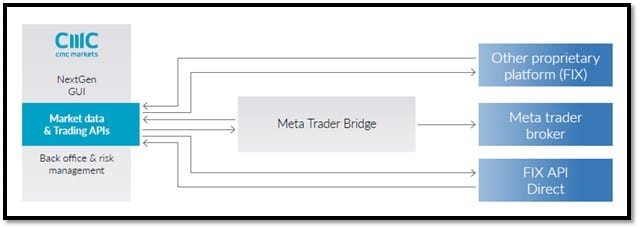
How CMC Markets' technology works
The company’s initial focus is on API connectivity across the UK, Europe, Latin America and Asia. CMC Markets will also be working on consolidating markets for the Grey and White Label products mentioned above. With the scope of the company extending further, Elston plans to turn his attention to developing tailored propositions for asset managers and hedge funds.
Elaborating on the perks of the offering of CMC Markets, Elston said: “Another element of the offering is market data - we are delivering it with transparency and legal clarity. As a reliable partner we guarantee to protect the owners of intellectual property behind any derived market data we distribute it.”
The company has already started to deliver its institutional product to several clients, with about 9 already active. CMC Markets is the counterparty to all trades which in itself is important, since clients can rely on the fact that the firm is FCA regulated and solidly capitalized as its market cap suggests.
CMC’s Liquidity for CFDs at a Glance
Elston shared with Finance Magnates that the firm is going to deliver a broad range if CFDs to its institutional clients, however for the time being there will be no single stock contracts.
“We are offering a solution that includes a broad range of OTC instruments. The list includes indices, commodities, treasuries and where available they are both delivered as cash and as futures derived variants. We are providing the broadest range of CFD contracts available to our potential clients, with the offering including not only globally popular instruments, but also specific local contracts,” Elston explained.
Connectivity and the Post-SNB Industry Challenge
The company is offering a FIX API solution which is pretty standard with the product already being plumbed into the major MT4 bridges, the Head of Institutional at CMC Markets explained.
Asked about the main reasons to bring the product to the market now, Elston said: “We think there is a mid-market gap out there and while there are other players and peers that have entered into this space over the course of the last few years the mid-market gap has become more apparent in the wake of the SNB.”
“We think that our technology reputation and our financial strength will spark interest in the FX product that we are planning to launch later this year which is specifically designed to fill the mid-market gap. Our financial stability will be a great positive for CMC Markets as a counterparty,” he concluded.
Looking at the spreads, the offering of CMC Markets looks quite competitive with the Dow Jones index price being delivered at a spread of 1.4 points. Should the company manage to implement these tight rates all across the offering, its expansion into FX and single stock CFDs in the future could make CMC Markets one of the main competitors in the industry.
The company is looking to expand its business at a time when the importance of the balance sheet of counterparts to brokers, banks and funds has become one of the key selling points. CMC Markets will be delivering its institutional offering via a new API technology, which is designed to meet the needs of most industry participants.
The company’s institutional team is active in about 20 markets worldwide and is headquartered in London. After the firm hired Richard Elston as Head of Institutional in July 2015, the strategic objective of the firm has become to extend the global footprint of the institutional business of CMC Markets.
A Tiered Rollout Starting with CFDs
Speaking to Finance Magnates, the Head of Institutional at CMC Markets, Richard Elston, explained that the firm has decided to start its official rollout with CFDs (contracts for difference) first and expand into FX and beyond later.
“While the API does carry FX, we are keen to promote the CFD side of the business at the moment. Given the fact that we have just gone through an IPO and our market cap is over £700 million, we believe that CMC Markets is in an advantageous position as a leading brokerage and a reliable counterpart in the market,” Elston said.
With a large list of clients globally, CMC Markets is actively taking advantage of becoming a publicly traded company. The capitalization of the brokerage can be a factor when financial institutions are choosing a reliable counterpart. Last week, the shares of the company closed on Friday with the valuation of the firm reaching £777 million ($1.12 billion).
CMC Markets’ sees its API as a growth opportunity for the firm both among its core institutional client base and for the hedge fund market. In addition to the API, CMC Markets has a suite of institutional products, including a Grey Label solution for introducing brokers, and a White Label market counterparty solution for larger banks and brokers.
How CMC Markets' technology works
The company’s initial focus is on API connectivity across the UK, Europe, Latin America and Asia. CMC Markets will also be working on consolidating markets for the Grey and White Label products mentioned above. With the scope of the company extending further, Elston plans to turn his attention to developing tailored propositions for asset managers and hedge funds.
Elaborating on the perks of the offering of CMC Markets, Elston said: “Another element of the offering is market data - we are delivering it with transparency and legal clarity. As a reliable partner we guarantee to protect the owners of intellectual property behind any derived market data we distribute it.”
The company has already started to deliver its institutional product to several clients, with about 9 already active. CMC Markets is the counterparty to all trades which in itself is important, since clients can rely on the fact that the firm is FCA regulated and solidly capitalized as its market cap suggests.
CMC’s Liquidity for CFDs at a Glance
Elston shared with Finance Magnates that the firm is going to deliver a broad range if CFDs to its institutional clients, however for the time being there will be no single stock contracts.
“We are offering a solution that includes a broad range of OTC instruments. The list includes indices, commodities, treasuries and where available they are both delivered as cash and as futures derived variants. We are providing the broadest range of CFD contracts available to our potential clients, with the offering including not only globally popular instruments, but also specific local contracts,” Elston explained.
Connectivity and the Post-SNB Industry Challenge
The company is offering a FIX API solution which is pretty standard with the product already being plumbed into the major MT4 bridges, the Head of Institutional at CMC Markets explained.
Asked about the main reasons to bring the product to the market now, Elston said: “We think there is a mid-market gap out there and while there are other players and peers that have entered into this space over the course of the last few years the mid-market gap has become more apparent in the wake of the SNB.”
“We think that our technology reputation and our financial strength will spark interest in the FX product that we are planning to launch later this year which is specifically designed to fill the mid-market gap. Our financial stability will be a great positive for CMC Markets as a counterparty,” he concluded.
Looking at the spreads, the offering of CMC Markets looks quite competitive with the Dow Jones index price being delivered at a spread of 1.4 points. Should the company manage to implement these tight rates all across the offering, its expansion into FX and single stock CFDs in the future could make CMC Markets one of the main competitors in the industry.
Retail Trading & Prop Firms in 2025: Five Defining Trends - And One Prediction for 2026
Featured Videos
Executive Interview | Charlotte Bullock | Chief Product Officer, Bank of London | FMLS:25
In this interview, we sat down with Charlotte Bullock, Head of Product at The Bank of London, previously at SAP and now shaping product at one of the sector’s most ambitious new banking players.
Charlotte reflects on the Summit so far and talks about the culture inside fintech banks today. We look at the pressures that come with scaling, and how firms can hold onto the nimble approach that made them stand out early on.
We also cover the state of payments ahead of her appearance on the payments roundtable: the blockages financial firms face, the areas that still need fixing, and what a realistic solution looks like in 2026.
In this interview, we sat down with Charlotte Bullock, Head of Product at The Bank of London, previously at SAP and now shaping product at one of the sector’s most ambitious new banking players.
Charlotte reflects on the Summit so far and talks about the culture inside fintech banks today. We look at the pressures that come with scaling, and how firms can hold onto the nimble approach that made them stand out early on.
We also cover the state of payments ahead of her appearance on the payments roundtable: the blockages financial firms face, the areas that still need fixing, and what a realistic solution looks like in 2026.
In this interview, we sat down with Charlotte Bullock, Head of Product at The Bank of London, previously at SAP and now shaping product at one of the sector’s most ambitious new banking players.
Charlotte reflects on the Summit so far and talks about the culture inside fintech banks today. We look at the pressures that come with scaling, and how firms can hold onto the nimble approach that made them stand out early on.
We also cover the state of payments ahead of her appearance on the payments roundtable: the blockages financial firms face, the areas that still need fixing, and what a realistic solution looks like in 2026.
In this interview, we sat down with Charlotte Bullock, Head of Product at The Bank of London, previously at SAP and now shaping product at one of the sector’s most ambitious new banking players.
Charlotte reflects on the Summit so far and talks about the culture inside fintech banks today. We look at the pressures that come with scaling, and how firms can hold onto the nimble approach that made them stand out early on.
We also cover the state of payments ahead of her appearance on the payments roundtable: the blockages financial firms face, the areas that still need fixing, and what a realistic solution looks like in 2026.
In this conversation, we sit down with Drew Niv, CSO at ATFX Connect and one of the most influential figures in modern FX.
We speak about market structure, the institutional view on liquidity, and the sharp rise of prop trading, a sector Drew has been commenting on in recent months. Drew explains why he once dismissed prop trading, why his view changed, and what he now thinks the model means for brokers, clients and risk managers.
We explore subscription-fee dependency, the high reneging rate, and the long-term challenge: how brokers can build a more stable and honest version of the model. Drew also talks about the traffic advantage standalone prop firms have built and why brokers may still win in the long run if they take the right approach.
In this conversation, we sit down with Drew Niv, CSO at ATFX Connect and one of the most influential figures in modern FX.
We speak about market structure, the institutional view on liquidity, and the sharp rise of prop trading, a sector Drew has been commenting on in recent months. Drew explains why he once dismissed prop trading, why his view changed, and what he now thinks the model means for brokers, clients and risk managers.
We explore subscription-fee dependency, the high reneging rate, and the long-term challenge: how brokers can build a more stable and honest version of the model. Drew also talks about the traffic advantage standalone prop firms have built and why brokers may still win in the long run if they take the right approach.
In this conversation, we sit down with Drew Niv, CSO at ATFX Connect and one of the most influential figures in modern FX.
We speak about market structure, the institutional view on liquidity, and the sharp rise of prop trading, a sector Drew has been commenting on in recent months. Drew explains why he once dismissed prop trading, why his view changed, and what he now thinks the model means for brokers, clients and risk managers.
We explore subscription-fee dependency, the high reneging rate, and the long-term challenge: how brokers can build a more stable and honest version of the model. Drew also talks about the traffic advantage standalone prop firms have built and why brokers may still win in the long run if they take the right approach.
In this conversation, we sit down with Drew Niv, CSO at ATFX Connect and one of the most influential figures in modern FX.
We speak about market structure, the institutional view on liquidity, and the sharp rise of prop trading, a sector Drew has been commenting on in recent months. Drew explains why he once dismissed prop trading, why his view changed, and what he now thinks the model means for brokers, clients and risk managers.
We explore subscription-fee dependency, the high reneging rate, and the long-term challenge: how brokers can build a more stable and honest version of the model. Drew also talks about the traffic advantage standalone prop firms have built and why brokers may still win in the long run if they take the right approach.
In this conversation, we sit down with Drew Niv, CSO at ATFX Connect and one of the most influential figures in modern FX.
We speak about market structure, the institutional view on liquidity, and the sharp rise of prop trading, a sector Drew has been commenting on in recent months. Drew explains why he once dismissed prop trading, why his view changed, and what he now thinks the model means for brokers, clients and risk managers.
We explore subscription-fee dependency, the high reneging rate, and the long-term challenge: how brokers can build a more stable and honest version of the model. Drew also talks about the traffic advantage standalone prop firms have built and why brokers may still win in the long run if they take the right approach.
In this conversation, we sit down with Drew Niv, CSO at ATFX Connect and one of the most influential figures in modern FX.
We speak about market structure, the institutional view on liquidity, and the sharp rise of prop trading, a sector Drew has been commenting on in recent months. Drew explains why he once dismissed prop trading, why his view changed, and what he now thinks the model means for brokers, clients and risk managers.
We explore subscription-fee dependency, the high reneging rate, and the long-term challenge: how brokers can build a more stable and honest version of the model. Drew also talks about the traffic advantage standalone prop firms have built and why brokers may still win in the long run if they take the right approach.
Executive Interview | Remonda Z. Kirketerp Møller| CEO & Founder Muinmos | FMLS:25
In this interview, Remonda Z. Kirketerp Møller, founder of Muinmos, breaks down the state of AI in regtech and what responsible adoption really looks like for brokers. We talk about rising fragmentation, the pressures around compliance accuracy, and why most firms are still in the early stages of AI maturity.
Ramanda also shares insights on regulator sandboxes, shifting expectations around accountability, and the current reality of MiCA licensing and passporting in Europe.
A concise look at where compliance, onboarding, and AI-driven processes are heading next.
In this interview, Remonda Z. Kirketerp Møller, founder of Muinmos, breaks down the state of AI in regtech and what responsible adoption really looks like for brokers. We talk about rising fragmentation, the pressures around compliance accuracy, and why most firms are still in the early stages of AI maturity.
Ramanda also shares insights on regulator sandboxes, shifting expectations around accountability, and the current reality of MiCA licensing and passporting in Europe.
A concise look at where compliance, onboarding, and AI-driven processes are heading next.
In this interview, Remonda Z. Kirketerp Møller, founder of Muinmos, breaks down the state of AI in regtech and what responsible adoption really looks like for brokers. We talk about rising fragmentation, the pressures around compliance accuracy, and why most firms are still in the early stages of AI maturity.
Ramanda also shares insights on regulator sandboxes, shifting expectations around accountability, and the current reality of MiCA licensing and passporting in Europe.
A concise look at where compliance, onboarding, and AI-driven processes are heading next.
In this interview, Remonda Z. Kirketerp Møller, founder of Muinmos, breaks down the state of AI in regtech and what responsible adoption really looks like for brokers. We talk about rising fragmentation, the pressures around compliance accuracy, and why most firms are still in the early stages of AI maturity.
Ramanda also shares insights on regulator sandboxes, shifting expectations around accountability, and the current reality of MiCA licensing and passporting in Europe.
A concise look at where compliance, onboarding, and AI-driven processes are heading next.
In this interview, Remonda Z. Kirketerp Møller, founder of Muinmos, breaks down the state of AI in regtech and what responsible adoption really looks like for brokers. We talk about rising fragmentation, the pressures around compliance accuracy, and why most firms are still in the early stages of AI maturity.
Ramanda also shares insights on regulator sandboxes, shifting expectations around accountability, and the current reality of MiCA licensing and passporting in Europe.
A concise look at where compliance, onboarding, and AI-driven processes are heading next.
In this interview, Remonda Z. Kirketerp Møller, founder of Muinmos, breaks down the state of AI in regtech and what responsible adoption really looks like for brokers. We talk about rising fragmentation, the pressures around compliance accuracy, and why most firms are still in the early stages of AI maturity.
Ramanda also shares insights on regulator sandboxes, shifting expectations around accountability, and the current reality of MiCA licensing and passporting in Europe.
A concise look at where compliance, onboarding, and AI-driven processes are heading next.
In this conversation, we speak with Aydin Bonabi, CEO and co-founder of Surveill, a firm focused on fraud detection and AI-driven compliance tools for financial institutions.
We start with Aydin’s view of the Summit and the challenges brokers face as fraud tactics grow more complex. He explains how firms can stay ahead through real-time signals, data patterns, and early-stage detection.
We also talk about AI training and why compliance teams often struggle to keep models accurate, fair, and aligned with regulatory expectations. Aydin breaks down what “good” AI training looks like inside a financial environment, including the importance of clean data, domain expertise, and human oversight.
He closes with a clear message: fraud is scaling, and so must the tools that stop it.
In this conversation, we speak with Aydin Bonabi, CEO and co-founder of Surveill, a firm focused on fraud detection and AI-driven compliance tools for financial institutions.
We start with Aydin’s view of the Summit and the challenges brokers face as fraud tactics grow more complex. He explains how firms can stay ahead through real-time signals, data patterns, and early-stage detection.
We also talk about AI training and why compliance teams often struggle to keep models accurate, fair, and aligned with regulatory expectations. Aydin breaks down what “good” AI training looks like inside a financial environment, including the importance of clean data, domain expertise, and human oversight.
He closes with a clear message: fraud is scaling, and so must the tools that stop it.
In this conversation, we speak with Aydin Bonabi, CEO and co-founder of Surveill, a firm focused on fraud detection and AI-driven compliance tools for financial institutions.
We start with Aydin’s view of the Summit and the challenges brokers face as fraud tactics grow more complex. He explains how firms can stay ahead through real-time signals, data patterns, and early-stage detection.
We also talk about AI training and why compliance teams often struggle to keep models accurate, fair, and aligned with regulatory expectations. Aydin breaks down what “good” AI training looks like inside a financial environment, including the importance of clean data, domain expertise, and human oversight.
He closes with a clear message: fraud is scaling, and so must the tools that stop it.
In this conversation, we speak with Aydin Bonabi, CEO and co-founder of Surveill, a firm focused on fraud detection and AI-driven compliance tools for financial institutions.
We start with Aydin’s view of the Summit and the challenges brokers face as fraud tactics grow more complex. He explains how firms can stay ahead through real-time signals, data patterns, and early-stage detection.
We also talk about AI training and why compliance teams often struggle to keep models accurate, fair, and aligned with regulatory expectations. Aydin breaks down what “good” AI training looks like inside a financial environment, including the importance of clean data, domain expertise, and human oversight.
He closes with a clear message: fraud is scaling, and so must the tools that stop it.
In this conversation, we speak with Aydin Bonabi, CEO and co-founder of Surveill, a firm focused on fraud detection and AI-driven compliance tools for financial institutions.
We start with Aydin’s view of the Summit and the challenges brokers face as fraud tactics grow more complex. He explains how firms can stay ahead through real-time signals, data patterns, and early-stage detection.
We also talk about AI training and why compliance teams often struggle to keep models accurate, fair, and aligned with regulatory expectations. Aydin breaks down what “good” AI training looks like inside a financial environment, including the importance of clean data, domain expertise, and human oversight.
He closes with a clear message: fraud is scaling, and so must the tools that stop it.
In this conversation, we speak with Aydin Bonabi, CEO and co-founder of Surveill, a firm focused on fraud detection and AI-driven compliance tools for financial institutions.
We start with Aydin’s view of the Summit and the challenges brokers face as fraud tactics grow more complex. He explains how firms can stay ahead through real-time signals, data patterns, and early-stage detection.
We also talk about AI training and why compliance teams often struggle to keep models accurate, fair, and aligned with regulatory expectations. Aydin breaks down what “good” AI training looks like inside a financial environment, including the importance of clean data, domain expertise, and human oversight.
He closes with a clear message: fraud is scaling, and so must the tools that stop it.
Exness expands its presence in Africa: Inside our interview with Paul Margarites in Cape Town
Finance Magnates met with Paul Margarites, Exness regional commercial director for Sub-Saharan Africa, during a visit to the firm’s office opening in Cape Town. In this talk, led by Andrea Badiola Mateos, Co-CEO at Finance Magnates, Paul shares views on the South African trading space, local user behavior, mobile trends, regulation, team growth, and how Exness plans to grow in more markets across the region. @Exness
Read the article at: https://www.financemagnates.com/thought-leadership/exness-expands-its-presence-in-africa-inside-our-interview-with-paul-margarites/
#exness #financemagnates #exnesstrading #CFDtrading #tradeonline #africanews #capetown
Finance Magnates met with Paul Margarites, Exness regional commercial director for Sub-Saharan Africa, during a visit to the firm’s office opening in Cape Town. In this talk, led by Andrea Badiola Mateos, Co-CEO at Finance Magnates, Paul shares views on the South African trading space, local user behavior, mobile trends, regulation, team growth, and how Exness plans to grow in more markets across the region. @Exness
Read the article at: https://www.financemagnates.com/thought-leadership/exness-expands-its-presence-in-africa-inside-our-interview-with-paul-margarites/
#exness #financemagnates #exnesstrading #CFDtrading #tradeonline #africanews #capetown
Finance Magnates met with Paul Margarites, Exness regional commercial director for Sub-Saharan Africa, during a visit to the firm’s office opening in Cape Town. In this talk, led by Andrea Badiola Mateos, Co-CEO at Finance Magnates, Paul shares views on the South African trading space, local user behavior, mobile trends, regulation, team growth, and how Exness plans to grow in more markets across the region. @Exness
Read the article at: https://www.financemagnates.com/thought-leadership/exness-expands-its-presence-in-africa-inside-our-interview-with-paul-margarites/
#exness #financemagnates #exnesstrading #CFDtrading #tradeonline #africanews #capetown
Finance Magnates met with Paul Margarites, Exness regional commercial director for Sub-Saharan Africa, during a visit to the firm’s office opening in Cape Town. In this talk, led by Andrea Badiola Mateos, Co-CEO at Finance Magnates, Paul shares views on the South African trading space, local user behavior, mobile trends, regulation, team growth, and how Exness plans to grow in more markets across the region. @Exness
Read the article at: https://www.financemagnates.com/thought-leadership/exness-expands-its-presence-in-africa-inside-our-interview-with-paul-margarites/
#exness #financemagnates #exnesstrading #CFDtrading #tradeonline #africanews #capetown
Finance Magnates met with Paul Margarites, Exness regional commercial director for Sub-Saharan Africa, during a visit to the firm’s office opening in Cape Town. In this talk, led by Andrea Badiola Mateos, Co-CEO at Finance Magnates, Paul shares views on the South African trading space, local user behavior, mobile trends, regulation, team growth, and how Exness plans to grow in more markets across the region. @Exness
Read the article at: https://www.financemagnates.com/thought-leadership/exness-expands-its-presence-in-africa-inside-our-interview-with-paul-margarites/
#exness #financemagnates #exnesstrading #CFDtrading #tradeonline #africanews #capetown
Finance Magnates met with Paul Margarites, Exness regional commercial director for Sub-Saharan Africa, during a visit to the firm’s office opening in Cape Town. In this talk, led by Andrea Badiola Mateos, Co-CEO at Finance Magnates, Paul shares views on the South African trading space, local user behavior, mobile trends, regulation, team growth, and how Exness plans to grow in more markets across the region. @Exness
Read the article at: https://www.financemagnates.com/thought-leadership/exness-expands-its-presence-in-africa-inside-our-interview-with-paul-margarites/
#exness #financemagnates #exnesstrading #CFDtrading #tradeonline #africanews #capetown