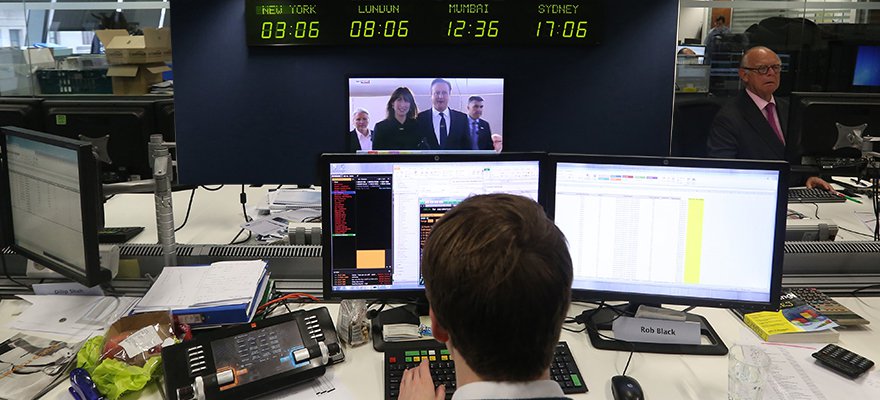
Following disappointing April rally, yen traders could yet get lucky in July ahead of the BoJ’s policy meeting.
Bloomberg
This article was written by John Benjamin, market analyst at Orbex.com.
The Japanese yen is at it again! Or rather yen speculators to be more precise. It has been an interesting year for yen traders, especially on the USD/JPY currency pair. To put it one way, it has been all about yen speculative positioning versus the Bank of Japan's monetary policy which started off early on in January this year.
The Bank of Japan stunned the markets in early January by cutting interest rates into negative at -0.10%. The US dollar, which had been steadily declining following the December 2015 rate hike from the Fed, briefly strengthened against the yen only to give up the gains just as quickly. After falling to lows of 106.277 yen by the end of March, the US dollar managed to retrace some of the gains by early May only to resume its declines yet again.
After the BoJ’s initial monetary policy salvo, speculators started paying special attention to the yen crosses, and this was seen at the height (or rather the trough) of the declines when in April, speculators rushed to offload their long yen positions ahead of the April’s BoJ monetary policy meeting. Thanks in large to the article by Bloomberg, the markets saw extreme positioning selling the yen, but it eventually caught traders by surprise as the Bank of Japan held monetary policy steady.
“Having adopted a negative interest rate on some excess reserves to penalize financial institutions for leaving money idle, the Bank of Japan may consider helping them lend by offering a negative rate on some loans, according to people familiar with talks at the BOJ.” ~ Bloomberg.com
The USD/JPY rally to local highs of 110.7 yen was short-lived with the pair quickly falling back below April’s lows of 106.277. BoJ Governor Kuroda maintained that the central bank was committed to achieving the 2% inflation target rate. The strong market positioning ahead of the event obviously fell through as a result.
"Pursuant to the Act, Treasury finds that no economy currently satisfies all three criteria, however, five major trading partners of the United States met two of the three criteria for enhanced analysis. Treasury is creating a new “Monitoring List” that includes these economies: China, Japan, Korea, Taiwan, and Germany." ~ US Treasury report on currency manipulation
The comments were in reference to the countries listed that were actively engaging in “one-sided intervention in the foreign exchange markets.”
The first chart below outlines the above timeline of events over the first 6 months of 2016.
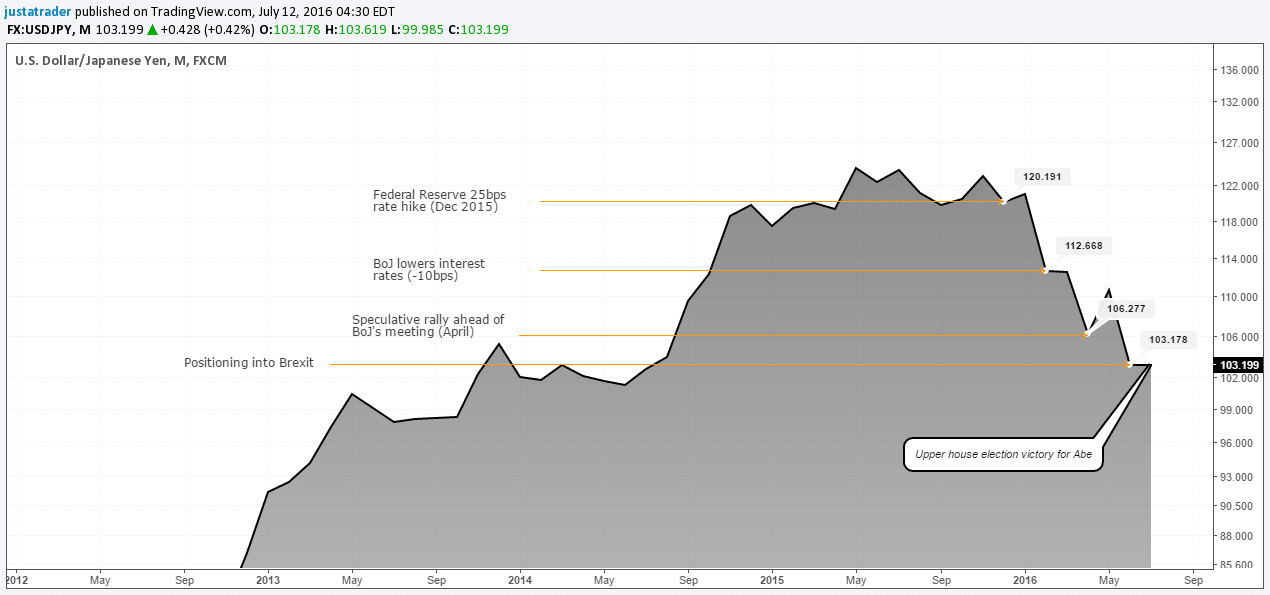
USDJPY, Monthly Chart – 2016 with timeline of events
Japanese yen – looking ahead
The latest fundamental catalyst behind the yen’s recent two day gains has been the weekend elections in Japan. Shinzo Abe’s Liberal Democratic Party (LDP) won with a decent majority in what some see as an approval for his Abenomics. While Abe had previously put off the proposed sales tax hike, he signaled that the government would be looking at launching fiscal stimulus measures.
The yen weakened by Monday’s close (11/07/2016). The Bank of Japan's monetary policy meeting is scheduled for July 28/29 and expectations start to mount once again that the Bank of Japan could pull the monetary policy trigger once more.
Indeed, this time, around, there is a higher chance that it could indeed act. The second quarter Tankan surveys for manufacturing and non-manufacturing showed an unchanged print. The BoJ's June Tankan survey showed that business conditions for large manufacturers in Japan were unchanged from 3 months ago at 6. The non-manufacturing survey deteriorated to 19 from the level of 22 a quarter ago. Businesses upped their forecasts for the yen at 111.41 yen to the dollar compared to previous forecasts of 117.46 yen.
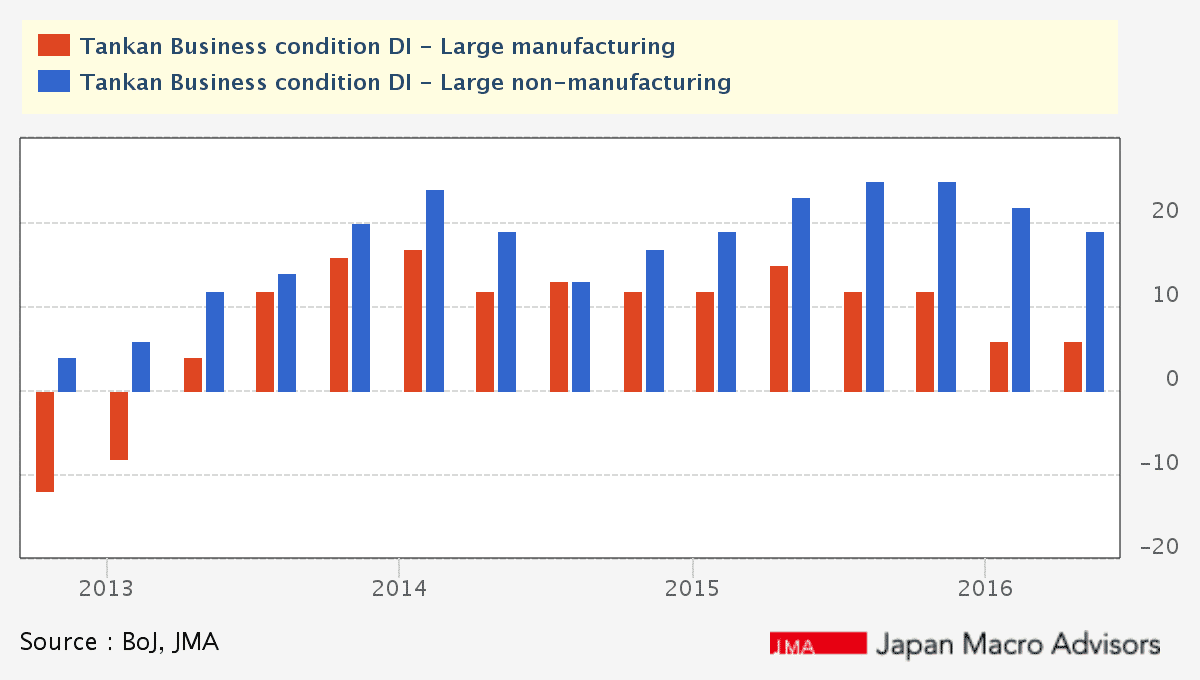
BoJ Tankan Survey, June 2016 (Source: Japan Macro Advisors)
Inflation also remained weak as of June’s reading for May. Japan’s core inflation fell 0.40% in May, compared to a year ago indicating that the underlying inflation continues to weaken.
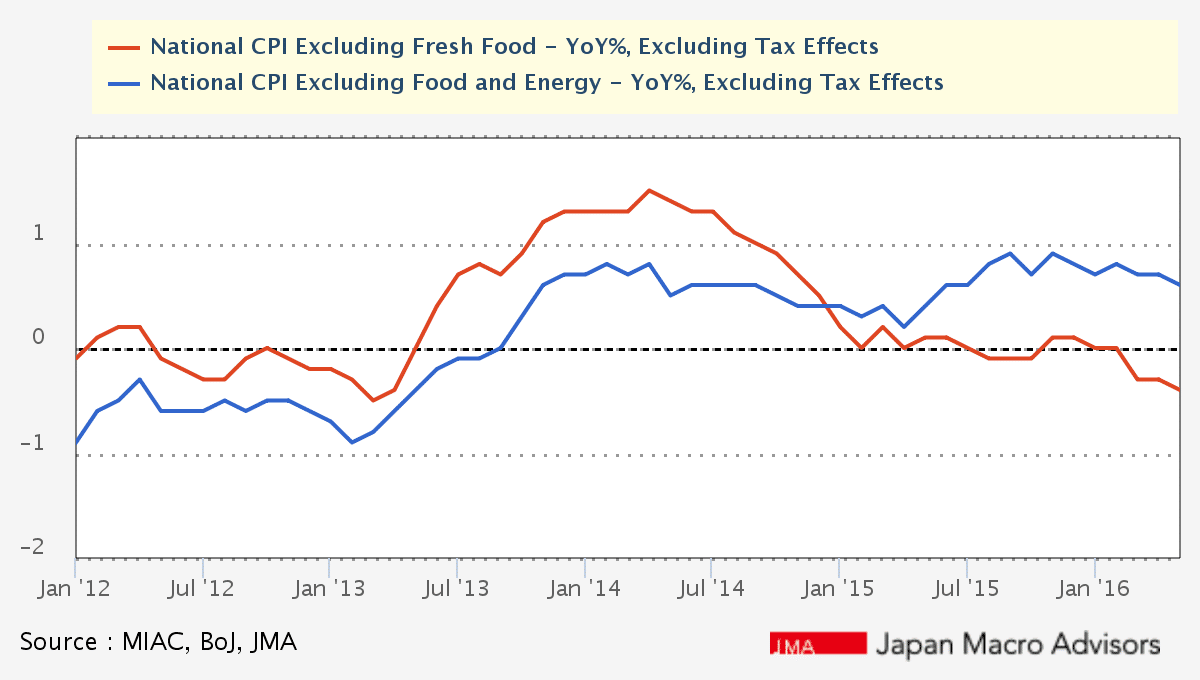
Japan National CPI y/y 0.40% (Source: Japan Macro Advisors)
With the uncertainty surrounding the Japan’s upper house elections done with, and the fact that there is some normalcy returning to the UK with news of Theresa May likely to become the UK’s next Prime Minister, the markets are likely to see a period of relative calm at least as far as the Brexit uncertainty surrounds.
From a technical perspective, USDJPY is currently showing signs of a strong recover from the lows of 99 – 100 seen during the Brexit verdict. In the near term, USDJPY is likely to remain to range within 104 – 106 and 102 levels with a potential breakout likely to come closer to the BoJ’s event. Following the breakout above 106, USDJPY clearly shows the potential for a rally towards 116 – 117 support level which held since late 2014 and was breached in February this year.
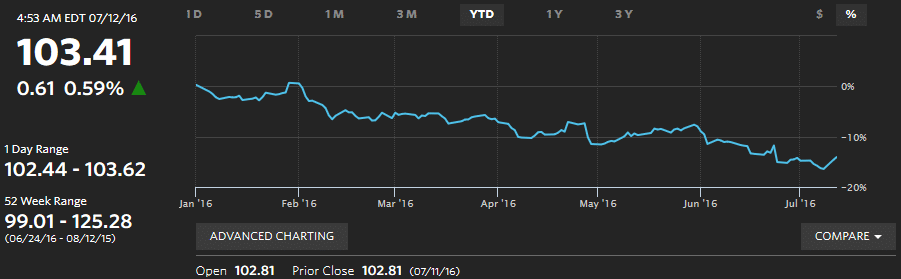
For a currency pair that has currently down around 14%, it wouldn’t be too surprising to find USDJPY regain some of its declines and perhaps close 2016 on a flat note.
This article was written by John Benjamin, market analyst at Orbex.com.
The Japanese yen is at it again! Or rather yen speculators to be more precise. It has been an interesting year for yen traders, especially on the USD/JPY currency pair. To put it one way, it has been all about yen speculative positioning versus the Bank of Japan's monetary policy which started off early on in January this year.
The Bank of Japan stunned the markets in early January by cutting interest rates into negative at -0.10%. The US dollar, which had been steadily declining following the December 2015 rate hike from the Fed, briefly strengthened against the yen only to give up the gains just as quickly. After falling to lows of 106.277 yen by the end of March, the US dollar managed to retrace some of the gains by early May only to resume its declines yet again.
After the BoJ’s initial monetary policy salvo, speculators started paying special attention to the yen crosses, and this was seen at the height (or rather the trough) of the declines when in April, speculators rushed to offload their long yen positions ahead of the April’s BoJ monetary policy meeting. Thanks in large to the article by Bloomberg, the markets saw extreme positioning selling the yen, but it eventually caught traders by surprise as the Bank of Japan held monetary policy steady.
“Having adopted a negative interest rate on some excess reserves to penalize financial institutions for leaving money idle, the Bank of Japan may consider helping them lend by offering a negative rate on some loans, according to people familiar with talks at the BOJ.” ~ Bloomberg.com
The USD/JPY rally to local highs of 110.7 yen was short-lived with the pair quickly falling back below April’s lows of 106.277. BoJ Governor Kuroda maintained that the central bank was committed to achieving the 2% inflation target rate. The strong market positioning ahead of the event obviously fell through as a result.
"Pursuant to the Act, Treasury finds that no economy currently satisfies all three criteria, however, five major trading partners of the United States met two of the three criteria for enhanced analysis. Treasury is creating a new “Monitoring List” that includes these economies: China, Japan, Korea, Taiwan, and Germany." ~ US Treasury report on currency manipulation
The comments were in reference to the countries listed that were actively engaging in “one-sided intervention in the foreign exchange markets.”
The first chart below outlines the above timeline of events over the first 6 months of 2016.
USDJPY, Monthly Chart – 2016 with timeline of events
Japanese yen – looking ahead
The latest fundamental catalyst behind the yen’s recent two day gains has been the weekend elections in Japan. Shinzo Abe’s Liberal Democratic Party (LDP) won with a decent majority in what some see as an approval for his Abenomics. While Abe had previously put off the proposed sales tax hike, he signaled that the government would be looking at launching fiscal stimulus measures.
The yen weakened by Monday’s close (11/07/2016). The Bank of Japan's monetary policy meeting is scheduled for July 28/29 and expectations start to mount once again that the Bank of Japan could pull the monetary policy trigger once more.
Indeed, this time, around, there is a higher chance that it could indeed act. The second quarter Tankan surveys for manufacturing and non-manufacturing showed an unchanged print. The BoJ's June Tankan survey showed that business conditions for large manufacturers in Japan were unchanged from 3 months ago at 6. The non-manufacturing survey deteriorated to 19 from the level of 22 a quarter ago. Businesses upped their forecasts for the yen at 111.41 yen to the dollar compared to previous forecasts of 117.46 yen.
BoJ Tankan Survey, June 2016 (Source: Japan Macro Advisors)
Inflation also remained weak as of June’s reading for May. Japan’s core inflation fell 0.40% in May, compared to a year ago indicating that the underlying inflation continues to weaken.
Japan National CPI y/y 0.40% (Source: Japan Macro Advisors)
With the uncertainty surrounding the Japan’s upper house elections done with, and the fact that there is some normalcy returning to the UK with news of Theresa May likely to become the UK’s next Prime Minister, the markets are likely to see a period of relative calm at least as far as the Brexit uncertainty surrounds.
From a technical perspective, USDJPY is currently showing signs of a strong recover from the lows of 99 – 100 seen during the Brexit verdict. In the near term, USDJPY is likely to remain to range within 104 – 106 and 102 levels with a potential breakout likely to come closer to the BoJ’s event. Following the breakout above 106, USDJPY clearly shows the potential for a rally towards 116 – 117 support level which held since late 2014 and was breached in February this year.
For a currency pair that has currently down around 14%, it wouldn’t be too surprising to find USDJPY regain some of its declines and perhaps close 2016 on a flat note.
iFOREX Adds Saudi and South Korean Equity CFDs as IPO Is Delayed
Featured Videos
Executive Interview | Charlotte Bullock | Chief Product Officer, Bank of London | FMLS:25
In this interview, we sat down with Charlotte Bullock, Head of Product at The Bank of London, previously at SAP and now shaping product at one of the sector’s most ambitious new banking players.
Charlotte reflects on the Summit so far and talks about the culture inside fintech banks today. We look at the pressures that come with scaling, and how firms can hold onto the nimble approach that made them stand out early on.
We also cover the state of payments ahead of her appearance on the payments roundtable: the blockages financial firms face, the areas that still need fixing, and what a realistic solution looks like in 2026.
In this interview, we sat down with Charlotte Bullock, Head of Product at The Bank of London, previously at SAP and now shaping product at one of the sector’s most ambitious new banking players.
Charlotte reflects on the Summit so far and talks about the culture inside fintech banks today. We look at the pressures that come with scaling, and how firms can hold onto the nimble approach that made them stand out early on.
We also cover the state of payments ahead of her appearance on the payments roundtable: the blockages financial firms face, the areas that still need fixing, and what a realistic solution looks like in 2026.
In this interview, we sat down with Charlotte Bullock, Head of Product at The Bank of London, previously at SAP and now shaping product at one of the sector’s most ambitious new banking players.
Charlotte reflects on the Summit so far and talks about the culture inside fintech banks today. We look at the pressures that come with scaling, and how firms can hold onto the nimble approach that made them stand out early on.
We also cover the state of payments ahead of her appearance on the payments roundtable: the blockages financial firms face, the areas that still need fixing, and what a realistic solution looks like in 2026.
In this interview, we sat down with Charlotte Bullock, Head of Product at The Bank of London, previously at SAP and now shaping product at one of the sector’s most ambitious new banking players.
Charlotte reflects on the Summit so far and talks about the culture inside fintech banks today. We look at the pressures that come with scaling, and how firms can hold onto the nimble approach that made them stand out early on.
We also cover the state of payments ahead of her appearance on the payments roundtable: the blockages financial firms face, the areas that still need fixing, and what a realistic solution looks like in 2026.
In this conversation, we sit down with Drew Niv, CSO at ATFX Connect and one of the most influential figures in modern FX.
We speak about market structure, the institutional view on liquidity, and the sharp rise of prop trading, a sector Drew has been commenting on in recent months. Drew explains why he once dismissed prop trading, why his view changed, and what he now thinks the model means for brokers, clients and risk managers.
We explore subscription-fee dependency, the high reneging rate, and the long-term challenge: how brokers can build a more stable and honest version of the model. Drew also talks about the traffic advantage standalone prop firms have built and why brokers may still win in the long run if they take the right approach.
In this conversation, we sit down with Drew Niv, CSO at ATFX Connect and one of the most influential figures in modern FX.
We speak about market structure, the institutional view on liquidity, and the sharp rise of prop trading, a sector Drew has been commenting on in recent months. Drew explains why he once dismissed prop trading, why his view changed, and what he now thinks the model means for brokers, clients and risk managers.
We explore subscription-fee dependency, the high reneging rate, and the long-term challenge: how brokers can build a more stable and honest version of the model. Drew also talks about the traffic advantage standalone prop firms have built and why brokers may still win in the long run if they take the right approach.
In this conversation, we sit down with Drew Niv, CSO at ATFX Connect and one of the most influential figures in modern FX.
We speak about market structure, the institutional view on liquidity, and the sharp rise of prop trading, a sector Drew has been commenting on in recent months. Drew explains why he once dismissed prop trading, why his view changed, and what he now thinks the model means for brokers, clients and risk managers.
We explore subscription-fee dependency, the high reneging rate, and the long-term challenge: how brokers can build a more stable and honest version of the model. Drew also talks about the traffic advantage standalone prop firms have built and why brokers may still win in the long run if they take the right approach.
In this conversation, we sit down with Drew Niv, CSO at ATFX Connect and one of the most influential figures in modern FX.
We speak about market structure, the institutional view on liquidity, and the sharp rise of prop trading, a sector Drew has been commenting on in recent months. Drew explains why he once dismissed prop trading, why his view changed, and what he now thinks the model means for brokers, clients and risk managers.
We explore subscription-fee dependency, the high reneging rate, and the long-term challenge: how brokers can build a more stable and honest version of the model. Drew also talks about the traffic advantage standalone prop firms have built and why brokers may still win in the long run if they take the right approach.
In this conversation, we sit down with Drew Niv, CSO at ATFX Connect and one of the most influential figures in modern FX.
We speak about market structure, the institutional view on liquidity, and the sharp rise of prop trading, a sector Drew has been commenting on in recent months. Drew explains why he once dismissed prop trading, why his view changed, and what he now thinks the model means for brokers, clients and risk managers.
We explore subscription-fee dependency, the high reneging rate, and the long-term challenge: how brokers can build a more stable and honest version of the model. Drew also talks about the traffic advantage standalone prop firms have built and why brokers may still win in the long run if they take the right approach.
In this conversation, we sit down with Drew Niv, CSO at ATFX Connect and one of the most influential figures in modern FX.
We speak about market structure, the institutional view on liquidity, and the sharp rise of prop trading, a sector Drew has been commenting on in recent months. Drew explains why he once dismissed prop trading, why his view changed, and what he now thinks the model means for brokers, clients and risk managers.
We explore subscription-fee dependency, the high reneging rate, and the long-term challenge: how brokers can build a more stable and honest version of the model. Drew also talks about the traffic advantage standalone prop firms have built and why brokers may still win in the long run if they take the right approach.
Executive Interview | Remonda Z. Kirketerp Møller| CEO & Founder Muinmos | FMLS:25
In this interview, Remonda Z. Kirketerp Møller, founder of Muinmos, breaks down the state of AI in regtech and what responsible adoption really looks like for brokers. We talk about rising fragmentation, the pressures around compliance accuracy, and why most firms are still in the early stages of AI maturity.
Ramanda also shares insights on regulator sandboxes, shifting expectations around accountability, and the current reality of MiCA licensing and passporting in Europe.
A concise look at where compliance, onboarding, and AI-driven processes are heading next.
In this interview, Remonda Z. Kirketerp Møller, founder of Muinmos, breaks down the state of AI in regtech and what responsible adoption really looks like for brokers. We talk about rising fragmentation, the pressures around compliance accuracy, and why most firms are still in the early stages of AI maturity.
Ramanda also shares insights on regulator sandboxes, shifting expectations around accountability, and the current reality of MiCA licensing and passporting in Europe.
A concise look at where compliance, onboarding, and AI-driven processes are heading next.
In this interview, Remonda Z. Kirketerp Møller, founder of Muinmos, breaks down the state of AI in regtech and what responsible adoption really looks like for brokers. We talk about rising fragmentation, the pressures around compliance accuracy, and why most firms are still in the early stages of AI maturity.
Ramanda also shares insights on regulator sandboxes, shifting expectations around accountability, and the current reality of MiCA licensing and passporting in Europe.
A concise look at where compliance, onboarding, and AI-driven processes are heading next.
In this interview, Remonda Z. Kirketerp Møller, founder of Muinmos, breaks down the state of AI in regtech and what responsible adoption really looks like for brokers. We talk about rising fragmentation, the pressures around compliance accuracy, and why most firms are still in the early stages of AI maturity.
Ramanda also shares insights on regulator sandboxes, shifting expectations around accountability, and the current reality of MiCA licensing and passporting in Europe.
A concise look at where compliance, onboarding, and AI-driven processes are heading next.
In this interview, Remonda Z. Kirketerp Møller, founder of Muinmos, breaks down the state of AI in regtech and what responsible adoption really looks like for brokers. We talk about rising fragmentation, the pressures around compliance accuracy, and why most firms are still in the early stages of AI maturity.
Ramanda also shares insights on regulator sandboxes, shifting expectations around accountability, and the current reality of MiCA licensing and passporting in Europe.
A concise look at where compliance, onboarding, and AI-driven processes are heading next.
In this interview, Remonda Z. Kirketerp Møller, founder of Muinmos, breaks down the state of AI in regtech and what responsible adoption really looks like for brokers. We talk about rising fragmentation, the pressures around compliance accuracy, and why most firms are still in the early stages of AI maturity.
Ramanda also shares insights on regulator sandboxes, shifting expectations around accountability, and the current reality of MiCA licensing and passporting in Europe.
A concise look at where compliance, onboarding, and AI-driven processes are heading next.
In this conversation, we speak with Aydin Bonabi, CEO and co-founder of Surveill, a firm focused on fraud detection and AI-driven compliance tools for financial institutions.
We start with Aydin’s view of the Summit and the challenges brokers face as fraud tactics grow more complex. He explains how firms can stay ahead through real-time signals, data patterns, and early-stage detection.
We also talk about AI training and why compliance teams often struggle to keep models accurate, fair, and aligned with regulatory expectations. Aydin breaks down what “good” AI training looks like inside a financial environment, including the importance of clean data, domain expertise, and human oversight.
He closes with a clear message: fraud is scaling, and so must the tools that stop it.
In this conversation, we speak with Aydin Bonabi, CEO and co-founder of Surveill, a firm focused on fraud detection and AI-driven compliance tools for financial institutions.
We start with Aydin’s view of the Summit and the challenges brokers face as fraud tactics grow more complex. He explains how firms can stay ahead through real-time signals, data patterns, and early-stage detection.
We also talk about AI training and why compliance teams often struggle to keep models accurate, fair, and aligned with regulatory expectations. Aydin breaks down what “good” AI training looks like inside a financial environment, including the importance of clean data, domain expertise, and human oversight.
He closes with a clear message: fraud is scaling, and so must the tools that stop it.
In this conversation, we speak with Aydin Bonabi, CEO and co-founder of Surveill, a firm focused on fraud detection and AI-driven compliance tools for financial institutions.
We start with Aydin’s view of the Summit and the challenges brokers face as fraud tactics grow more complex. He explains how firms can stay ahead through real-time signals, data patterns, and early-stage detection.
We also talk about AI training and why compliance teams often struggle to keep models accurate, fair, and aligned with regulatory expectations. Aydin breaks down what “good” AI training looks like inside a financial environment, including the importance of clean data, domain expertise, and human oversight.
He closes with a clear message: fraud is scaling, and so must the tools that stop it.
In this conversation, we speak with Aydin Bonabi, CEO and co-founder of Surveill, a firm focused on fraud detection and AI-driven compliance tools for financial institutions.
We start with Aydin’s view of the Summit and the challenges brokers face as fraud tactics grow more complex. He explains how firms can stay ahead through real-time signals, data patterns, and early-stage detection.
We also talk about AI training and why compliance teams often struggle to keep models accurate, fair, and aligned with regulatory expectations. Aydin breaks down what “good” AI training looks like inside a financial environment, including the importance of clean data, domain expertise, and human oversight.
He closes with a clear message: fraud is scaling, and so must the tools that stop it.
In this conversation, we speak with Aydin Bonabi, CEO and co-founder of Surveill, a firm focused on fraud detection and AI-driven compliance tools for financial institutions.
We start with Aydin’s view of the Summit and the challenges brokers face as fraud tactics grow more complex. He explains how firms can stay ahead through real-time signals, data patterns, and early-stage detection.
We also talk about AI training and why compliance teams often struggle to keep models accurate, fair, and aligned with regulatory expectations. Aydin breaks down what “good” AI training looks like inside a financial environment, including the importance of clean data, domain expertise, and human oversight.
He closes with a clear message: fraud is scaling, and so must the tools that stop it.
In this conversation, we speak with Aydin Bonabi, CEO and co-founder of Surveill, a firm focused on fraud detection and AI-driven compliance tools for financial institutions.
We start with Aydin’s view of the Summit and the challenges brokers face as fraud tactics grow more complex. He explains how firms can stay ahead through real-time signals, data patterns, and early-stage detection.
We also talk about AI training and why compliance teams often struggle to keep models accurate, fair, and aligned with regulatory expectations. Aydin breaks down what “good” AI training looks like inside a financial environment, including the importance of clean data, domain expertise, and human oversight.
He closes with a clear message: fraud is scaling, and so must the tools that stop it.
Exness expands its presence in Africa: Inside our interview with Paul Margarites in Cape Town
Finance Magnates met with Paul Margarites, Exness regional commercial director for Sub-Saharan Africa, during a visit to the firm’s office opening in Cape Town. In this talk, led by Andrea Badiola Mateos, Co-CEO at Finance Magnates, Paul shares views on the South African trading space, local user behavior, mobile trends, regulation, team growth, and how Exness plans to grow in more markets across the region. @Exness
Read the article at: https://www.financemagnates.com/thought-leadership/exness-expands-its-presence-in-africa-inside-our-interview-with-paul-margarites/
#exness #financemagnates #exnesstrading #CFDtrading #tradeonline #africanews #capetown
Finance Magnates met with Paul Margarites, Exness regional commercial director for Sub-Saharan Africa, during a visit to the firm’s office opening in Cape Town. In this talk, led by Andrea Badiola Mateos, Co-CEO at Finance Magnates, Paul shares views on the South African trading space, local user behavior, mobile trends, regulation, team growth, and how Exness plans to grow in more markets across the region. @Exness
Read the article at: https://www.financemagnates.com/thought-leadership/exness-expands-its-presence-in-africa-inside-our-interview-with-paul-margarites/
#exness #financemagnates #exnesstrading #CFDtrading #tradeonline #africanews #capetown
Finance Magnates met with Paul Margarites, Exness regional commercial director for Sub-Saharan Africa, during a visit to the firm’s office opening in Cape Town. In this talk, led by Andrea Badiola Mateos, Co-CEO at Finance Magnates, Paul shares views on the South African trading space, local user behavior, mobile trends, regulation, team growth, and how Exness plans to grow in more markets across the region. @Exness
Read the article at: https://www.financemagnates.com/thought-leadership/exness-expands-its-presence-in-africa-inside-our-interview-with-paul-margarites/
#exness #financemagnates #exnesstrading #CFDtrading #tradeonline #africanews #capetown
Finance Magnates met with Paul Margarites, Exness regional commercial director for Sub-Saharan Africa, during a visit to the firm’s office opening in Cape Town. In this talk, led by Andrea Badiola Mateos, Co-CEO at Finance Magnates, Paul shares views on the South African trading space, local user behavior, mobile trends, regulation, team growth, and how Exness plans to grow in more markets across the region. @Exness
Read the article at: https://www.financemagnates.com/thought-leadership/exness-expands-its-presence-in-africa-inside-our-interview-with-paul-margarites/
#exness #financemagnates #exnesstrading #CFDtrading #tradeonline #africanews #capetown
Finance Magnates met with Paul Margarites, Exness regional commercial director for Sub-Saharan Africa, during a visit to the firm’s office opening in Cape Town. In this talk, led by Andrea Badiola Mateos, Co-CEO at Finance Magnates, Paul shares views on the South African trading space, local user behavior, mobile trends, regulation, team growth, and how Exness plans to grow in more markets across the region. @Exness
Read the article at: https://www.financemagnates.com/thought-leadership/exness-expands-its-presence-in-africa-inside-our-interview-with-paul-margarites/
#exness #financemagnates #exnesstrading #CFDtrading #tradeonline #africanews #capetown
Finance Magnates met with Paul Margarites, Exness regional commercial director for Sub-Saharan Africa, during a visit to the firm’s office opening in Cape Town. In this talk, led by Andrea Badiola Mateos, Co-CEO at Finance Magnates, Paul shares views on the South African trading space, local user behavior, mobile trends, regulation, team growth, and how Exness plans to grow in more markets across the region. @Exness
Read the article at: https://www.financemagnates.com/thought-leadership/exness-expands-its-presence-in-africa-inside-our-interview-with-paul-margarites/
#exness #financemagnates #exnesstrading #CFDtrading #tradeonline #africanews #capetown