Peter Adamson explains why the FX market reaction to a potential Brexit is based upon the irrational fear born of two unwarranted assumptions.
Ah, the joys of trading forex. One man, not a major international figure mind you, just a mayor, makes a public statement, and twenty-eight billion pounds change hands.
On Sunday afternoon Boris Johnson, mayor of London, publicly stated that he would back the campaign for the UK to leave the European Union. On Sunday evening the pound opened 130 pips down relative to the dollar. As of this writing it has lost three cents. That is a little over two percent of its value. The GBP M1 money supply currently stands at about £1.46 trillion. On Friday that sum was worth $2.1 trillion. Now it is worth about $2.05 trillion and losing steadily.
What it Means for You
How does this affect you? It depends who you are and what your options are when it comes to shifting your liabilities. If you are a forex trader, you have already smelled the blood and you see an opportunity. If you are a UK exporter, your products just got two percent cheaper. If you are David Cameron, you likely had trouble digesting your bacon sandwich on Monday morning.
Background
But before I go any further, I would like to clarify a few points. Having read a number of articles about an impending Grexit last year, I was somewhat surprised to discover how poorly the authors grasped the core issues. These were not pyjama bloggers, but professional journalists writing for major news outlets who failed to understand the difference between membership in the euro and membership in the European Union, for example. This suggests to me that the general public may not have as firm a handle on all of the issues as one might expect, so if you will bear with me, I will attempt to explain them briefly.
The European Union began in 1957 as a free trade zone known as the European Economic Community. It has since morphed into a supranational government with its own currency, central bank, president and parliament.
That said, the parliament has no legal power and all decisions are ultimately made by a commission of unelected members. Member states are required to keep their legislation in harmony with that of the EU. This gives the commission de facto authority over national parliaments.
Some but not all of the member states have adopted the euro as their national currency. This has the advantage of protecting them from currency fluctuations which facilitates cross-border trade. It has the disadvantage of sacrificing a little more of their sovereignty since they cannot issue their own currency, control their monetary base or adjust their interest rates.
This would return its status to that of an independent state with no political ties to the EU.
Brexit and the Currency Markets
So why is the forex market reacting as it is to a potential Brexit? What we see here is irrational fear. It is irrational because it is based in two unwarranted assumptions.
The first assumption is that Boris Johnson's decision to back the Leave campaign will influence the outcome of the referendum. This is not a certainty.
The other assumption is that if the third largest economy in the European Union leaves, this will mark the End Of Civilisation As We Know It. Or at least of the European Union as we know it.
But if the UK leaving is so bad for the EU, why didn't the euro tank on the news? And if the pound tanked as badly as it did, where is the evidence that a Brexit would be worse for the UK than it would be for the EU? Changes to the value of the pound since Sunday suggest that the underlying assumption is that if there is a Brexit it will be very bad for the UK but not all that bad for the EU. In this article I intend to challenge that assumption and then examine what the implications may be for the pound.
What Is at Stake?
UK
Let's take a closer look at what is at stake for the UK.
EU membership currently costs the UK taxpayer about £20 billion per year. Given that the UK national budget for 2016 is in the neighbourhood of £760 billion, £20 billion is not a cheese sandwich. It is in fact 2.6% of total government expenditure.
What value does the UK taxpayer get in return? The most obvious value is open access to markets across the EU. Yet when you consider that access to these markets could and would be easily achieved with a handful of bilateral trade agreements, it becomes easier to understand why some people think the UK would be better off on its own. Beyond that, there is a nebulous notion of strength in unity, but this is difficult to quantify, and even more difficult to weigh against the corresponding loss of autonomy. As far as military considerations go, the UK is a major military power in its own right, and a member of NATO. EU membership does not affect either.
EU
Now let's take a look at what is at stake for the EU. There is a legitimate fear that if one major country leaves the union, others may follow. Even if they don't, the credibility and political clout of the EU would be forever damaged.
Many political careers have been built on the European project. For these politicians it is a vehicle to accumulate and concentrate power without any accountability to annoying voters. Naturally they are not keen to see it come apart. But what about the rest of us?
In short, the economic impact to the UK would likely be positive, and the cost to the EU would be more political than social or economic.
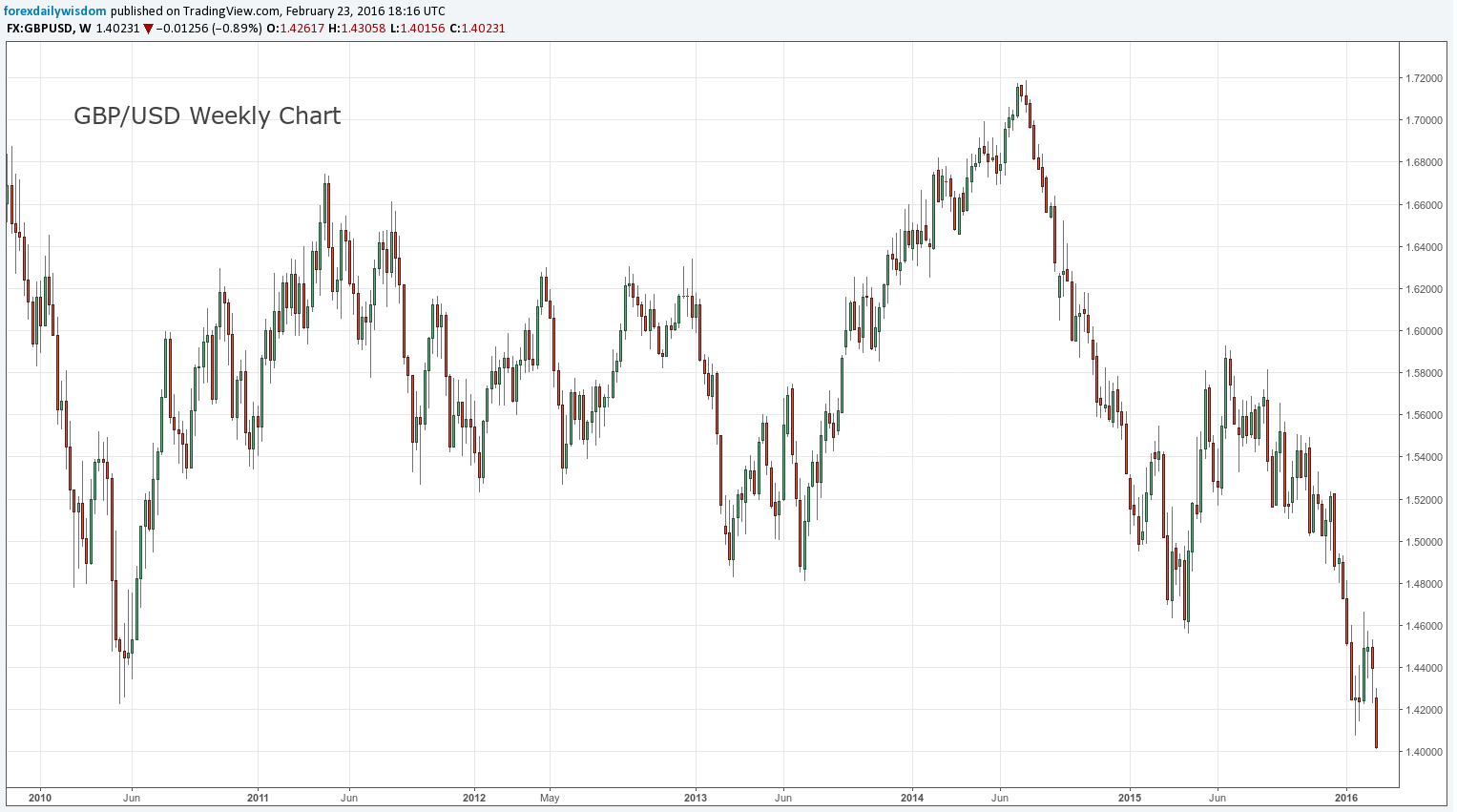
The pound was in a downward trend well before Boris Johnson made his announcement.
Whither the Pound?
The pound has been losing value in relation to other majors for some time now. I expect this trend to continue in the near term, irrespective of Boris, David, Mario, Christine or any of the global elites whose whims determine our fate. The GBP snowball was gently rolling down the slope when Boris gave it a tap with his toe.
The world will not come to an end either way. Proponents of a Brexit are not xenophobic monsters bent on committing economic suicide. There are issues of epic proportion facing western democracies today. A Brexit is not one of them.
Ah, the joys of trading forex. One man, not a major international figure mind you, just a mayor, makes a public statement, and twenty-eight billion pounds change hands.
On Sunday afternoon Boris Johnson, mayor of London, publicly stated that he would back the campaign for the UK to leave the European Union. On Sunday evening the pound opened 130 pips down relative to the dollar. As of this writing it has lost three cents. That is a little over two percent of its value. The GBP M1 money supply currently stands at about £1.46 trillion. On Friday that sum was worth $2.1 trillion. Now it is worth about $2.05 trillion and losing steadily.
What it Means for You
How does this affect you? It depends who you are and what your options are when it comes to shifting your liabilities. If you are a forex trader, you have already smelled the blood and you see an opportunity. If you are a UK exporter, your products just got two percent cheaper. If you are David Cameron, you likely had trouble digesting your bacon sandwich on Monday morning.
Background
But before I go any further, I would like to clarify a few points. Having read a number of articles about an impending Grexit last year, I was somewhat surprised to discover how poorly the authors grasped the core issues. These were not pyjama bloggers, but professional journalists writing for major news outlets who failed to understand the difference between membership in the euro and membership in the European Union, for example. This suggests to me that the general public may not have as firm a handle on all of the issues as one might expect, so if you will bear with me, I will attempt to explain them briefly.
The European Union began in 1957 as a free trade zone known as the European Economic Community. It has since morphed into a supranational government with its own currency, central bank, president and parliament.
That said, the parliament has no legal power and all decisions are ultimately made by a commission of unelected members. Member states are required to keep their legislation in harmony with that of the EU. This gives the commission de facto authority over national parliaments.
Some but not all of the member states have adopted the euro as their national currency. This has the advantage of protecting them from currency fluctuations which facilitates cross-border trade. It has the disadvantage of sacrificing a little more of their sovereignty since they cannot issue their own currency, control their monetary base or adjust their interest rates.
This would return its status to that of an independent state with no political ties to the EU.
Brexit and the Currency Markets
So why is the forex market reacting as it is to a potential Brexit? What we see here is irrational fear. It is irrational because it is based in two unwarranted assumptions.
The first assumption is that Boris Johnson's decision to back the Leave campaign will influence the outcome of the referendum. This is not a certainty.
The other assumption is that if the third largest economy in the European Union leaves, this will mark the End Of Civilisation As We Know It. Or at least of the European Union as we know it.
But if the UK leaving is so bad for the EU, why didn't the euro tank on the news? And if the pound tanked as badly as it did, where is the evidence that a Brexit would be worse for the UK than it would be for the EU? Changes to the value of the pound since Sunday suggest that the underlying assumption is that if there is a Brexit it will be very bad for the UK but not all that bad for the EU. In this article I intend to challenge that assumption and then examine what the implications may be for the pound.
What Is at Stake?
UK
Let's take a closer look at what is at stake for the UK.
EU membership currently costs the UK taxpayer about £20 billion per year. Given that the UK national budget for 2016 is in the neighbourhood of £760 billion, £20 billion is not a cheese sandwich. It is in fact 2.6% of total government expenditure.
What value does the UK taxpayer get in return? The most obvious value is open access to markets across the EU. Yet when you consider that access to these markets could and would be easily achieved with a handful of bilateral trade agreements, it becomes easier to understand why some people think the UK would be better off on its own. Beyond that, there is a nebulous notion of strength in unity, but this is difficult to quantify, and even more difficult to weigh against the corresponding loss of autonomy. As far as military considerations go, the UK is a major military power in its own right, and a member of NATO. EU membership does not affect either.
EU
Now let's take a look at what is at stake for the EU. There is a legitimate fear that if one major country leaves the union, others may follow. Even if they don't, the credibility and political clout of the EU would be forever damaged.
Many political careers have been built on the European project. For these politicians it is a vehicle to accumulate and concentrate power without any accountability to annoying voters. Naturally they are not keen to see it come apart. But what about the rest of us?
In short, the economic impact to the UK would likely be positive, and the cost to the EU would be more political than social or economic.
The pound was in a downward trend well before Boris Johnson made his announcement.
Whither the Pound?
The pound has been losing value in relation to other majors for some time now. I expect this trend to continue in the near term, irrespective of Boris, David, Mario, Christine or any of the global elites whose whims determine our fate. The GBP snowball was gently rolling down the slope when Boris gave it a tap with his toe.
The world will not come to an end either way. Proponents of a Brexit are not xenophobic monsters bent on committing economic suicide. There are issues of epic proportion facing western democracies today. A Brexit is not one of them.
INFINOX Capital UK’s Profit Rises 17% as Broker Shifts Focus to Institutional Trading
Featured Videos
Exness expands its presence in Africa: Inside our interview with Paul Margarites in Cape Town
Finance Magnates met with Paul Margarites, Exness regional commercial director for Sub-Saharan Africa, during a visit to the firm’s office opening in Cape Town. In this talk, led by Andrea Badiola Mateos, Co-CEO at Finance Magnates, Paul shares views on the South African trading space, local user behavior, mobile trends, regulation, team growth, and how Exness plans to grow in more markets across the region. @Exness
Read the article at: https://www.financemagnates.com/thought-leadership/exness-expands-its-presence-in-africa-inside-our-interview-with-paul-margarites/
#exness #financemagnates #exnesstrading #CFDtrading #tradeonline #africanews #capetown
Finance Magnates met with Paul Margarites, Exness regional commercial director for Sub-Saharan Africa, during a visit to the firm’s office opening in Cape Town. In this talk, led by Andrea Badiola Mateos, Co-CEO at Finance Magnates, Paul shares views on the South African trading space, local user behavior, mobile trends, regulation, team growth, and how Exness plans to grow in more markets across the region. @Exness
Read the article at: https://www.financemagnates.com/thought-leadership/exness-expands-its-presence-in-africa-inside-our-interview-with-paul-margarites/
#exness #financemagnates #exnesstrading #CFDtrading #tradeonline #africanews #capetown
Finance Magnates met with Paul Margarites, Exness regional commercial director for Sub-Saharan Africa, during a visit to the firm’s office opening in Cape Town. In this talk, led by Andrea Badiola Mateos, Co-CEO at Finance Magnates, Paul shares views on the South African trading space, local user behavior, mobile trends, regulation, team growth, and how Exness plans to grow in more markets across the region. @Exness
Read the article at: https://www.financemagnates.com/thought-leadership/exness-expands-its-presence-in-africa-inside-our-interview-with-paul-margarites/
#exness #financemagnates #exnesstrading #CFDtrading #tradeonline #africanews #capetown
Finance Magnates met with Paul Margarites, Exness regional commercial director for Sub-Saharan Africa, during a visit to the firm’s office opening in Cape Town. In this talk, led by Andrea Badiola Mateos, Co-CEO at Finance Magnates, Paul shares views on the South African trading space, local user behavior, mobile trends, regulation, team growth, and how Exness plans to grow in more markets across the region. @Exness
Read the article at: https://www.financemagnates.com/thought-leadership/exness-expands-its-presence-in-africa-inside-our-interview-with-paul-margarites/
#exness #financemagnates #exnesstrading #CFDtrading #tradeonline #africanews #capetown
Interview with Jas Shah
Builder | Adviser | Fintech Writer | Product Strategist
In this episode, Jonathan Fine sat down with Jas Shah, one of the most thoughtful voices in global fintech. Known for his work across advisory, product, stablecoins, and his widely read writing, Jas brings a rare combination of industry insight and plain-spoken clarity.
We talk about his first impression of the Summit, the projects that keep him busy today, and how they connect to the stablecoin panel he joined. Jas shares his view on the link between fintech, wealthtech and retail brokers, especially as firms like Revolut, eToro and Trading212 blur long-standing lines in the market.
We also explore what stablecoin adoption might look like for retail investment platforms, including a few product and UX angles that are not obvious at first glance.
To close, Jas explains how he thinks about writing, and how he approaches “shipping” pieces that spark debate across the industry.
Interview with Jas Shah
Builder | Adviser | Fintech Writer | Product Strategist
In this episode, Jonathan Fine sat down with Jas Shah, one of the most thoughtful voices in global fintech. Known for his work across advisory, product, stablecoins, and his widely read writing, Jas brings a rare combination of industry insight and plain-spoken clarity.
We talk about his first impression of the Summit, the projects that keep him busy today, and how they connect to the stablecoin panel he joined. Jas shares his view on the link between fintech, wealthtech and retail brokers, especially as firms like Revolut, eToro and Trading212 blur long-standing lines in the market.
We also explore what stablecoin adoption might look like for retail investment platforms, including a few product and UX angles that are not obvious at first glance.
To close, Jas explains how he thinks about writing, and how he approaches “shipping” pieces that spark debate across the industry.
Interview with Jas Shah
Builder | Adviser | Fintech Writer | Product Strategist
In this episode, Jonathan Fine sat down with Jas Shah, one of the most thoughtful voices in global fintech. Known for his work across advisory, product, stablecoins, and his widely read writing, Jas brings a rare combination of industry insight and plain-spoken clarity.
We talk about his first impression of the Summit, the projects that keep him busy today, and how they connect to the stablecoin panel he joined. Jas shares his view on the link between fintech, wealthtech and retail brokers, especially as firms like Revolut, eToro and Trading212 blur long-standing lines in the market.
We also explore what stablecoin adoption might look like for retail investment platforms, including a few product and UX angles that are not obvious at first glance.
To close, Jas explains how he thinks about writing, and how he approaches “shipping” pieces that spark debate across the industry.
Interview with Jas Shah
Builder | Adviser | Fintech Writer | Product Strategist
In this episode, Jonathan Fine sat down with Jas Shah, one of the most thoughtful voices in global fintech. Known for his work across advisory, product, stablecoins, and his widely read writing, Jas brings a rare combination of industry insight and plain-spoken clarity.
We talk about his first impression of the Summit, the projects that keep him busy today, and how they connect to the stablecoin panel he joined. Jas shares his view on the link between fintech, wealthtech and retail brokers, especially as firms like Revolut, eToro and Trading212 blur long-standing lines in the market.
We also explore what stablecoin adoption might look like for retail investment platforms, including a few product and UX angles that are not obvious at first glance.
To close, Jas explains how he thinks about writing, and how he approaches “shipping” pieces that spark debate across the industry.
Interview with Jas Shah
Builder | Adviser | Fintech Writer | Product Strategist
In this episode, Jonathan Fine sat down with Jas Shah, one of the most thoughtful voices in global fintech. Known for his work across advisory, product, stablecoins, and his widely read writing, Jas brings a rare combination of industry insight and plain-spoken clarity.
We talk about his first impression of the Summit, the projects that keep him busy today, and how they connect to the stablecoin panel he joined. Jas shares his view on the link between fintech, wealthtech and retail brokers, especially as firms like Revolut, eToro and Trading212 blur long-standing lines in the market.
We also explore what stablecoin adoption might look like for retail investment platforms, including a few product and UX angles that are not obvious at first glance.
To close, Jas explains how he thinks about writing, and how he approaches “shipping” pieces that spark debate across the industry.
Interview with Jas Shah
Builder | Adviser | Fintech Writer | Product Strategist
In this episode, Jonathan Fine sat down with Jas Shah, one of the most thoughtful voices in global fintech. Known for his work across advisory, product, stablecoins, and his widely read writing, Jas brings a rare combination of industry insight and plain-spoken clarity.
We talk about his first impression of the Summit, the projects that keep him busy today, and how they connect to the stablecoin panel he joined. Jas shares his view on the link between fintech, wealthtech and retail brokers, especially as firms like Revolut, eToro and Trading212 blur long-standing lines in the market.
We also explore what stablecoin adoption might look like for retail investment platforms, including a few product and UX angles that are not obvious at first glance.
To close, Jas explains how he thinks about writing, and how he approaches “shipping” pieces that spark debate across the industry.
Vitalii Bulynin Talks About Versus Trade, New Pairs, and Big Plans
In this interview, Versus Trade Co-Founder Vitalii Bulynin explains how the company got its license fast, why its trading pairs are fresh and fun, and what the team will build next.
He also discusses the most active pairs, the IB and MIB plans, and hiring needs for new markets.
Watch the whole talk to learn more about how Versus Trade works and where it is heading.
#financemagnates #VersusTrade #TradingPairs #BTCvsGold #goldtrading #innovation
In this interview, Versus Trade Co-Founder Vitalii Bulynin explains how the company got its license fast, why its trading pairs are fresh and fun, and what the team will build next.
He also discusses the most active pairs, the IB and MIB plans, and hiring needs for new markets.
Watch the whole talk to learn more about how Versus Trade works and where it is heading.
#financemagnates #VersusTrade #TradingPairs #BTCvsGold #goldtrading #innovation
In this interview, Versus Trade Co-Founder Vitalii Bulynin explains how the company got its license fast, why its trading pairs are fresh and fun, and what the team will build next.
He also discusses the most active pairs, the IB and MIB plans, and hiring needs for new markets.
Watch the whole talk to learn more about how Versus Trade works and where it is heading.
#financemagnates #VersusTrade #TradingPairs #BTCvsGold #goldtrading #innovation
In this interview, Versus Trade Co-Founder Vitalii Bulynin explains how the company got its license fast, why its trading pairs are fresh and fun, and what the team will build next.
He also discusses the most active pairs, the IB and MIB plans, and hiring needs for new markets.
Watch the whole talk to learn more about how Versus Trade works and where it is heading.
#financemagnates #VersusTrade #TradingPairs #BTCvsGold #goldtrading #innovation
In this interview, Versus Trade Co-Founder Vitalii Bulynin explains how the company got its license fast, why its trading pairs are fresh and fun, and what the team will build next.
He also discusses the most active pairs, the IB and MIB plans, and hiring needs for new markets.
Watch the whole talk to learn more about how Versus Trade works and where it is heading.
#financemagnates #VersusTrade #TradingPairs #BTCvsGold #goldtrading #innovation
In this interview, Versus Trade Co-Founder Vitalii Bulynin explains how the company got its license fast, why its trading pairs are fresh and fun, and what the team will build next.
He also discusses the most active pairs, the IB and MIB plans, and hiring needs for new markets.
Watch the whole talk to learn more about how Versus Trade works and where it is heading.
#financemagnates #VersusTrade #TradingPairs #BTCvsGold #goldtrading #innovation
Marketing in 2026 Audiences, Costs, and Smarter AI
As brokers eye B2B business and compete with fintechs and crypto exchanges alike, marketers need to act wisely with often limited budgets. AI can offer scalable solutions, but only if used properly.
Join seasoned marketing executives and specialists as they discuss the main challenges they identify in financial services in 2026 and how they address them.
Attendees of this session will walk away with:
- A nuts-and-bolts account of acquisition costs across platforms and geos
- Analysis of today’s multi-layered audience segments and differences in behaviour
- First-hand account of how global brokers balance consistency and local flavour
- Notes from the field about intelligently using AI and automation in marketing
Speakers:
-Yam Yehoshua, Editor-In-Chief at Finance Magnates
-Federico Paderni, Managing Director for Growth Markets in Europe at X
-Jo Benton, Chief Marketing Officer, Consulting | Fractional CMO
-Itai Levitan, Head of Strategy at investingLive
-Roberto Napolitano, CMO at Innovate Finance
-Tony Cross, Director at Monk Communications
#fmls #fmls25 #fmevents #FintechMarketing #AI #DigitalStrategy #Fintech #Innovation
Connect with us at:
🔗 LinkedIn: / financemagnates-events
👍 Facebook: / financemagnatesevents
📸 Instagram: / fmevents_official
🐦 Twitter: / f_m_events
🎥 TikTok: / fmevents_official
As brokers eye B2B business and compete with fintechs and crypto exchanges alike, marketers need to act wisely with often limited budgets. AI can offer scalable solutions, but only if used properly.
Join seasoned marketing executives and specialists as they discuss the main challenges they identify in financial services in 2026 and how they address them.
Attendees of this session will walk away with:
- A nuts-and-bolts account of acquisition costs across platforms and geos
- Analysis of today’s multi-layered audience segments and differences in behaviour
- First-hand account of how global brokers balance consistency and local flavour
- Notes from the field about intelligently using AI and automation in marketing
Speakers:
-Yam Yehoshua, Editor-In-Chief at Finance Magnates
-Federico Paderni, Managing Director for Growth Markets in Europe at X
-Jo Benton, Chief Marketing Officer, Consulting | Fractional CMO
-Itai Levitan, Head of Strategy at investingLive
-Roberto Napolitano, CMO at Innovate Finance
-Tony Cross, Director at Monk Communications
#fmls #fmls25 #fmevents #FintechMarketing #AI #DigitalStrategy #Fintech #Innovation
Connect with us at:
🔗 LinkedIn: / financemagnates-events
👍 Facebook: / financemagnatesevents
📸 Instagram: / fmevents_official
🐦 Twitter: / f_m_events
🎥 TikTok: / fmevents_official
As brokers eye B2B business and compete with fintechs and crypto exchanges alike, marketers need to act wisely with often limited budgets. AI can offer scalable solutions, but only if used properly.
Join seasoned marketing executives and specialists as they discuss the main challenges they identify in financial services in 2026 and how they address them.
Attendees of this session will walk away with:
- A nuts-and-bolts account of acquisition costs across platforms and geos
- Analysis of today’s multi-layered audience segments and differences in behaviour
- First-hand account of how global brokers balance consistency and local flavour
- Notes from the field about intelligently using AI and automation in marketing
Speakers:
-Yam Yehoshua, Editor-In-Chief at Finance Magnates
-Federico Paderni, Managing Director for Growth Markets in Europe at X
-Jo Benton, Chief Marketing Officer, Consulting | Fractional CMO
-Itai Levitan, Head of Strategy at investingLive
-Roberto Napolitano, CMO at Innovate Finance
-Tony Cross, Director at Monk Communications
#fmls #fmls25 #fmevents #FintechMarketing #AI #DigitalStrategy #Fintech #Innovation
Connect with us at:
🔗 LinkedIn: / financemagnates-events
👍 Facebook: / financemagnatesevents
📸 Instagram: / fmevents_official
🐦 Twitter: / f_m_events
🎥 TikTok: / fmevents_official
As brokers eye B2B business and compete with fintechs and crypto exchanges alike, marketers need to act wisely with often limited budgets. AI can offer scalable solutions, but only if used properly.
Join seasoned marketing executives and specialists as they discuss the main challenges they identify in financial services in 2026 and how they address them.
Attendees of this session will walk away with:
- A nuts-and-bolts account of acquisition costs across platforms and geos
- Analysis of today’s multi-layered audience segments and differences in behaviour
- First-hand account of how global brokers balance consistency and local flavour
- Notes from the field about intelligently using AI and automation in marketing
Speakers:
-Yam Yehoshua, Editor-In-Chief at Finance Magnates
-Federico Paderni, Managing Director for Growth Markets in Europe at X
-Jo Benton, Chief Marketing Officer, Consulting | Fractional CMO
-Itai Levitan, Head of Strategy at investingLive
-Roberto Napolitano, CMO at Innovate Finance
-Tony Cross, Director at Monk Communications
#fmls #fmls25 #fmevents #FintechMarketing #AI #DigitalStrategy #Fintech #Innovation
Connect with us at:
🔗 LinkedIn: / financemagnates-events
👍 Facebook: / financemagnatesevents
📸 Instagram: / fmevents_official
🐦 Twitter: / f_m_events
🎥 TikTok: / fmevents_official
As brokers eye B2B business and compete with fintechs and crypto exchanges alike, marketers need to act wisely with often limited budgets. AI can offer scalable solutions, but only if used properly.
Join seasoned marketing executives and specialists as they discuss the main challenges they identify in financial services in 2026 and how they address them.
Attendees of this session will walk away with:
- A nuts-and-bolts account of acquisition costs across platforms and geos
- Analysis of today’s multi-layered audience segments and differences in behaviour
- First-hand account of how global brokers balance consistency and local flavour
- Notes from the field about intelligently using AI and automation in marketing
Speakers:
-Yam Yehoshua, Editor-In-Chief at Finance Magnates
-Federico Paderni, Managing Director for Growth Markets in Europe at X
-Jo Benton, Chief Marketing Officer, Consulting | Fractional CMO
-Itai Levitan, Head of Strategy at investingLive
-Roberto Napolitano, CMO at Innovate Finance
-Tony Cross, Director at Monk Communications
#fmls #fmls25 #fmevents #FintechMarketing #AI #DigitalStrategy #Fintech #Innovation
Connect with us at:
🔗 LinkedIn: / financemagnates-events
👍 Facebook: / financemagnatesevents
📸 Instagram: / fmevents_official
🐦 Twitter: / f_m_events
🎥 TikTok: / fmevents_official
As brokers eye B2B business and compete with fintechs and crypto exchanges alike, marketers need to act wisely with often limited budgets. AI can offer scalable solutions, but only if used properly.
Join seasoned marketing executives and specialists as they discuss the main challenges they identify in financial services in 2026 and how they address them.
Attendees of this session will walk away with:
- A nuts-and-bolts account of acquisition costs across platforms and geos
- Analysis of today’s multi-layered audience segments and differences in behaviour
- First-hand account of how global brokers balance consistency and local flavour
- Notes from the field about intelligently using AI and automation in marketing
Speakers:
-Yam Yehoshua, Editor-In-Chief at Finance Magnates
-Federico Paderni, Managing Director for Growth Markets in Europe at X
-Jo Benton, Chief Marketing Officer, Consulting | Fractional CMO
-Itai Levitan, Head of Strategy at investingLive
-Roberto Napolitano, CMO at Innovate Finance
-Tony Cross, Director at Monk Communications
#fmls #fmls25 #fmevents #FintechMarketing #AI #DigitalStrategy #Fintech #Innovation
Connect with us at:
🔗 LinkedIn: / financemagnates-events
👍 Facebook: / financemagnatesevents
📸 Instagram: / fmevents_official
🐦 Twitter: / f_m_events
🎥 TikTok: / fmevents_official
Fail Better Trading Tech to Tackle Industry Risks
Much like their traders in the market, brokers must diversify to manage risk and stay resilient. But that can get costly, clunky, and lengthy.
This candid panel brings together builders across the trading infrastructure space to uncover the shifting dynamics behind tools, interfaces, and full-stack ambitions.
Attendees will hear:
-Why platform dependency has become one of the most overlooked risks in the trading business?
-Buy vs. build: What do hybrid models look like, and why are industry graveyards filled with failed ‘killer apps’?
-How AI is already changing execution, risk, and reporting—and what’s next?
-Which features, assets, and tools gain the most traction, and where brokers should look for tech-driven retention?
Speakers:
-Stephen Miles, Chief Revenue Officer at FYNXT
-John Morris, Co-Founder at FXBlue
-Matthew Smith, Group Chair & CEO at EC Markets
-Tom Higgins, Founder & CEO at Gold-i
-Gil Ben Hur, Founder at 5% Group
#fmls #fmls25 #fmevents #Brokers #Trading #Fintech #FintechInnovation #TradingTechnology #Innovation
Connect with us at:
🔗 LinkedIn: / financemagnates-events
👍 Facebook: / financemagnatesevents
📸 Instagram: / fmevents_official
🐦 Twitter: / f_m_events
🎥 TikTok: / fmevents_official
Much like their traders in the market, brokers must diversify to manage risk and stay resilient. But that can get costly, clunky, and lengthy.
This candid panel brings together builders across the trading infrastructure space to uncover the shifting dynamics behind tools, interfaces, and full-stack ambitions.
Attendees will hear:
-Why platform dependency has become one of the most overlooked risks in the trading business?
-Buy vs. build: What do hybrid models look like, and why are industry graveyards filled with failed ‘killer apps’?
-How AI is already changing execution, risk, and reporting—and what’s next?
-Which features, assets, and tools gain the most traction, and where brokers should look for tech-driven retention?
Speakers:
-Stephen Miles, Chief Revenue Officer at FYNXT
-John Morris, Co-Founder at FXBlue
-Matthew Smith, Group Chair & CEO at EC Markets
-Tom Higgins, Founder & CEO at Gold-i
-Gil Ben Hur, Founder at 5% Group
#fmls #fmls25 #fmevents #Brokers #Trading #Fintech #FintechInnovation #TradingTechnology #Innovation
Connect with us at:
🔗 LinkedIn: / financemagnates-events
👍 Facebook: / financemagnatesevents
📸 Instagram: / fmevents_official
🐦 Twitter: / f_m_events
🎥 TikTok: / fmevents_official
Much like their traders in the market, brokers must diversify to manage risk and stay resilient. But that can get costly, clunky, and lengthy.
This candid panel brings together builders across the trading infrastructure space to uncover the shifting dynamics behind tools, interfaces, and full-stack ambitions.
Attendees will hear:
-Why platform dependency has become one of the most overlooked risks in the trading business?
-Buy vs. build: What do hybrid models look like, and why are industry graveyards filled with failed ‘killer apps’?
-How AI is already changing execution, risk, and reporting—and what’s next?
-Which features, assets, and tools gain the most traction, and where brokers should look for tech-driven retention?
Speakers:
-Stephen Miles, Chief Revenue Officer at FYNXT
-John Morris, Co-Founder at FXBlue
-Matthew Smith, Group Chair & CEO at EC Markets
-Tom Higgins, Founder & CEO at Gold-i
-Gil Ben Hur, Founder at 5% Group
#fmls #fmls25 #fmevents #Brokers #Trading #Fintech #FintechInnovation #TradingTechnology #Innovation
Connect with us at:
🔗 LinkedIn: / financemagnates-events
👍 Facebook: / financemagnatesevents
📸 Instagram: / fmevents_official
🐦 Twitter: / f_m_events
🎥 TikTok: / fmevents_official
Much like their traders in the market, brokers must diversify to manage risk and stay resilient. But that can get costly, clunky, and lengthy.
This candid panel brings together builders across the trading infrastructure space to uncover the shifting dynamics behind tools, interfaces, and full-stack ambitions.
Attendees will hear:
-Why platform dependency has become one of the most overlooked risks in the trading business?
-Buy vs. build: What do hybrid models look like, and why are industry graveyards filled with failed ‘killer apps’?
-How AI is already changing execution, risk, and reporting—and what’s next?
-Which features, assets, and tools gain the most traction, and where brokers should look for tech-driven retention?
Speakers:
-Stephen Miles, Chief Revenue Officer at FYNXT
-John Morris, Co-Founder at FXBlue
-Matthew Smith, Group Chair & CEO at EC Markets
-Tom Higgins, Founder & CEO at Gold-i
-Gil Ben Hur, Founder at 5% Group
#fmls #fmls25 #fmevents #Brokers #Trading #Fintech #FintechInnovation #TradingTechnology #Innovation
Connect with us at:
🔗 LinkedIn: / financemagnates-events
👍 Facebook: / financemagnatesevents
📸 Instagram: / fmevents_official
🐦 Twitter: / f_m_events
🎥 TikTok: / fmevents_official
Much like their traders in the market, brokers must diversify to manage risk and stay resilient. But that can get costly, clunky, and lengthy.
This candid panel brings together builders across the trading infrastructure space to uncover the shifting dynamics behind tools, interfaces, and full-stack ambitions.
Attendees will hear:
-Why platform dependency has become one of the most overlooked risks in the trading business?
-Buy vs. build: What do hybrid models look like, and why are industry graveyards filled with failed ‘killer apps’?
-How AI is already changing execution, risk, and reporting—and what’s next?
-Which features, assets, and tools gain the most traction, and where brokers should look for tech-driven retention?
Speakers:
-Stephen Miles, Chief Revenue Officer at FYNXT
-John Morris, Co-Founder at FXBlue
-Matthew Smith, Group Chair & CEO at EC Markets
-Tom Higgins, Founder & CEO at Gold-i
-Gil Ben Hur, Founder at 5% Group
#fmls #fmls25 #fmevents #Brokers #Trading #Fintech #FintechInnovation #TradingTechnology #Innovation
Connect with us at:
🔗 LinkedIn: / financemagnates-events
👍 Facebook: / financemagnatesevents
📸 Instagram: / fmevents_official
🐦 Twitter: / f_m_events
🎥 TikTok: / fmevents_official
Much like their traders in the market, brokers must diversify to manage risk and stay resilient. But that can get costly, clunky, and lengthy.
This candid panel brings together builders across the trading infrastructure space to uncover the shifting dynamics behind tools, interfaces, and full-stack ambitions.
Attendees will hear:
-Why platform dependency has become one of the most overlooked risks in the trading business?
-Buy vs. build: What do hybrid models look like, and why are industry graveyards filled with failed ‘killer apps’?
-How AI is already changing execution, risk, and reporting—and what’s next?
-Which features, assets, and tools gain the most traction, and where brokers should look for tech-driven retention?
Speakers:
-Stephen Miles, Chief Revenue Officer at FYNXT
-John Morris, Co-Founder at FXBlue
-Matthew Smith, Group Chair & CEO at EC Markets
-Tom Higgins, Founder & CEO at Gold-i
-Gil Ben Hur, Founder at 5% Group
#fmls #fmls25 #fmevents #Brokers #Trading #Fintech #FintechInnovation #TradingTechnology #Innovation
Connect with us at:
🔗 LinkedIn: / financemagnates-events
👍 Facebook: / financemagnatesevents
📸 Instagram: / fmevents_official
🐦 Twitter: / f_m_events
🎥 TikTok: / fmevents_official