The currency pair EUR/USD has not moved much during Asian trading with a slight upward trend. The dollar has stabilized compared to most counter currencies before this week's meeting of the Federal Reserve. The two-day meeting will be finished tonight and it will show a new growth projection, there won’t be a press conference after it finishes.
After the decision is made, the Fed will only release a statement in which the decision will be explained. During the day, the eurozone will be publishing significant economic results, while in the afternoon, a report is going to be released on durable goods orders in the US.
The euro has strengthened against other major currencies, although the published data showed that German consumer climate fell in June, however less than expected. Forex pair EUR/USD rose to 1.0995. Official data showed that German GfK consumer climate fell in June to 10.0 points from 10.1 in the previous month, and was expected to fall to 9.9 points.
A separate report showed that German import price index increased in June by 0.5 percent after rising 0.9% in the previous month, a predicted growth of 0.6% against the pound, the yen and the Swiss franc. The euro has strengthened. EUR/GBP climbed to 0.8390, EUR/JPY rose to 115.98, and the EUR/CHF jumped to 1.0916.
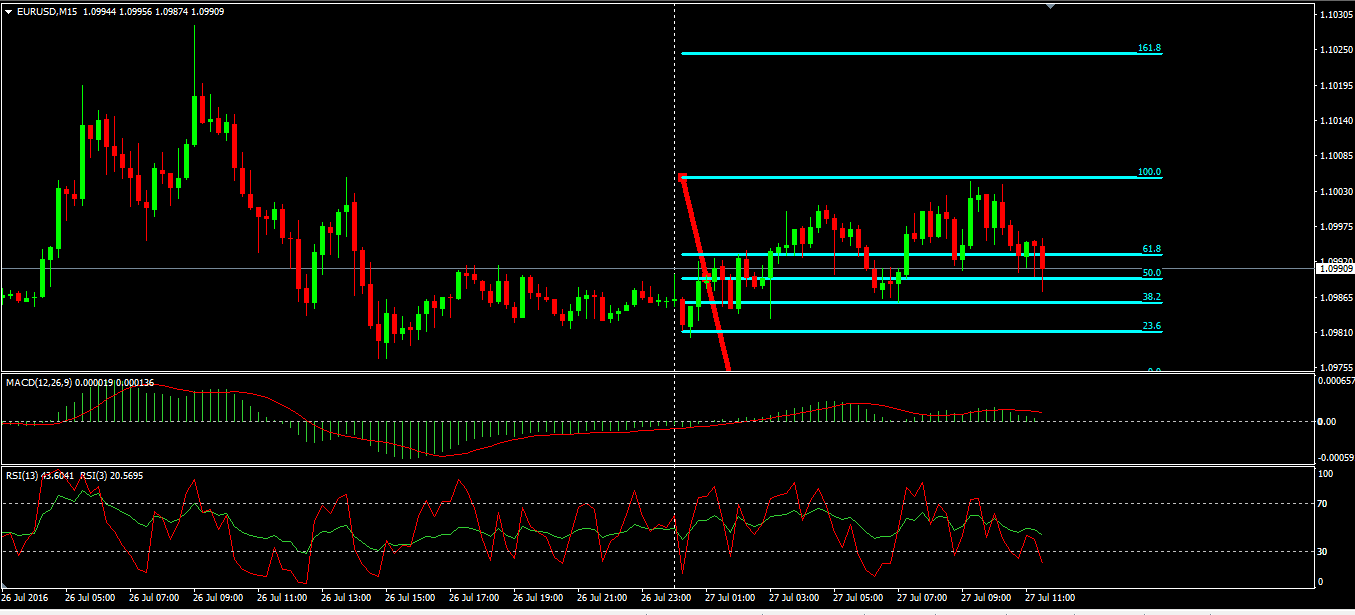
Japanese Prime Minister Shinzo Abe said his government would put together a stimulus package of more than 265 billion dollars in order to stimulate the economy. The single currency rose against the Canadian and New Zealand dollar. EUR/CAD rose to 1.4493 and EUR/NZD rose to 1.5606. The Euro Index has increased by 0.23% to 88.20. It shows a key resistance at 1.10 in the picture.
The price has bounced from the 100 Fibonacci level. It was confirmed by the double peak at M15 charts. The price has broken the 61.8 Fibonacci level and continued a short-term declining trend. A double bottom shows at 38.2 Fibonacci level.
The British pound did not move much against the dollar during Asian trading, though increased oscillations occurred after it posted better than expected results of the GDP during the second quarter.
Compared to the previous quarter, it had a growth of 0.6%, which was better than the expected 0.4%. On an annual basis, GDP grew 2.2%. Preliminary data showed that the economy of Great Britain has increased during the second quarter by 0.6%, after rising 0.4% in the first quarter. Economists had expected growth of 0.4%.
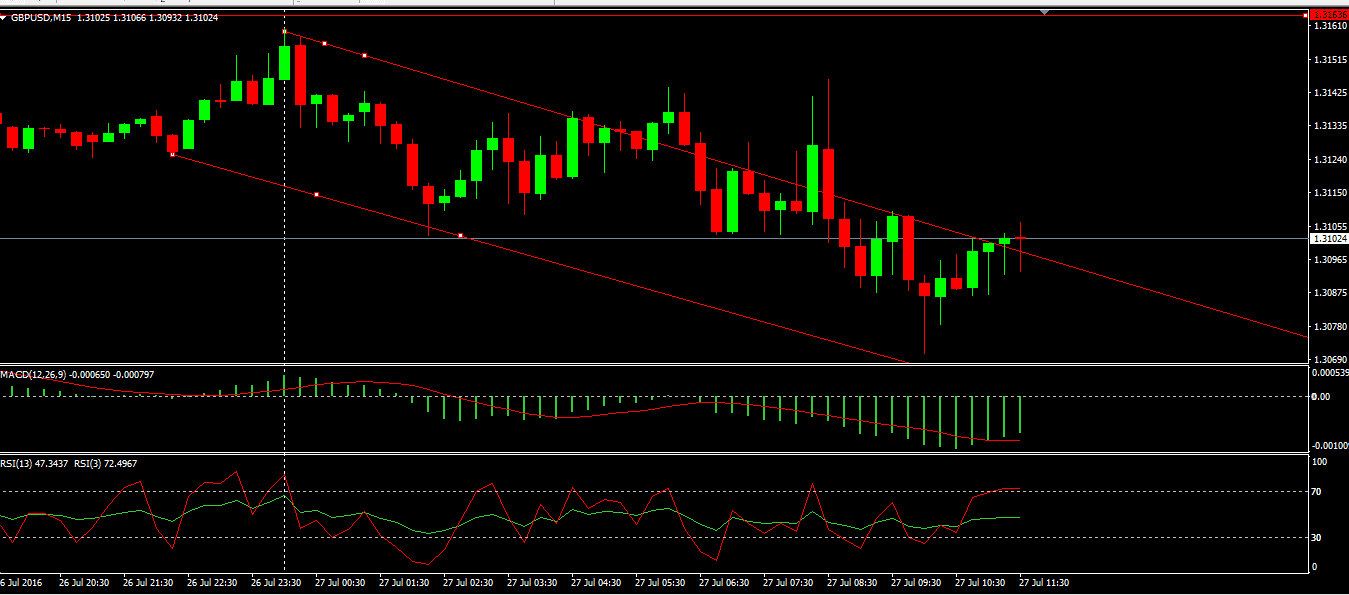
The index of the service sector of Great Britain rose in June by 0.3 % after rising 0.5% in the previous month, which was in line with the forecasts of economists. A declining trend line can be seen in the image below. Double peak wasn't broken at the 1.31500 strong resistance area. The short position below shows the 1.31500 with targets at 1.30750 and 1.30 in extension.
The Australian dollar fell against other major currencies after published data showed that consumer price inflation in Australia rose in the second quarter, in line with expectations. The pair AUD/USD is up at the moment of writing, recorded on the bottom 0.7456, and subsequently consolidated at 0.7484.
Official data showed that consumer price inflation in Australia rose in the second quarter to 0.4% percent from minus 0.2% in the previous quarter, which was in line with forecasts of economists. Australian core consumer prices rose in the second quarter to 0.5% from 0.2% in the previous quarter. Analysts had expected growth of 0.4%.
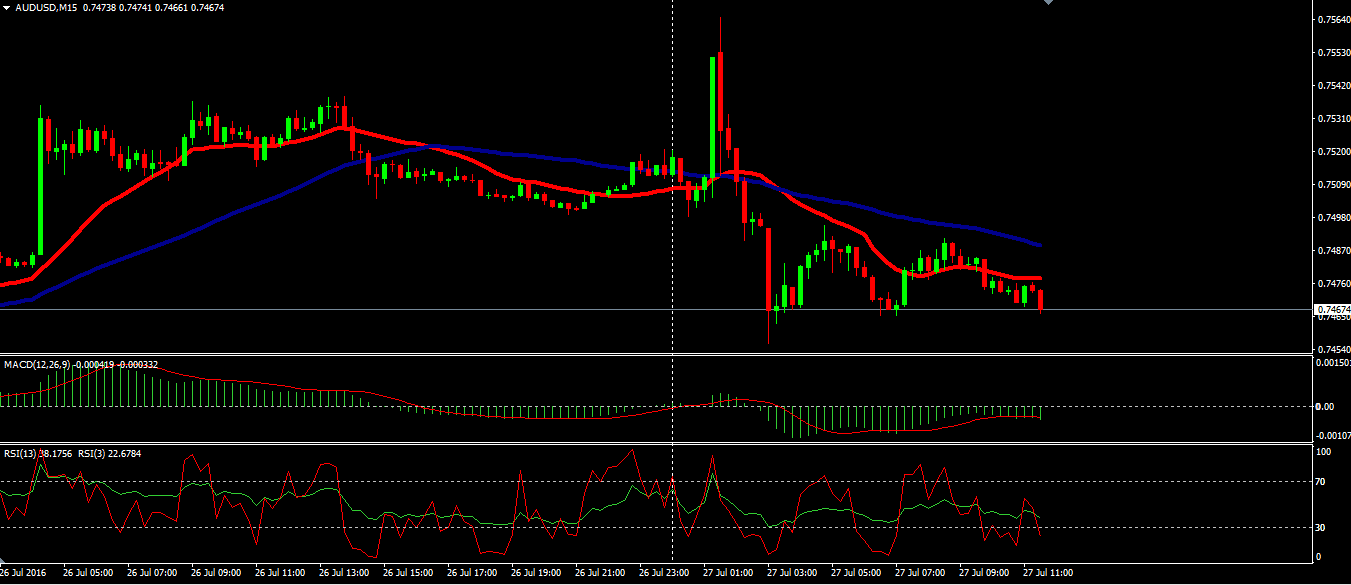
The Australian dollar fell against the yen. AUD/JPY dropped to 78.90. AUD/USD sharply dropped below the 0.6565 area. 20MA full red line crossing over 50MA full blue line was taken as a signal for short positions on AUD/USD below 0.75200 with targets on 0.74500 and 0.74. It can be seen the double bottom at 0.75400. It wasn't broken but it can be tested very soon. Technical indicators are bearish and call for a further decline in prices.
Prices of stocks on Wall Street were mixed as investors were cautious ahead of the outcome of the meeting of the Federal Reserve. Dow Jones fell by 0.10%, the S & P 500 climbed by 0.03%, while the NASDAQ was higher by 0.24%. Investors are wary of the two-day meeting of the Federal Reserve. Analysts do not expect the central bank to raise interest rates but they’re waiting for signals related to the possible tightening of monetary policy by the end of the year.
Asian stocks were mixed. The Japanese Nikkei 225 index rose 1.72%, the Hang Seng index in Hong Kong fell 0.28%, while Australia's S&P/ASX 200 was higher by 0.04%. Japanese Prime Minister Shinzo Abe said his government would put together a stimulus package of more than 265 billion dollars in order to stimulate the economy.
European stocks rose. Euro Stoxx 50 rose 0.72%, France's CAC 40 climbed 1.07%, and Germany’s DAX 30 was higher by 0.86%, while London's FTSE 100 rose 0.24%. Prices and US stocks closed mixed yesterday.
The industrial sector, the sector of basic materials, and oil and gas sector closed in decline yesterday, while on the other hand, shares of companies in the utility sector, the communications sector, and consumer goods increased.
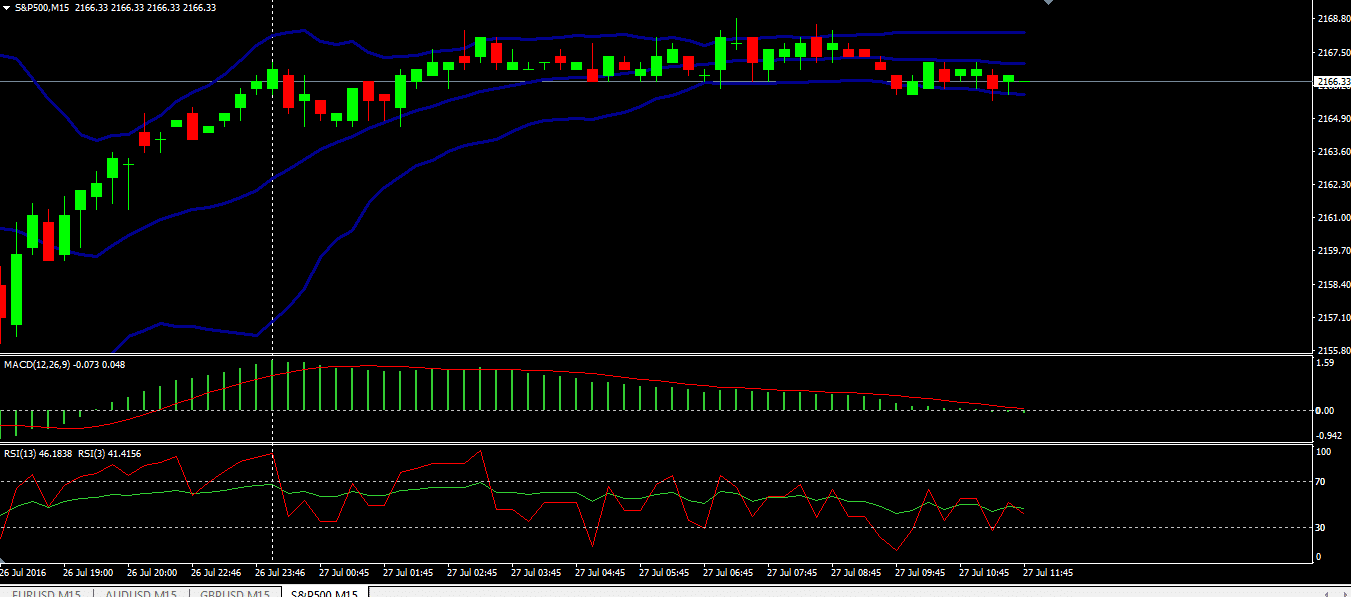
During the Asian and early European trading, S&P 500 rose 0.21%. A long term rising trend line can be seen. The price has formed a strong support area at 2166. It is confirmed by lower Bollinger Bands.
It shows that it was taken as a signal for buying positions above 2166 with targets on 2170 and 2190 in extension. The price was trading in the range of 2163-2168. The price didn't break the strong first resistance level at 2170. It can be expected to rise in price very soon. Technical indicators are bullish and call for further advance. It can be broken with 2200 index points as a strong resistance level.
The currency pair EUR/USD has not moved much during Asian trading with a slight upward trend. The dollar has stabilized compared to most counter currencies before this week's meeting of the Federal Reserve. The two-day meeting will be finished tonight and it will show a new growth projection, there won’t be a press conference after it finishes.
After the decision is made, the Fed will only release a statement in which the decision will be explained. During the day, the eurozone will be publishing significant economic results, while in the afternoon, a report is going to be released on durable goods orders in the US.
The euro has strengthened against other major currencies, although the published data showed that German consumer climate fell in June, however less than expected. Forex pair EUR/USD rose to 1.0995. Official data showed that German GfK consumer climate fell in June to 10.0 points from 10.1 in the previous month, and was expected to fall to 9.9 points.
A separate report showed that German import price index increased in June by 0.5 percent after rising 0.9% in the previous month, a predicted growth of 0.6% against the pound, the yen and the Swiss franc. The euro has strengthened. EUR/GBP climbed to 0.8390, EUR/JPY rose to 115.98, and the EUR/CHF jumped to 1.0916.
Japanese Prime Minister Shinzo Abe said his government would put together a stimulus package of more than 265 billion dollars in order to stimulate the economy. The single currency rose against the Canadian and New Zealand dollar. EUR/CAD rose to 1.4493 and EUR/NZD rose to 1.5606. The Euro Index has increased by 0.23% to 88.20. It shows a key resistance at 1.10 in the picture.
The price has bounced from the 100 Fibonacci level. It was confirmed by the double peak at M15 charts. The price has broken the 61.8 Fibonacci level and continued a short-term declining trend. A double bottom shows at 38.2 Fibonacci level.
The British pound did not move much against the dollar during Asian trading, though increased oscillations occurred after it posted better than expected results of the GDP during the second quarter.
Compared to the previous quarter, it had a growth of 0.6%, which was better than the expected 0.4%. On an annual basis, GDP grew 2.2%. Preliminary data showed that the economy of Great Britain has increased during the second quarter by 0.6%, after rising 0.4% in the first quarter. Economists had expected growth of 0.4%.
The index of the service sector of Great Britain rose in June by 0.3 % after rising 0.5% in the previous month, which was in line with the forecasts of economists. A declining trend line can be seen in the image below. Double peak wasn't broken at the 1.31500 strong resistance area. The short position below shows the 1.31500 with targets at 1.30750 and 1.30 in extension.
The Australian dollar fell against other major currencies after published data showed that consumer price inflation in Australia rose in the second quarter, in line with expectations. The pair AUD/USD is up at the moment of writing, recorded on the bottom 0.7456, and subsequently consolidated at 0.7484.
Official data showed that consumer price inflation in Australia rose in the second quarter to 0.4% percent from minus 0.2% in the previous quarter, which was in line with forecasts of economists. Australian core consumer prices rose in the second quarter to 0.5% from 0.2% in the previous quarter. Analysts had expected growth of 0.4%.
The Australian dollar fell against the yen. AUD/JPY dropped to 78.90. AUD/USD sharply dropped below the 0.6565 area. 20MA full red line crossing over 50MA full blue line was taken as a signal for short positions on AUD/USD below 0.75200 with targets on 0.74500 and 0.74. It can be seen the double bottom at 0.75400. It wasn't broken but it can be tested very soon. Technical indicators are bearish and call for a further decline in prices.
Prices of stocks on Wall Street were mixed as investors were cautious ahead of the outcome of the meeting of the Federal Reserve. Dow Jones fell by 0.10%, the S & P 500 climbed by 0.03%, while the NASDAQ was higher by 0.24%. Investors are wary of the two-day meeting of the Federal Reserve. Analysts do not expect the central bank to raise interest rates but they’re waiting for signals related to the possible tightening of monetary policy by the end of the year.
Asian stocks were mixed. The Japanese Nikkei 225 index rose 1.72%, the Hang Seng index in Hong Kong fell 0.28%, while Australia's S&P/ASX 200 was higher by 0.04%. Japanese Prime Minister Shinzo Abe said his government would put together a stimulus package of more than 265 billion dollars in order to stimulate the economy.
European stocks rose. Euro Stoxx 50 rose 0.72%, France's CAC 40 climbed 1.07%, and Germany’s DAX 30 was higher by 0.86%, while London's FTSE 100 rose 0.24%. Prices and US stocks closed mixed yesterday.
The industrial sector, the sector of basic materials, and oil and gas sector closed in decline yesterday, while on the other hand, shares of companies in the utility sector, the communications sector, and consumer goods increased.
During the Asian and early European trading, S&P 500 rose 0.21%. A long term rising trend line can be seen. The price has formed a strong support area at 2166. It is confirmed by lower Bollinger Bands.
It shows that it was taken as a signal for buying positions above 2166 with targets on 2170 and 2190 in extension. The price was trading in the range of 2163-2168. The price didn't break the strong first resistance level at 2170. It can be expected to rise in price very soon. Technical indicators are bullish and call for further advance. It can be broken with 2200 index points as a strong resistance level.
Retail Trading & Prop Firms in 2025: Five Defining Trends - And One Prediction for 2026
Featured Videos
Executive Interview | Charlotte Bullock | Chief Product Officer, Bank of London | FMLS:25
In this interview, we sat down with Charlotte Bullock, Head of Product at The Bank of London, previously at SAP and now shaping product at one of the sector’s most ambitious new banking players.
Charlotte reflects on the Summit so far and talks about the culture inside fintech banks today. We look at the pressures that come with scaling, and how firms can hold onto the nimble approach that made them stand out early on.
We also cover the state of payments ahead of her appearance on the payments roundtable: the blockages financial firms face, the areas that still need fixing, and what a realistic solution looks like in 2026.
In this interview, we sat down with Charlotte Bullock, Head of Product at The Bank of London, previously at SAP and now shaping product at one of the sector’s most ambitious new banking players.
Charlotte reflects on the Summit so far and talks about the culture inside fintech banks today. We look at the pressures that come with scaling, and how firms can hold onto the nimble approach that made them stand out early on.
We also cover the state of payments ahead of her appearance on the payments roundtable: the blockages financial firms face, the areas that still need fixing, and what a realistic solution looks like in 2026.
In this interview, we sat down with Charlotte Bullock, Head of Product at The Bank of London, previously at SAP and now shaping product at one of the sector’s most ambitious new banking players.
Charlotte reflects on the Summit so far and talks about the culture inside fintech banks today. We look at the pressures that come with scaling, and how firms can hold onto the nimble approach that made them stand out early on.
We also cover the state of payments ahead of her appearance on the payments roundtable: the blockages financial firms face, the areas that still need fixing, and what a realistic solution looks like in 2026.
In this interview, we sat down with Charlotte Bullock, Head of Product at The Bank of London, previously at SAP and now shaping product at one of the sector’s most ambitious new banking players.
Charlotte reflects on the Summit so far and talks about the culture inside fintech banks today. We look at the pressures that come with scaling, and how firms can hold onto the nimble approach that made them stand out early on.
We also cover the state of payments ahead of her appearance on the payments roundtable: the blockages financial firms face, the areas that still need fixing, and what a realistic solution looks like in 2026.
In this conversation, we sit down with Drew Niv, CSO at ATFX Connect and one of the most influential figures in modern FX.
We speak about market structure, the institutional view on liquidity, and the sharp rise of prop trading, a sector Drew has been commenting on in recent months. Drew explains why he once dismissed prop trading, why his view changed, and what he now thinks the model means for brokers, clients and risk managers.
We explore subscription-fee dependency, the high reneging rate, and the long-term challenge: how brokers can build a more stable and honest version of the model. Drew also talks about the traffic advantage standalone prop firms have built and why brokers may still win in the long run if they take the right approach.
In this conversation, we sit down with Drew Niv, CSO at ATFX Connect and one of the most influential figures in modern FX.
We speak about market structure, the institutional view on liquidity, and the sharp rise of prop trading, a sector Drew has been commenting on in recent months. Drew explains why he once dismissed prop trading, why his view changed, and what he now thinks the model means for brokers, clients and risk managers.
We explore subscription-fee dependency, the high reneging rate, and the long-term challenge: how brokers can build a more stable and honest version of the model. Drew also talks about the traffic advantage standalone prop firms have built and why brokers may still win in the long run if they take the right approach.
In this conversation, we sit down with Drew Niv, CSO at ATFX Connect and one of the most influential figures in modern FX.
We speak about market structure, the institutional view on liquidity, and the sharp rise of prop trading, a sector Drew has been commenting on in recent months. Drew explains why he once dismissed prop trading, why his view changed, and what he now thinks the model means for brokers, clients and risk managers.
We explore subscription-fee dependency, the high reneging rate, and the long-term challenge: how brokers can build a more stable and honest version of the model. Drew also talks about the traffic advantage standalone prop firms have built and why brokers may still win in the long run if they take the right approach.
In this conversation, we sit down with Drew Niv, CSO at ATFX Connect and one of the most influential figures in modern FX.
We speak about market structure, the institutional view on liquidity, and the sharp rise of prop trading, a sector Drew has been commenting on in recent months. Drew explains why he once dismissed prop trading, why his view changed, and what he now thinks the model means for brokers, clients and risk managers.
We explore subscription-fee dependency, the high reneging rate, and the long-term challenge: how brokers can build a more stable and honest version of the model. Drew also talks about the traffic advantage standalone prop firms have built and why brokers may still win in the long run if they take the right approach.
In this conversation, we sit down with Drew Niv, CSO at ATFX Connect and one of the most influential figures in modern FX.
We speak about market structure, the institutional view on liquidity, and the sharp rise of prop trading, a sector Drew has been commenting on in recent months. Drew explains why he once dismissed prop trading, why his view changed, and what he now thinks the model means for brokers, clients and risk managers.
We explore subscription-fee dependency, the high reneging rate, and the long-term challenge: how brokers can build a more stable and honest version of the model. Drew also talks about the traffic advantage standalone prop firms have built and why brokers may still win in the long run if they take the right approach.
In this conversation, we sit down with Drew Niv, CSO at ATFX Connect and one of the most influential figures in modern FX.
We speak about market structure, the institutional view on liquidity, and the sharp rise of prop trading, a sector Drew has been commenting on in recent months. Drew explains why he once dismissed prop trading, why his view changed, and what he now thinks the model means for brokers, clients and risk managers.
We explore subscription-fee dependency, the high reneging rate, and the long-term challenge: how brokers can build a more stable and honest version of the model. Drew also talks about the traffic advantage standalone prop firms have built and why brokers may still win in the long run if they take the right approach.
Executive Interview | Remonda Z. Kirketerp Møller| CEO & Founder Muinmos | FMLS:25
In this interview, Remonda Z. Kirketerp Møller, founder of Muinmos, breaks down the state of AI in regtech and what responsible adoption really looks like for brokers. We talk about rising fragmentation, the pressures around compliance accuracy, and why most firms are still in the early stages of AI maturity.
Ramanda also shares insights on regulator sandboxes, shifting expectations around accountability, and the current reality of MiCA licensing and passporting in Europe.
A concise look at where compliance, onboarding, and AI-driven processes are heading next.
In this interview, Remonda Z. Kirketerp Møller, founder of Muinmos, breaks down the state of AI in regtech and what responsible adoption really looks like for brokers. We talk about rising fragmentation, the pressures around compliance accuracy, and why most firms are still in the early stages of AI maturity.
Ramanda also shares insights on regulator sandboxes, shifting expectations around accountability, and the current reality of MiCA licensing and passporting in Europe.
A concise look at where compliance, onboarding, and AI-driven processes are heading next.
In this interview, Remonda Z. Kirketerp Møller, founder of Muinmos, breaks down the state of AI in regtech and what responsible adoption really looks like for brokers. We talk about rising fragmentation, the pressures around compliance accuracy, and why most firms are still in the early stages of AI maturity.
Ramanda also shares insights on regulator sandboxes, shifting expectations around accountability, and the current reality of MiCA licensing and passporting in Europe.
A concise look at where compliance, onboarding, and AI-driven processes are heading next.
In this interview, Remonda Z. Kirketerp Møller, founder of Muinmos, breaks down the state of AI in regtech and what responsible adoption really looks like for brokers. We talk about rising fragmentation, the pressures around compliance accuracy, and why most firms are still in the early stages of AI maturity.
Ramanda also shares insights on regulator sandboxes, shifting expectations around accountability, and the current reality of MiCA licensing and passporting in Europe.
A concise look at where compliance, onboarding, and AI-driven processes are heading next.
In this interview, Remonda Z. Kirketerp Møller, founder of Muinmos, breaks down the state of AI in regtech and what responsible adoption really looks like for brokers. We talk about rising fragmentation, the pressures around compliance accuracy, and why most firms are still in the early stages of AI maturity.
Ramanda also shares insights on regulator sandboxes, shifting expectations around accountability, and the current reality of MiCA licensing and passporting in Europe.
A concise look at where compliance, onboarding, and AI-driven processes are heading next.
In this interview, Remonda Z. Kirketerp Møller, founder of Muinmos, breaks down the state of AI in regtech and what responsible adoption really looks like for brokers. We talk about rising fragmentation, the pressures around compliance accuracy, and why most firms are still in the early stages of AI maturity.
Ramanda also shares insights on regulator sandboxes, shifting expectations around accountability, and the current reality of MiCA licensing and passporting in Europe.
A concise look at where compliance, onboarding, and AI-driven processes are heading next.
In this conversation, we speak with Aydin Bonabi, CEO and co-founder of Surveill, a firm focused on fraud detection and AI-driven compliance tools for financial institutions.
We start with Aydin’s view of the Summit and the challenges brokers face as fraud tactics grow more complex. He explains how firms can stay ahead through real-time signals, data patterns, and early-stage detection.
We also talk about AI training and why compliance teams often struggle to keep models accurate, fair, and aligned with regulatory expectations. Aydin breaks down what “good” AI training looks like inside a financial environment, including the importance of clean data, domain expertise, and human oversight.
He closes with a clear message: fraud is scaling, and so must the tools that stop it.
In this conversation, we speak with Aydin Bonabi, CEO and co-founder of Surveill, a firm focused on fraud detection and AI-driven compliance tools for financial institutions.
We start with Aydin’s view of the Summit and the challenges brokers face as fraud tactics grow more complex. He explains how firms can stay ahead through real-time signals, data patterns, and early-stage detection.
We also talk about AI training and why compliance teams often struggle to keep models accurate, fair, and aligned with regulatory expectations. Aydin breaks down what “good” AI training looks like inside a financial environment, including the importance of clean data, domain expertise, and human oversight.
He closes with a clear message: fraud is scaling, and so must the tools that stop it.
In this conversation, we speak with Aydin Bonabi, CEO and co-founder of Surveill, a firm focused on fraud detection and AI-driven compliance tools for financial institutions.
We start with Aydin’s view of the Summit and the challenges brokers face as fraud tactics grow more complex. He explains how firms can stay ahead through real-time signals, data patterns, and early-stage detection.
We also talk about AI training and why compliance teams often struggle to keep models accurate, fair, and aligned with regulatory expectations. Aydin breaks down what “good” AI training looks like inside a financial environment, including the importance of clean data, domain expertise, and human oversight.
He closes with a clear message: fraud is scaling, and so must the tools that stop it.
In this conversation, we speak with Aydin Bonabi, CEO and co-founder of Surveill, a firm focused on fraud detection and AI-driven compliance tools for financial institutions.
We start with Aydin’s view of the Summit and the challenges brokers face as fraud tactics grow more complex. He explains how firms can stay ahead through real-time signals, data patterns, and early-stage detection.
We also talk about AI training and why compliance teams often struggle to keep models accurate, fair, and aligned with regulatory expectations. Aydin breaks down what “good” AI training looks like inside a financial environment, including the importance of clean data, domain expertise, and human oversight.
He closes with a clear message: fraud is scaling, and so must the tools that stop it.
In this conversation, we speak with Aydin Bonabi, CEO and co-founder of Surveill, a firm focused on fraud detection and AI-driven compliance tools for financial institutions.
We start with Aydin’s view of the Summit and the challenges brokers face as fraud tactics grow more complex. He explains how firms can stay ahead through real-time signals, data patterns, and early-stage detection.
We also talk about AI training and why compliance teams often struggle to keep models accurate, fair, and aligned with regulatory expectations. Aydin breaks down what “good” AI training looks like inside a financial environment, including the importance of clean data, domain expertise, and human oversight.
He closes with a clear message: fraud is scaling, and so must the tools that stop it.
In this conversation, we speak with Aydin Bonabi, CEO and co-founder of Surveill, a firm focused on fraud detection and AI-driven compliance tools for financial institutions.
We start with Aydin’s view of the Summit and the challenges brokers face as fraud tactics grow more complex. He explains how firms can stay ahead through real-time signals, data patterns, and early-stage detection.
We also talk about AI training and why compliance teams often struggle to keep models accurate, fair, and aligned with regulatory expectations. Aydin breaks down what “good” AI training looks like inside a financial environment, including the importance of clean data, domain expertise, and human oversight.
He closes with a clear message: fraud is scaling, and so must the tools that stop it.
Exness expands its presence in Africa: Inside our interview with Paul Margarites in Cape Town
Finance Magnates met with Paul Margarites, Exness regional commercial director for Sub-Saharan Africa, during a visit to the firm’s office opening in Cape Town. In this talk, led by Andrea Badiola Mateos, Co-CEO at Finance Magnates, Paul shares views on the South African trading space, local user behavior, mobile trends, regulation, team growth, and how Exness plans to grow in more markets across the region. @Exness
Read the article at: https://www.financemagnates.com/thought-leadership/exness-expands-its-presence-in-africa-inside-our-interview-with-paul-margarites/
#exness #financemagnates #exnesstrading #CFDtrading #tradeonline #africanews #capetown
Finance Magnates met with Paul Margarites, Exness regional commercial director for Sub-Saharan Africa, during a visit to the firm’s office opening in Cape Town. In this talk, led by Andrea Badiola Mateos, Co-CEO at Finance Magnates, Paul shares views on the South African trading space, local user behavior, mobile trends, regulation, team growth, and how Exness plans to grow in more markets across the region. @Exness
Read the article at: https://www.financemagnates.com/thought-leadership/exness-expands-its-presence-in-africa-inside-our-interview-with-paul-margarites/
#exness #financemagnates #exnesstrading #CFDtrading #tradeonline #africanews #capetown
Finance Magnates met with Paul Margarites, Exness regional commercial director for Sub-Saharan Africa, during a visit to the firm’s office opening in Cape Town. In this talk, led by Andrea Badiola Mateos, Co-CEO at Finance Magnates, Paul shares views on the South African trading space, local user behavior, mobile trends, regulation, team growth, and how Exness plans to grow in more markets across the region. @Exness
Read the article at: https://www.financemagnates.com/thought-leadership/exness-expands-its-presence-in-africa-inside-our-interview-with-paul-margarites/
#exness #financemagnates #exnesstrading #CFDtrading #tradeonline #africanews #capetown
Finance Magnates met with Paul Margarites, Exness regional commercial director for Sub-Saharan Africa, during a visit to the firm’s office opening in Cape Town. In this talk, led by Andrea Badiola Mateos, Co-CEO at Finance Magnates, Paul shares views on the South African trading space, local user behavior, mobile trends, regulation, team growth, and how Exness plans to grow in more markets across the region. @Exness
Read the article at: https://www.financemagnates.com/thought-leadership/exness-expands-its-presence-in-africa-inside-our-interview-with-paul-margarites/
#exness #financemagnates #exnesstrading #CFDtrading #tradeonline #africanews #capetown
Finance Magnates met with Paul Margarites, Exness regional commercial director for Sub-Saharan Africa, during a visit to the firm’s office opening in Cape Town. In this talk, led by Andrea Badiola Mateos, Co-CEO at Finance Magnates, Paul shares views on the South African trading space, local user behavior, mobile trends, regulation, team growth, and how Exness plans to grow in more markets across the region. @Exness
Read the article at: https://www.financemagnates.com/thought-leadership/exness-expands-its-presence-in-africa-inside-our-interview-with-paul-margarites/
#exness #financemagnates #exnesstrading #CFDtrading #tradeonline #africanews #capetown
Finance Magnates met with Paul Margarites, Exness regional commercial director for Sub-Saharan Africa, during a visit to the firm’s office opening in Cape Town. In this talk, led by Andrea Badiola Mateos, Co-CEO at Finance Magnates, Paul shares views on the South African trading space, local user behavior, mobile trends, regulation, team growth, and how Exness plans to grow in more markets across the region. @Exness
Read the article at: https://www.financemagnates.com/thought-leadership/exness-expands-its-presence-in-africa-inside-our-interview-with-paul-margarites/
#exness #financemagnates #exnesstrading #CFDtrading #tradeonline #africanews #capetown