In contrast to the tumultuous Swiss National Bank induced moves, the earth-shattering stock markets volatility is good for brokers
Photo: Bloomberg
The Black Monday in China, has been followed up by flash crashes in the U.S. and an unprecedented set of daily moves in equity indices. With the diversification of the bulk of the industry away from foreign exchange, a number of brokers have seen massive increases in trading volumes.
While some brokers have experienced their largest trading volumes in a single day ever, the state of client accounts has been wildly fluctuating. According to some firms from within the industry they have seen some customers multiplying their accounts up to 10 times, while others have lost substantial parts of their deposits or their whole balances.
As the turmoil continues we can’t say whether the most volatile part of this cycle is over. Chinese shares have continued to fluctuate wildly on Tuesday and Wednesday, even after the People’s Bank of China has cut rates and reserve requirement ratios, and the market appeared to be stabilizing for a time.
Wednesday appears to be a comparatively quiet day so far, but volatility persists as doubts about the ability of Chinese fiscal and monetary authorities to steer the second largest economy in the world continue growing.
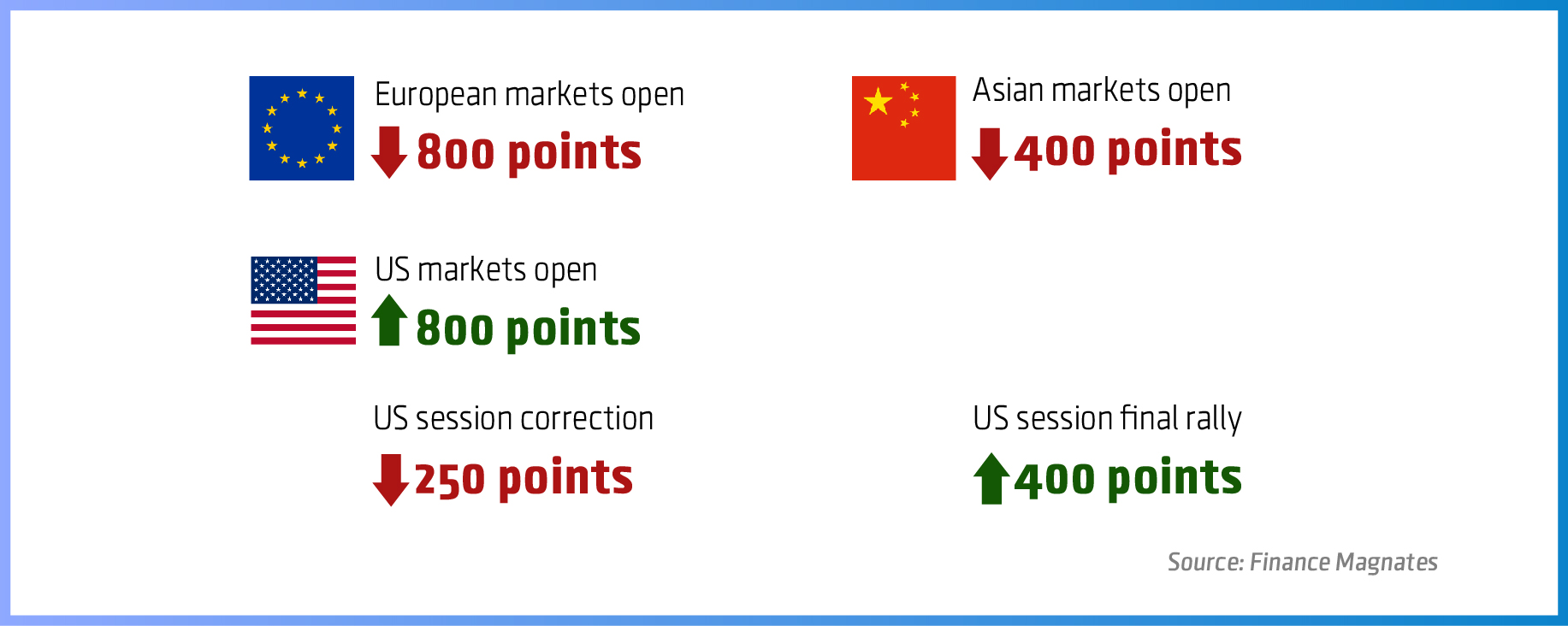
DJIA e-mini futures daily moves on Monday
What the industry has experienced on Monday could remain in history books, as the Dow Jones Industrial Average (DJIA) e-mini futures fluctuated over 4500 points during the day with massive volatility driving huge volumes across multiple asset classes. In contrast to the SNB turmoil in January, foreign exchange remained the most stable sector of the financial markets (as normally is the case).
Retail and institutional brokers performance
Commenting on the market developments several sources from the industry stated that they have seen their best day for the year, and for some it was their best day ever. Indeed, if we look from a historic perspective such massive volatility has been last observed during the great financial crisis of 2008 when it has become customary to see global stock indices fluctuating up or down over 5 per cent.
While some clients have managed to grow their accounts up to 10 times, others who have been performing solidly throughout the year have lost everything. With financial markets remaining a zero sum game, this should be the expected outcome. In fact if there was anything unexpected about these past couple of days its the timing.
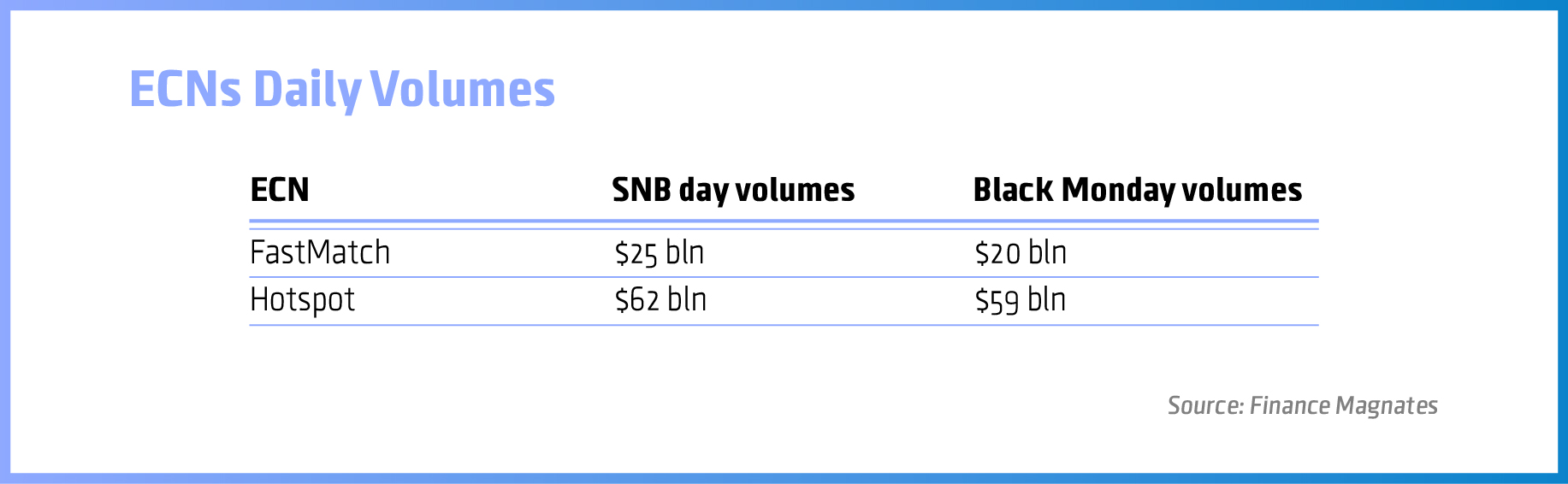
ECNs daily volumes comparison
The typical summer lull which normally settles in in July and August is normally constraining volumes. However this time its different - FastMatch registered its second best day for the year at just below $20 billion, while BATS owned Hotspot registered over $59 billion in transactions yesterday. Such figures can only be compared to the 15th of January, the day when the Swiss National Bank dropped the floor under the Swiss franc and induced industry losses of up to $1 billion.
How did the market turmoil happen?
A variety of factors have been affecting global stock markets, but the prevailing opinion around the industry is that Chinese economic woes are the primary reason for the global stock market collapse. According to John Murray who is Global Head of Sales and Business Development at London based City Credit Capital, the slowdown is primarily based on a real estate bubble.
Commenting on the matter he explained, “Real estate sales are like an addictive drug to an economy, every person involved in a real estate transaction, except the buyer, wants the price to go higher. The moment the purchase is complete, the buyer joins the rest of the team and wants the price to go higher. This in turn results in a “positive” for the economy, while in the meantime all participants are willingly making it a little more addicted to the real estate drug.”
“China’s manufacturing is slowing, the purchasing of the consumer is slowing and they are over leveraged on credit. The correction is needed and will come soon. The growth cannot continue at the pace we’ve seen and now the market is spoiled on the positive numbers,” he added.
Several indicators which are tracking volatility have hit alarming levels. The VIX index, which is measuring the volatility of the S&P500 has spiked higher to levels unseen since the post Lehman Brothers turmoil, while the VVIX, which is measuring the volatility of the VIX index has hit an all time high.
The VVIX traded as high as 150, which is substantially higher than in all turbulent times in previous years.
Some analysts have expressed certainty that volatility is here to stay, especially as further news about the state of the global economy start flowing in. Traders are looking actively at the major pairs since emerging markets currencies are still not attractive enough in terms of liquidity and spreads.
At the same time Chinese authorities are expressing some hopes, as the head of the PBOC research bureau Lu Lei said that the move of the central bank to reform the yuan central parity mechanism (read “devalue the renminbi”) will have an impact on the liquidity of the financial system and yesterday’s move by the monetary authorities on China should be sufficient to alleviate any pressure.
We are yet to see if that will indeed be the case, as Chinese stocks have fallen another 1.3 per cent on Wednesday completely reversing overnight gains.
The Black Monday in China, has been followed up by flash crashes in the U.S. and an unprecedented set of daily moves in equity indices. With the diversification of the bulk of the industry away from foreign exchange, a number of brokers have seen massive increases in trading volumes.
While some brokers have experienced their largest trading volumes in a single day ever, the state of client accounts has been wildly fluctuating. According to some firms from within the industry they have seen some customers multiplying their accounts up to 10 times, while others have lost substantial parts of their deposits or their whole balances.
As the turmoil continues we can’t say whether the most volatile part of this cycle is over. Chinese shares have continued to fluctuate wildly on Tuesday and Wednesday, even after the People’s Bank of China has cut rates and reserve requirement ratios, and the market appeared to be stabilizing for a time.
Wednesday appears to be a comparatively quiet day so far, but volatility persists as doubts about the ability of Chinese fiscal and monetary authorities to steer the second largest economy in the world continue growing.
DJIA e-mini futures daily moves on Monday
What the industry has experienced on Monday could remain in history books, as the Dow Jones Industrial Average (DJIA) e-mini futures fluctuated over 4500 points during the day with massive volatility driving huge volumes across multiple asset classes. In contrast to the SNB turmoil in January, foreign exchange remained the most stable sector of the financial markets (as normally is the case).
Retail and institutional brokers performance
Commenting on the market developments several sources from the industry stated that they have seen their best day for the year, and for some it was their best day ever. Indeed, if we look from a historic perspective such massive volatility has been last observed during the great financial crisis of 2008 when it has become customary to see global stock indices fluctuating up or down over 5 per cent.
While some clients have managed to grow their accounts up to 10 times, others who have been performing solidly throughout the year have lost everything. With financial markets remaining a zero sum game, this should be the expected outcome. In fact if there was anything unexpected about these past couple of days its the timing.
ECNs daily volumes comparison
The typical summer lull which normally settles in in July and August is normally constraining volumes. However this time its different - FastMatch registered its second best day for the year at just below $20 billion, while BATS owned Hotspot registered over $59 billion in transactions yesterday. Such figures can only be compared to the 15th of January, the day when the Swiss National Bank dropped the floor under the Swiss franc and induced industry losses of up to $1 billion.
How did the market turmoil happen?
A variety of factors have been affecting global stock markets, but the prevailing opinion around the industry is that Chinese economic woes are the primary reason for the global stock market collapse. According to John Murray who is Global Head of Sales and Business Development at London based City Credit Capital, the slowdown is primarily based on a real estate bubble.
Commenting on the matter he explained, “Real estate sales are like an addictive drug to an economy, every person involved in a real estate transaction, except the buyer, wants the price to go higher. The moment the purchase is complete, the buyer joins the rest of the team and wants the price to go higher. This in turn results in a “positive” for the economy, while in the meantime all participants are willingly making it a little more addicted to the real estate drug.”
“China’s manufacturing is slowing, the purchasing of the consumer is slowing and they are over leveraged on credit. The correction is needed and will come soon. The growth cannot continue at the pace we’ve seen and now the market is spoiled on the positive numbers,” he added.
Several indicators which are tracking volatility have hit alarming levels. The VIX index, which is measuring the volatility of the S&P500 has spiked higher to levels unseen since the post Lehman Brothers turmoil, while the VVIX, which is measuring the volatility of the VIX index has hit an all time high.
The VVIX traded as high as 150, which is substantially higher than in all turbulent times in previous years.
Some analysts have expressed certainty that volatility is here to stay, especially as further news about the state of the global economy start flowing in. Traders are looking actively at the major pairs since emerging markets currencies are still not attractive enough in terms of liquidity and spreads.
At the same time Chinese authorities are expressing some hopes, as the head of the PBOC research bureau Lu Lei said that the move of the central bank to reform the yuan central parity mechanism (read “devalue the renminbi”) will have an impact on the liquidity of the financial system and yesterday’s move by the monetary authorities on China should be sufficient to alleviate any pressure.
We are yet to see if that will indeed be the case, as Chinese stocks have fallen another 1.3 per cent on Wednesday completely reversing overnight gains.
In this conversation, we sit down with Drew Niv, CSO at ATFX Connect and one of the most influential figures in modern FX.
We speak about market structure, the institutional view on liquidity, and the sharp rise of prop trading, a sector Drew has been commenting on in recent months. Drew explains why he once dismissed prop trading, why his view changed, and what he now thinks the model means for brokers, clients and risk managers.
We explore subscription-fee dependency, the high reneging rate, and the long-term challenge: how brokers can build a more stable and honest version of the model. Drew also talks about the traffic advantage standalone prop firms have built and why brokers may still win in the long run if they take the right approach.
In this conversation, we sit down with Drew Niv, CSO at ATFX Connect and one of the most influential figures in modern FX.
We speak about market structure, the institutional view on liquidity, and the sharp rise of prop trading, a sector Drew has been commenting on in recent months. Drew explains why he once dismissed prop trading, why his view changed, and what he now thinks the model means for brokers, clients and risk managers.
We explore subscription-fee dependency, the high reneging rate, and the long-term challenge: how brokers can build a more stable and honest version of the model. Drew also talks about the traffic advantage standalone prop firms have built and why brokers may still win in the long run if they take the right approach.
In this conversation, we sit down with Drew Niv, CSO at ATFX Connect and one of the most influential figures in modern FX.
We speak about market structure, the institutional view on liquidity, and the sharp rise of prop trading, a sector Drew has been commenting on in recent months. Drew explains why he once dismissed prop trading, why his view changed, and what he now thinks the model means for brokers, clients and risk managers.
We explore subscription-fee dependency, the high reneging rate, and the long-term challenge: how brokers can build a more stable and honest version of the model. Drew also talks about the traffic advantage standalone prop firms have built and why brokers may still win in the long run if they take the right approach.
In this conversation, we sit down with Drew Niv, CSO at ATFX Connect and one of the most influential figures in modern FX.
We speak about market structure, the institutional view on liquidity, and the sharp rise of prop trading, a sector Drew has been commenting on in recent months. Drew explains why he once dismissed prop trading, why his view changed, and what he now thinks the model means for brokers, clients and risk managers.
We explore subscription-fee dependency, the high reneging rate, and the long-term challenge: how brokers can build a more stable and honest version of the model. Drew also talks about the traffic advantage standalone prop firms have built and why brokers may still win in the long run if they take the right approach.
Executive Interview | Remonda Z. Kirketerp Møller| CEO & Founder Muinmos | FMLS:25
In this interview, Remonda Z. Kirketerp Møller, founder of Muinmos, breaks down the state of AI in regtech and what responsible adoption really looks like for brokers. We talk about rising fragmentation, the pressures around compliance accuracy, and why most firms are still in the early stages of AI maturity.
Ramanda also shares insights on regulator sandboxes, shifting expectations around accountability, and the current reality of MiCA licensing and passporting in Europe.
A concise look at where compliance, onboarding, and AI-driven processes are heading next.
In this interview, Remonda Z. Kirketerp Møller, founder of Muinmos, breaks down the state of AI in regtech and what responsible adoption really looks like for brokers. We talk about rising fragmentation, the pressures around compliance accuracy, and why most firms are still in the early stages of AI maturity.
Ramanda also shares insights on regulator sandboxes, shifting expectations around accountability, and the current reality of MiCA licensing and passporting in Europe.
A concise look at where compliance, onboarding, and AI-driven processes are heading next.
In this interview, Remonda Z. Kirketerp Møller, founder of Muinmos, breaks down the state of AI in regtech and what responsible adoption really looks like for brokers. We talk about rising fragmentation, the pressures around compliance accuracy, and why most firms are still in the early stages of AI maturity.
Ramanda also shares insights on regulator sandboxes, shifting expectations around accountability, and the current reality of MiCA licensing and passporting in Europe.
A concise look at where compliance, onboarding, and AI-driven processes are heading next.
In this interview, Remonda Z. Kirketerp Møller, founder of Muinmos, breaks down the state of AI in regtech and what responsible adoption really looks like for brokers. We talk about rising fragmentation, the pressures around compliance accuracy, and why most firms are still in the early stages of AI maturity.
Ramanda also shares insights on regulator sandboxes, shifting expectations around accountability, and the current reality of MiCA licensing and passporting in Europe.
A concise look at where compliance, onboarding, and AI-driven processes are heading next.
In this interview, Remonda Z. Kirketerp Møller, founder of Muinmos, breaks down the state of AI in regtech and what responsible adoption really looks like for brokers. We talk about rising fragmentation, the pressures around compliance accuracy, and why most firms are still in the early stages of AI maturity.
Ramanda also shares insights on regulator sandboxes, shifting expectations around accountability, and the current reality of MiCA licensing and passporting in Europe.
A concise look at where compliance, onboarding, and AI-driven processes are heading next.
In this interview, Remonda Z. Kirketerp Møller, founder of Muinmos, breaks down the state of AI in regtech and what responsible adoption really looks like for brokers. We talk about rising fragmentation, the pressures around compliance accuracy, and why most firms are still in the early stages of AI maturity.
Ramanda also shares insights on regulator sandboxes, shifting expectations around accountability, and the current reality of MiCA licensing and passporting in Europe.
A concise look at where compliance, onboarding, and AI-driven processes are heading next.
In this conversation, we speak with Aydin Bonabi, CEO and co-founder of Surveill, a firm focused on fraud detection and AI-driven compliance tools for financial institutions.
We start with Aydin’s view of the Summit and the challenges brokers face as fraud tactics grow more complex. He explains how firms can stay ahead through real-time signals, data patterns, and early-stage detection.
We also talk about AI training and why compliance teams often struggle to keep models accurate, fair, and aligned with regulatory expectations. Aydin breaks down what “good” AI training looks like inside a financial environment, including the importance of clean data, domain expertise, and human oversight.
He closes with a clear message: fraud is scaling, and so must the tools that stop it.
In this conversation, we speak with Aydin Bonabi, CEO and co-founder of Surveill, a firm focused on fraud detection and AI-driven compliance tools for financial institutions.
We start with Aydin’s view of the Summit and the challenges brokers face as fraud tactics grow more complex. He explains how firms can stay ahead through real-time signals, data patterns, and early-stage detection.
We also talk about AI training and why compliance teams often struggle to keep models accurate, fair, and aligned with regulatory expectations. Aydin breaks down what “good” AI training looks like inside a financial environment, including the importance of clean data, domain expertise, and human oversight.
He closes with a clear message: fraud is scaling, and so must the tools that stop it.
In this conversation, we speak with Aydin Bonabi, CEO and co-founder of Surveill, a firm focused on fraud detection and AI-driven compliance tools for financial institutions.
We start with Aydin’s view of the Summit and the challenges brokers face as fraud tactics grow more complex. He explains how firms can stay ahead through real-time signals, data patterns, and early-stage detection.
We also talk about AI training and why compliance teams often struggle to keep models accurate, fair, and aligned with regulatory expectations. Aydin breaks down what “good” AI training looks like inside a financial environment, including the importance of clean data, domain expertise, and human oversight.
He closes with a clear message: fraud is scaling, and so must the tools that stop it.
In this conversation, we speak with Aydin Bonabi, CEO and co-founder of Surveill, a firm focused on fraud detection and AI-driven compliance tools for financial institutions.
We start with Aydin’s view of the Summit and the challenges brokers face as fraud tactics grow more complex. He explains how firms can stay ahead through real-time signals, data patterns, and early-stage detection.
We also talk about AI training and why compliance teams often struggle to keep models accurate, fair, and aligned with regulatory expectations. Aydin breaks down what “good” AI training looks like inside a financial environment, including the importance of clean data, domain expertise, and human oversight.
He closes with a clear message: fraud is scaling, and so must the tools that stop it.
In this conversation, we speak with Aydin Bonabi, CEO and co-founder of Surveill, a firm focused on fraud detection and AI-driven compliance tools for financial institutions.
We start with Aydin’s view of the Summit and the challenges brokers face as fraud tactics grow more complex. He explains how firms can stay ahead through real-time signals, data patterns, and early-stage detection.
We also talk about AI training and why compliance teams often struggle to keep models accurate, fair, and aligned with regulatory expectations. Aydin breaks down what “good” AI training looks like inside a financial environment, including the importance of clean data, domain expertise, and human oversight.
He closes with a clear message: fraud is scaling, and so must the tools that stop it.
In this conversation, we speak with Aydin Bonabi, CEO and co-founder of Surveill, a firm focused on fraud detection and AI-driven compliance tools for financial institutions.
We start with Aydin’s view of the Summit and the challenges brokers face as fraud tactics grow more complex. He explains how firms can stay ahead through real-time signals, data patterns, and early-stage detection.
We also talk about AI training and why compliance teams often struggle to keep models accurate, fair, and aligned with regulatory expectations. Aydin breaks down what “good” AI training looks like inside a financial environment, including the importance of clean data, domain expertise, and human oversight.
He closes with a clear message: fraud is scaling, and so must the tools that stop it.
Exness expands its presence in Africa: Inside our interview with Paul Margarites in Cape Town
Finance Magnates met with Paul Margarites, Exness regional commercial director for Sub-Saharan Africa, during a visit to the firm’s office opening in Cape Town. In this talk, led by Andrea Badiola Mateos, Co-CEO at Finance Magnates, Paul shares views on the South African trading space, local user behavior, mobile trends, regulation, team growth, and how Exness plans to grow in more markets across the region. @Exness
Read the article at: https://www.financemagnates.com/thought-leadership/exness-expands-its-presence-in-africa-inside-our-interview-with-paul-margarites/
#exness #financemagnates #exnesstrading #CFDtrading #tradeonline #africanews #capetown
Finance Magnates met with Paul Margarites, Exness regional commercial director for Sub-Saharan Africa, during a visit to the firm’s office opening in Cape Town. In this talk, led by Andrea Badiola Mateos, Co-CEO at Finance Magnates, Paul shares views on the South African trading space, local user behavior, mobile trends, regulation, team growth, and how Exness plans to grow in more markets across the region. @Exness
Read the article at: https://www.financemagnates.com/thought-leadership/exness-expands-its-presence-in-africa-inside-our-interview-with-paul-margarites/
#exness #financemagnates #exnesstrading #CFDtrading #tradeonline #africanews #capetown
Finance Magnates met with Paul Margarites, Exness regional commercial director for Sub-Saharan Africa, during a visit to the firm’s office opening in Cape Town. In this talk, led by Andrea Badiola Mateos, Co-CEO at Finance Magnates, Paul shares views on the South African trading space, local user behavior, mobile trends, regulation, team growth, and how Exness plans to grow in more markets across the region. @Exness
Read the article at: https://www.financemagnates.com/thought-leadership/exness-expands-its-presence-in-africa-inside-our-interview-with-paul-margarites/
#exness #financemagnates #exnesstrading #CFDtrading #tradeonline #africanews #capetown
Finance Magnates met with Paul Margarites, Exness regional commercial director for Sub-Saharan Africa, during a visit to the firm’s office opening in Cape Town. In this talk, led by Andrea Badiola Mateos, Co-CEO at Finance Magnates, Paul shares views on the South African trading space, local user behavior, mobile trends, regulation, team growth, and how Exness plans to grow in more markets across the region. @Exness
Read the article at: https://www.financemagnates.com/thought-leadership/exness-expands-its-presence-in-africa-inside-our-interview-with-paul-margarites/
#exness #financemagnates #exnesstrading #CFDtrading #tradeonline #africanews #capetown
Finance Magnates met with Paul Margarites, Exness regional commercial director for Sub-Saharan Africa, during a visit to the firm’s office opening in Cape Town. In this talk, led by Andrea Badiola Mateos, Co-CEO at Finance Magnates, Paul shares views on the South African trading space, local user behavior, mobile trends, regulation, team growth, and how Exness plans to grow in more markets across the region. @Exness
Read the article at: https://www.financemagnates.com/thought-leadership/exness-expands-its-presence-in-africa-inside-our-interview-with-paul-margarites/
#exness #financemagnates #exnesstrading #CFDtrading #tradeonline #africanews #capetown
Finance Magnates met with Paul Margarites, Exness regional commercial director for Sub-Saharan Africa, during a visit to the firm’s office opening in Cape Town. In this talk, led by Andrea Badiola Mateos, Co-CEO at Finance Magnates, Paul shares views on the South African trading space, local user behavior, mobile trends, regulation, team growth, and how Exness plans to grow in more markets across the region. @Exness
Read the article at: https://www.financemagnates.com/thought-leadership/exness-expands-its-presence-in-africa-inside-our-interview-with-paul-margarites/
#exness #financemagnates #exnesstrading #CFDtrading #tradeonline #africanews #capetown
Executive Interview | Jas Shah | FMLS:25
Interview with Jas Shah
Builder | Adviser | Fintech Writer | Product Strategist
In this episode, Jonathan Fine sat down with Jas Shah, one of the most thoughtful voices in global fintech. Known for his work across advisory, product, stablecoins, and his widely read writing, Jas brings a rare combination of industry insight and plain-spoken clarity.
We talk about his first impression of the Summit, the projects that keep him busy today, and how they connect to the stablecoin panel he joined. Jas shares his view on the link between fintech, wealthtech and retail brokers, especially as firms like Revolut, eToro and Trading212 blur long-standing lines in the market.
We also explore what stablecoin adoption might look like for retail investment platforms, including a few product and UX angles that are not obvious at first glance.
To close, Jas explains how he thinks about writing, and how he approaches “shipping” pieces that spark debate across the industry.
Interview with Jas Shah
Builder | Adviser | Fintech Writer | Product Strategist
In this episode, Jonathan Fine sat down with Jas Shah, one of the most thoughtful voices in global fintech. Known for his work across advisory, product, stablecoins, and his widely read writing, Jas brings a rare combination of industry insight and plain-spoken clarity.
We talk about his first impression of the Summit, the projects that keep him busy today, and how they connect to the stablecoin panel he joined. Jas shares his view on the link between fintech, wealthtech and retail brokers, especially as firms like Revolut, eToro and Trading212 blur long-standing lines in the market.
We also explore what stablecoin adoption might look like for retail investment platforms, including a few product and UX angles that are not obvious at first glance.
To close, Jas explains how he thinks about writing, and how he approaches “shipping” pieces that spark debate across the industry.
Interview with Jas Shah
Builder | Adviser | Fintech Writer | Product Strategist
In this episode, Jonathan Fine sat down with Jas Shah, one of the most thoughtful voices in global fintech. Known for his work across advisory, product, stablecoins, and his widely read writing, Jas brings a rare combination of industry insight and plain-spoken clarity.
We talk about his first impression of the Summit, the projects that keep him busy today, and how they connect to the stablecoin panel he joined. Jas shares his view on the link between fintech, wealthtech and retail brokers, especially as firms like Revolut, eToro and Trading212 blur long-standing lines in the market.
We also explore what stablecoin adoption might look like for retail investment platforms, including a few product and UX angles that are not obvious at first glance.
To close, Jas explains how he thinks about writing, and how he approaches “shipping” pieces that spark debate across the industry.
Interview with Jas Shah
Builder | Adviser | Fintech Writer | Product Strategist
In this episode, Jonathan Fine sat down with Jas Shah, one of the most thoughtful voices in global fintech. Known for his work across advisory, product, stablecoins, and his widely read writing, Jas brings a rare combination of industry insight and plain-spoken clarity.
We talk about his first impression of the Summit, the projects that keep him busy today, and how they connect to the stablecoin panel he joined. Jas shares his view on the link between fintech, wealthtech and retail brokers, especially as firms like Revolut, eToro and Trading212 blur long-standing lines in the market.
We also explore what stablecoin adoption might look like for retail investment platforms, including a few product and UX angles that are not obvious at first glance.
To close, Jas explains how he thinks about writing, and how he approaches “shipping” pieces that spark debate across the industry.
Interview with Jas Shah
Builder | Adviser | Fintech Writer | Product Strategist
In this episode, Jonathan Fine sat down with Jas Shah, one of the most thoughtful voices in global fintech. Known for his work across advisory, product, stablecoins, and his widely read writing, Jas brings a rare combination of industry insight and plain-spoken clarity.
We talk about his first impression of the Summit, the projects that keep him busy today, and how they connect to the stablecoin panel he joined. Jas shares his view on the link between fintech, wealthtech and retail brokers, especially as firms like Revolut, eToro and Trading212 blur long-standing lines in the market.
We also explore what stablecoin adoption might look like for retail investment platforms, including a few product and UX angles that are not obvious at first glance.
To close, Jas explains how he thinks about writing, and how he approaches “shipping” pieces that spark debate across the industry.
Interview with Jas Shah
Builder | Adviser | Fintech Writer | Product Strategist
In this episode, Jonathan Fine sat down with Jas Shah, one of the most thoughtful voices in global fintech. Known for his work across advisory, product, stablecoins, and his widely read writing, Jas brings a rare combination of industry insight and plain-spoken clarity.
We talk about his first impression of the Summit, the projects that keep him busy today, and how they connect to the stablecoin panel he joined. Jas shares his view on the link between fintech, wealthtech and retail brokers, especially as firms like Revolut, eToro and Trading212 blur long-standing lines in the market.
We also explore what stablecoin adoption might look like for retail investment platforms, including a few product and UX angles that are not obvious at first glance.
To close, Jas explains how he thinks about writing, and how he approaches “shipping” pieces that spark debate across the industry.