
FXCM ended a strong week by continuing its rally on Friday. This article examines the factors that may have helped.
Finance Magnates
Shares of embattled broker FXCM, finally experienced some love from investors after months of negative sentiment. The positive move began last Monday as shares rose over 50% to close at $8.08. The impetus was a statement from the broker that FXCM and Leucadia, which had provided $300 million in emergency funding in January, “remain committed to restructuring their existing Letter Agreement in a manner that is consistent with a sustainable long-term and value-enhancing strategy for both companies”.
In addition, the statement revealed the intentions of FXCM’s senior management to participate in stock purchases, along with the company’s own stock repurchase program. Putting their money where their mouth is, SEC statements showed that the management, headed by CEO and CFO Drew Niv and Robert Lande respectively, did in fact engage in stock purchases. This news led FXCM shares higher again on Wednesday, with the stock closing at $9.16 after briefly appearing above $10.00 for the first time since October.
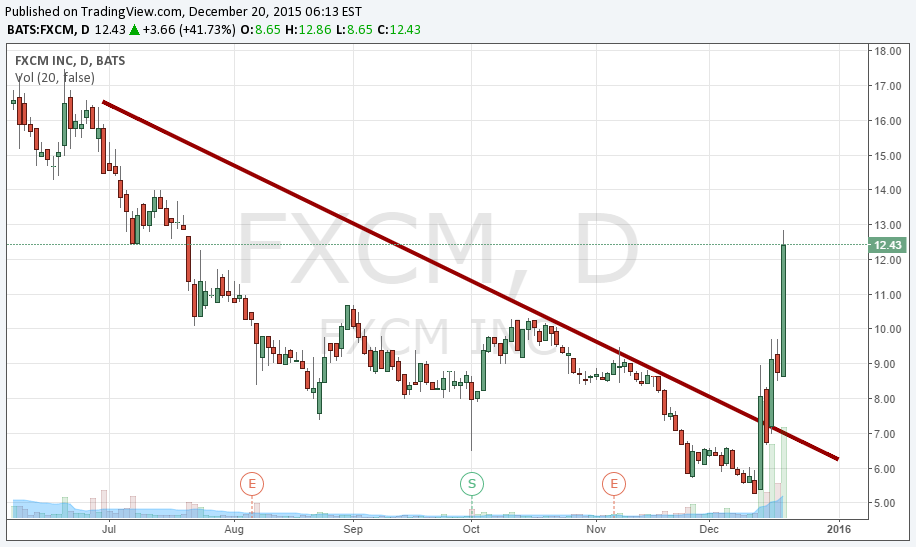
The week culminated in the largest dollar move on Friday as shares rallied $3.66, or 42% to close the week at $12.43. Unlike the week’s previous moves, the rally occurred without any specific company announcements. In addition, the performance was in contrast to the overall market, which saw the Dow Jones shed 367 points (2.1%).
Option expiration and technicals
In order to explain what triggered Friday’s move, we can look to two possible reasons: the day’s option expiries, and positive technical for the stock. In terms of the latter, the stock cleared several resistance levels such as the $8.72 and $10 mark that were viewed as key points by retail traders. Having earlier in the week popped out of a negative downtrend, the continued move higher is believed to have gained momentum, causing additional systems to become bullish on FXCM.
Beyond the technical momentum, Friday also represented Quadruple Witching for the stock markets. Occurring on the third Friday of March, June, September and December, these days see stock options, stock futures, index options and index futures all expire on the same day. The result is historically higher volatilities caused by the intra-day moves of traders adjusting portfolios to reflect expirations.
In terms of FXCM, the week’s move may have caught bearish traders who had sold calls or shorted the stock and led them to aggressively buy shares to cover option or margin obligations. In this regard, FXCM’s stock did see a spike in volumes, with over 2 million shares trading compared to their three month average of just below 200,000.
BATS IPO Plans
One fundamental driver that could be in play and may lead to value players becoming interested in FXCM was news that BATS Global Markets has filed intentions to go public. With their $365 million acquisition of Hotspot FX from KCG earlier in the year, the IPO filing provided more clarity on that deal. With FXCM putting its 35% stake of FastMatch, a Hotspot rival, on the market to cover a portion of its Leucadia debt, the BATS filing provides more clarity on valuations.
Among the key items revealed by BATS:
Hotspot 2014 revenues: $47.1 million
Hotspot 2014 Net Income: $12.3 million (Implies valuation of nearly 30x trailing income)
2015 Hotspot revenue capture: $3.01 per million traded (similar to FastMatch’s core commission)
Pipeline plans: May launch SEF to enter swap market and launch MTF in the UK
2015 results: $4 million net loss on $23.2 million in revenues for Hotspot since March acquisition
The figures point to a rich valuation put on Hotspot’s business with much of the paid value based on the FX ECN’s relationships and potential growth when combined with BATS. For FXCM, the Hotspot deal can be used as a proxy to value FastMatch. Using similar valuations, FXCM’s stake is FastMatch in slated to be worth between $45-$55 million.
Worth noting is that even after last week’s rally, the stock remains well below its post-SNB crisis level, let alone the $170 level it had traded around during the same period last year. However, the current momentum could see further gains thanks to improving fundamentals in the forex market.
Following a dull November, volumes have finally picked up again during December, in what is typically a weaker month. Public figures of trading from both FastMatch and Hotspot reveal that both venues are on pace to report a strong month of trading. For Hotspot, at an average of just above $30 billion in daily volumes, December is on pace to be the best month since May. At FastMatch, the venue is currently averaging over $10 billion in daily volume for the first time this year, with an average of $11.8 billion. If the figure holds, it would be the best month since November 2014.
For FXCM and other brokers, the volume increases taking place at publicly reporting venues bode well for their retail businesses. Due to a lack of clarity on the Fed’s coming actions, as well as whether the ECB would continue to be apply monetary stimulus policies, forex speculation among traders has declined.
However, with the ECB continuing to cut rates, and the Fed raising them for the first time since 2006 and signalling for further hikes in 2016, there is a clearer picture for traders. As such, we could see renewed speculation among traders for carry trades and other currency rate arbitrage strategies as they become more comfortable with the near term direction of global interest rates.
Shares of embattled broker FXCM, finally experienced some love from investors after months of negative sentiment. The positive move began last Monday as shares rose over 50% to close at $8.08. The impetus was a statement from the broker that FXCM and Leucadia, which had provided $300 million in emergency funding in January, “remain committed to restructuring their existing Letter Agreement in a manner that is consistent with a sustainable long-term and value-enhancing strategy for both companies”.
In addition, the statement revealed the intentions of FXCM’s senior management to participate in stock purchases, along with the company’s own stock repurchase program. Putting their money where their mouth is, SEC statements showed that the management, headed by CEO and CFO Drew Niv and Robert Lande respectively, did in fact engage in stock purchases. This news led FXCM shares higher again on Wednesday, with the stock closing at $9.16 after briefly appearing above $10.00 for the first time since October.
The week culminated in the largest dollar move on Friday as shares rallied $3.66, or 42% to close the week at $12.43. Unlike the week’s previous moves, the rally occurred without any specific company announcements. In addition, the performance was in contrast to the overall market, which saw the Dow Jones shed 367 points (2.1%).
Option expiration and technicals
In order to explain what triggered Friday’s move, we can look to two possible reasons: the day’s option expiries, and positive technical for the stock. In terms of the latter, the stock cleared several resistance levels such as the $8.72 and $10 mark that were viewed as key points by retail traders. Having earlier in the week popped out of a negative downtrend, the continued move higher is believed to have gained momentum, causing additional systems to become bullish on FXCM.
Beyond the technical momentum, Friday also represented Quadruple Witching for the stock markets. Occurring on the third Friday of March, June, September and December, these days see stock options, stock futures, index options and index futures all expire on the same day. The result is historically higher volatilities caused by the intra-day moves of traders adjusting portfolios to reflect expirations.
In terms of FXCM, the week’s move may have caught bearish traders who had sold calls or shorted the stock and led them to aggressively buy shares to cover option or margin obligations. In this regard, FXCM’s stock did see a spike in volumes, with over 2 million shares trading compared to their three month average of just below 200,000.
BATS IPO Plans
One fundamental driver that could be in play and may lead to value players becoming interested in FXCM was news that BATS Global Markets has filed intentions to go public. With their $365 million acquisition of Hotspot FX from KCG earlier in the year, the IPO filing provided more clarity on that deal. With FXCM putting its 35% stake of FastMatch, a Hotspot rival, on the market to cover a portion of its Leucadia debt, the BATS filing provides more clarity on valuations.
Among the key items revealed by BATS:
Hotspot 2014 revenues: $47.1 million
Hotspot 2014 Net Income: $12.3 million (Implies valuation of nearly 30x trailing income)
2015 Hotspot revenue capture: $3.01 per million traded (similar to FastMatch’s core commission)
Pipeline plans: May launch SEF to enter swap market and launch MTF in the UK
2015 results: $4 million net loss on $23.2 million in revenues for Hotspot since March acquisition
The figures point to a rich valuation put on Hotspot’s business with much of the paid value based on the FX ECN’s relationships and potential growth when combined with BATS. For FXCM, the Hotspot deal can be used as a proxy to value FastMatch. Using similar valuations, FXCM’s stake is FastMatch in slated to be worth between $45-$55 million.
Worth noting is that even after last week’s rally, the stock remains well below its post-SNB crisis level, let alone the $170 level it had traded around during the same period last year. However, the current momentum could see further gains thanks to improving fundamentals in the forex market.
Following a dull November, volumes have finally picked up again during December, in what is typically a weaker month. Public figures of trading from both FastMatch and Hotspot reveal that both venues are on pace to report a strong month of trading. For Hotspot, at an average of just above $30 billion in daily volumes, December is on pace to be the best month since May. At FastMatch, the venue is currently averaging over $10 billion in daily volume for the first time this year, with an average of $11.8 billion. If the figure holds, it would be the best month since November 2014.
For FXCM and other brokers, the volume increases taking place at publicly reporting venues bode well for their retail businesses. Due to a lack of clarity on the Fed’s coming actions, as well as whether the ECB would continue to be apply monetary stimulus policies, forex speculation among traders has declined.
However, with the ECB continuing to cut rates, and the Fed raising them for the first time since 2006 and signalling for further hikes in 2016, there is a clearer picture for traders. As such, we could see renewed speculation among traders for carry trades and other currency rate arbitrage strategies as they become more comfortable with the near term direction of global interest rates.
In this conversation, we sit down with Drew Niv, CSO at ATFX Connect and one of the most influential figures in modern FX.
We speak about market structure, the institutional view on liquidity, and the sharp rise of prop trading, a sector Drew has been commenting on in recent months. Drew explains why he once dismissed prop trading, why his view changed, and what he now thinks the model means for brokers, clients and risk managers.
We explore subscription-fee dependency, the high reneging rate, and the long-term challenge: how brokers can build a more stable and honest version of the model. Drew also talks about the traffic advantage standalone prop firms have built and why brokers may still win in the long run if they take the right approach.
In this conversation, we sit down with Drew Niv, CSO at ATFX Connect and one of the most influential figures in modern FX.
We speak about market structure, the institutional view on liquidity, and the sharp rise of prop trading, a sector Drew has been commenting on in recent months. Drew explains why he once dismissed prop trading, why his view changed, and what he now thinks the model means for brokers, clients and risk managers.
We explore subscription-fee dependency, the high reneging rate, and the long-term challenge: how brokers can build a more stable and honest version of the model. Drew also talks about the traffic advantage standalone prop firms have built and why brokers may still win in the long run if they take the right approach.
In this conversation, we sit down with Drew Niv, CSO at ATFX Connect and one of the most influential figures in modern FX.
We speak about market structure, the institutional view on liquidity, and the sharp rise of prop trading, a sector Drew has been commenting on in recent months. Drew explains why he once dismissed prop trading, why his view changed, and what he now thinks the model means for brokers, clients and risk managers.
We explore subscription-fee dependency, the high reneging rate, and the long-term challenge: how brokers can build a more stable and honest version of the model. Drew also talks about the traffic advantage standalone prop firms have built and why brokers may still win in the long run if they take the right approach.
In this conversation, we sit down with Drew Niv, CSO at ATFX Connect and one of the most influential figures in modern FX.
We speak about market structure, the institutional view on liquidity, and the sharp rise of prop trading, a sector Drew has been commenting on in recent months. Drew explains why he once dismissed prop trading, why his view changed, and what he now thinks the model means for brokers, clients and risk managers.
We explore subscription-fee dependency, the high reneging rate, and the long-term challenge: how brokers can build a more stable and honest version of the model. Drew also talks about the traffic advantage standalone prop firms have built and why brokers may still win in the long run if they take the right approach.
Executive Interview | Remonda Z. Kirketerp Møller| CEO & Founder Muinmos | FMLS:25
In this interview, Remonda Z. Kirketerp Møller, founder of Muinmos, breaks down the state of AI in regtech and what responsible adoption really looks like for brokers. We talk about rising fragmentation, the pressures around compliance accuracy, and why most firms are still in the early stages of AI maturity.
Ramanda also shares insights on regulator sandboxes, shifting expectations around accountability, and the current reality of MiCA licensing and passporting in Europe.
A concise look at where compliance, onboarding, and AI-driven processes are heading next.
In this interview, Remonda Z. Kirketerp Møller, founder of Muinmos, breaks down the state of AI in regtech and what responsible adoption really looks like for brokers. We talk about rising fragmentation, the pressures around compliance accuracy, and why most firms are still in the early stages of AI maturity.
Ramanda also shares insights on regulator sandboxes, shifting expectations around accountability, and the current reality of MiCA licensing and passporting in Europe.
A concise look at where compliance, onboarding, and AI-driven processes are heading next.
In this interview, Remonda Z. Kirketerp Møller, founder of Muinmos, breaks down the state of AI in regtech and what responsible adoption really looks like for brokers. We talk about rising fragmentation, the pressures around compliance accuracy, and why most firms are still in the early stages of AI maturity.
Ramanda also shares insights on regulator sandboxes, shifting expectations around accountability, and the current reality of MiCA licensing and passporting in Europe.
A concise look at where compliance, onboarding, and AI-driven processes are heading next.
In this interview, Remonda Z. Kirketerp Møller, founder of Muinmos, breaks down the state of AI in regtech and what responsible adoption really looks like for brokers. We talk about rising fragmentation, the pressures around compliance accuracy, and why most firms are still in the early stages of AI maturity.
Ramanda also shares insights on regulator sandboxes, shifting expectations around accountability, and the current reality of MiCA licensing and passporting in Europe.
A concise look at where compliance, onboarding, and AI-driven processes are heading next.
In this interview, Remonda Z. Kirketerp Møller, founder of Muinmos, breaks down the state of AI in regtech and what responsible adoption really looks like for brokers. We talk about rising fragmentation, the pressures around compliance accuracy, and why most firms are still in the early stages of AI maturity.
Ramanda also shares insights on regulator sandboxes, shifting expectations around accountability, and the current reality of MiCA licensing and passporting in Europe.
A concise look at where compliance, onboarding, and AI-driven processes are heading next.
In this interview, Remonda Z. Kirketerp Møller, founder of Muinmos, breaks down the state of AI in regtech and what responsible adoption really looks like for brokers. We talk about rising fragmentation, the pressures around compliance accuracy, and why most firms are still in the early stages of AI maturity.
Ramanda also shares insights on regulator sandboxes, shifting expectations around accountability, and the current reality of MiCA licensing and passporting in Europe.
A concise look at where compliance, onboarding, and AI-driven processes are heading next.
In this conversation, we speak with Aydin Bonabi, CEO and co-founder of Surveill, a firm focused on fraud detection and AI-driven compliance tools for financial institutions.
We start with Aydin’s view of the Summit and the challenges brokers face as fraud tactics grow more complex. He explains how firms can stay ahead through real-time signals, data patterns, and early-stage detection.
We also talk about AI training and why compliance teams often struggle to keep models accurate, fair, and aligned with regulatory expectations. Aydin breaks down what “good” AI training looks like inside a financial environment, including the importance of clean data, domain expertise, and human oversight.
He closes with a clear message: fraud is scaling, and so must the tools that stop it.
In this conversation, we speak with Aydin Bonabi, CEO and co-founder of Surveill, a firm focused on fraud detection and AI-driven compliance tools for financial institutions.
We start with Aydin’s view of the Summit and the challenges brokers face as fraud tactics grow more complex. He explains how firms can stay ahead through real-time signals, data patterns, and early-stage detection.
We also talk about AI training and why compliance teams often struggle to keep models accurate, fair, and aligned with regulatory expectations. Aydin breaks down what “good” AI training looks like inside a financial environment, including the importance of clean data, domain expertise, and human oversight.
He closes with a clear message: fraud is scaling, and so must the tools that stop it.
In this conversation, we speak with Aydin Bonabi, CEO and co-founder of Surveill, a firm focused on fraud detection and AI-driven compliance tools for financial institutions.
We start with Aydin’s view of the Summit and the challenges brokers face as fraud tactics grow more complex. He explains how firms can stay ahead through real-time signals, data patterns, and early-stage detection.
We also talk about AI training and why compliance teams often struggle to keep models accurate, fair, and aligned with regulatory expectations. Aydin breaks down what “good” AI training looks like inside a financial environment, including the importance of clean data, domain expertise, and human oversight.
He closes with a clear message: fraud is scaling, and so must the tools that stop it.
In this conversation, we speak with Aydin Bonabi, CEO and co-founder of Surveill, a firm focused on fraud detection and AI-driven compliance tools for financial institutions.
We start with Aydin’s view of the Summit and the challenges brokers face as fraud tactics grow more complex. He explains how firms can stay ahead through real-time signals, data patterns, and early-stage detection.
We also talk about AI training and why compliance teams often struggle to keep models accurate, fair, and aligned with regulatory expectations. Aydin breaks down what “good” AI training looks like inside a financial environment, including the importance of clean data, domain expertise, and human oversight.
He closes with a clear message: fraud is scaling, and so must the tools that stop it.
In this conversation, we speak with Aydin Bonabi, CEO and co-founder of Surveill, a firm focused on fraud detection and AI-driven compliance tools for financial institutions.
We start with Aydin’s view of the Summit and the challenges brokers face as fraud tactics grow more complex. He explains how firms can stay ahead through real-time signals, data patterns, and early-stage detection.
We also talk about AI training and why compliance teams often struggle to keep models accurate, fair, and aligned with regulatory expectations. Aydin breaks down what “good” AI training looks like inside a financial environment, including the importance of clean data, domain expertise, and human oversight.
He closes with a clear message: fraud is scaling, and so must the tools that stop it.
In this conversation, we speak with Aydin Bonabi, CEO and co-founder of Surveill, a firm focused on fraud detection and AI-driven compliance tools for financial institutions.
We start with Aydin’s view of the Summit and the challenges brokers face as fraud tactics grow more complex. He explains how firms can stay ahead through real-time signals, data patterns, and early-stage detection.
We also talk about AI training and why compliance teams often struggle to keep models accurate, fair, and aligned with regulatory expectations. Aydin breaks down what “good” AI training looks like inside a financial environment, including the importance of clean data, domain expertise, and human oversight.
He closes with a clear message: fraud is scaling, and so must the tools that stop it.
Exness expands its presence in Africa: Inside our interview with Paul Margarites in Cape Town
Finance Magnates met with Paul Margarites, Exness regional commercial director for Sub-Saharan Africa, during a visit to the firm’s office opening in Cape Town. In this talk, led by Andrea Badiola Mateos, Co-CEO at Finance Magnates, Paul shares views on the South African trading space, local user behavior, mobile trends, regulation, team growth, and how Exness plans to grow in more markets across the region. @Exness
Read the article at: https://www.financemagnates.com/thought-leadership/exness-expands-its-presence-in-africa-inside-our-interview-with-paul-margarites/
#exness #financemagnates #exnesstrading #CFDtrading #tradeonline #africanews #capetown
Finance Magnates met with Paul Margarites, Exness regional commercial director for Sub-Saharan Africa, during a visit to the firm’s office opening in Cape Town. In this talk, led by Andrea Badiola Mateos, Co-CEO at Finance Magnates, Paul shares views on the South African trading space, local user behavior, mobile trends, regulation, team growth, and how Exness plans to grow in more markets across the region. @Exness
Read the article at: https://www.financemagnates.com/thought-leadership/exness-expands-its-presence-in-africa-inside-our-interview-with-paul-margarites/
#exness #financemagnates #exnesstrading #CFDtrading #tradeonline #africanews #capetown
Finance Magnates met with Paul Margarites, Exness regional commercial director for Sub-Saharan Africa, during a visit to the firm’s office opening in Cape Town. In this talk, led by Andrea Badiola Mateos, Co-CEO at Finance Magnates, Paul shares views on the South African trading space, local user behavior, mobile trends, regulation, team growth, and how Exness plans to grow in more markets across the region. @Exness
Read the article at: https://www.financemagnates.com/thought-leadership/exness-expands-its-presence-in-africa-inside-our-interview-with-paul-margarites/
#exness #financemagnates #exnesstrading #CFDtrading #tradeonline #africanews #capetown
Finance Magnates met with Paul Margarites, Exness regional commercial director for Sub-Saharan Africa, during a visit to the firm’s office opening in Cape Town. In this talk, led by Andrea Badiola Mateos, Co-CEO at Finance Magnates, Paul shares views on the South African trading space, local user behavior, mobile trends, regulation, team growth, and how Exness plans to grow in more markets across the region. @Exness
Read the article at: https://www.financemagnates.com/thought-leadership/exness-expands-its-presence-in-africa-inside-our-interview-with-paul-margarites/
#exness #financemagnates #exnesstrading #CFDtrading #tradeonline #africanews #capetown
Finance Magnates met with Paul Margarites, Exness regional commercial director for Sub-Saharan Africa, during a visit to the firm’s office opening in Cape Town. In this talk, led by Andrea Badiola Mateos, Co-CEO at Finance Magnates, Paul shares views on the South African trading space, local user behavior, mobile trends, regulation, team growth, and how Exness plans to grow in more markets across the region. @Exness
Read the article at: https://www.financemagnates.com/thought-leadership/exness-expands-its-presence-in-africa-inside-our-interview-with-paul-margarites/
#exness #financemagnates #exnesstrading #CFDtrading #tradeonline #africanews #capetown
Finance Magnates met with Paul Margarites, Exness regional commercial director for Sub-Saharan Africa, during a visit to the firm’s office opening in Cape Town. In this talk, led by Andrea Badiola Mateos, Co-CEO at Finance Magnates, Paul shares views on the South African trading space, local user behavior, mobile trends, regulation, team growth, and how Exness plans to grow in more markets across the region. @Exness
Read the article at: https://www.financemagnates.com/thought-leadership/exness-expands-its-presence-in-africa-inside-our-interview-with-paul-margarites/
#exness #financemagnates #exnesstrading #CFDtrading #tradeonline #africanews #capetown
Executive Interview | Jas Shah | FMLS:25
Interview with Jas Shah
Builder | Adviser | Fintech Writer | Product Strategist
In this episode, Jonathan Fine sat down with Jas Shah, one of the most thoughtful voices in global fintech. Known for his work across advisory, product, stablecoins, and his widely read writing, Jas brings a rare combination of industry insight and plain-spoken clarity.
We talk about his first impression of the Summit, the projects that keep him busy today, and how they connect to the stablecoin panel he joined. Jas shares his view on the link between fintech, wealthtech and retail brokers, especially as firms like Revolut, eToro and Trading212 blur long-standing lines in the market.
We also explore what stablecoin adoption might look like for retail investment platforms, including a few product and UX angles that are not obvious at first glance.
To close, Jas explains how he thinks about writing, and how he approaches “shipping” pieces that spark debate across the industry.
Interview with Jas Shah
Builder | Adviser | Fintech Writer | Product Strategist
In this episode, Jonathan Fine sat down with Jas Shah, one of the most thoughtful voices in global fintech. Known for his work across advisory, product, stablecoins, and his widely read writing, Jas brings a rare combination of industry insight and plain-spoken clarity.
We talk about his first impression of the Summit, the projects that keep him busy today, and how they connect to the stablecoin panel he joined. Jas shares his view on the link between fintech, wealthtech and retail brokers, especially as firms like Revolut, eToro and Trading212 blur long-standing lines in the market.
We also explore what stablecoin adoption might look like for retail investment platforms, including a few product and UX angles that are not obvious at first glance.
To close, Jas explains how he thinks about writing, and how he approaches “shipping” pieces that spark debate across the industry.
Interview with Jas Shah
Builder | Adviser | Fintech Writer | Product Strategist
In this episode, Jonathan Fine sat down with Jas Shah, one of the most thoughtful voices in global fintech. Known for his work across advisory, product, stablecoins, and his widely read writing, Jas brings a rare combination of industry insight and plain-spoken clarity.
We talk about his first impression of the Summit, the projects that keep him busy today, and how they connect to the stablecoin panel he joined. Jas shares his view on the link between fintech, wealthtech and retail brokers, especially as firms like Revolut, eToro and Trading212 blur long-standing lines in the market.
We also explore what stablecoin adoption might look like for retail investment platforms, including a few product and UX angles that are not obvious at first glance.
To close, Jas explains how he thinks about writing, and how he approaches “shipping” pieces that spark debate across the industry.
Interview with Jas Shah
Builder | Adviser | Fintech Writer | Product Strategist
In this episode, Jonathan Fine sat down with Jas Shah, one of the most thoughtful voices in global fintech. Known for his work across advisory, product, stablecoins, and his widely read writing, Jas brings a rare combination of industry insight and plain-spoken clarity.
We talk about his first impression of the Summit, the projects that keep him busy today, and how they connect to the stablecoin panel he joined. Jas shares his view on the link between fintech, wealthtech and retail brokers, especially as firms like Revolut, eToro and Trading212 blur long-standing lines in the market.
We also explore what stablecoin adoption might look like for retail investment platforms, including a few product and UX angles that are not obvious at first glance.
To close, Jas explains how he thinks about writing, and how he approaches “shipping” pieces that spark debate across the industry.
Interview with Jas Shah
Builder | Adviser | Fintech Writer | Product Strategist
In this episode, Jonathan Fine sat down with Jas Shah, one of the most thoughtful voices in global fintech. Known for his work across advisory, product, stablecoins, and his widely read writing, Jas brings a rare combination of industry insight and plain-spoken clarity.
We talk about his first impression of the Summit, the projects that keep him busy today, and how they connect to the stablecoin panel he joined. Jas shares his view on the link between fintech, wealthtech and retail brokers, especially as firms like Revolut, eToro and Trading212 blur long-standing lines in the market.
We also explore what stablecoin adoption might look like for retail investment platforms, including a few product and UX angles that are not obvious at first glance.
To close, Jas explains how he thinks about writing, and how he approaches “shipping” pieces that spark debate across the industry.
Interview with Jas Shah
Builder | Adviser | Fintech Writer | Product Strategist
In this episode, Jonathan Fine sat down with Jas Shah, one of the most thoughtful voices in global fintech. Known for his work across advisory, product, stablecoins, and his widely read writing, Jas brings a rare combination of industry insight and plain-spoken clarity.
We talk about his first impression of the Summit, the projects that keep him busy today, and how they connect to the stablecoin panel he joined. Jas shares his view on the link between fintech, wealthtech and retail brokers, especially as firms like Revolut, eToro and Trading212 blur long-standing lines in the market.
We also explore what stablecoin adoption might look like for retail investment platforms, including a few product and UX angles that are not obvious at first glance.
To close, Jas explains how he thinks about writing, and how he approaches “shipping” pieces that spark debate across the industry.