Telling IPO documents of IronFX show an attempt at a new business model that initially generated huge trading volumes… what went wrong?
Finance Magnates
Few industry insiders have remained unfamiliar with the story of IronFX. The Cyprus headquartered brokerage has been making headlines as its operations were impacted by complaints from Chinese IBs. The firm's Chinese offices were stormed by angry clients demanding their withdrawals back in the beginning of 2015.
Subsequent reports from additional clients with pending withdrawal requests have also been circulating around the web. The company, however, claims that it has been conducting business in line with its terms and conditions, maintaining that the clients are responsible for any misconduct by themselves not adhering to these terms and conditions.
IronFX has repeatedly stated that the company is experiencing ongoing issues with a group of traders who have been abusing its promotions system. Regarding clients with pending withdrawals, they claim to be innocent of any wrongdoing, even reporting instances where some customers claim unsettled withdrawal requests immediately after depositing their funds.
It would be most enlightening to discover what really happened to this company, whose reputation has suffered greatly as a consequence of critical web reviews and the complaints launched by CySEC and the Cypriot Financial Ombudsman.
Some internal IPO documents which were obtained by Finance Magnates have shed some light on the situation.
The IronFX Business Model
Back in 2010, when the company started its operations, the firm chose a different approach than most market players at the time. With an extensive team of “account managers”, the brokerage relied upon developing a strong relationship with its clients, which in theory should have resulted in higher deposit rates.
At the same time, the firm picked a market maker model of operation allowing it to capture a bigger part of the revenue than any agency broker would be able to book. With the trades starting to flow into the retail foreign exchange market, the approach initially worked quite well for the company.
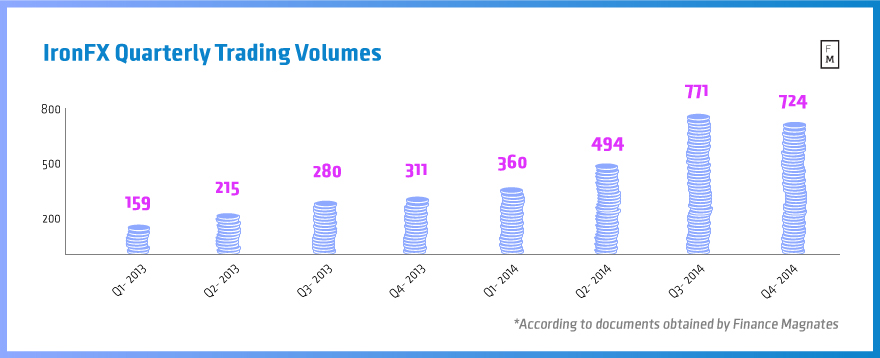
Aided by the opening of multiple company offices across the globe, IronFX managed to achieve enviable growth figures. Internal IPO documents which were obtained by Finance Magnates showed that at its peak in the third-quarter of 2014, the company’s turnover totaled over $770 billion.
Note that the trading volumes shown below were generated with 1:500 leverage and with bonuses of up to 100 percent on top of the original deposit of the client. With the considerable marketing costs attached to maintaining so many employees, competitions, sponsorship and advertisement, the trading volumes at IronFX would have had to continue perpetually growing, a trend that was reversed in the last quarter of 2014.
IronFX Quarterly Trading Volumes
Bonus, Bonus, Bonus
Bearing in mind the volumes which were registered by the brokerage, it is interesting to observe the evolution of the business model. While in the beginning, the bonus promotions worked just fine and new depositors were incoming, at some point clients stopped depositing.
The tactic that IronFX used to prevent this from happening was to increase the amount of bonuses. Despite the conditions attached to bonus withdrawals, the clients who had opened multiple accounts with the same conditions effectively managed to hedge their risks in the big trend environment in which major pairs had been trading last year.
Clients Labeled as Bonus Abusers
Consider this: you and your spouse open two accounts in June of 2014, both of you get a bonus and you take different directions on the market. One is long the EUR/USD, the other is short the EUR/USD. Both of the accounts utilize substantial margin levels.
In the case of the EUR/USD move last year, a person who opened a 1,000,000 position which is warranted with a 2,000 EUR (assuming the leverage is 1:500) in the account could face two outcomes - losing those 2,000 EUR and the remaining principle on the account if the trader was long EUR/USD, or gaining $1,500,000 by December (assuming you entered at 1.35 and closed at 1.20).
With the company identifying the trickery the Chinese clients had become particularly partial to, it chose to label them as bonus abusers and deny the repayment of their funds. The damage to the reputation of the brokerage was a surprise for the company, as the news spread quickly and more withdrawal requests started to flow in. The reputation of IronFX started to precede it and trickled down to the day to day operations of the company. Client after client, complaint after complaint, the efforts of the marketing department and the account managers started to lose their influence.
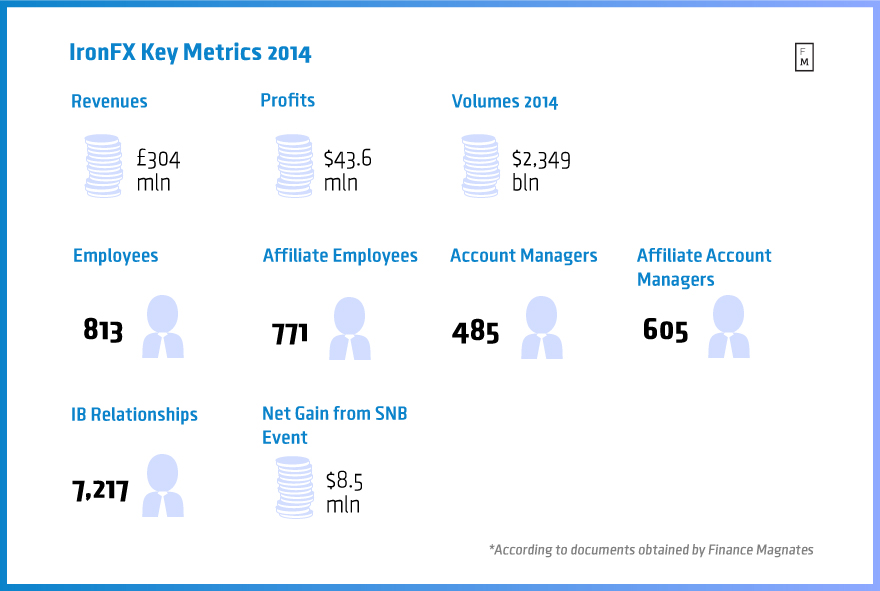
Key 2014 data facts found in the IPO documents that are the source of this article
The company has openly claimed that it is generally internalizing about 90 percent of its flow.
According to the data obtained by Finance Magnates, the company boasts 813 employees, 771 affiliate employees, 485 account managers, 605 affiliate account managers, 7217 introducing broker relationships, and its revenues for 2014 totaled $304 million with profits exceeding $43 million. These figures are taken from its operational peak in 2014, before the big downsizing of its business and office closures in 2015.
How will the company tackle the difficult situation in which it has found itself ? Only time will tell - hopefully there will be a fair resolution for all clients of the company who haven’t abused its promotions, and for the broker itself.
Few industry insiders have remained unfamiliar with the story of IronFX. The Cyprus headquartered brokerage has been making headlines as its operations were impacted by complaints from Chinese IBs. The firm's Chinese offices were stormed by angry clients demanding their withdrawals back in the beginning of 2015.
Subsequent reports from additional clients with pending withdrawal requests have also been circulating around the web. The company, however, claims that it has been conducting business in line with its terms and conditions, maintaining that the clients are responsible for any misconduct by themselves not adhering to these terms and conditions.
IronFX has repeatedly stated that the company is experiencing ongoing issues with a group of traders who have been abusing its promotions system. Regarding clients with pending withdrawals, they claim to be innocent of any wrongdoing, even reporting instances where some customers claim unsettled withdrawal requests immediately after depositing their funds.
It would be most enlightening to discover what really happened to this company, whose reputation has suffered greatly as a consequence of critical web reviews and the complaints launched by CySEC and the Cypriot Financial Ombudsman.
Some internal IPO documents which were obtained by Finance Magnates have shed some light on the situation.
The IronFX Business Model
Back in 2010, when the company started its operations, the firm chose a different approach than most market players at the time. With an extensive team of “account managers”, the brokerage relied upon developing a strong relationship with its clients, which in theory should have resulted in higher deposit rates.
At the same time, the firm picked a market maker model of operation allowing it to capture a bigger part of the revenue than any agency broker would be able to book. With the trades starting to flow into the retail foreign exchange market, the approach initially worked quite well for the company.
Aided by the opening of multiple company offices across the globe, IronFX managed to achieve enviable growth figures. Internal IPO documents which were obtained by Finance Magnates showed that at its peak in the third-quarter of 2014, the company’s turnover totaled over $770 billion.
Note that the trading volumes shown below were generated with 1:500 leverage and with bonuses of up to 100 percent on top of the original deposit of the client. With the considerable marketing costs attached to maintaining so many employees, competitions, sponsorship and advertisement, the trading volumes at IronFX would have had to continue perpetually growing, a trend that was reversed in the last quarter of 2014.
IronFX Quarterly Trading Volumes
Bonus, Bonus, Bonus
Bearing in mind the volumes which were registered by the brokerage, it is interesting to observe the evolution of the business model. While in the beginning, the bonus promotions worked just fine and new depositors were incoming, at some point clients stopped depositing.
The tactic that IronFX used to prevent this from happening was to increase the amount of bonuses. Despite the conditions attached to bonus withdrawals, the clients who had opened multiple accounts with the same conditions effectively managed to hedge their risks in the big trend environment in which major pairs had been trading last year.
Clients Labeled as Bonus Abusers
Consider this: you and your spouse open two accounts in June of 2014, both of you get a bonus and you take different directions on the market. One is long the EUR/USD, the other is short the EUR/USD. Both of the accounts utilize substantial margin levels.
In the case of the EUR/USD move last year, a person who opened a 1,000,000 position which is warranted with a 2,000 EUR (assuming the leverage is 1:500) in the account could face two outcomes - losing those 2,000 EUR and the remaining principle on the account if the trader was long EUR/USD, or gaining $1,500,000 by December (assuming you entered at 1.35 and closed at 1.20).
With the company identifying the trickery the Chinese clients had become particularly partial to, it chose to label them as bonus abusers and deny the repayment of their funds. The damage to the reputation of the brokerage was a surprise for the company, as the news spread quickly and more withdrawal requests started to flow in. The reputation of IronFX started to precede it and trickled down to the day to day operations of the company. Client after client, complaint after complaint, the efforts of the marketing department and the account managers started to lose their influence.
Key 2014 data facts found in the IPO documents that are the source of this article
The company has openly claimed that it is generally internalizing about 90 percent of its flow.
According to the data obtained by Finance Magnates, the company boasts 813 employees, 771 affiliate employees, 485 account managers, 605 affiliate account managers, 7217 introducing broker relationships, and its revenues for 2014 totaled $304 million with profits exceeding $43 million. These figures are taken from its operational peak in 2014, before the big downsizing of its business and office closures in 2015.
How will the company tackle the difficult situation in which it has found itself ? Only time will tell - hopefully there will be a fair resolution for all clients of the company who haven’t abused its promotions, and for the broker itself.
Italy’s Consob Tightens Net on AI-Fueled Scams With Fresh Website Bans
Featured Videos
FP Markets Winner Spotlight 🏆 | Global Broker of the Year 2025 #Trading #Broker #Innovation #Shorts
FP Markets Winner Spotlight 🏆 | Global Broker of the Year 2025 #Trading #Broker #Innovation #Shorts
FP Markets Winner Spotlight 🏆 | Global Broker of the Year 2025 #Trading #Broker #Innovation #Shorts
FP Markets Winner Spotlight 🏆 | Global Broker of the Year 2025 #Trading #Broker #Innovation #Shorts
FP Markets takes the spotlight as Global Broker of the Year 2025 at the Finance Magnates Awards.
Martin Stoilov, Head of Client Experience, shares that trust, innovation, and people played a key role in the company’s success, supported by a strong foundation of integrity and client-centricity.
Following this milestone, FP Markets continues to focus on growth, technology investment, and its core values of transparency and excellence.
👉 Be part of FM Awards 2026: https://awards.financemagnates.com/#nominate
FP Markets takes the spotlight as Global Broker of the Year 2025 at the Finance Magnates Awards.
Martin Stoilov, Head of Client Experience, shares that trust, innovation, and people played a key role in the company’s success, supported by a strong foundation of integrity and client-centricity.
Following this milestone, FP Markets continues to focus on growth, technology investment, and its core values of transparency and excellence.
👉 Be part of FM Awards 2026: https://awards.financemagnates.com/#nominate
FP Markets takes the spotlight as Global Broker of the Year 2025 at the Finance Magnates Awards.
Martin Stoilov, Head of Client Experience, shares that trust, innovation, and people played a key role in the company’s success, supported by a strong foundation of integrity and client-centricity.
Following this milestone, FP Markets continues to focus on growth, technology investment, and its core values of transparency and excellence.
👉 Be part of FM Awards 2026: https://awards.financemagnates.com/#nominate
FP Markets takes the spotlight as Global Broker of the Year 2025 at the Finance Magnates Awards.
Martin Stoilov, Head of Client Experience, shares that trust, innovation, and people played a key role in the company’s success, supported by a strong foundation of integrity and client-centricity.
Following this milestone, FP Markets continues to focus on growth, technology investment, and its core values of transparency and excellence.
👉 Be part of FM Awards 2026: https://awards.financemagnates.com/#nominate
In this video, we review @HolaPrimeMarketsOfficial, a multi-asset forex and CFDs broker offering different account types, trading platforms, and flexible trading conditions.
We cover the broker’s overall offering, including account options, trading environment, platforms like MT4 and MT5, and additional services such as managed accounts and fast withdrawals.
Watch the full video to see if Hola Prime Markets fits your trading needs.
📣 Stay up to date with the latest in finance and trading. Follow Finance Magnates for industry news, insights, and global event coverage.
Connect with us:
🔗 LinkedIn: /financemagnates
👍 Facebook: /financemagnates
📸 Instagram: https://www.instagram.com/financemagnates
🐦 X: https://x.com/financemagnates
🎥 TikTok: https://www.tiktok.com/tag/financemagnates
▶️ YouTube: /@financemagnates_official
#HolaPrime #ForexBroker #CFDTrading #FinanceMagnates #Trading #Forex #BrokerReview
In this video, we review @HolaPrimeMarketsOfficial, a multi-asset forex and CFDs broker offering different account types, trading platforms, and flexible trading conditions.
We cover the broker’s overall offering, including account options, trading environment, platforms like MT4 and MT5, and additional services such as managed accounts and fast withdrawals.
Watch the full video to see if Hola Prime Markets fits your trading needs.
📣 Stay up to date with the latest in finance and trading. Follow Finance Magnates for industry news, insights, and global event coverage.
Connect with us:
🔗 LinkedIn: /financemagnates
👍 Facebook: /financemagnates
📸 Instagram: https://www.instagram.com/financemagnates
🐦 X: https://x.com/financemagnates
🎥 TikTok: https://www.tiktok.com/tag/financemagnates
▶️ YouTube: /@financemagnates_official
#HolaPrime #ForexBroker #CFDTrading #FinanceMagnates #Trading #Forex #BrokerReview
In this video, we review @HolaPrimeMarketsOfficial, a multi-asset forex and CFDs broker offering different account types, trading platforms, and flexible trading conditions.
We cover the broker’s overall offering, including account options, trading environment, platforms like MT4 and MT5, and additional services such as managed accounts and fast withdrawals.
Watch the full video to see if Hola Prime Markets fits your trading needs.
📣 Stay up to date with the latest in finance and trading. Follow Finance Magnates for industry news, insights, and global event coverage.
Connect with us:
🔗 LinkedIn: /financemagnates
👍 Facebook: /financemagnates
📸 Instagram: https://www.instagram.com/financemagnates
🐦 X: https://x.com/financemagnates
🎥 TikTok: https://www.tiktok.com/tag/financemagnates
▶️ YouTube: /@financemagnates_official
#HolaPrime #ForexBroker #CFDTrading #FinanceMagnates #Trading #Forex #BrokerReview
In this video, we review @HolaPrimeMarketsOfficial, a multi-asset forex and CFDs broker offering different account types, trading platforms, and flexible trading conditions.
We cover the broker’s overall offering, including account options, trading environment, platforms like MT4 and MT5, and additional services such as managed accounts and fast withdrawals.
Watch the full video to see if Hola Prime Markets fits your trading needs.
📣 Stay up to date with the latest in finance and trading. Follow Finance Magnates for industry news, insights, and global event coverage.
Connect with us:
🔗 LinkedIn: /financemagnates
👍 Facebook: /financemagnates
📸 Instagram: https://www.instagram.com/financemagnates
🐦 X: https://x.com/financemagnates
🎥 TikTok: https://www.tiktok.com/tag/financemagnates
▶️ YouTube: /@financemagnates_official
#HolaPrime #ForexBroker #CFDTrading #FinanceMagnates #Trading #Forex #BrokerReview
In this video, we review @HolaPrimeMarketsOfficial, a multi-asset forex and CFDs broker offering different account types, trading platforms, and flexible trading conditions.
We cover the broker’s overall offering, including account options, trading environment, platforms like MT4 and MT5, and additional services such as managed accounts and fast withdrawals.
Watch the full video to see if Hola Prime Markets fits your trading needs.
📣 Stay up to date with the latest in finance and trading. Follow Finance Magnates for industry news, insights, and global event coverage.
Connect with us:
🔗 LinkedIn: /financemagnates
👍 Facebook: /financemagnates
📸 Instagram: https://www.instagram.com/financemagnates
🐦 X: https://x.com/financemagnates
🎥 TikTok: https://www.tiktok.com/tag/financemagnates
▶️ YouTube: /@financemagnates_official
#HolaPrime #ForexBroker #CFDTrading #FinanceMagnates #Trading #Forex #BrokerReview
In this video, we review @HolaPrimeMarketsOfficial, a multi-asset forex and CFDs broker offering different account types, trading platforms, and flexible trading conditions.
We cover the broker’s overall offering, including account options, trading environment, platforms like MT4 and MT5, and additional services such as managed accounts and fast withdrawals.
Watch the full video to see if Hola Prime Markets fits your trading needs.
📣 Stay up to date with the latest in finance and trading. Follow Finance Magnates for industry news, insights, and global event coverage.
Connect with us:
🔗 LinkedIn: /financemagnates
👍 Facebook: /financemagnates
📸 Instagram: https://www.instagram.com/financemagnates
🐦 X: https://x.com/financemagnates
🎥 TikTok: https://www.tiktok.com/tag/financemagnates
▶️ YouTube: /@financemagnates_official
#HolaPrime #ForexBroker #CFDTrading #FinanceMagnates #Trading #Forex #BrokerReview
Hola Prime Review: What You Need to Know | Full Breakdown by Finance Magnates
Hola Prime Review: What You Need to Know | Full Breakdown by Finance Magnates
Hola Prime Review: What You Need to Know | Full Breakdown by Finance Magnates
Hola Prime Review: What You Need to Know | Full Breakdown by Finance Magnates
Hola Prime Review: What You Need to Know | Full Breakdown by Finance Magnates
Hola Prime Review: What You Need to Know | Full Breakdown by Finance Magnates
In this video, we review @HolaPrime_Global, a proprietary trading firm offering evaluation programs and performance-based payouts in simulated market environments.
We cover how the challenge model works, including account types, profit splits (up to 95%), trading rules, and what it takes to reach a funded account. You’ll also learn about available platforms like MT4, MT5, cTrader, and more, along with insights into payouts, support, and trading conditions.
Watch the full video to see if Hola Prime fits your trading style.
📣 Stay up to date with the latest in finance and trading. Follow Finance Magnates for industry news, insights, and global event coverage.
Connect with us:
🔗 LinkedIn: /financemagnates
👍 Facebook: /financemagnates
📸 Instagram: https://www.instagram.com/financemagnates
🐦 X: https://x.com/financemagnates
🎥 TikTok: https://www.tiktok.com/tag/financemagnates
▶️ YouTube: /@financemagnates_official
#HolaPrime #PropFirm #Trading #FinanceMagnates #Forex #FuturesTrading #TradingReview #PropFirmReview
In this video, we review @HolaPrime_Global, a proprietary trading firm offering evaluation programs and performance-based payouts in simulated market environments.
We cover how the challenge model works, including account types, profit splits (up to 95%), trading rules, and what it takes to reach a funded account. You’ll also learn about available platforms like MT4, MT5, cTrader, and more, along with insights into payouts, support, and trading conditions.
Watch the full video to see if Hola Prime fits your trading style.
📣 Stay up to date with the latest in finance and trading. Follow Finance Magnates for industry news, insights, and global event coverage.
Connect with us:
🔗 LinkedIn: /financemagnates
👍 Facebook: /financemagnates
📸 Instagram: https://www.instagram.com/financemagnates
🐦 X: https://x.com/financemagnates
🎥 TikTok: https://www.tiktok.com/tag/financemagnates
▶️ YouTube: /@financemagnates_official
#HolaPrime #PropFirm #Trading #FinanceMagnates #Forex #FuturesTrading #TradingReview #PropFirmReview
In this video, we review @HolaPrime_Global, a proprietary trading firm offering evaluation programs and performance-based payouts in simulated market environments.
We cover how the challenge model works, including account types, profit splits (up to 95%), trading rules, and what it takes to reach a funded account. You’ll also learn about available platforms like MT4, MT5, cTrader, and more, along with insights into payouts, support, and trading conditions.
Watch the full video to see if Hola Prime fits your trading style.
📣 Stay up to date with the latest in finance and trading. Follow Finance Magnates for industry news, insights, and global event coverage.
Connect with us:
🔗 LinkedIn: /financemagnates
👍 Facebook: /financemagnates
📸 Instagram: https://www.instagram.com/financemagnates
🐦 X: https://x.com/financemagnates
🎥 TikTok: https://www.tiktok.com/tag/financemagnates
▶️ YouTube: /@financemagnates_official
#HolaPrime #PropFirm #Trading #FinanceMagnates #Forex #FuturesTrading #TradingReview #PropFirmReview
In this video, we review @HolaPrime_Global, a proprietary trading firm offering evaluation programs and performance-based payouts in simulated market environments.
We cover how the challenge model works, including account types, profit splits (up to 95%), trading rules, and what it takes to reach a funded account. You’ll also learn about available platforms like MT4, MT5, cTrader, and more, along with insights into payouts, support, and trading conditions.
Watch the full video to see if Hola Prime fits your trading style.
📣 Stay up to date with the latest in finance and trading. Follow Finance Magnates for industry news, insights, and global event coverage.
Connect with us:
🔗 LinkedIn: /financemagnates
👍 Facebook: /financemagnates
📸 Instagram: https://www.instagram.com/financemagnates
🐦 X: https://x.com/financemagnates
🎥 TikTok: https://www.tiktok.com/tag/financemagnates
▶️ YouTube: /@financemagnates_official
#HolaPrime #PropFirm #Trading #FinanceMagnates #Forex #FuturesTrading #TradingReview #PropFirmReview
In this video, we review @HolaPrime_Global, a proprietary trading firm offering evaluation programs and performance-based payouts in simulated market environments.
We cover how the challenge model works, including account types, profit splits (up to 95%), trading rules, and what it takes to reach a funded account. You’ll also learn about available platforms like MT4, MT5, cTrader, and more, along with insights into payouts, support, and trading conditions.
Watch the full video to see if Hola Prime fits your trading style.
📣 Stay up to date with the latest in finance and trading. Follow Finance Magnates for industry news, insights, and global event coverage.
Connect with us:
🔗 LinkedIn: /financemagnates
👍 Facebook: /financemagnates
📸 Instagram: https://www.instagram.com/financemagnates
🐦 X: https://x.com/financemagnates
🎥 TikTok: https://www.tiktok.com/tag/financemagnates
▶️ YouTube: /@financemagnates_official
#HolaPrime #PropFirm #Trading #FinanceMagnates #Forex #FuturesTrading #TradingReview #PropFirmReview
In this video, we review @HolaPrime_Global, a proprietary trading firm offering evaluation programs and performance-based payouts in simulated market environments.
We cover how the challenge model works, including account types, profit splits (up to 95%), trading rules, and what it takes to reach a funded account. You’ll also learn about available platforms like MT4, MT5, cTrader, and more, along with insights into payouts, support, and trading conditions.
Watch the full video to see if Hola Prime fits your trading style.
📣 Stay up to date with the latest in finance and trading. Follow Finance Magnates for industry news, insights, and global event coverage.
Connect with us:
🔗 LinkedIn: /financemagnates
👍 Facebook: /financemagnates
📸 Instagram: https://www.instagram.com/financemagnates
🐦 X: https://x.com/financemagnates
🎥 TikTok: https://www.tiktok.com/tag/financemagnates
▶️ YouTube: /@financemagnates_official
#HolaPrime #PropFirm #Trading #FinanceMagnates #Forex #FuturesTrading #TradingReview #PropFirmReview
Axi Winner Spotlight 🏆 | Global Most Innovative Broker 2025 #Innovation #Trading #Fintech #Broker
Axi Winner Spotlight 🏆 | Global Most Innovative Broker 2025 #Innovation #Trading #Fintech #Broker
Axi Winner Spotlight 🏆 | Global Most Innovative Broker 2025 #Innovation #Trading #Fintech #Broker
Axi Winner Spotlight 🏆 | Global Most Innovative Broker 2025 #Innovation #Trading #Fintech #Broker
Axi Winner Spotlight 🏆 | Global Most Innovative Broker 2025 #Innovation #Trading #Fintech #Broker
Axi Winner Spotlight 🏆 | Global Most Innovative Broker 2025 #Innovation #Trading #Fintech #Broker
Axi takes the spotlight at the Finance Magnates Awards, winning Global Most Innovative Broker 2025.
Olivia Xenofontos and Ivanna Openko share how the team will feel: proud, motivated, and ready to keep delivering.
They also describe the night as well-organized, focused, and enjoyable for all.
👉 Be part of FM Awards 2026.
Axi takes the spotlight at the Finance Magnates Awards, winning Global Most Innovative Broker 2025.
Olivia Xenofontos and Ivanna Openko share how the team will feel: proud, motivated, and ready to keep delivering.
They also describe the night as well-organized, focused, and enjoyable for all.
👉 Be part of FM Awards 2026.
Axi takes the spotlight at the Finance Magnates Awards, winning Global Most Innovative Broker 2025.
Olivia Xenofontos and Ivanna Openko share how the team will feel: proud, motivated, and ready to keep delivering.
They also describe the night as well-organized, focused, and enjoyable for all.
👉 Be part of FM Awards 2026.
Axi takes the spotlight at the Finance Magnates Awards, winning Global Most Innovative Broker 2025.
Olivia Xenofontos and Ivanna Openko share how the team will feel: proud, motivated, and ready to keep delivering.
They also describe the night as well-organized, focused, and enjoyable for all.
👉 Be part of FM Awards 2026.
Axi takes the spotlight at the Finance Magnates Awards, winning Global Most Innovative Broker 2025.
Olivia Xenofontos and Ivanna Openko share how the team will feel: proud, motivated, and ready to keep delivering.
They also describe the night as well-organized, focused, and enjoyable for all.
👉 Be part of FM Awards 2026.
Axi takes the spotlight at the Finance Magnates Awards, winning Global Most Innovative Broker 2025.
Olivia Xenofontos and Ivanna Openko share how the team will feel: proud, motivated, and ready to keep delivering.
They also describe the night as well-organized, focused, and enjoyable for all.
👉 Be part of FM Awards 2026.
Recognition that matters.
Built on transparency.
Driven by the industry.
The Finance Magnates Awards 2026.
Nominations are now open.
🔗 https://awards.financemagnates.com/?utm_source=SM&utm_medium=social&utm_campaign=recognition-matters
Recognition that matters.
Built on transparency.
Driven by the industry.
The Finance Magnates Awards 2026.
Nominations are now open.
🔗 https://awards.financemagnates.com/?utm_source=SM&utm_medium=social&utm_campaign=recognition-matters
Recognition that matters.
Built on transparency.
Driven by the industry.
The Finance Magnates Awards 2026.
Nominations are now open.
🔗 https://awards.financemagnates.com/?utm_source=SM&utm_medium=social&utm_campaign=recognition-matters
Recognition that matters.
Built on transparency.
Driven by the industry.
The Finance Magnates Awards 2026.
Nominations are now open.
🔗 https://awards.financemagnates.com/?utm_source=SM&utm_medium=social&utm_campaign=recognition-matters
Recognition that matters.
Built on transparency.
Driven by the industry.
The Finance Magnates Awards 2026.
Nominations are now open.
🔗 https://awards.financemagnates.com/?utm_source=SM&utm_medium=social&utm_campaign=recognition-matters
Recognition that matters.
Built on transparency.
Driven by the industry.
The Finance Magnates Awards 2026.
Nominations are now open.
🔗 https://awards.financemagnates.com/?utm_source=SM&utm_medium=social&utm_campaign=recognition-matters