The CEO of Node40 and the Director of Finance at Dash talk about the reasons for the cryptocurrency's breakout.
Finance Magnates
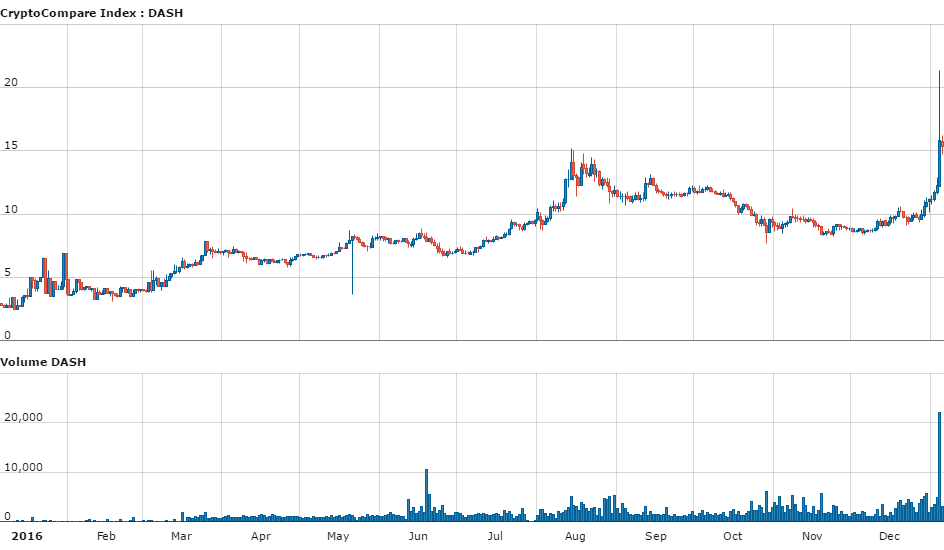
While everyone is focusing on the current Bitcoin rally, the privacy focused cryptocurrency Dash has experienced amazing growth of its own. The DASH/USD exchange rate has shot up over 56% over last week alone, bringing the price to around $16 now and the overall market value to $112 million.
The CEO of one of the biggest server hosting providers for the network, Node40, and the Director of Finance at Dash told us about the reasons they see for the cryptocurrency's breakout and its latest software update, Sentinel (12.1).
Ryan Taylor, Director of Finance at Dash
What do you attribute the overnight surge to?
While we are seeing increased interest from China, most of the speculation on the reasons for the surge seems to center around the announced release date for the next version of our software. The new version is the largest release in over a year, and will introduce a number of improvements, particularly for merchants.
Most notably, we are introducing the first decentralized network interface, which enables developers to integrate a website, application, or register software directly with the network in an incredibly simple and secure way. The release also incorporates many other “under the hood” firsts for digital currencies, such as the first proof-of-service implementation and the first object-oriented governance system. The “under the hood” changes won’t immediately improve the user experience, but are foundational elements for our Evolution release later this year, which aims to make using cryptocurrency incredibly easy to use. We like to say that it should be so easy that your grandma could use it. Right now, the industry is a long way from that vision, but Dash is very focused on bringing that to reality.
In general, I think the market is recognizing that we are building on our proven track record of innovation and delivering yet another set of amazing technologies. By announcing that these technologies are robustly tested and ready for release, I think a higher valuation is justified. As we continue executing our strategy of making cryptocurrency easy to use for merchants and consumers, we believe the upward trajectory will continue.
Why do you expect this tremendous growth to continue?
Our initial governance and self-funding system served as an amazing advantage for us throughout 2016, as our market cap grew 289%… much faster than the industry as a whole. However, as we set our sights higher and aim for mass adoption, we know we needed a system that can effectively scale. Sentinel is our answer, and lays the foundation for a scalable system with which we can adapt much more rapidly than before. In short, our next release lays the foundation for a highly-scalable, highly-flexible, and rapidly adaptable system that allows our development to accelerate rapidly.
What else is in store for 2017?
We have some incredible partnerships in the pipeline that unfortunately are still pre-announcement. But you will begin to see partnerships with some of the largest players in the industry this year, and notable institutions becoming supporters of the project as well. Around the end of the year, our flagship effort Evolution is slated for release, which we believe will permanently transform the cryptocurrency user experience as profoundly as the web browser transformed the experience of the Internet.
One of the things I’m most excited about is the opening of our headquarters in Scottsdale, Arizona on February 1st. Our offices will be located in beautiful LEED-certified class A office space at SkySong - Arizona State University’s Innovation Center. I’m not aware of any other cryptocurrency with self-funded office space, so I believe that’s another industry first. We believe a professional working space for our team will bring enormous productivity, credibility, and value to the project.
Perry Woodin, founder and CEO of Node40
What do you attribute Dash's overnight surge to?

Perry Woodin, Founder, Node40
All of the top-tier cryptocurrencies are surging at the moment. With Bitcoin breaking records, we have the case of a rising tide lifting all boats. The past 48 hours has been impressive for Dash in part due to an official release schedule for Dash 12.1.x posted by Evan Duffield on Monday the 2nd. I also think the latest article by Brian Armstrong of Coinbase is contributing to the rise. Here we have one of the best known CEOs in the space coming out and stating that Bitcoin is not going to fill the role of a day-to-day transactional currency. Armstrong sees Bitcoin as "the reserve currency of the digital currency space.” If this becomes the accepted position, then you are going to see Dash continue to grow. With the ongoing development of Dash Evolution, it is only a matter of time before others see the utility offered by Dash.
How does Node40 benefit from this surge?
The surge leads to increased exposure. Whenever there are breakouts like today, we see an influx in the number of signups at Node40 from people interested in learning more about Dash. From a practical perspective, a surge allows us to realize an upside profit. Most of our customers pay us in Dash and we hold for as long as possible before exchanging to US dollars. When we see a surge in price, it takes the burden off of paying our vendors.
Do you believe in the latest Dash update and why?
For most users, 12.1 may not look like a significant update. Some of Dash’s core features will be a bit more polished, but what’s important about 12.1 is it lays the foundation for Dash Evolution. Having spent a great deal of time working with 12.1 in a test environment, I am very impressed with the changes. It is really impressive how the core development team has used 12.1 to bridge the gap between what Dash is now and what it will become with Evolution.
While everyone is focusing on the current Bitcoin rally, the privacy focused cryptocurrency Dash has experienced amazing growth of its own. The DASH/USD exchange rate has shot up over 56% over last week alone, bringing the price to around $16 now and the overall market value to $112 million.
The CEO of one of the biggest server hosting providers for the network, Node40, and the Director of Finance at Dash told us about the reasons they see for the cryptocurrency's breakout and its latest software update, Sentinel (12.1).
Ryan Taylor, Director of Finance at Dash
What do you attribute the overnight surge to?
While we are seeing increased interest from China, most of the speculation on the reasons for the surge seems to center around the announced release date for the next version of our software. The new version is the largest release in over a year, and will introduce a number of improvements, particularly for merchants.
Most notably, we are introducing the first decentralized network interface, which enables developers to integrate a website, application, or register software directly with the network in an incredibly simple and secure way. The release also incorporates many other “under the hood” firsts for digital currencies, such as the first proof-of-service implementation and the first object-oriented governance system. The “under the hood” changes won’t immediately improve the user experience, but are foundational elements for our Evolution release later this year, which aims to make using cryptocurrency incredibly easy to use. We like to say that it should be so easy that your grandma could use it. Right now, the industry is a long way from that vision, but Dash is very focused on bringing that to reality.
In general, I think the market is recognizing that we are building on our proven track record of innovation and delivering yet another set of amazing technologies. By announcing that these technologies are robustly tested and ready for release, I think a higher valuation is justified. As we continue executing our strategy of making cryptocurrency easy to use for merchants and consumers, we believe the upward trajectory will continue.
Why do you expect this tremendous growth to continue?
Our initial governance and self-funding system served as an amazing advantage for us throughout 2016, as our market cap grew 289%… much faster than the industry as a whole. However, as we set our sights higher and aim for mass adoption, we know we needed a system that can effectively scale. Sentinel is our answer, and lays the foundation for a scalable system with which we can adapt much more rapidly than before. In short, our next release lays the foundation for a highly-scalable, highly-flexible, and rapidly adaptable system that allows our development to accelerate rapidly.
What else is in store for 2017?
We have some incredible partnerships in the pipeline that unfortunately are still pre-announcement. But you will begin to see partnerships with some of the largest players in the industry this year, and notable institutions becoming supporters of the project as well. Around the end of the year, our flagship effort Evolution is slated for release, which we believe will permanently transform the cryptocurrency user experience as profoundly as the web browser transformed the experience of the Internet.
One of the things I’m most excited about is the opening of our headquarters in Scottsdale, Arizona on February 1st. Our offices will be located in beautiful LEED-certified class A office space at SkySong - Arizona State University’s Innovation Center. I’m not aware of any other cryptocurrency with self-funded office space, so I believe that’s another industry first. We believe a professional working space for our team will bring enormous productivity, credibility, and value to the project.
Perry Woodin, founder and CEO of Node40
What do you attribute Dash's overnight surge to?
Perry Woodin, Founder, Node40
All of the top-tier cryptocurrencies are surging at the moment. With Bitcoin breaking records, we have the case of a rising tide lifting all boats. The past 48 hours has been impressive for Dash in part due to an official release schedule for Dash 12.1.x posted by Evan Duffield on Monday the 2nd. I also think the latest article by Brian Armstrong of Coinbase is contributing to the rise. Here we have one of the best known CEOs in the space coming out and stating that Bitcoin is not going to fill the role of a day-to-day transactional currency. Armstrong sees Bitcoin as "the reserve currency of the digital currency space.” If this becomes the accepted position, then you are going to see Dash continue to grow. With the ongoing development of Dash Evolution, it is only a matter of time before others see the utility offered by Dash.
How does Node40 benefit from this surge?
The surge leads to increased exposure. Whenever there are breakouts like today, we see an influx in the number of signups at Node40 from people interested in learning more about Dash. From a practical perspective, a surge allows us to realize an upside profit. Most of our customers pay us in Dash and we hold for as long as possible before exchanging to US dollars. When we see a surge in price, it takes the burden off of paying our vendors.
Do you believe in the latest Dash update and why?
For most users, 12.1 may not look like a significant update. Some of Dash’s core features will be a bit more polished, but what’s important about 12.1 is it lays the foundation for Dash Evolution. Having spent a great deal of time working with 12.1 in a test environment, I am very impressed with the changes. It is really impressive how the core development team has used 12.1 to bridge the gap between what Dash is now and what it will become with Evolution.
In this conversation, we sit down with Drew Niv, CSO at ATFX Connect and one of the most influential figures in modern FX.
We speak about market structure, the institutional view on liquidity, and the sharp rise of prop trading, a sector Drew has been commenting on in recent months. Drew explains why he once dismissed prop trading, why his view changed, and what he now thinks the model means for brokers, clients and risk managers.
We explore subscription-fee dependency, the high reneging rate, and the long-term challenge: how brokers can build a more stable and honest version of the model. Drew also talks about the traffic advantage standalone prop firms have built and why brokers may still win in the long run if they take the right approach.
In this conversation, we sit down with Drew Niv, CSO at ATFX Connect and one of the most influential figures in modern FX.
We speak about market structure, the institutional view on liquidity, and the sharp rise of prop trading, a sector Drew has been commenting on in recent months. Drew explains why he once dismissed prop trading, why his view changed, and what he now thinks the model means for brokers, clients and risk managers.
We explore subscription-fee dependency, the high reneging rate, and the long-term challenge: how brokers can build a more stable and honest version of the model. Drew also talks about the traffic advantage standalone prop firms have built and why brokers may still win in the long run if they take the right approach.
In this conversation, we sit down with Drew Niv, CSO at ATFX Connect and one of the most influential figures in modern FX.
We speak about market structure, the institutional view on liquidity, and the sharp rise of prop trading, a sector Drew has been commenting on in recent months. Drew explains why he once dismissed prop trading, why his view changed, and what he now thinks the model means for brokers, clients and risk managers.
We explore subscription-fee dependency, the high reneging rate, and the long-term challenge: how brokers can build a more stable and honest version of the model. Drew also talks about the traffic advantage standalone prop firms have built and why brokers may still win in the long run if they take the right approach.
In this conversation, we sit down with Drew Niv, CSO at ATFX Connect and one of the most influential figures in modern FX.
We speak about market structure, the institutional view on liquidity, and the sharp rise of prop trading, a sector Drew has been commenting on in recent months. Drew explains why he once dismissed prop trading, why his view changed, and what he now thinks the model means for brokers, clients and risk managers.
We explore subscription-fee dependency, the high reneging rate, and the long-term challenge: how brokers can build a more stable and honest version of the model. Drew also talks about the traffic advantage standalone prop firms have built and why brokers may still win in the long run if they take the right approach.
Executive Interview | Remonda Z. Kirketerp Møller| CEO & Founder Muinmos | FMLS:25
In this interview, Remonda Z. Kirketerp Møller, founder of Muinmos, breaks down the state of AI in regtech and what responsible adoption really looks like for brokers. We talk about rising fragmentation, the pressures around compliance accuracy, and why most firms are still in the early stages of AI maturity.
Ramanda also shares insights on regulator sandboxes, shifting expectations around accountability, and the current reality of MiCA licensing and passporting in Europe.
A concise look at where compliance, onboarding, and AI-driven processes are heading next.
In this interview, Remonda Z. Kirketerp Møller, founder of Muinmos, breaks down the state of AI in regtech and what responsible adoption really looks like for brokers. We talk about rising fragmentation, the pressures around compliance accuracy, and why most firms are still in the early stages of AI maturity.
Ramanda also shares insights on regulator sandboxes, shifting expectations around accountability, and the current reality of MiCA licensing and passporting in Europe.
A concise look at where compliance, onboarding, and AI-driven processes are heading next.
In this interview, Remonda Z. Kirketerp Møller, founder of Muinmos, breaks down the state of AI in regtech and what responsible adoption really looks like for brokers. We talk about rising fragmentation, the pressures around compliance accuracy, and why most firms are still in the early stages of AI maturity.
Ramanda also shares insights on regulator sandboxes, shifting expectations around accountability, and the current reality of MiCA licensing and passporting in Europe.
A concise look at where compliance, onboarding, and AI-driven processes are heading next.
In this interview, Remonda Z. Kirketerp Møller, founder of Muinmos, breaks down the state of AI in regtech and what responsible adoption really looks like for brokers. We talk about rising fragmentation, the pressures around compliance accuracy, and why most firms are still in the early stages of AI maturity.
Ramanda also shares insights on regulator sandboxes, shifting expectations around accountability, and the current reality of MiCA licensing and passporting in Europe.
A concise look at where compliance, onboarding, and AI-driven processes are heading next.
In this interview, Remonda Z. Kirketerp Møller, founder of Muinmos, breaks down the state of AI in regtech and what responsible adoption really looks like for brokers. We talk about rising fragmentation, the pressures around compliance accuracy, and why most firms are still in the early stages of AI maturity.
Ramanda also shares insights on regulator sandboxes, shifting expectations around accountability, and the current reality of MiCA licensing and passporting in Europe.
A concise look at where compliance, onboarding, and AI-driven processes are heading next.
In this interview, Remonda Z. Kirketerp Møller, founder of Muinmos, breaks down the state of AI in regtech and what responsible adoption really looks like for brokers. We talk about rising fragmentation, the pressures around compliance accuracy, and why most firms are still in the early stages of AI maturity.
Ramanda also shares insights on regulator sandboxes, shifting expectations around accountability, and the current reality of MiCA licensing and passporting in Europe.
A concise look at where compliance, onboarding, and AI-driven processes are heading next.
In this conversation, we speak with Aydin Bonabi, CEO and co-founder of Surveill, a firm focused on fraud detection and AI-driven compliance tools for financial institutions.
We start with Aydin’s view of the Summit and the challenges brokers face as fraud tactics grow more complex. He explains how firms can stay ahead through real-time signals, data patterns, and early-stage detection.
We also talk about AI training and why compliance teams often struggle to keep models accurate, fair, and aligned with regulatory expectations. Aydin breaks down what “good” AI training looks like inside a financial environment, including the importance of clean data, domain expertise, and human oversight.
He closes with a clear message: fraud is scaling, and so must the tools that stop it.
In this conversation, we speak with Aydin Bonabi, CEO and co-founder of Surveill, a firm focused on fraud detection and AI-driven compliance tools for financial institutions.
We start with Aydin’s view of the Summit and the challenges brokers face as fraud tactics grow more complex. He explains how firms can stay ahead through real-time signals, data patterns, and early-stage detection.
We also talk about AI training and why compliance teams often struggle to keep models accurate, fair, and aligned with regulatory expectations. Aydin breaks down what “good” AI training looks like inside a financial environment, including the importance of clean data, domain expertise, and human oversight.
He closes with a clear message: fraud is scaling, and so must the tools that stop it.
In this conversation, we speak with Aydin Bonabi, CEO and co-founder of Surveill, a firm focused on fraud detection and AI-driven compliance tools for financial institutions.
We start with Aydin’s view of the Summit and the challenges brokers face as fraud tactics grow more complex. He explains how firms can stay ahead through real-time signals, data patterns, and early-stage detection.
We also talk about AI training and why compliance teams often struggle to keep models accurate, fair, and aligned with regulatory expectations. Aydin breaks down what “good” AI training looks like inside a financial environment, including the importance of clean data, domain expertise, and human oversight.
He closes with a clear message: fraud is scaling, and so must the tools that stop it.
In this conversation, we speak with Aydin Bonabi, CEO and co-founder of Surveill, a firm focused on fraud detection and AI-driven compliance tools for financial institutions.
We start with Aydin’s view of the Summit and the challenges brokers face as fraud tactics grow more complex. He explains how firms can stay ahead through real-time signals, data patterns, and early-stage detection.
We also talk about AI training and why compliance teams often struggle to keep models accurate, fair, and aligned with regulatory expectations. Aydin breaks down what “good” AI training looks like inside a financial environment, including the importance of clean data, domain expertise, and human oversight.
He closes with a clear message: fraud is scaling, and so must the tools that stop it.
In this conversation, we speak with Aydin Bonabi, CEO and co-founder of Surveill, a firm focused on fraud detection and AI-driven compliance tools for financial institutions.
We start with Aydin’s view of the Summit and the challenges brokers face as fraud tactics grow more complex. He explains how firms can stay ahead through real-time signals, data patterns, and early-stage detection.
We also talk about AI training and why compliance teams often struggle to keep models accurate, fair, and aligned with regulatory expectations. Aydin breaks down what “good” AI training looks like inside a financial environment, including the importance of clean data, domain expertise, and human oversight.
He closes with a clear message: fraud is scaling, and so must the tools that stop it.
In this conversation, we speak with Aydin Bonabi, CEO and co-founder of Surveill, a firm focused on fraud detection and AI-driven compliance tools for financial institutions.
We start with Aydin’s view of the Summit and the challenges brokers face as fraud tactics grow more complex. He explains how firms can stay ahead through real-time signals, data patterns, and early-stage detection.
We also talk about AI training and why compliance teams often struggle to keep models accurate, fair, and aligned with regulatory expectations. Aydin breaks down what “good” AI training looks like inside a financial environment, including the importance of clean data, domain expertise, and human oversight.
He closes with a clear message: fraud is scaling, and so must the tools that stop it.
Exness expands its presence in Africa: Inside our interview with Paul Margarites in Cape Town
Finance Magnates met with Paul Margarites, Exness regional commercial director for Sub-Saharan Africa, during a visit to the firm’s office opening in Cape Town. In this talk, led by Andrea Badiola Mateos, Co-CEO at Finance Magnates, Paul shares views on the South African trading space, local user behavior, mobile trends, regulation, team growth, and how Exness plans to grow in more markets across the region. @Exness
Read the article at: https://www.financemagnates.com/thought-leadership/exness-expands-its-presence-in-africa-inside-our-interview-with-paul-margarites/
#exness #financemagnates #exnesstrading #CFDtrading #tradeonline #africanews #capetown
Finance Magnates met with Paul Margarites, Exness regional commercial director for Sub-Saharan Africa, during a visit to the firm’s office opening in Cape Town. In this talk, led by Andrea Badiola Mateos, Co-CEO at Finance Magnates, Paul shares views on the South African trading space, local user behavior, mobile trends, regulation, team growth, and how Exness plans to grow in more markets across the region. @Exness
Read the article at: https://www.financemagnates.com/thought-leadership/exness-expands-its-presence-in-africa-inside-our-interview-with-paul-margarites/
#exness #financemagnates #exnesstrading #CFDtrading #tradeonline #africanews #capetown
Finance Magnates met with Paul Margarites, Exness regional commercial director for Sub-Saharan Africa, during a visit to the firm’s office opening in Cape Town. In this talk, led by Andrea Badiola Mateos, Co-CEO at Finance Magnates, Paul shares views on the South African trading space, local user behavior, mobile trends, regulation, team growth, and how Exness plans to grow in more markets across the region. @Exness
Read the article at: https://www.financemagnates.com/thought-leadership/exness-expands-its-presence-in-africa-inside-our-interview-with-paul-margarites/
#exness #financemagnates #exnesstrading #CFDtrading #tradeonline #africanews #capetown
Finance Magnates met with Paul Margarites, Exness regional commercial director for Sub-Saharan Africa, during a visit to the firm’s office opening in Cape Town. In this talk, led by Andrea Badiola Mateos, Co-CEO at Finance Magnates, Paul shares views on the South African trading space, local user behavior, mobile trends, regulation, team growth, and how Exness plans to grow in more markets across the region. @Exness
Read the article at: https://www.financemagnates.com/thought-leadership/exness-expands-its-presence-in-africa-inside-our-interview-with-paul-margarites/
#exness #financemagnates #exnesstrading #CFDtrading #tradeonline #africanews #capetown
Finance Magnates met with Paul Margarites, Exness regional commercial director for Sub-Saharan Africa, during a visit to the firm’s office opening in Cape Town. In this talk, led by Andrea Badiola Mateos, Co-CEO at Finance Magnates, Paul shares views on the South African trading space, local user behavior, mobile trends, regulation, team growth, and how Exness plans to grow in more markets across the region. @Exness
Read the article at: https://www.financemagnates.com/thought-leadership/exness-expands-its-presence-in-africa-inside-our-interview-with-paul-margarites/
#exness #financemagnates #exnesstrading #CFDtrading #tradeonline #africanews #capetown
Finance Magnates met with Paul Margarites, Exness regional commercial director for Sub-Saharan Africa, during a visit to the firm’s office opening in Cape Town. In this talk, led by Andrea Badiola Mateos, Co-CEO at Finance Magnates, Paul shares views on the South African trading space, local user behavior, mobile trends, regulation, team growth, and how Exness plans to grow in more markets across the region. @Exness
Read the article at: https://www.financemagnates.com/thought-leadership/exness-expands-its-presence-in-africa-inside-our-interview-with-paul-margarites/
#exness #financemagnates #exnesstrading #CFDtrading #tradeonline #africanews #capetown
Executive Interview | Jas Shah | FMLS:25
Interview with Jas Shah
Builder | Adviser | Fintech Writer | Product Strategist
In this episode, Jonathan Fine sat down with Jas Shah, one of the most thoughtful voices in global fintech. Known for his work across advisory, product, stablecoins, and his widely read writing, Jas brings a rare combination of industry insight and plain-spoken clarity.
We talk about his first impression of the Summit, the projects that keep him busy today, and how they connect to the stablecoin panel he joined. Jas shares his view on the link between fintech, wealthtech and retail brokers, especially as firms like Revolut, eToro and Trading212 blur long-standing lines in the market.
We also explore what stablecoin adoption might look like for retail investment platforms, including a few product and UX angles that are not obvious at first glance.
To close, Jas explains how he thinks about writing, and how he approaches “shipping” pieces that spark debate across the industry.
Interview with Jas Shah
Builder | Adviser | Fintech Writer | Product Strategist
In this episode, Jonathan Fine sat down with Jas Shah, one of the most thoughtful voices in global fintech. Known for his work across advisory, product, stablecoins, and his widely read writing, Jas brings a rare combination of industry insight and plain-spoken clarity.
We talk about his first impression of the Summit, the projects that keep him busy today, and how they connect to the stablecoin panel he joined. Jas shares his view on the link between fintech, wealthtech and retail brokers, especially as firms like Revolut, eToro and Trading212 blur long-standing lines in the market.
We also explore what stablecoin adoption might look like for retail investment platforms, including a few product and UX angles that are not obvious at first glance.
To close, Jas explains how he thinks about writing, and how he approaches “shipping” pieces that spark debate across the industry.
Interview with Jas Shah
Builder | Adviser | Fintech Writer | Product Strategist
In this episode, Jonathan Fine sat down with Jas Shah, one of the most thoughtful voices in global fintech. Known for his work across advisory, product, stablecoins, and his widely read writing, Jas brings a rare combination of industry insight and plain-spoken clarity.
We talk about his first impression of the Summit, the projects that keep him busy today, and how they connect to the stablecoin panel he joined. Jas shares his view on the link between fintech, wealthtech and retail brokers, especially as firms like Revolut, eToro and Trading212 blur long-standing lines in the market.
We also explore what stablecoin adoption might look like for retail investment platforms, including a few product and UX angles that are not obvious at first glance.
To close, Jas explains how he thinks about writing, and how he approaches “shipping” pieces that spark debate across the industry.
Interview with Jas Shah
Builder | Adviser | Fintech Writer | Product Strategist
In this episode, Jonathan Fine sat down with Jas Shah, one of the most thoughtful voices in global fintech. Known for his work across advisory, product, stablecoins, and his widely read writing, Jas brings a rare combination of industry insight and plain-spoken clarity.
We talk about his first impression of the Summit, the projects that keep him busy today, and how they connect to the stablecoin panel he joined. Jas shares his view on the link between fintech, wealthtech and retail brokers, especially as firms like Revolut, eToro and Trading212 blur long-standing lines in the market.
We also explore what stablecoin adoption might look like for retail investment platforms, including a few product and UX angles that are not obvious at first glance.
To close, Jas explains how he thinks about writing, and how he approaches “shipping” pieces that spark debate across the industry.
Interview with Jas Shah
Builder | Adviser | Fintech Writer | Product Strategist
In this episode, Jonathan Fine sat down with Jas Shah, one of the most thoughtful voices in global fintech. Known for his work across advisory, product, stablecoins, and his widely read writing, Jas brings a rare combination of industry insight and plain-spoken clarity.
We talk about his first impression of the Summit, the projects that keep him busy today, and how they connect to the stablecoin panel he joined. Jas shares his view on the link between fintech, wealthtech and retail brokers, especially as firms like Revolut, eToro and Trading212 blur long-standing lines in the market.
We also explore what stablecoin adoption might look like for retail investment platforms, including a few product and UX angles that are not obvious at first glance.
To close, Jas explains how he thinks about writing, and how he approaches “shipping” pieces that spark debate across the industry.
Interview with Jas Shah
Builder | Adviser | Fintech Writer | Product Strategist
In this episode, Jonathan Fine sat down with Jas Shah, one of the most thoughtful voices in global fintech. Known for his work across advisory, product, stablecoins, and his widely read writing, Jas brings a rare combination of industry insight and plain-spoken clarity.
We talk about his first impression of the Summit, the projects that keep him busy today, and how they connect to the stablecoin panel he joined. Jas shares his view on the link between fintech, wealthtech and retail brokers, especially as firms like Revolut, eToro and Trading212 blur long-standing lines in the market.
We also explore what stablecoin adoption might look like for retail investment platforms, including a few product and UX angles that are not obvious at first glance.
To close, Jas explains how he thinks about writing, and how he approaches “shipping” pieces that spark debate across the industry.