
FX Weekly: NZD, CAD, and JPY Slip, Here’s Why and What to Watch

Friday, 26/09/2025 | 08:44 GMT by Itai Levitan for FinanceMagnates.com
  • NZD, CAD, and JPY all fell against the USD this week
  • Driven by RBNZ leadership uncertainty, a USD/CAD breakout with limited oil support, and a yen stuck in range
NZD, CAD, and JPY all fell against the USD this week

The weekly scoreboard shows the New Zealand dollar (-1.55%), Canadian dollar (-1.23%), and Japanese yen (-1.18%) lagging against the USD. Below is a concise read on what likely pushed each one lower and the forward checks that matter next.
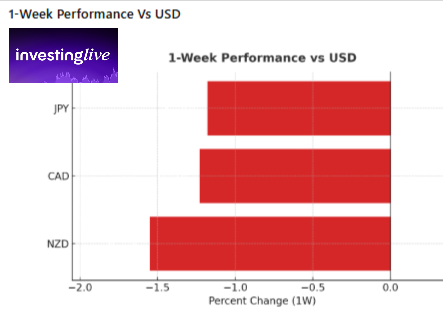
1-week Performance of Weak Currencies vs USD

New Zealand dollar (NZD): leadership shift, soft risk tone

  • Why weaker: The Reserve Bank of New Zealand named Anna Breman as the new Governor, a change that stirred transition uncertainty at a time when the economy is already navigating slower growth and high real rates. See the background on the appointment here: RBNZ, new Governor Anna Breman. In weeks like this, the USD carry advantage and a cautious global risk tone tend to weigh hardest on high beta currencies like NZD.

  • What to watch: first policy communication signals from the incoming Governor, any guidance on the inflation-growth tradeoff, and whether risk markets stabilize. If global equities and commodities steady, NZD usually finds a bid. If the message from the RBNZ hints at patience or a lower-for-longer growth path, rallies can fade.

Canadian dollar (CAD): USD strength, policy and oil decoupling

  • Why weaker: USD/CAD pushed to the highest since May, a move driven by broad USD strength and an FX market that may be re-pricing the impact of US fiscal policy on growth and rates. See USD/CAD rises to the highest since May and this take on how fiscal policy power may have been underestimated. Oil did not offer the usual cushion, which left CAD exposed.

  • What to watch: whether the USD uptrend pauses, the next Bank of Canada tone on growth and inflation, and any re-coupling with crude. A daily close back below recent USD/CAD breakout levels would hint that pressure is easing. Sustained closes above keep the path open toward higher ranges.

Japanese yen (JPY): range risks, breakout chatter, and politics

  • Why weaker: Markets flirted with a USD/JPY breakout, then questioned if it is another head fake. Policy normalization in Japan remains slow, while US yields and the carry remain supportive for USD/JPY. See USD/JPY breakout or another fakeout and UBS lifting forecasts, flagging a 140–150 range amid political risks.

  • What to watch: signals from the Bank of Japan on balance sheet and rates, any verbal pushback from officials if USD/JPY runs hot, and equity volatility. A grind within the 140–150 band keeps carry in the driver’s seat. Only a clear shift in BoJ tone, or a surge in risk aversion, would change the glide path.

A quick checklist for traders and investors

  • Dollar driver: if US growth and fiscal impulse continue to support higher real yields, the USD stays bid, which keeps pressure on NZD, CAD, and JPY.

  • Policy communication: RBNZ transition messaging, BoC growth and inflation language, BoJ normalization cues. Small changes here can swing expectations quickly.

  • Price tells: watch USD/CAD holding above the recent breakout, USD/JPY behavior around 140–150, and NZD/USD reaction to RBNZ remarks and global risk tone.

  • Risk mood: a calmer equity tape and firmer commodities usually help NZD and CAD first, while a risk-off day often sends JPY mixed unless US yields drop decisively.

In summary: The week favored the USD as policy and carry dynamics stayed supportive. NZD felt the weight of a leadership handover and soft risk appetite, CAD struggled with a USD/CAD breakout and limited oil help, and JPY remained range bound with upside risks in USD/JPY unless Japan’s policy signals firm up.

The weekly scoreboard shows the New Zealand dollar (-1.55%), Canadian dollar (-1.23%), and Japanese yen (-1.18%) lagging against the USD. Below is a concise read on what likely pushed each one lower and the forward checks that matter next.

1-week Performance of Weak Currencies vs USD

New Zealand dollar (NZD): leadership shift, soft risk tone

  • Why weaker: The Reserve Bank of New Zealand named Anna Breman as the new Governor, a change that stirred transition uncertainty at a time when the economy is already navigating slower growth and high real rates. See the background on the appointment here: RBNZ, new Governor Anna Breman. In weeks like this, the USD carry advantage and a cautious global risk tone tend to weigh hardest on high beta currencies like NZD.

  • What to watch: first policy communication signals from the incoming Governor, any guidance on the inflation-growth tradeoff, and whether risk markets stabilize. If global equities and commodities steady, NZD usually finds a bid. If the message from the RBNZ hints at patience or a lower-for-longer growth path, rallies can fade.

Canadian dollar (CAD): USD strength, policy and oil decoupling

  • Why weaker: USD/CAD pushed to the highest since May, a move driven by broad USD strength and an FX market that may be re-pricing the impact of US fiscal policy on growth and rates. See USD/CAD rises to the highest since May and this take on how fiscal policy power may have been underestimated. Oil did not offer the usual cushion, which left CAD exposed.

  • What to watch: whether the USD uptrend pauses, the next Bank of Canada tone on growth and inflation, and any re-coupling with crude. A daily close back below recent USD/CAD breakout levels would hint that pressure is easing. Sustained closes above keep the path open toward higher ranges.

Japanese yen (JPY): range risks, breakout chatter, and politics

  • Why weaker: Markets flirted with a USD/JPY breakout, then questioned if it is another head fake. Policy normalization in Japan remains slow, while US yields and the carry remain supportive for USD/JPY. See USD/JPY breakout or another fakeout and UBS lifting forecasts, flagging a 140–150 range amid political risks.

  • What to watch: signals from the Bank of Japan on balance sheet and rates, any verbal pushback from officials if USD/JPY runs hot, and equity volatility. A grind within the 140–150 band keeps carry in the driver’s seat. Only a clear shift in BoJ tone, or a surge in risk aversion, would change the glide path.

A quick checklist for traders and investors

  • Dollar driver: if US growth and fiscal impulse continue to support higher real yields, the USD stays bid, which keeps pressure on NZD, CAD, and JPY.

  • Policy communication: RBNZ transition messaging, BoC growth and inflation language, BoJ normalization cues. Small changes here can swing expectations quickly.

  • Price tells: watch USD/CAD holding above the recent breakout, USD/JPY behavior around 140–150, and NZD/USD reaction to RBNZ remarks and global risk tone.

  • Risk mood: a calmer equity tape and firmer commodities usually help NZD and CAD first, while a risk-off day often sends JPY mixed unless US yields drop decisively.

In summary: The week favored the USD as policy and carry dynamics stayed supportive. NZD felt the weight of a leadership handover and soft risk appetite, CAD struggled with a USD/CAD breakout and limited oil help, and JPY remained range bound with upside risks in USD/JPY unless Japan’s policy signals firm up.

Itai Levitan for FinanceMagnates.com
  • 11 Articles
  • 1 Follower
Head of Strategy at investingLive.com (formerly ForexLive.com), with 25 years of business experience and over a decade in investing, equities & real estate. Holding an MBA and a BS in Computer Science, he combines technical expertise with strategic insight to deliver actionable perspectives on the markets. At investingLive.com, Levitan leads efforts to provide actionable analysis, trade ideas & decision support for traders and investors. Focuses on reward-to-risk strategies, while dedicating over 15,000 hours to chart study and producing forecasts and trade ideas. As an advanced user of AI in finance, he works at the junction of data, methodology, and markets, seeing AI as a driver of productivity, innovation, and deeper investigation. His focus is on practical trading and real-world analysis. “We live in a fascinating time where AI opens new doors and creates strategies. For someone who loves strategy and markets, this is a playground ever-changing and endlessly interesting.”
  • 11 Articles
  • 1 Follower

More from the Author

Trading Room

!"#$%&'()*+,-./0123456789:;<=>?@ABCDEFGHIJKLMNOPQRSTUVWXYZ[\]^_`abcdefghijklmnopqrstuvwxyz{|} !"#$%&'()*+,-./0123456789:;<=>?@ABCDEFGHIJKLMNOPQRSTUVWXYZ[\]^_`abcdefghijklmnopqrstuvwxyz{|}