The line between gambling and trading is a thin one, Matthew Clark discusses just how thin that line is and when to know you've crossed it.
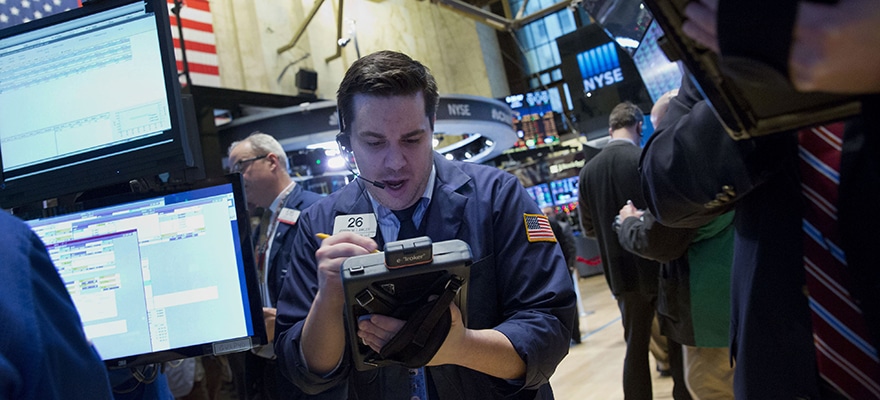
NYSE traders on a typical working day, Photo: Bloomberg
I was recently asked the above question and as a professional Forex trader with over 20 years of experience at the highest levels it made me think why do people think this and when does trading actually become gambling?
My father, a property developer by trade, has often said to me ‘’that traders are a leach on humanity (a little harsh I think), you create nothing.’’ But he went onto explain that as a builder, he invests his time and money to build properties that someone else can then live in or use thus creating new wealth for the economy and an income for himself. A trader in his and a lot of people views (especially after the several years of bad press) may make an income but creates no additional wealth in the world.
Trading and gambling are similar in that they both look to make capital gain over a short period of time without creating new wealth. They both have a get rich quick impression to the non-trader and are often viewed with disdain. But they are wrong as a professional trader usually does not get rich quick but grows his income and capital base slowly over time.
The similarities do not stop there, successful traders and gamblers are typically highly skilled and spend years mastering their craft. Success means a steady regular income and not a onetime jackpot. I am sure you have seen many books on how to beat the casino at blackjack or how to make easy money trading the market but anyone who has tried these knows that they are written to entice people who only want to get rich quick and don’t want to work and are therefore ultimately doomed to fail.
A successful trader is a craftsman, no different from a master carpenter or bricklayer. All craftsman learn by apprenticeships, this is not just theory taught in a classroom or by books. But an apprenticeships is a period of time of personal, professional and proprietary experiences leading to the knowledge and skills to perform the craft. Both trading and gambling have seen the development of mathematical techniques and indicators in order to increase their chances of success, but knowing them and learning in different markets how to apply them is something that cannot be read. It must be learnt by experience.
A successful trader has built a trading plan from experience and most importantly sticks to it. The old adage “If you fail to plan, then you’ve already planned to fail” is extremely appropriate to trading. A trading plan defines what is supposed to be done, why when and how, covering the type of trading appropriate (intraday or longer term) to personal expectations and money management. This removes any bad decisions made in the heat of the moment, stopping irrational decisions being made. As I write this we are awaiting the April release of Non Farm payrolls, a professional trader has a trading plan covering every eventuality of the price action and what they will do at each level, so mistakes and rash decisions are not made.
When you start trading in any financial markets there is a learning curve and losses must be made and lessons learnt as part of this education
The definition of gambling is ‘’the act or practice of risking the loss of something important by taking a chance or acting recklessly’’ by having and adhering to a trading plan we are not acting recklessly. But many traders are gambling without knowing, by trading in a way, or for reasons, that are completely opposite to success in the market. So when does trading become gambling?
When you start trading in any financial markets there is a learning curve and losses must be made and lessons learnt as part of this education. Anyone who tells you they do not have losers is a liar and having losing trades doesn’t mean you cannot be a successful trader. In fact with correct money management (which we will discuss in a future article) a system with twice as many loser as winners can still make a profitable trading system. Until knowledge has been developed that allows a person to overcome the odds of losing then gambling is taking place with each transaction.
Trading and gambling both create emotions and a sense of satisfaction when right, it is hard to get rid of this emotion but with a trading plan we can reduce it, if you are trading simply for the excitement then you are not trading in a methodical and tested way and therefore you are gambling. While making money is the result of successful trading, trading simply to win drives us further away from success and our goals. What I mean by this is, a focus on winning forces the trader into a position where they will not close bad positions because doing so would be to admit they had lost.
Successful traders take many losses, they admit they are wrong and therefore keep the damage to their capital base small. By not having the belief that every trade must be a winner and taking losses when circumstance indicate that the market has gone against their trading plan it allows them to be profitable over the long run. Holding onto losing trades when conditions have changed for the trade means that the trader is now gambling and has stopped using the sound methodical methods they took in taking the trade.
Money management is one of the most important factors in staying successful and the correct use of Leverage and applying these techniques are essential to becoming a successful trader and not a gambler. With brokers offering up to 500 to 1 leverage how much leverage should be taken. Personally I like to risk between 1% per trade. For example if I have a stop loss 50 pips away in Euros and I have 100,000 dollars in my account , I am prepared to lose 1000 dollars , my maximum ticket size should therefore be Euro 200,000. If I am wrong I am wrong and move on, if you find yourself doubling up or even more as you don’t want to admit you are wrong then you are gambling and it is just a matter of time until you wipe out your account. You can often see this type of action when watching gamblers trying to bet themselves out of a hole and traders can slip into this trading (gambling) style if they start to go on a bad run.
No matter how good a trader you are you will encounter periods when you just can’t seem to get the market right and you feel that the market is against you. The market does not know what your positions are and it is not a conspiracy against you. Professional traders when they start to be out of tune with the market either stop trading for a period of time or ( as I do) start to take much smaller positions , fraction of my normal size, until they get the feel for the price action again.
If you find yourself trading more or larger tickets to make back the money to try and dig yourself out of a hole, you have crossed the line and are no longer trading you are gambling.
Never, I repeat never, take out loans, borrow from friend and family or use credit cards to place money in the market. I know of people who have persuaded their family that they can make money and have lost in excess of 500,000 Gap leaving themselves and their family in a desperate situation. If you bear in mind that the brokers already offer you leverage on the money you have, if you can’t turn a profit with your own cash what makes you think you can make money trading someone else’s. It isn’t about trading larger tickets it is about being smart and not letting emotion get in the way.
If you find yourself trading more or larger tickets to make back the money to try and dig yourself out of a hole, you have crossed the line and are no longer trading you are gambling.
Admittedly keeping emotions out of the equation is difficult especially when we are trading in markets that are driven by the human emotions of feed and greed. But by keeping to your set of fixed rules you can remove this emotion .If you find yourself abandoning your rules in order to place random positions into the market then you are in trouble and gambling. Similar to gambler who is no longer concerned with calculating and playing the odds but would rather just stay at the table and place bets , hoping to simply make their money back or strike it rich.
Probably the most important thing for a professional trader and one we repeatedly say at Global Forex Pros when teaching traders is that we always know where our stop loss is before we enter into any trade. This ingrains in a trader a rule that he knows when he will be wrong and has to accept it. Never move your stop once in place unless moving closer to your entry or in the money to protect your profit. If you do you are gambling and making the beginners mistake of letting your losses run against you. Placing your stops in the market protects you from unforeseen events in the market and installs a routine to keep you adhering to your trading plan. To trade without stops opens you up to tremendous risk and unlimited losses.
So to summarize the above and answer the initial question ‘’Is Trading a Profession or Professional Gambling?" after more than 20 years as a professional trader I would say that trading is a profession. No different from any other profession , it takes years fora trainee chef to learn from his more experienced mentors and head chefs how to master his ingredients. Trading is no different, you can’t expect to read a book and expect to understand everything about trading. It is necessary to learn from your mistakes and understand that every trader at some point has made the same mistakes. The difference is they have learnt from them, built a trading plan and stuck to it. As you can see from the examples above it’s a fine line from sticking to your plan and slipping into the world of a gambler.
I was recently asked the above question and as a professional Forex trader with over 20 years of experience at the highest levels it made me think why do people think this and when does trading actually become gambling?
My father, a property developer by trade, has often said to me ‘’that traders are a leach on humanity (a little harsh I think), you create nothing.’’ But he went onto explain that as a builder, he invests his time and money to build properties that someone else can then live in or use thus creating new wealth for the economy and an income for himself. A trader in his and a lot of people views (especially after the several years of bad press) may make an income but creates no additional wealth in the world.
Trading and gambling are similar in that they both look to make capital gain over a short period of time without creating new wealth. They both have a get rich quick impression to the non-trader and are often viewed with disdain. But they are wrong as a professional trader usually does not get rich quick but grows his income and capital base slowly over time.
The similarities do not stop there, successful traders and gamblers are typically highly skilled and spend years mastering their craft. Success means a steady regular income and not a onetime jackpot. I am sure you have seen many books on how to beat the casino at blackjack or how to make easy money trading the market but anyone who has tried these knows that they are written to entice people who only want to get rich quick and don’t want to work and are therefore ultimately doomed to fail.
A successful trader is a craftsman, no different from a master carpenter or bricklayer. All craftsman learn by apprenticeships, this is not just theory taught in a classroom or by books. But an apprenticeships is a period of time of personal, professional and proprietary experiences leading to the knowledge and skills to perform the craft. Both trading and gambling have seen the development of mathematical techniques and indicators in order to increase their chances of success, but knowing them and learning in different markets how to apply them is something that cannot be read. It must be learnt by experience.
A successful trader has built a trading plan from experience and most importantly sticks to it. The old adage “If you fail to plan, then you’ve already planned to fail” is extremely appropriate to trading. A trading plan defines what is supposed to be done, why when and how, covering the type of trading appropriate (intraday or longer term) to personal expectations and money management. This removes any bad decisions made in the heat of the moment, stopping irrational decisions being made. As I write this we are awaiting the April release of Non Farm payrolls, a professional trader has a trading plan covering every eventuality of the price action and what they will do at each level, so mistakes and rash decisions are not made.
When you start trading in any financial markets there is a learning curve and losses must be made and lessons learnt as part of this education
The definition of gambling is ‘’the act or practice of risking the loss of something important by taking a chance or acting recklessly’’ by having and adhering to a trading plan we are not acting recklessly. But many traders are gambling without knowing, by trading in a way, or for reasons, that are completely opposite to success in the market. So when does trading become gambling?
When you start trading in any financial markets there is a learning curve and losses must be made and lessons learnt as part of this education. Anyone who tells you they do not have losers is a liar and having losing trades doesn’t mean you cannot be a successful trader. In fact with correct money management (which we will discuss in a future article) a system with twice as many loser as winners can still make a profitable trading system. Until knowledge has been developed that allows a person to overcome the odds of losing then gambling is taking place with each transaction.
Trading and gambling both create emotions and a sense of satisfaction when right, it is hard to get rid of this emotion but with a trading plan we can reduce it, if you are trading simply for the excitement then you are not trading in a methodical and tested way and therefore you are gambling. While making money is the result of successful trading, trading simply to win drives us further away from success and our goals. What I mean by this is, a focus on winning forces the trader into a position where they will not close bad positions because doing so would be to admit they had lost.
Successful traders take many losses, they admit they are wrong and therefore keep the damage to their capital base small. By not having the belief that every trade must be a winner and taking losses when circumstance indicate that the market has gone against their trading plan it allows them to be profitable over the long run. Holding onto losing trades when conditions have changed for the trade means that the trader is now gambling and has stopped using the sound methodical methods they took in taking the trade.
Money management is one of the most important factors in staying successful and the correct use of Leverage and applying these techniques are essential to becoming a successful trader and not a gambler. With brokers offering up to 500 to 1 leverage how much leverage should be taken. Personally I like to risk between 1% per trade. For example if I have a stop loss 50 pips away in Euros and I have 100,000 dollars in my account , I am prepared to lose 1000 dollars , my maximum ticket size should therefore be Euro 200,000. If I am wrong I am wrong and move on, if you find yourself doubling up or even more as you don’t want to admit you are wrong then you are gambling and it is just a matter of time until you wipe out your account. You can often see this type of action when watching gamblers trying to bet themselves out of a hole and traders can slip into this trading (gambling) style if they start to go on a bad run.
No matter how good a trader you are you will encounter periods when you just can’t seem to get the market right and you feel that the market is against you. The market does not know what your positions are and it is not a conspiracy against you. Professional traders when they start to be out of tune with the market either stop trading for a period of time or ( as I do) start to take much smaller positions , fraction of my normal size, until they get the feel for the price action again.
If you find yourself trading more or larger tickets to make back the money to try and dig yourself out of a hole, you have crossed the line and are no longer trading you are gambling.
Never, I repeat never, take out loans, borrow from friend and family or use credit cards to place money in the market. I know of people who have persuaded their family that they can make money and have lost in excess of 500,000 Gap leaving themselves and their family in a desperate situation. If you bear in mind that the brokers already offer you leverage on the money you have, if you can’t turn a profit with your own cash what makes you think you can make money trading someone else’s. It isn’t about trading larger tickets it is about being smart and not letting emotion get in the way.
If you find yourself trading more or larger tickets to make back the money to try and dig yourself out of a hole, you have crossed the line and are no longer trading you are gambling.
Admittedly keeping emotions out of the equation is difficult especially when we are trading in markets that are driven by the human emotions of feed and greed. But by keeping to your set of fixed rules you can remove this emotion .If you find yourself abandoning your rules in order to place random positions into the market then you are in trouble and gambling. Similar to gambler who is no longer concerned with calculating and playing the odds but would rather just stay at the table and place bets , hoping to simply make their money back or strike it rich.
Probably the most important thing for a professional trader and one we repeatedly say at Global Forex Pros when teaching traders is that we always know where our stop loss is before we enter into any trade. This ingrains in a trader a rule that he knows when he will be wrong and has to accept it. Never move your stop once in place unless moving closer to your entry or in the money to protect your profit. If you do you are gambling and making the beginners mistake of letting your losses run against you. Placing your stops in the market protects you from unforeseen events in the market and installs a routine to keep you adhering to your trading plan. To trade without stops opens you up to tremendous risk and unlimited losses.
So to summarize the above and answer the initial question ‘’Is Trading a Profession or Professional Gambling?" after more than 20 years as a professional trader I would say that trading is a profession. No different from any other profession , it takes years fora trainee chef to learn from his more experienced mentors and head chefs how to master his ingredients. Trading is no different, you can’t expect to read a book and expect to understand everything about trading. It is necessary to learn from your mistakes and understand that every trader at some point has made the same mistakes. The difference is they have learnt from them, built a trading plan and stuck to it. As you can see from the examples above it’s a fine line from sticking to your plan and slipping into the world of a gambler.
This article is written by Matthew Clark who is the owner of
Global Forex Pros.
ABOUT THE AUTHOR: Matthew has been a trader for more than 20 years running FX desks at major banks and retail brokers. He recently started Global Forex Pros as a service for brokers to offer their clients, teaching them to trade in real time as professional traders learn at banks and institutions, giving the retail trader the confidence to trade and increasing volumes for the broker. Matthew has been a trader for more than 20 years running FX desks at major banks and retail brokers. He recently started Global Forex Pros as a service for brokers to offer their clients, teaching them to trade in real-time as professional traders learn at banks and institutions, giving the retail trader the confidence to trade and increasing volumes for the broker.
Clearstream to Settle LCH-Cleared Equity Contracts
FP Markets Winner Spotlight 🏆 | Global Broker of the Year 2025 #Trading #Broker #Innovation #Shorts
FP Markets Winner Spotlight 🏆 | Global Broker of the Year 2025 #Trading #Broker #Innovation #Shorts
FP Markets takes the spotlight as Global Broker of the Year 2025 at the Finance Magnates Awards.
Martin Stoilov, Head of Client Experience, shares that trust, innovation, and people played a key role in the company’s success, supported by a strong foundation of integrity and client-centricity.
Following this milestone, FP Markets continues to focus on growth, technology investment, and its core values of transparency and excellence.
👉 Be part of FM Awards 2026: https://awards.financemagnates.com/#nominate
FP Markets takes the spotlight as Global Broker of the Year 2025 at the Finance Magnates Awards.
Martin Stoilov, Head of Client Experience, shares that trust, innovation, and people played a key role in the company’s success, supported by a strong foundation of integrity and client-centricity.
Following this milestone, FP Markets continues to focus on growth, technology investment, and its core values of transparency and excellence.
👉 Be part of FM Awards 2026: https://awards.financemagnates.com/#nominate
In this video, we review @HolaPrimeMarketsOfficial, a multi-asset forex and CFDs broker offering different account types, trading platforms, and flexible trading conditions.
We cover the broker’s overall offering, including account options, trading environment, platforms like MT4 and MT5, and additional services such as managed accounts and fast withdrawals.
Watch the full video to see if Hola Prime Markets fits your trading needs.
📣 Stay up to date with the latest in finance and trading. Follow Finance Magnates for industry news, insights, and global event coverage.
Connect with us:
🔗 LinkedIn: /financemagnates
👍 Facebook: /financemagnates
📸 Instagram: https://www.instagram.com/financemagnates
🐦 X: https://x.com/financemagnates
🎥 TikTok: https://www.tiktok.com/tag/financemagnates
▶️ YouTube: /@financemagnates_official
#HolaPrime #ForexBroker #CFDTrading #FinanceMagnates #Trading #Forex #BrokerReview
In this video, we review @HolaPrimeMarketsOfficial, a multi-asset forex and CFDs broker offering different account types, trading platforms, and flexible trading conditions.
We cover the broker’s overall offering, including account options, trading environment, platforms like MT4 and MT5, and additional services such as managed accounts and fast withdrawals.
Watch the full video to see if Hola Prime Markets fits your trading needs.
📣 Stay up to date with the latest in finance and trading. Follow Finance Magnates for industry news, insights, and global event coverage.
Connect with us:
🔗 LinkedIn: /financemagnates
👍 Facebook: /financemagnates
📸 Instagram: https://www.instagram.com/financemagnates
🐦 X: https://x.com/financemagnates
🎥 TikTok: https://www.tiktok.com/tag/financemagnates
▶️ YouTube: /@financemagnates_official
#HolaPrime #ForexBroker #CFDTrading #FinanceMagnates #Trading #Forex #BrokerReview
Hola Prime Review: What You Need to Know | Full Breakdown by Finance Magnates
Hola Prime Review: What You Need to Know | Full Breakdown by Finance Magnates
In this video, we review @HolaPrime_Global, a proprietary trading firm offering evaluation programs and performance-based payouts in simulated market environments.
We cover how the challenge model works, including account types, profit splits (up to 95%), trading rules, and what it takes to reach a funded account. You’ll also learn about available platforms like MT4, MT5, cTrader, and more, along with insights into payouts, support, and trading conditions.
Watch the full video to see if Hola Prime fits your trading style.
📣 Stay up to date with the latest in finance and trading. Follow Finance Magnates for industry news, insights, and global event coverage.
Connect with us:
🔗 LinkedIn: /financemagnates
👍 Facebook: /financemagnates
📸 Instagram: https://www.instagram.com/financemagnates
🐦 X: https://x.com/financemagnates
🎥 TikTok: https://www.tiktok.com/tag/financemagnates
▶️ YouTube: /@financemagnates_official
#HolaPrime #PropFirm #Trading #FinanceMagnates #Forex #FuturesTrading #TradingReview #PropFirmReview
In this video, we review @HolaPrime_Global, a proprietary trading firm offering evaluation programs and performance-based payouts in simulated market environments.
We cover how the challenge model works, including account types, profit splits (up to 95%), trading rules, and what it takes to reach a funded account. You’ll also learn about available platforms like MT4, MT5, cTrader, and more, along with insights into payouts, support, and trading conditions.
Watch the full video to see if Hola Prime fits your trading style.
📣 Stay up to date with the latest in finance and trading. Follow Finance Magnates for industry news, insights, and global event coverage.
Connect with us:
🔗 LinkedIn: /financemagnates
👍 Facebook: /financemagnates
📸 Instagram: https://www.instagram.com/financemagnates
🐦 X: https://x.com/financemagnates
🎥 TikTok: https://www.tiktok.com/tag/financemagnates
▶️ YouTube: /@financemagnates_official
#HolaPrime #PropFirm #Trading #FinanceMagnates #Forex #FuturesTrading #TradingReview #PropFirmReview
Axi Winner Spotlight 🏆 | Global Most Innovative Broker 2025 #Innovation #Trading #Fintech #Broker
Axi Winner Spotlight 🏆 | Global Most Innovative Broker 2025 #Innovation #Trading #Fintech #Broker
Axi takes the spotlight at the Finance Magnates Awards, winning Global Most Innovative Broker 2025.
Olivia Xenofontos and Ivanna Openko share how the team will feel: proud, motivated, and ready to keep delivering.
They also describe the night as well-organized, focused, and enjoyable for all.
👉 Be part of FM Awards 2026.
Axi takes the spotlight at the Finance Magnates Awards, winning Global Most Innovative Broker 2025.
Olivia Xenofontos and Ivanna Openko share how the team will feel: proud, motivated, and ready to keep delivering.
They also describe the night as well-organized, focused, and enjoyable for all.
👉 Be part of FM Awards 2026.
Recognition that matters.
Built on transparency.
Driven by the industry.
The Finance Magnates Awards 2026.
Nominations are now open.
🔗 https://awards.financemagnates.com/?utm_source=SM&utm_medium=social&utm_campaign=recognition-matters
Recognition that matters.
Built on transparency.
Driven by the industry.
The Finance Magnates Awards 2026.
Nominations are now open.
🔗 https://awards.financemagnates.com/?utm_source=SM&utm_medium=social&utm_campaign=recognition-matters