U.S. Elections Market Impact: What Does History Show?
Monday,02/09/2024|08:37GMTby
FM
Octa looks at the historical correlation between US elections and stocks, gold, & the USD.
● Financial markets are considered erratic and unpredictable during election times as investors weigh the possibility of major policy changes and economic upheaval.
● However, history shows that the U.S. elections never led to anything extraordinary in terms of financial markets’ performance.
● Analysis of historical macroeconomic indicators fails to yield a conclusive correlation between presidential administrations and economic outcomes.
● The U.S. stocks tend to become more unstable in the run-up to elections.
● The U.S. dollar's value is influenced by how domestic and international markets perceive presidential candidates' economic policies.
● Due to its safe-haven status, gold typically experiences increased buying interest during electoral volatility.
Economy
The relationship between the party affiliations of the U.S. presidents and economic growth has been a topic of extensive research and debate. Historically, some studies have suggested a correlation between the party in power and economic performance. For instance, data from the post-World War II era often shows that the U.S. economy has grown faster under Democratic presidents than Republican presidents. However, this correlation does not necessarily imply causation.
Kar Yong Ang, the Octa analyst, said: ‘Economic growth is a function of numerous variables, including global economic conditions, technological advancements, fiscal and monetary policies, and unforeseen events like natural disasters or pandemics. Therefore, attributing economic performance solely to the president's party affiliation can be overly simplistic and potentially misleading.’
Indeed, the legislative branch also plays a crucial role in shaping economic policy. A president's ability to implement their economic agenda often depends on the composition of Congress. For example, a president facing a divided government may struggle to pass significant economic reforms, regardless of party affiliation.
Still, there is widespread belief that Democratic administrations tend to focus more on fiscal stimulus and social welfare programs, which can boost consumer spending and economic growth in the short term. On the other hand, Republican administrations often emphasise tax cuts and deregulation, which can stimulate business investment and long-term economic growth.
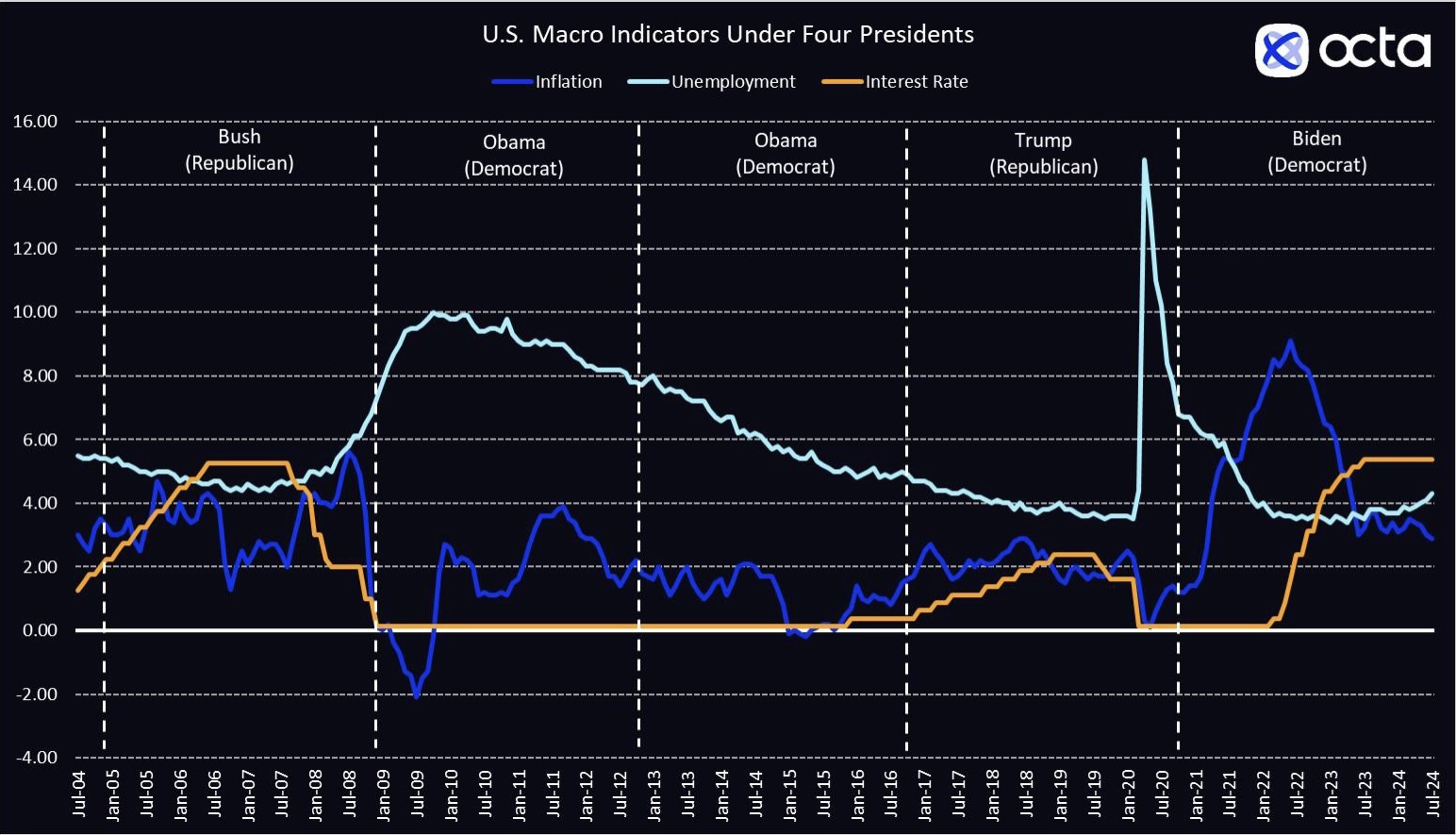
The U.S. Key macro indicators under four presidents (2004–2024)
Source: Octa
At the same time, both bad and good events happen, regardless of who is in the White House. ‘Quite frankly, sometimes it's just pure luck that defines Presidents’ track record on the economy. For example, Obama entered the White House when the U.S. economy was just about to start recovering following the great financial crisis of 2007–2008, whereas Trump may be said to be less fortunate as he faced the unprecedented Covid crisis during the final year of his presidency’, says Kar Yong Ang, Octa’s analyst. Overall, judging by historical macro indicators, there is no definite conclusion to make about which President is better for the economy.
U.S. Stocks
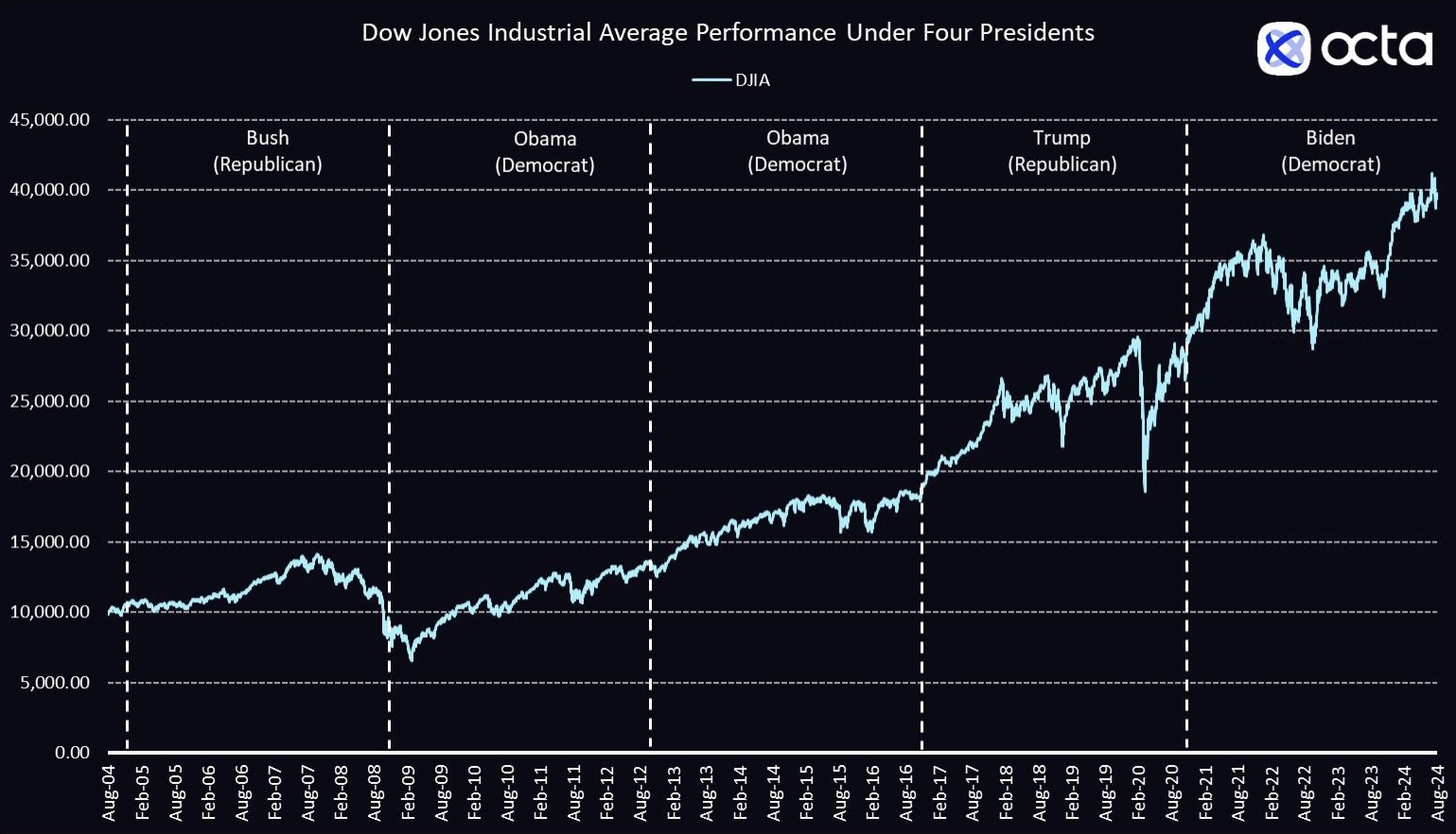
The U.S. stocks tend to experience increased volatility in the months leading up to an election. This is largely due to the uncertainty surrounding potential policy changes that could affect international trade, economic growth, and geopolitical stability. Therefore, market participants often engage in 'wait-and-see' behaviour, holding off on major investment decisions until the election outcome is clear. Historically, the stock market tends to perform better in the year following an election, particularly if the incumbent party wins, as this suggests policy continuity.
While elections can certainly stir immediate reactions, historical data reveals that their long-term impact on financial markets tends to be limited. Market performance over the medium to long term is more often influenced by broader economic parameters like inflation trends rather than who wins the election.
Dow Jones Industrial Average (DJIA) performance under four presidents (2004–2024)
Source: Octa
Historically, sectors like healthcare, energy, technology, and finance react differently to election results due to their sensitivity to legislative changes. The 2016 U.S. election serves as a notable example of markets reacting strongly to the election results, anticipating tax cuts and regulatory reforms that boosted market sentiment.
U.S. Dollar
Both domestic and international perceptions of the candidates' economic policies influence the U.S. dollar's performance during the election years. A candidate perceived as fiscally conservative might strengthen the dollar due to expectations of reduced government spending and lower inflation. Conversely, a candidate favouring expansive fiscal policies could lead to a weaker dollar due to concerns over increased debt.
Trade policies are another crucial factor. A candidate with a protectionist stance might introduce tariffs or renegotiate trade deals, which can affect the dollar's value. Protectionist policies can lead to a stronger dollar in the short term due to reduced imports, but they might also result in retaliatory measures from trade partners, which could weaken the dollar in the long run.
Geopolitical stability and foreign relations are additional aspects that can affect the dollar during the election periods. A candidate perceived as more stable and predictable in foreign policy might boost the investors' confidence, leading to a stronger dollar. On the other hand, a candidate whose policies are seen as potentially destabilizing could lead to a weaker dollar as investors seek alternative assets.
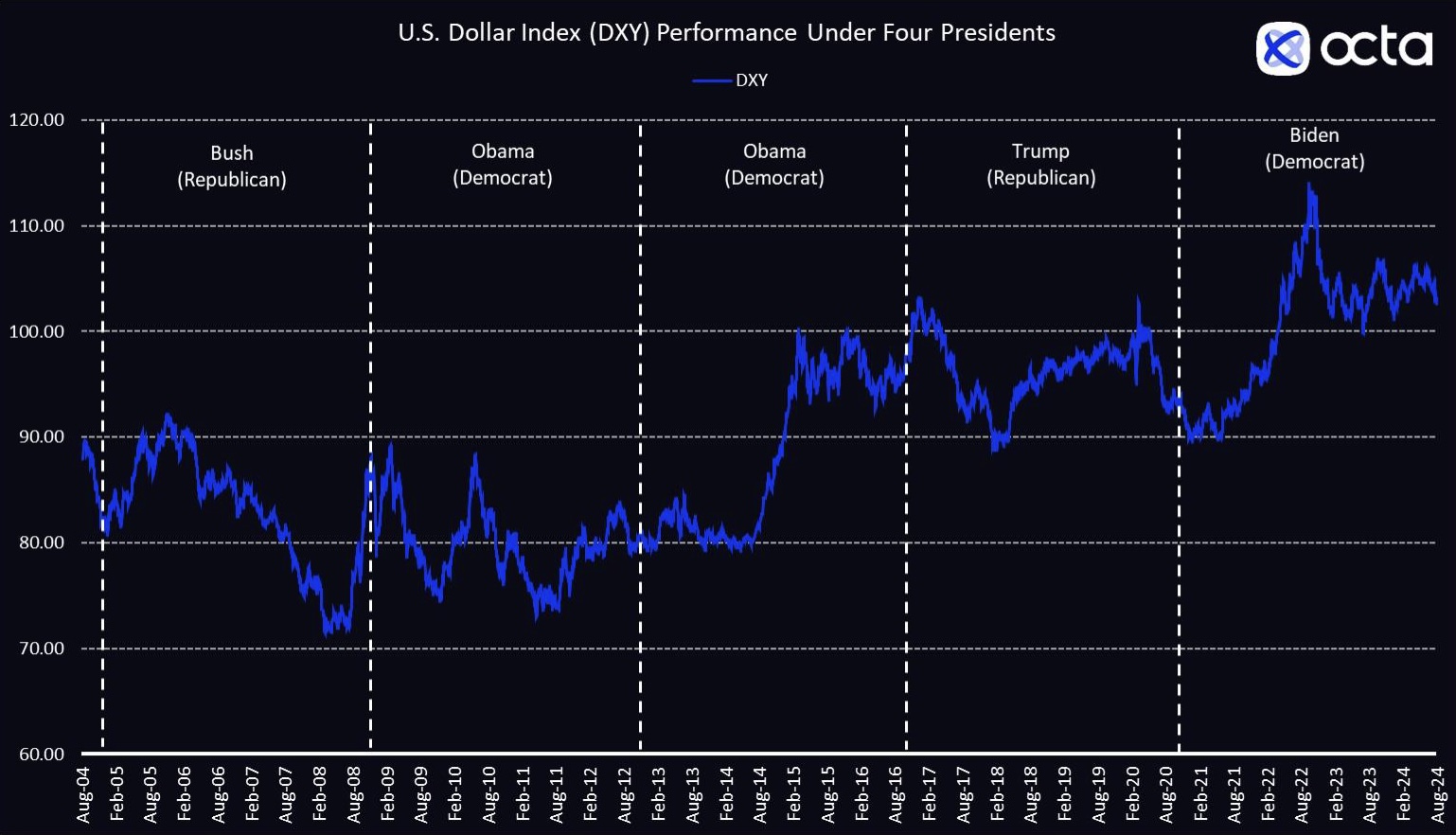
The U.S Dollar Index (DXY) performance under four presidents (2004–2024)
Source: Octa
Over the past 20 years, the U.S. Dollar Index (DXY) has performed better under Democratic Presidents and had negative returns under Republican leadership. However, as with the U.S. stock indices, it’s crucial not to oversimplify this trend. The U.S. dollar is a global reserve currency influenced by a myriad of factors beyond just presidential policies.
Gold
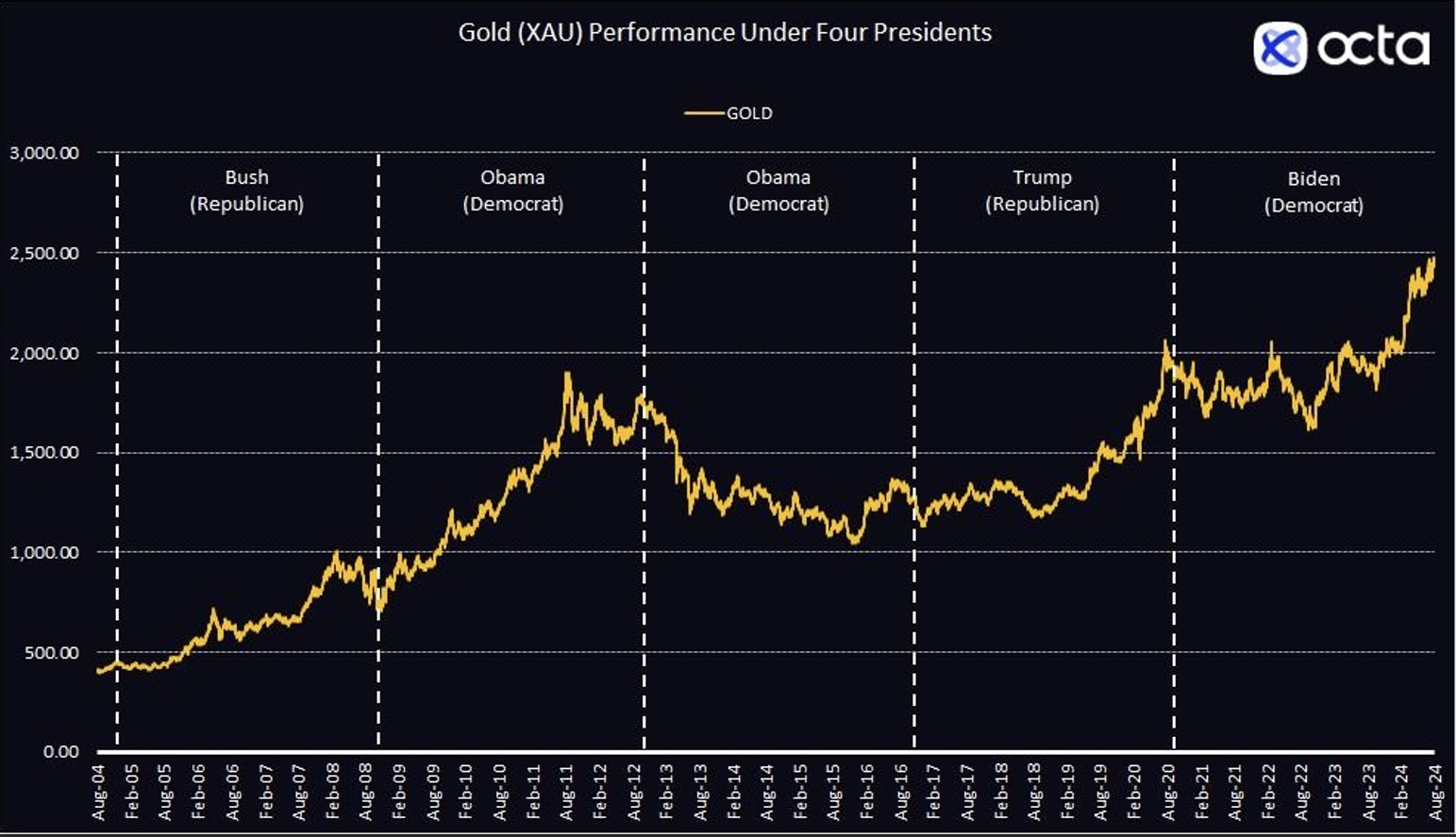
Gold, considered a safe-haven asset, typically sees increased demand during election periods marked by uncertainty. Historical data indicates that on a micro level, gold prices tend to rise in the months leading up to an election and may continue to do so if the election results are contested or lead to significant policy shifts. However, Kar Yong Ang, an Octa analyst, notes: ‘If we look at the bigger picture, we see that gold price just generally tends to increase in the long-term and the ideological stance of an incumbent U.S. President has very little or no impact on its performance’. Indeed, the value of gold almost doubled during President Obama's first term in office but experienced a 30% decline during his second term.
The U.S Dollar Index (DXY) performance under four residents (2004–2024)
Source: Octa
According to a study by the World Gold Council (WGC), gold typically performs slightly better in the six months leading up to a Republican president's election and stays flat afterwards. On the other hand, it tends to underperform before a Democratic president's election and performs just below its long-term average in the six months post-election period.[1] However, WGC admits that these results are statistically insignificant and that gold is responding not to the party affiliation of an elected President but, more likely, to the expected effect of specific policies.
About Octa
Octa is an international broker that has been providing online trading services worldwide since 2011. It offers commission-free access to financial markets and a variety of services already utilised by clients from 180 countries with more than 42 million trading accounts. Octa's free educational webinars, articles, and analytical tools help clients reach their investment goals.
The company is involved in a comprehensive network of charitable and humanitarian initiatives, including the improvement of educational infrastructure and short-notice relief projects supporting local communities.
Octa has won more than 70 awards since its foundation, including the ‘Best Educational Broker 2023’ award from World Business Outlook and the ‘Best Global Broker Asia 2022’ award.
● Financial markets are considered erratic and unpredictable during election times as investors weigh the possibility of major policy changes and economic upheaval.
● However, history shows that the U.S. elections never led to anything extraordinary in terms of financial markets’ performance.
● Analysis of historical macroeconomic indicators fails to yield a conclusive correlation between presidential administrations and economic outcomes.
● The U.S. stocks tend to become more unstable in the run-up to elections.
● The U.S. dollar's value is influenced by how domestic and international markets perceive presidential candidates' economic policies.
● Due to its safe-haven status, gold typically experiences increased buying interest during electoral volatility.
Economy
The relationship between the party affiliations of the U.S. presidents and economic growth has been a topic of extensive research and debate. Historically, some studies have suggested a correlation between the party in power and economic performance. For instance, data from the post-World War II era often shows that the U.S. economy has grown faster under Democratic presidents than Republican presidents. However, this correlation does not necessarily imply causation.
Kar Yong Ang, the Octa analyst, said: ‘Economic growth is a function of numerous variables, including global economic conditions, technological advancements, fiscal and monetary policies, and unforeseen events like natural disasters or pandemics. Therefore, attributing economic performance solely to the president's party affiliation can be overly simplistic and potentially misleading.’
Indeed, the legislative branch also plays a crucial role in shaping economic policy. A president's ability to implement their economic agenda often depends on the composition of Congress. For example, a president facing a divided government may struggle to pass significant economic reforms, regardless of party affiliation.
Still, there is widespread belief that Democratic administrations tend to focus more on fiscal stimulus and social welfare programs, which can boost consumer spending and economic growth in the short term. On the other hand, Republican administrations often emphasise tax cuts and deregulation, which can stimulate business investment and long-term economic growth.
The U.S. Key macro indicators under four presidents (2004–2024)
Source: Octa
At the same time, both bad and good events happen, regardless of who is in the White House. ‘Quite frankly, sometimes it's just pure luck that defines Presidents’ track record on the economy. For example, Obama entered the White House when the U.S. economy was just about to start recovering following the great financial crisis of 2007–2008, whereas Trump may be said to be less fortunate as he faced the unprecedented Covid crisis during the final year of his presidency’, says Kar Yong Ang, Octa’s analyst. Overall, judging by historical macro indicators, there is no definite conclusion to make about which President is better for the economy.
U.S. Stocks
The U.S. stocks tend to experience increased volatility in the months leading up to an election. This is largely due to the uncertainty surrounding potential policy changes that could affect international trade, economic growth, and geopolitical stability. Therefore, market participants often engage in 'wait-and-see' behaviour, holding off on major investment decisions until the election outcome is clear. Historically, the stock market tends to perform better in the year following an election, particularly if the incumbent party wins, as this suggests policy continuity.
While elections can certainly stir immediate reactions, historical data reveals that their long-term impact on financial markets tends to be limited. Market performance over the medium to long term is more often influenced by broader economic parameters like inflation trends rather than who wins the election.
Dow Jones Industrial Average (DJIA) performance under four presidents (2004–2024)
Source: Octa
Historically, sectors like healthcare, energy, technology, and finance react differently to election results due to their sensitivity to legislative changes. The 2016 U.S. election serves as a notable example of markets reacting strongly to the election results, anticipating tax cuts and regulatory reforms that boosted market sentiment.
U.S. Dollar
Both domestic and international perceptions of the candidates' economic policies influence the U.S. dollar's performance during the election years. A candidate perceived as fiscally conservative might strengthen the dollar due to expectations of reduced government spending and lower inflation. Conversely, a candidate favouring expansive fiscal policies could lead to a weaker dollar due to concerns over increased debt.
Trade policies are another crucial factor. A candidate with a protectionist stance might introduce tariffs or renegotiate trade deals, which can affect the dollar's value. Protectionist policies can lead to a stronger dollar in the short term due to reduced imports, but they might also result in retaliatory measures from trade partners, which could weaken the dollar in the long run.
Geopolitical stability and foreign relations are additional aspects that can affect the dollar during the election periods. A candidate perceived as more stable and predictable in foreign policy might boost the investors' confidence, leading to a stronger dollar. On the other hand, a candidate whose policies are seen as potentially destabilizing could lead to a weaker dollar as investors seek alternative assets.
The U.S Dollar Index (DXY) performance under four presidents (2004–2024)
Source: Octa
Over the past 20 years, the U.S. Dollar Index (DXY) has performed better under Democratic Presidents and had negative returns under Republican leadership. However, as with the U.S. stock indices, it’s crucial not to oversimplify this trend. The U.S. dollar is a global reserve currency influenced by a myriad of factors beyond just presidential policies.
Gold
Gold, considered a safe-haven asset, typically sees increased demand during election periods marked by uncertainty. Historical data indicates that on a micro level, gold prices tend to rise in the months leading up to an election and may continue to do so if the election results are contested or lead to significant policy shifts. However, Kar Yong Ang, an Octa analyst, notes: ‘If we look at the bigger picture, we see that gold price just generally tends to increase in the long-term and the ideological stance of an incumbent U.S. President has very little or no impact on its performance’. Indeed, the value of gold almost doubled during President Obama's first term in office but experienced a 30% decline during his second term.
The U.S Dollar Index (DXY) performance under four residents (2004–2024)
Source: Octa
According to a study by the World Gold Council (WGC), gold typically performs slightly better in the six months leading up to a Republican president's election and stays flat afterwards. On the other hand, it tends to underperform before a Democratic president's election and performs just below its long-term average in the six months post-election period.[1] However, WGC admits that these results are statistically insignificant and that gold is responding not to the party affiliation of an elected President but, more likely, to the expected effect of specific policies.
About Octa
Octa is an international broker that has been providing online trading services worldwide since 2011. It offers commission-free access to financial markets and a variety of services already utilised by clients from 180 countries with more than 42 million trading accounts. Octa's free educational webinars, articles, and analytical tools help clients reach their investment goals.
The company is involved in a comprehensive network of charitable and humanitarian initiatives, including the improvement of educational infrastructure and short-notice relief projects supporting local communities.
Octa has won more than 70 awards since its foundation, including the ‘Best Educational Broker 2023’ award from World Business Outlook and the ‘Best Global Broker Asia 2022’ award.
FP Markets Winner Spotlight 🏆 | Global Broker of the Year 2025 #Trading #Broker #Innovation #Shorts
FP Markets Winner Spotlight 🏆 | Global Broker of the Year 2025 #Trading #Broker #Innovation #Shorts
FP Markets takes the spotlight as Global Broker of the Year 2025 at the Finance Magnates Awards.
Martin Stoilov, Head of Client Experience, shares that trust, innovation, and people played a key role in the company’s success, supported by a strong foundation of integrity and client-centricity.
Following this milestone, FP Markets continues to focus on growth, technology investment, and its core values of transparency and excellence.
👉 Be part of FM Awards 2026: https://awards.financemagnates.com/#nominate
FP Markets takes the spotlight as Global Broker of the Year 2025 at the Finance Magnates Awards.
Martin Stoilov, Head of Client Experience, shares that trust, innovation, and people played a key role in the company’s success, supported by a strong foundation of integrity and client-centricity.
Following this milestone, FP Markets continues to focus on growth, technology investment, and its core values of transparency and excellence.
👉 Be part of FM Awards 2026: https://awards.financemagnates.com/#nominate
In this video, we review @HolaPrimeMarketsOfficial, a multi-asset forex and CFDs broker offering different account types, trading platforms, and flexible trading conditions.
We cover the broker’s overall offering, including account options, trading environment, platforms like MT4 and MT5, and additional services such as managed accounts and fast withdrawals.
Watch the full video to see if Hola Prime Markets fits your trading needs.
📣 Stay up to date with the latest in finance and trading. Follow Finance Magnates for industry news, insights, and global event coverage.
Connect with us:
🔗 LinkedIn: /financemagnates
👍 Facebook: /financemagnates
📸 Instagram: https://www.instagram.com/financemagnates
🐦 X: https://x.com/financemagnates
🎥 TikTok: https://www.tiktok.com/tag/financemagnates
▶️ YouTube: /@financemagnates_official
#HolaPrime #ForexBroker #CFDTrading #FinanceMagnates #Trading #Forex #BrokerReview
In this video, we review @HolaPrimeMarketsOfficial, a multi-asset forex and CFDs broker offering different account types, trading platforms, and flexible trading conditions.
We cover the broker’s overall offering, including account options, trading environment, platforms like MT4 and MT5, and additional services such as managed accounts and fast withdrawals.
Watch the full video to see if Hola Prime Markets fits your trading needs.
📣 Stay up to date with the latest in finance and trading. Follow Finance Magnates for industry news, insights, and global event coverage.
Connect with us:
🔗 LinkedIn: /financemagnates
👍 Facebook: /financemagnates
📸 Instagram: https://www.instagram.com/financemagnates
🐦 X: https://x.com/financemagnates
🎥 TikTok: https://www.tiktok.com/tag/financemagnates
▶️ YouTube: /@financemagnates_official
#HolaPrime #ForexBroker #CFDTrading #FinanceMagnates #Trading #Forex #BrokerReview
Hola Prime Review: What You Need to Know | Full Breakdown by Finance Magnates
Hola Prime Review: What You Need to Know | Full Breakdown by Finance Magnates
In this video, we review @HolaPrime_Global, a proprietary trading firm offering evaluation programs and performance-based payouts in simulated market environments.
We cover how the challenge model works, including account types, profit splits (up to 95%), trading rules, and what it takes to reach a funded account. You’ll also learn about available platforms like MT4, MT5, cTrader, and more, along with insights into payouts, support, and trading conditions.
Watch the full video to see if Hola Prime fits your trading style.
📣 Stay up to date with the latest in finance and trading. Follow Finance Magnates for industry news, insights, and global event coverage.
Connect with us:
🔗 LinkedIn: /financemagnates
👍 Facebook: /financemagnates
📸 Instagram: https://www.instagram.com/financemagnates
🐦 X: https://x.com/financemagnates
🎥 TikTok: https://www.tiktok.com/tag/financemagnates
▶️ YouTube: /@financemagnates_official
#HolaPrime #PropFirm #Trading #FinanceMagnates #Forex #FuturesTrading #TradingReview #PropFirmReview
In this video, we review @HolaPrime_Global, a proprietary trading firm offering evaluation programs and performance-based payouts in simulated market environments.
We cover how the challenge model works, including account types, profit splits (up to 95%), trading rules, and what it takes to reach a funded account. You’ll also learn about available platforms like MT4, MT5, cTrader, and more, along with insights into payouts, support, and trading conditions.
Watch the full video to see if Hola Prime fits your trading style.
📣 Stay up to date with the latest in finance and trading. Follow Finance Magnates for industry news, insights, and global event coverage.
Connect with us:
🔗 LinkedIn: /financemagnates
👍 Facebook: /financemagnates
📸 Instagram: https://www.instagram.com/financemagnates
🐦 X: https://x.com/financemagnates
🎥 TikTok: https://www.tiktok.com/tag/financemagnates
▶️ YouTube: /@financemagnates_official
#HolaPrime #PropFirm #Trading #FinanceMagnates #Forex #FuturesTrading #TradingReview #PropFirmReview
Axi Winner Spotlight 🏆 | Global Most Innovative Broker 2025 #Innovation #Trading #Fintech #Broker
Axi Winner Spotlight 🏆 | Global Most Innovative Broker 2025 #Innovation #Trading #Fintech #Broker
Axi takes the spotlight at the Finance Magnates Awards, winning Global Most Innovative Broker 2025.
Olivia Xenofontos and Ivanna Openko share how the team will feel: proud, motivated, and ready to keep delivering.
They also describe the night as well-organized, focused, and enjoyable for all.
👉 Be part of FM Awards 2026.
Axi takes the spotlight at the Finance Magnates Awards, winning Global Most Innovative Broker 2025.
Olivia Xenofontos and Ivanna Openko share how the team will feel: proud, motivated, and ready to keep delivering.
They also describe the night as well-organized, focused, and enjoyable for all.
👉 Be part of FM Awards 2026.
Recognition that matters.
Built on transparency.
Driven by the industry.
The Finance Magnates Awards 2026.
Nominations are now open.
🔗 https://awards.financemagnates.com/?utm_source=SM&utm_medium=social&utm_campaign=recognition-matters
Recognition that matters.
Built on transparency.
Driven by the industry.
The Finance Magnates Awards 2026.
Nominations are now open.
🔗 https://awards.financemagnates.com/?utm_source=SM&utm_medium=social&utm_campaign=recognition-matters