

A broker can have millions in available capital and still struggle to meet a customer withdrawal.
The problem isn't necessarily a lack of funds. It's where those funds are held, the currency they're denominated in and whether they can be accessed when needed.
As stablecoins make round-the-clock settlement possible, this disconnect is becoming increasingly important. Payment infrastructure has accelerated, but the treasury operations supporting it haven't always kept pace.
For brokers, the consequences extend beyond delayed payments. Fragmented liquidity creates unnecessary funding requirements, increases operational costs and ties up capital that could otherwise be deployed more productively.
24/7 settlement isn't simply a back-office processing challenge. It's increasingly a question of capital efficiency.
The challenge: quantifying fragmented liquidity
Consider how a typical international brokerage operates.
It has several PSP and banking relationships in different countries. It is managing multiple currencies and holding digital assets across several wallets. Maybe it’s also operating through separate legal entities, each with its own accounts and regulatory obligations.
A necessary structure, but one that can create a fragmented picture of the company's available funds.
One PSP account may be overfunded while another runs short. Meanwhile, idle fiat buffers in traditional bank accounts cannot be transferred until Monday, and crypto liquidity is trapped across siloed trading entities under their intercompany arrangements.
The money exists. It just isn't available where or when it's needed.
To avoid payment delays, brokers pre-fund accounts to cover regional withdrawal spikes. They maintain weekend cash buffers. They leave liquidity sitting in wallets or accounts in case demand suddenly increases.
It's a defensive strategy. And an expensive one.
Maintaining liquidity across multiple providers and currencies comes at a cost. Capital held as a precaution in one account may be unavailable to support payment obligations elsewhere, increasing the overall funding requirements of the business.
For brokers operating across multiple markets, even relatively small inefficiencies can become significant when repeated across currencies, payment providers and legal entities.
The challenge isn't to eliminate liquidity buffers. Brokers need sufficient reserves to manage risk and meet their obligations. It is to reduce unnecessary duplication and make more effective use of the liquidity already available.
The modern broker’s solution to the cost of fragmented liquidity
Stablecoins can improve the speed and flexibility of moving funds, but the opportunity lies in how brokers manage liquidity across their entire operation.
Reducing unnecessary pre-funding, improving visibility and making more informed conversion decisions can have a much broader impact on capital efficiency.
Imagine a broker receiving stablecoin deposits on Saturday. The funds arrive almost immediately, subject to AML/CFT screening. But the broker also needs to make customer withdrawals in euros, meet obligations in dollars, and maintain sufficient liquidity across several entities.
Should it convert those stablecoins into fiat currency immediately? Hold some until later? Move liquidity to another account in anticipation of increased withdrawals?
These decisions depend on expected payment flows, available balances, foreign exchange exposure, and the cost of converting funds.
Automatically converting every stablecoin deposit into fiat may sound efficient. But it can create unnecessary transaction costs or leave the broker short of digital-asset liquidity when demand changes.
Holding everything in stablecoins creates different risks, particularly if fiat payouts are required.
Currency exposure adds another layer of complexity. A broker may receive customer deposits in dollar-denominated stablecoins while facing withdrawal obligations in euros or sterling. Converting too early can create unnecessary costs, while waiting too long can expose the business to currency movements or leave it without sufficient fiat liquidity when payouts are due.
The question isn't simply how quickly funds can be converted, but when conversion makes commercial sense within the broker's wider treasury position. The smarter approach is to treat conversion as an integral part of treasury management rather than a standalone payment function.
That means making decisions based on the company's overall liquidity position, not simply processing each incoming transaction in isolation.
From payment processing to treasury orchestration
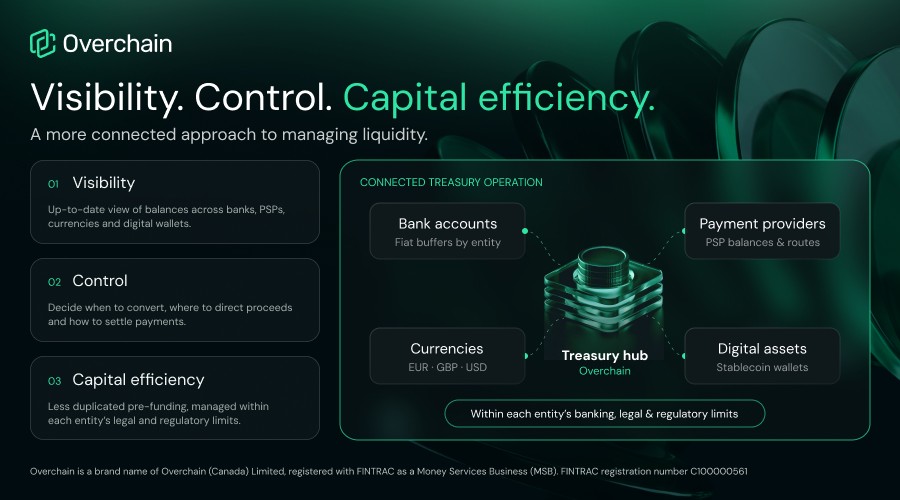
Modern brokers are bringing these different sources of liquidity into a more connected system.
Treasury teams need unified visibility: a clear, up-to-date picture of where funds are held across bank accounts, PSPs, currencies and digital wallets.
Without that visibility, it's difficult to know whether the business genuinely needs more liquidity or simply needs to move existing funds more efficiently.
But visibility is the starting point, not the solution in itself. Knowing where funds are held doesn't automatically make them transferable.
Effective treasury management also requires the ability to act on that information: selecting appropriate conversion and settlement routes, managing liquidity across providers and operating within the regulatory and legal constraints of each entity.
The objective isn't to make every balance interchangeable. It's to give treasury teams greater control over the liquidity they can legitimately access and deploy.
Brokers need the ability to decide when to convert stablecoins, where to direct the proceeds, and how to settle payments through the appropriate banking or payment partners.
Finally, those decisions need to be connected to actual payment flows.
If a broker expects increased withdrawal demand in a particular market over the weekend, it should be able to position liquidity accordingly, subject to banking availability, regulatory requirements and entity-level restrictions.
The goal is to move away from a defensive strategy that maintains excessive reserves everywhere, towards managing liquidity dynamically as demand changes.
Balancing capital efficiency with operational resilience
Liquidity efficiency also needs to be balanced against operational resilience.
Consolidating funds with fewer providers may simplify treasury management, but excessive reliance on any single payment provider, liquidity source or settlement route can introduce new risks.
provider experiences an outage, changes its operating restrictions or temporarily suspends a payment route.
Equally, spreading funds across too many providers without a coordinated treasury strategy can create unnecessary complexity and increase the amount of capital that needs to be maintained across the business.
The challenge is to maintain sufficient diversification without creating unnecessary fragmentation.
For brokers, that means having visibility across their payment and liquidity relationships, alongside the flexibility to use alternative routes when individual providers become unavailable.
Resilience and capital efficiency shouldn't be treated as competing objectives. With the right infrastructure, brokers can maintain appropriate safeguards while improving how liquidity is allocated and managed.
What this looks like in practice
Consider a hypothetical brokerage operating across Europe, Asia and Latin America.
The business holds $5 million in operational liquidity across its payment providers, accounts and digital wallets. However, when $1 million in customer withdrawal requests arrives over the weekend, the provider responsible for those payouts has only $500,000 immediately available.
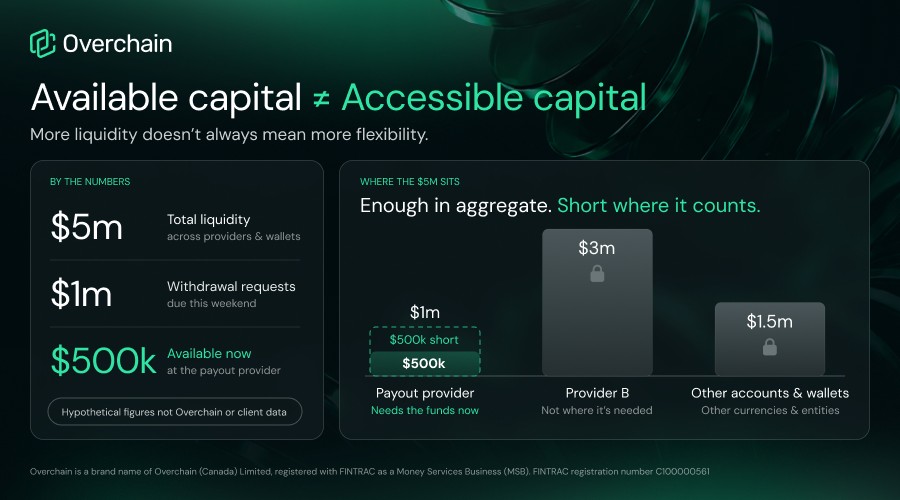
Elsewhere in the business, another provider holds $3 million, while the remaining funds are distributed across other accounts and wallets.
The brokerage has more than enough liquidity in aggregate. But that doesn't mean it can access or deploy those funds where they're needed.
Under a fragmented system, the treasury team may need to arrange additional funding, delay eligible withdrawals or maintain larger precautionary balances to avoid encountering the same problem again.
With connected treasury infrastructure, the team can assess its available balances, identify which funds are accessible and determine the most appropriate response.
Depending on the circumstances, that could mean converting stablecoins to meet fiat obligations, using an alternative settlement provider or repositioning liquidity ahead of anticipated demand.
The decision also needs to account for conversion costs, currency exposure, provider availability and any restrictions on transferring funds between legal entities.
Not every transfer will be instantaneous. Local banking hours, currency availability and legal restrictions still matter.
But better coordination can reduce unnecessary duplication of reserves and improve the use of existing capital.
The commercial benefit isn't simply faster payouts. It's the ability to meet payment obligations more efficiently without maintaining excessive liquidity across every provider and currency.
From faster payments to smarter capital management
Stablecoins have removed many of the traditional time constraints on moving value. But they haven't automatically removed the operational barriers that prevent brokers from using that value efficiently. Without connected treasury infrastructure, faster payments simply move the bottleneck elsewhere.
For brokers, competitive advantage increasingly depends on how effectively they manage liquidity across their operations: understanding where capital sits, how efficiently it can be deployed and how quickly treasury teams can respond to changing demands.
Stablecoins have changed how quickly value can move. The next challenge is building the infrastructure, controls and connectivity that allow businesses to make better use of that value.
For brokers, the real opportunity isn't simply to settle payments around the clock. It's to operate a treasury function that can keep pace.


