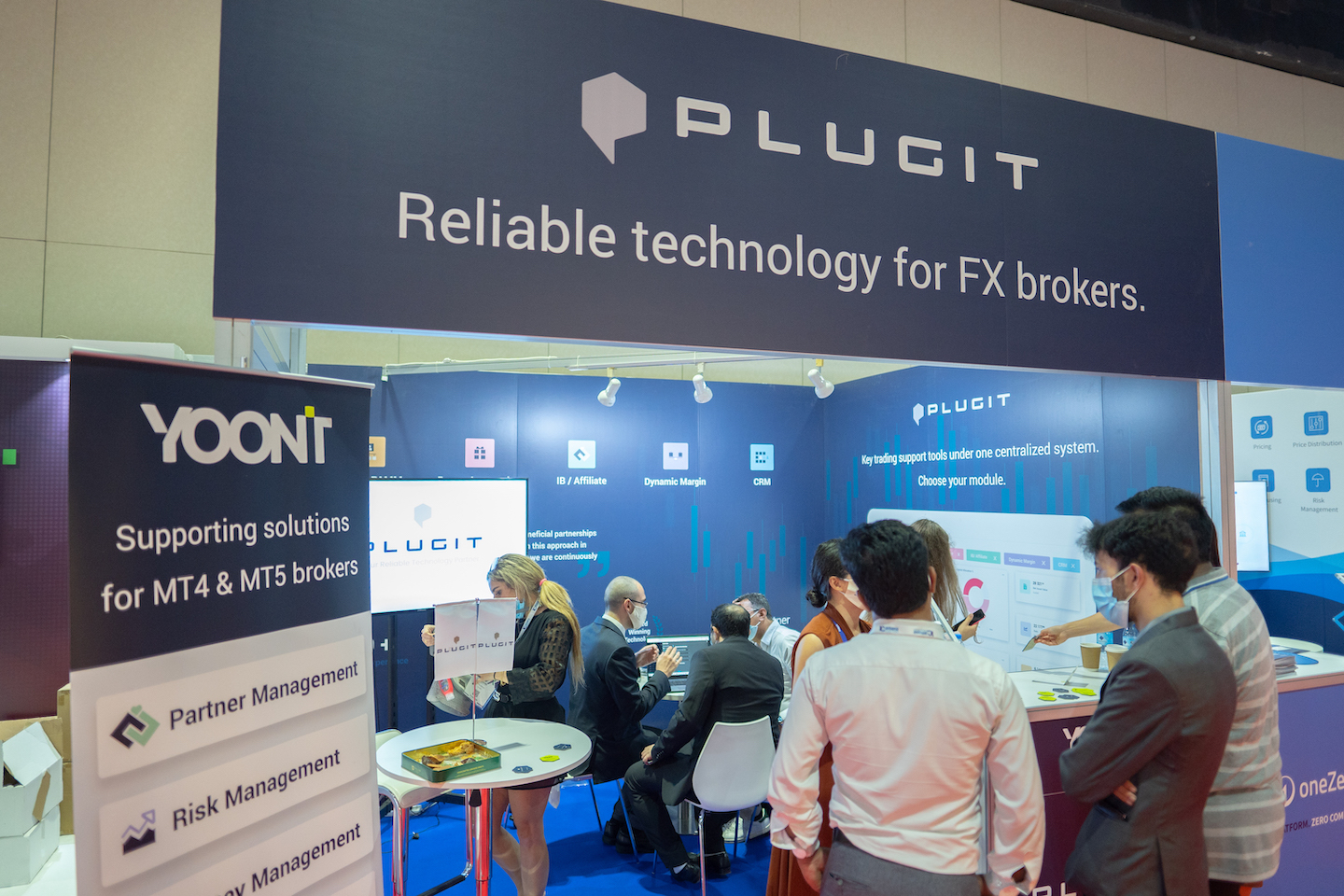
Plugit's Operations Manager, Yulia Tereshchenko, explains the company's recent strategy and branding efforts in 2021.
PLUGIT
Plugit has been a household name at recent conferences, spotlighted by its flagship product YOONIT V2. Finance Magnates had a chance to speak with Yulia Tereshchenko, Operations Manager at Plugit for her perspective on the company's recent strategy and rollout of its various modules.
In what ways has Plugit’s presence at recent conferences been beneficial for the company and will you be attending the London Summit in November?
Apart from the vast exposure and brand awareness we’re getting, exhibiting at these events makes it easy for our potential clients to connect with us and meet in person, see our offerings in real time and discuss potential collaborations.
For us, they are a venue for brainstorming, networking, and making vital connections that can lead to new ideas and partnerships in a way that virtual meetings cannot.
The Forex Expo in Dubai welcomed many participants from the MENA region, both from B2B and B2C sides, with existing brokerages and IB’s looking to expand their business, and quite a few of their retail clients (i.e., portfolio managers, fund managers, etc) looking to establish their own brokerage.
We had the perfect opportunity to demonstrate our products and services to the audience, make new important connections and expand our client base in the region, which would have been difficult or take much more time and effort otherwise.
At the iFX EXPO we had the chance to catch up with our old connections, friends, and industry peers, as well as discuss and set a start to new useful collaborations with other providers.
We are looking forward to the upcoming London Summit in November, where we will also be among the exhibitors.
London has a high concentration of financial trading institutions and forex industry participants with some of the major players on the market and we are excited for an opportunity to meet some of them.
Ultimately, such conferences are a great way to learn about the latest technology advancements and ideas from the fintech industry, as well as doing business.
Plugit has had an active year, rolling out a series of new product developments for a growing client base. Can you describe this rollout and how this has impacted clients?
We have put a copious amount of work in the past year to improve our flagship product - modular trading support system YOONIT, making an even bigger difference in how our clients operate.
With our latest release of YOONIT V2, we have introduced several improvements to the system as a whole and to its various modules.
We have elevated the UX with visual enhancements such as a sleek new interface design with multiple themes, improved the navigation of the system to be more responsive with less processing time, incorporated a system help centre, where users can now find detailed information on their subscriptions, licences, and comprehensive user guides and manuals.
Regarding the modules, we have added Dynamic Margin and Bonus Automation to the system making it total of 5 modules under one dashboard available for our clients to choose from; added more tools and various functions to specific modules, such as Cash Back option in the IB module from our latest updates, which will help attract more clients, and many more.
We have enhanced every aspect of the system to improve user experience and so that our clients can scale their business at their own pace, achieving new levels of operational efficiency.
How has the YOONIT system been received by the audience at the aforesaid conferences, and how does this service outshine the competition?
It was very well received by the audience, with numerous participants coming to our booth for a demonstration of the platform, with lots of positive feedback about the feature-packed and easy to use interface, as well as the pleasant fee structure that we offer.
One of the main advantages of the YOONIT system is its centralized nature where we offer mature solutions as individual modules.
Brokers can choose whichever modules they need at a time while still getting the most benefits of the whole system, as opposed to all or nothing approach.
Together with a modern user interface and easy configuration, it makes a powerful solution for brokerages of any level and size. Brokers can handle complex tasks and automate most of the processes, thus saving time and having greater control of the risks, all while being cost-effective.
YOONIT offers brokers the most demanding features with maximum stability, functionality and reliability, while keeping the cost at a more affordable level.
In addition, if there is any feature or function missing within the current system, we are very flexible on adding custom features on request for a greater use of the system. The same goes for doing new integrations with third parties.
YOONIT is designed to adapt to the evolving requirements of brokers while streamlining daily operations and optimizing processes without the need for significant capital.
How has Plugit catered to an evolving FX industry with its robust technology suite? Do you see any new emerging demands in the industry in 2022?
The recent influx of new traders has brought more wealth into the industry, but it has also exposed brokers to certain risks, imposing them to rethink their operations and created a need for more advanced solutions that is up to date with new demands.
YOONIT provides centralized back-end management, coupled with an intuitive user interface and easy configuration.
The system is designed to maximize flexibility, emphasizing scalability, customization, and ease of use, with full automation, real-time synchronization, and a multilingual dashboard for a global client base.
The centralized nature of our offering gives brokers the ability to have multiple tools in one place, with the option to choose the modules that best fit their business needs.
While the FinTech industry is fast paced, there are a significant number of brokers that are still using outdated technology, which often brings its fair share of issues such as lack of features, limited functionality, lower responsiveness, compatibility issues, higher risk of error to name a few, which can cost brokers time and resources, as well as bring significant monetary losses.
Our industry has entered a new technology era with intelligent solutions to support the many brokers present in this space. Manually operating a brokerage does not cut it anymore.
We will see more advanced solutions in the future that will enable brokers to automate a large part of their business. Doing this will not only mitigate the risks they are facing, especially during volatile times, it will also significantly lower their operational costs.
Plugit has received several awards over the past years, can you touch on the achievements the company has had?
Last year has been very fruitful indeed, exceeding our expectations. Internally, we have onboarded many new clients, established new mutually beneficial partnerships, had a few additions to our team, and overall experienced immense growth.
But most notably, our hard work has been recognized by the industry participants and peers, and we have received our first awards for our technology achievements.
Starting with the Global Forex Awards 2021 – B2B, in which PLUGIT won an award in the “Best Fintech & Solutions” category, where we were chosen by the financial institutions and customers worldwide through an independent nomination and public voting process.
Serving the industry as a provider and as a brand for over a decade, it is a significate achievement for us to have been awarded Best Fintech & Solutions and to be acknowledged among the leading providers of technology and solutions in the sector.
Followed by the second award we received this year for the “Best Trading Support Solutions” at the Forex Expo in Dubai, recognizing our flagship product among our competitors, which we had the pleasure of receiving personally.
Our team is always striving to deliver outstanding results, so that our clients can enjoy A-class technology, that is why we never stop developing and adding to our product offering, whether it is a new feature, improved functionality or the elevated UX.
Acknowledgement of our work, such as the above-mentioned industry awards, motivates and gives us the confidence to push ourselves to exceed our clients’ expectations and continue setting trends with innovative new technology developments.
If you’re looking to meet us at the London Summit to learn more about our technology services leave us a message at sales@plugitapps.com
Plugit has been a household name at recent conferences, spotlighted by its flagship product YOONIT V2. Finance Magnates had a chance to speak with Yulia Tereshchenko, Operations Manager at Plugit for her perspective on the company's recent strategy and rollout of its various modules.
In what ways has Plugit’s presence at recent conferences been beneficial for the company and will you be attending the London Summit in November?
Apart from the vast exposure and brand awareness we’re getting, exhibiting at these events makes it easy for our potential clients to connect with us and meet in person, see our offerings in real time and discuss potential collaborations.
For us, they are a venue for brainstorming, networking, and making vital connections that can lead to new ideas and partnerships in a way that virtual meetings cannot.
The Forex Expo in Dubai welcomed many participants from the MENA region, both from B2B and B2C sides, with existing brokerages and IB’s looking to expand their business, and quite a few of their retail clients (i.e., portfolio managers, fund managers, etc) looking to establish their own brokerage.
We had the perfect opportunity to demonstrate our products and services to the audience, make new important connections and expand our client base in the region, which would have been difficult or take much more time and effort otherwise.
At the iFX EXPO we had the chance to catch up with our old connections, friends, and industry peers, as well as discuss and set a start to new useful collaborations with other providers.
We are looking forward to the upcoming London Summit in November, where we will also be among the exhibitors.
London has a high concentration of financial trading institutions and forex industry participants with some of the major players on the market and we are excited for an opportunity to meet some of them.
Ultimately, such conferences are a great way to learn about the latest technology advancements and ideas from the fintech industry, as well as doing business.
Plugit has had an active year, rolling out a series of new product developments for a growing client base. Can you describe this rollout and how this has impacted clients?
We have put a copious amount of work in the past year to improve our flagship product - modular trading support system YOONIT, making an even bigger difference in how our clients operate.
With our latest release of YOONIT V2, we have introduced several improvements to the system as a whole and to its various modules.
We have elevated the UX with visual enhancements such as a sleek new interface design with multiple themes, improved the navigation of the system to be more responsive with less processing time, incorporated a system help centre, where users can now find detailed information on their subscriptions, licences, and comprehensive user guides and manuals.
Regarding the modules, we have added Dynamic Margin and Bonus Automation to the system making it total of 5 modules under one dashboard available for our clients to choose from; added more tools and various functions to specific modules, such as Cash Back option in the IB module from our latest updates, which will help attract more clients, and many more.
We have enhanced every aspect of the system to improve user experience and so that our clients can scale their business at their own pace, achieving new levels of operational efficiency.
How has the YOONIT system been received by the audience at the aforesaid conferences, and how does this service outshine the competition?
It was very well received by the audience, with numerous participants coming to our booth for a demonstration of the platform, with lots of positive feedback about the feature-packed and easy to use interface, as well as the pleasant fee structure that we offer.
One of the main advantages of the YOONIT system is its centralized nature where we offer mature solutions as individual modules.
Brokers can choose whichever modules they need at a time while still getting the most benefits of the whole system, as opposed to all or nothing approach.
Together with a modern user interface and easy configuration, it makes a powerful solution for brokerages of any level and size. Brokers can handle complex tasks and automate most of the processes, thus saving time and having greater control of the risks, all while being cost-effective.
YOONIT offers brokers the most demanding features with maximum stability, functionality and reliability, while keeping the cost at a more affordable level.
In addition, if there is any feature or function missing within the current system, we are very flexible on adding custom features on request for a greater use of the system. The same goes for doing new integrations with third parties.
YOONIT is designed to adapt to the evolving requirements of brokers while streamlining daily operations and optimizing processes without the need for significant capital.
How has Plugit catered to an evolving FX industry with its robust technology suite? Do you see any new emerging demands in the industry in 2022?
The recent influx of new traders has brought more wealth into the industry, but it has also exposed brokers to certain risks, imposing them to rethink their operations and created a need for more advanced solutions that is up to date with new demands.
YOONIT provides centralized back-end management, coupled with an intuitive user interface and easy configuration.
The system is designed to maximize flexibility, emphasizing scalability, customization, and ease of use, with full automation, real-time synchronization, and a multilingual dashboard for a global client base.
The centralized nature of our offering gives brokers the ability to have multiple tools in one place, with the option to choose the modules that best fit their business needs.
While the FinTech industry is fast paced, there are a significant number of brokers that are still using outdated technology, which often brings its fair share of issues such as lack of features, limited functionality, lower responsiveness, compatibility issues, higher risk of error to name a few, which can cost brokers time and resources, as well as bring significant monetary losses.
Our industry has entered a new technology era with intelligent solutions to support the many brokers present in this space. Manually operating a brokerage does not cut it anymore.
We will see more advanced solutions in the future that will enable brokers to automate a large part of their business. Doing this will not only mitigate the risks they are facing, especially during volatile times, it will also significantly lower their operational costs.
Plugit has received several awards over the past years, can you touch on the achievements the company has had?
Last year has been very fruitful indeed, exceeding our expectations. Internally, we have onboarded many new clients, established new mutually beneficial partnerships, had a few additions to our team, and overall experienced immense growth.
But most notably, our hard work has been recognized by the industry participants and peers, and we have received our first awards for our technology achievements.
Starting with the Global Forex Awards 2021 – B2B, in which PLUGIT won an award in the “Best Fintech & Solutions” category, where we were chosen by the financial institutions and customers worldwide through an independent nomination and public voting process.
Serving the industry as a provider and as a brand for over a decade, it is a significate achievement for us to have been awarded Best Fintech & Solutions and to be acknowledged among the leading providers of technology and solutions in the sector.
Followed by the second award we received this year for the “Best Trading Support Solutions” at the Forex Expo in Dubai, recognizing our flagship product among our competitors, which we had the pleasure of receiving personally.
Our team is always striving to deliver outstanding results, so that our clients can enjoy A-class technology, that is why we never stop developing and adding to our product offering, whether it is a new feature, improved functionality or the elevated UX.
Acknowledgement of our work, such as the above-mentioned industry awards, motivates and gives us the confidence to push ourselves to exceed our clients’ expectations and continue setting trends with innovative new technology developments.
If you’re looking to meet us at the London Summit to learn more about our technology services leave us a message at sales@plugitapps.com
Hantec Financial Nominated for Most Trusted Broker at UF AWARDS APAC 2026
Featured Videos
AvaTrade to Acquire Most of FXCM; NAGA Raises $8M
AvaTrade to Acquire Most of FXCM; NAGA Raises $8M
AvaTrade to Acquire Most of FXCM; NAGA Raises $8M
AvaTrade to Acquire Most of FXCM; NAGA Raises $8M
Today’s financial news recap covers AvaTrade agrees to acquire most of FXCM, NAGA secures eight million dollars in new financing, and Wise seeks a tax settlement in the UK.
Finance Magnates Daily Recap brings you the latest news from forex and CFD brokers, fintech, payments, cryptocurrency, digital assets, trading platforms, financial regulation and global markets.
Get the key company news, executive moves, deals, regulatory updates and market developments of the day, in just a few minutes. New episodes published every weekday.
Read more: https://www.financemagnates.com
#FinanceMagnates #ForexNews #FintechNews
Today’s financial news recap covers AvaTrade agrees to acquire most of FXCM, NAGA secures eight million dollars in new financing, and Wise seeks a tax settlement in the UK.
Finance Magnates Daily Recap brings you the latest news from forex and CFD brokers, fintech, payments, cryptocurrency, digital assets, trading platforms, financial regulation and global markets.
Get the key company news, executive moves, deals, regulatory updates and market developments of the day, in just a few minutes. New episodes published every weekday.
Read more: https://www.financemagnates.com
#FinanceMagnates #ForexNews #FintechNews
Today’s financial news recap covers AvaTrade agrees to acquire most of FXCM, NAGA secures eight million dollars in new financing, and Wise seeks a tax settlement in the UK.
Finance Magnates Daily Recap brings you the latest news from forex and CFD brokers, fintech, payments, cryptocurrency, digital assets, trading platforms, financial regulation and global markets.
Get the key company news, executive moves, deals, regulatory updates and market developments of the day, in just a few minutes. New episodes published every weekday.
Read more: https://www.financemagnates.com
#FinanceMagnates #ForexNews #FintechNews
Today’s financial news recap covers AvaTrade agrees to acquire most of FXCM, NAGA secures eight million dollars in new financing, and Wise seeks a tax settlement in the UK.
Finance Magnates Daily Recap brings you the latest news from forex and CFD brokers, fintech, payments, cryptocurrency, digital assets, trading platforms, financial regulation and global markets.
Get the key company news, executive moves, deals, regulatory updates and market developments of the day, in just a few minutes. New episodes published every weekday.
Read more: https://www.financemagnates.com
#FinanceMagnates #ForexNews #FintechNews
XTB Adds Overnight US Stock Trading; Nasdaq Ventures Invests in One Trading
XTB Adds Overnight US Stock Trading; Nasdaq Ventures Invests in One Trading
XTB Adds Overnight US Stock Trading; Nasdaq Ventures Invests in One Trading
XTB Adds Overnight US Stock Trading; Nasdaq Ventures Invests in One Trading
XTB Adds Overnight US Stock Trading; Nasdaq Ventures Invests in One Trading
XTB Adds Overnight US Stock Trading; Nasdaq Ventures Invests in One Trading
Today’s financial news recap covers XTB expands overnight US stock trading, Fortrade reports higher revenue, Nasdaq backs One Trading, and Vest Labs raises 13 million dollars.
Finance Magnates Daily Recap brings you the latest news from forex and CFD brokers, fintech, payments, cryptocurrency, digital assets, trading platforms, financial regulation and global markets.
Get the key company news, executive moves, deals, regulatory updates and market developments of the day, in just a few minutes. New episodes published every weekday.
Read more: https://www.financemagnates.com
#FinanceMagnates #ForexNews #FintechNews
Today’s financial news recap covers XTB expands overnight US stock trading, Fortrade reports higher revenue, Nasdaq backs One Trading, and Vest Labs raises 13 million dollars.
Finance Magnates Daily Recap brings you the latest news from forex and CFD brokers, fintech, payments, cryptocurrency, digital assets, trading platforms, financial regulation and global markets.
Get the key company news, executive moves, deals, regulatory updates and market developments of the day, in just a few minutes. New episodes published every weekday.
Read more: https://www.financemagnates.com
#FinanceMagnates #ForexNews #FintechNews
Today’s financial news recap covers XTB expands overnight US stock trading, Fortrade reports higher revenue, Nasdaq backs One Trading, and Vest Labs raises 13 million dollars.
Finance Magnates Daily Recap brings you the latest news from forex and CFD brokers, fintech, payments, cryptocurrency, digital assets, trading platforms, financial regulation and global markets.
Get the key company news, executive moves, deals, regulatory updates and market developments of the day, in just a few minutes. New episodes published every weekday.
Read more: https://www.financemagnates.com
#FinanceMagnates #ForexNews #FintechNews
Today’s financial news recap covers XTB expands overnight US stock trading, Fortrade reports higher revenue, Nasdaq backs One Trading, and Vest Labs raises 13 million dollars.
Finance Magnates Daily Recap brings you the latest news from forex and CFD brokers, fintech, payments, cryptocurrency, digital assets, trading platforms, financial regulation and global markets.
Get the key company news, executive moves, deals, regulatory updates and market developments of the day, in just a few minutes. New episodes published every weekday.
Read more: https://www.financemagnates.com
#FinanceMagnates #ForexNews #FintechNews
Today’s financial news recap covers XTB expands overnight US stock trading, Fortrade reports higher revenue, Nasdaq backs One Trading, and Vest Labs raises 13 million dollars.
Finance Magnates Daily Recap brings you the latest news from forex and CFD brokers, fintech, payments, cryptocurrency, digital assets, trading platforms, financial regulation and global markets.
Get the key company news, executive moves, deals, regulatory updates and market developments of the day, in just a few minutes. New episodes published every weekday.
Read more: https://www.financemagnates.com
#FinanceMagnates #ForexNews #FintechNews
Today’s financial news recap covers XTB expands overnight US stock trading, Fortrade reports higher revenue, Nasdaq backs One Trading, and Vest Labs raises 13 million dollars.
Finance Magnates Daily Recap brings you the latest news from forex and CFD brokers, fintech, payments, cryptocurrency, digital assets, trading platforms, financial regulation and global markets.
Get the key company news, executive moves, deals, regulatory updates and market developments of the day, in just a few minutes. New episodes published every weekday.
Read more: https://www.financemagnates.com
#FinanceMagnates #ForexNews #FintechNews
CMC Founder Downplays Volatility Hit; Devexperts Names CEO
CMC Founder Downplays Volatility Hit; Devexperts Names CEO
CMC Founder Downplays Volatility Hit; Devexperts Names CEO
CMC Founder Downplays Volatility Hit; Devexperts Names CEO
CMC Founder Downplays Volatility Hit; Devexperts Names CEO
CMC Founder Downplays Volatility Hit; Devexperts Names CEO
Today’s financial news recap covers low volatility pressures brokers, Devexperts names a new CEO, Saxo cuts onboarding time, and OKX reaches a 25 billion dollar valuation.
Finance Magnates Daily Recap brings you the latest news from forex and CFD brokers, fintech, payments, cryptocurrency, digital assets, trading platforms, financial regulation and global markets.
Get the key company news, executive moves, deals, regulatory updates and market developments of the day, in just a few minutes. New episodes published every weekday.
Read more: https://www.financemagnates.com
#FinanceMagnates #ForexNews #FintechNews
Today’s financial news recap covers low volatility pressures brokers, Devexperts names a new CEO, Saxo cuts onboarding time, and OKX reaches a 25 billion dollar valuation.
Finance Magnates Daily Recap brings you the latest news from forex and CFD brokers, fintech, payments, cryptocurrency, digital assets, trading platforms, financial regulation and global markets.
Get the key company news, executive moves, deals, regulatory updates and market developments of the day, in just a few minutes. New episodes published every weekday.
Read more: https://www.financemagnates.com
#FinanceMagnates #ForexNews #FintechNews
Today’s financial news recap covers low volatility pressures brokers, Devexperts names a new CEO, Saxo cuts onboarding time, and OKX reaches a 25 billion dollar valuation.
Finance Magnates Daily Recap brings you the latest news from forex and CFD brokers, fintech, payments, cryptocurrency, digital assets, trading platforms, financial regulation and global markets.
Get the key company news, executive moves, deals, regulatory updates and market developments of the day, in just a few minutes. New episodes published every weekday.
Read more: https://www.financemagnates.com
#FinanceMagnates #ForexNews #FintechNews
Today’s financial news recap covers low volatility pressures brokers, Devexperts names a new CEO, Saxo cuts onboarding time, and OKX reaches a 25 billion dollar valuation.
Finance Magnates Daily Recap brings you the latest news from forex and CFD brokers, fintech, payments, cryptocurrency, digital assets, trading platforms, financial regulation and global markets.
Get the key company news, executive moves, deals, regulatory updates and market developments of the day, in just a few minutes. New episodes published every weekday.
Read more: https://www.financemagnates.com
#FinanceMagnates #ForexNews #FintechNews
Today’s financial news recap covers low volatility pressures brokers, Devexperts names a new CEO, Saxo cuts onboarding time, and OKX reaches a 25 billion dollar valuation.
Finance Magnates Daily Recap brings you the latest news from forex and CFD brokers, fintech, payments, cryptocurrency, digital assets, trading platforms, financial regulation and global markets.
Get the key company news, executive moves, deals, regulatory updates and market developments of the day, in just a few minutes. New episodes published every weekday.
Read more: https://www.financemagnates.com
#FinanceMagnates #ForexNews #FintechNews
Today’s financial news recap covers low volatility pressures brokers, Devexperts names a new CEO, Saxo cuts onboarding time, and OKX reaches a 25 billion dollar valuation.
Finance Magnates Daily Recap brings you the latest news from forex and CFD brokers, fintech, payments, cryptocurrency, digital assets, trading platforms, financial regulation and global markets.
Get the key company news, executive moves, deals, regulatory updates and market developments of the day, in just a few minutes. New episodes published every weekday.
Read more: https://www.financemagnates.com
#FinanceMagnates #ForexNews #FintechNews
Today’s financial news recap covers Trade Nation buys FXCM's UK client book, Trading 212 reports higher revenue, the CFTC's move to allow perpetual index futures.
Finance Magnates Daily Recap brings you the latest news from forex and CFD brokers, fintech, payments, cryptocurrency, digital assets, trading platforms, financial regulation and global markets.
Get the key company news, executive moves, deals, regulatory updates and market developments of the day, in just a few minutes. New episodes published every weekday.
Read more: https://www.financemagnates.com
#FinanceMagnates #ForexNews #FintechNews
Today’s financial news recap covers Trade Nation buys FXCM's UK client book, Trading 212 reports higher revenue, the CFTC's move to allow perpetual index futures.
Finance Magnates Daily Recap brings you the latest news from forex and CFD brokers, fintech, payments, cryptocurrency, digital assets, trading platforms, financial regulation and global markets.
Get the key company news, executive moves, deals, regulatory updates and market developments of the day, in just a few minutes. New episodes published every weekday.
Read more: https://www.financemagnates.com
#FinanceMagnates #ForexNews #FintechNews
Today’s financial news recap covers Trade Nation buys FXCM's UK client book, Trading 212 reports higher revenue, the CFTC's move to allow perpetual index futures.
Finance Magnates Daily Recap brings you the latest news from forex and CFD brokers, fintech, payments, cryptocurrency, digital assets, trading platforms, financial regulation and global markets.
Get the key company news, executive moves, deals, regulatory updates and market developments of the day, in just a few minutes. New episodes published every weekday.
Read more: https://www.financemagnates.com
#FinanceMagnates #ForexNews #FintechNews
Today’s financial news recap covers Trade Nation buys FXCM's UK client book, Trading 212 reports higher revenue, the CFTC's move to allow perpetual index futures.
Finance Magnates Daily Recap brings you the latest news from forex and CFD brokers, fintech, payments, cryptocurrency, digital assets, trading platforms, financial regulation and global markets.
Get the key company news, executive moves, deals, regulatory updates and market developments of the day, in just a few minutes. New episodes published every weekday.
Read more: https://www.financemagnates.com
#FinanceMagnates #ForexNews #FintechNews
Today’s financial news recap covers Trade Nation buys FXCM's UK client book, Trading 212 reports higher revenue, the CFTC's move to allow perpetual index futures.
Finance Magnates Daily Recap brings you the latest news from forex and CFD brokers, fintech, payments, cryptocurrency, digital assets, trading platforms, financial regulation and global markets.
Get the key company news, executive moves, deals, regulatory updates and market developments of the day, in just a few minutes. New episodes published every weekday.
Read more: https://www.financemagnates.com
#FinanceMagnates #ForexNews #FintechNews
Today’s financial news recap covers Trade Nation buys FXCM's UK client book, Trading 212 reports higher revenue, the CFTC's move to allow perpetual index futures.
Finance Magnates Daily Recap brings you the latest news from forex and CFD brokers, fintech, payments, cryptocurrency, digital assets, trading platforms, financial regulation and global markets.
Get the key company news, executive moves, deals, regulatory updates and market developments of the day, in just a few minutes. New episodes published every weekday.
Read more: https://www.financemagnates.com
#FinanceMagnates #ForexNews #FintechNews
Your career isn’t a linear path.
Your career isn’t a linear path.
Your career isn’t a linear path.
Your career isn’t a linear path.
Your career isn’t a linear path.
Your career isn’t a linear path.
Roles change. Career goals change. Sometimes you want a completely new challenge.
But the skills and knowledge you build along the way can stay with you and give you something to build on.
For Jeff Patterson, that continued growth is key to long-term career development.
You bring the skills. FM Academy helps you build the knowledge.
#FMAcademy #FinanceMagnates #FinanceCareers #ProfessionalDevelopment #Fintech
Roles change. Career goals change. Sometimes you want a completely new challenge.
But the skills and knowledge you build along the way can stay with you and give you something to build on.
For Jeff Patterson, that continued growth is key to long-term career development.
You bring the skills. FM Academy helps you build the knowledge.
#FMAcademy #FinanceMagnates #FinanceCareers #ProfessionalDevelopment #Fintech
Roles change. Career goals change. Sometimes you want a completely new challenge.
But the skills and knowledge you build along the way can stay with you and give you something to build on.
For Jeff Patterson, that continued growth is key to long-term career development.
You bring the skills. FM Academy helps you build the knowledge.
#FMAcademy #FinanceMagnates #FinanceCareers #ProfessionalDevelopment #Fintech
Roles change. Career goals change. Sometimes you want a completely new challenge.
But the skills and knowledge you build along the way can stay with you and give you something to build on.
For Jeff Patterson, that continued growth is key to long-term career development.
You bring the skills. FM Academy helps you build the knowledge.
#FMAcademy #FinanceMagnates #FinanceCareers #ProfessionalDevelopment #Fintech
Roles change. Career goals change. Sometimes you want a completely new challenge.
But the skills and knowledge you build along the way can stay with you and give you something to build on.
For Jeff Patterson, that continued growth is key to long-term career development.
You bring the skills. FM Academy helps you build the knowledge.
#FMAcademy #FinanceMagnates #FinanceCareers #ProfessionalDevelopment #Fintech
Roles change. Career goals change. Sometimes you want a completely new challenge.
But the skills and knowledge you build along the way can stay with you and give you something to build on.
For Jeff Patterson, that continued growth is key to long-term career development.
You bring the skills. FM Academy helps you build the knowledge.
#FMAcademy #FinanceMagnates #FinanceCareers #ProfessionalDevelopment #Fintech