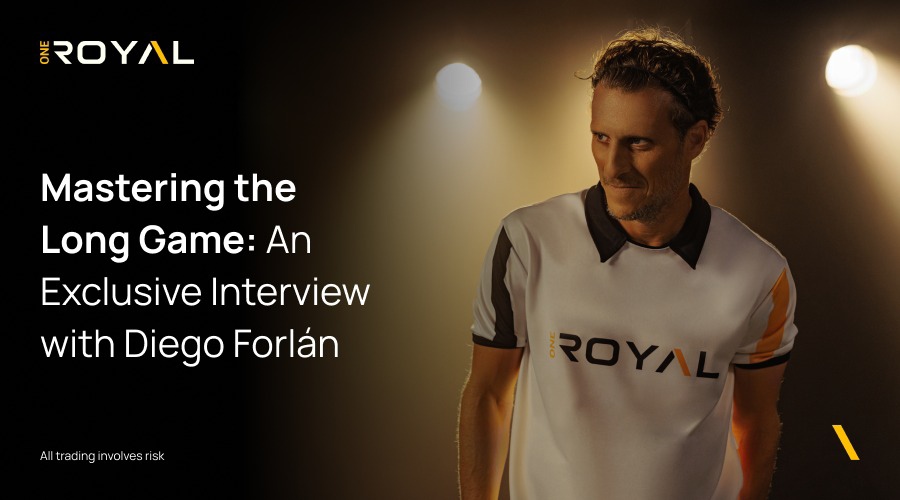
Mastering the Long Game: An Exclusive Interview with Diego Forlán

Tuesday, 20/10/2026 | 10:46 GMT by OneRoyal
Disclaimer
  • In a conversation about ambition, pressure and perspective, Forlán reflects on the work behind the highlights and the lessons he has taken into his partnership with OneRoyal.
OneRoyal

A goal takes a moment. The work that makes it possible takes years. For Diego Forlán, success has always involved decisions made far from the spotlight: how to prepare, when to adapt, and what to do when the result does not reflect the effort.

In this exclusive interview, Forlán looks beyond the big occasions to discuss the thinking that sustained his career. He talks about resisting short-term pressure, learning to trust his judgement, and recognising when patience matters more than an immediate impact. His partnership with OneRoyal brings another dimension to the conversation, creating parallels between the demands of football and the uncertainty of trading.

Through it all, he returns to a conviction shaped by experience: one performance should never define the bigger picture.

As a young footballer, what did success look like to you? How did that definition change as your career progressed?

For me, success is having something you believe in and dedicate yourself to. Something you try to do to the best of your abilities. It's not always the result that matters most. It's knowing that, deep down, you committed yourself fully and did everything you could to make things work. Because, sometimes, the result is out of your hands. But the effort, commitment, dedication, and attitude you bring to every challenge are always down to you.

Fans see the goals and the big occasions. What did you do consistently behind the scenes that made those moments possible?

The goals and the special moments are a result of a lot of hard work. It takes dedication, perseverance, and discipline. You need to set your targets and keep moving towards them. To play and succeed at the highest levels, you need to be willing to sacrifice. You need to stick to your plan and that often involves making tough decisions. No matter how well you do, there’s always ways to improve. You need to keep chasing that growth to stay on top of your game.

How did you learn to distinguish between a bad run of form and something in your game that genuinely needed to change?

It’s not always easy. You have to build up an awareness of your own game. Things will never go perfectly 100% of the time, and that’s normal. But, if your performance is constantly falling below the standards you expect, despite putting in the hard work, something may need to change. It often helps to sit down and think about things. Analyse your performances and see if a pattern emerges. If you need to make an adjustment. Or if you’re just in a rut and need to push through.

In a big match, how do you judge when to be patient and when to take a chance?

I think this is something that you develop with experience. When you’re young or just starting out, it can be harder to be patient. You’re excited to make an impact and show what you can do, and that can sometimes override critical thinking. But as you grow, you learn to read the game better. You become more confident in yourself, in your teammates, and in your overall judgement. You start to understand what moves and what opportunities have a higher chance of success, and when it may be better to sit back and wait.

After a great performance, what helped you reset and prepare for the next game? Was that ever harder than responding to a defeat?

Regardless of whether I was coming off a win or a loss, it was always important to take some time to rest and reflect before going again. You should never let one outcome, positive or negative, define what comes next. But there’s always something to learn. Analyse what went well and what you did right, or what you could improve on before the next match. You need to stay focused, remain disciplined, and keep making decisions that lead you closer to your overall goals.

Football demands results immediately, but building a career takes years. How did you keep short-term pressure from affecting your longer-term decisions?

In football, as in life, there are always external and internal pressures. You want to prove yourself, to show you’re capable of succeeding at the highest level. Of making a positive impact for both you and your team. But it’s important not to let these pressures overwhelm you. Giving into them can often have a negative impact on your performance. While difficult, sometimes the best thing to do is just let the pressure bounce off of you. Focus on your long-term goals and aspirations. And keep making decisions every single day that bring you that little bit closer to them. Building a fruitful career is a marathon, not a sprint. Letting short-term pressures influence your decision-making can often take you in the wrong direction.

From what you know of trading, do you see any parallels with football in how people prepare, handle uncertainty, or respond when things don’t go their way?

I think a lot of parallels can be drawn between football and trading. Both are high-pressure environments where split-second decisions can often define success or failure. As in football, trading requires preparation and dedication. You need to work hard, build a plan, and stick to it, even when outside influences may try to push you off track. Whether on the pitch or in the markets, you can never win every time. This is part of the game, but more importantly is how you react to the losses. You can’t let them define you. But you can learn, understand what didn’t work, and improve for the next time. How well you respond to failure often decides how successful you will be in reaching your long-term goals.

Through your relationship with OneRoyal, has anything about the financial world surprised you or sparked your curiosity?

One of the most surprising things to come out of my partnership with OneRoyal is how it has redefined trading for me. I used to think that it was a solo effort. But the truth is that it’s closer to a team sport like football. While a trader is responsible for their own performance, much like a player, when working with a broker like OneRoyal, support is always available. Tools, analysis, and guidance are all provided to help traders make the best decisions in pursuit of their financial goals. Just like the coaches, nutritionists, and equipment footballers have access to. Achievements are also celebrated together. Like with OneRoyal’s upcoming 20th Anniversary Gala in Istanbul, which I’m honoured to be attending, where clients and partners from around the world will gather to celebrate two decades of success.

If you could speak to the young Diego at the very start of his career, what would you tell him?

The first thing I'd tell him is to be patient. To not get too carried away with how things start. The first steps don't always go as you expect. There will always be difficult moments where things don't work out. What's important is to have clear goals that you're always working towards. There's a phrase I've always lived by: in time, everything falls into place. As long as you're working hard, being consistent, patient, and keeping your goal in mind, you'll get there. Don't let singular moments define you. One game, one decision, one thing that didn't go your way. You need to keep your eye on the big picture and understand that achieving your goals is a process.

Forlán’s reflections bring the conversation back to the work that follows the final whistle. There is a performance to assess, something to learn, and another decision to make. His partnership with OneRoyal gives him a new setting in which to explore those ideas, particularly the relationship between personal responsibility and the support around it. The long game, in his telling, is built through the choices made while the outcome is still uncertain.

Disclaimer

Thought Leadership

!"#$%&'()*+,-./0123456789:;<=>?@ABCDEFGHIJKLMNOPQRSTUVWXYZ[\]^_`abcdefghijklmnopqrstuvwxyz{|} !"#$%&'()*+,-./0123456789:;<=>?@ABCDEFGHIJKLMNOPQRSTUVWXYZ[\]^_`abcdefghijklmnopqrstuvwxyz{|}