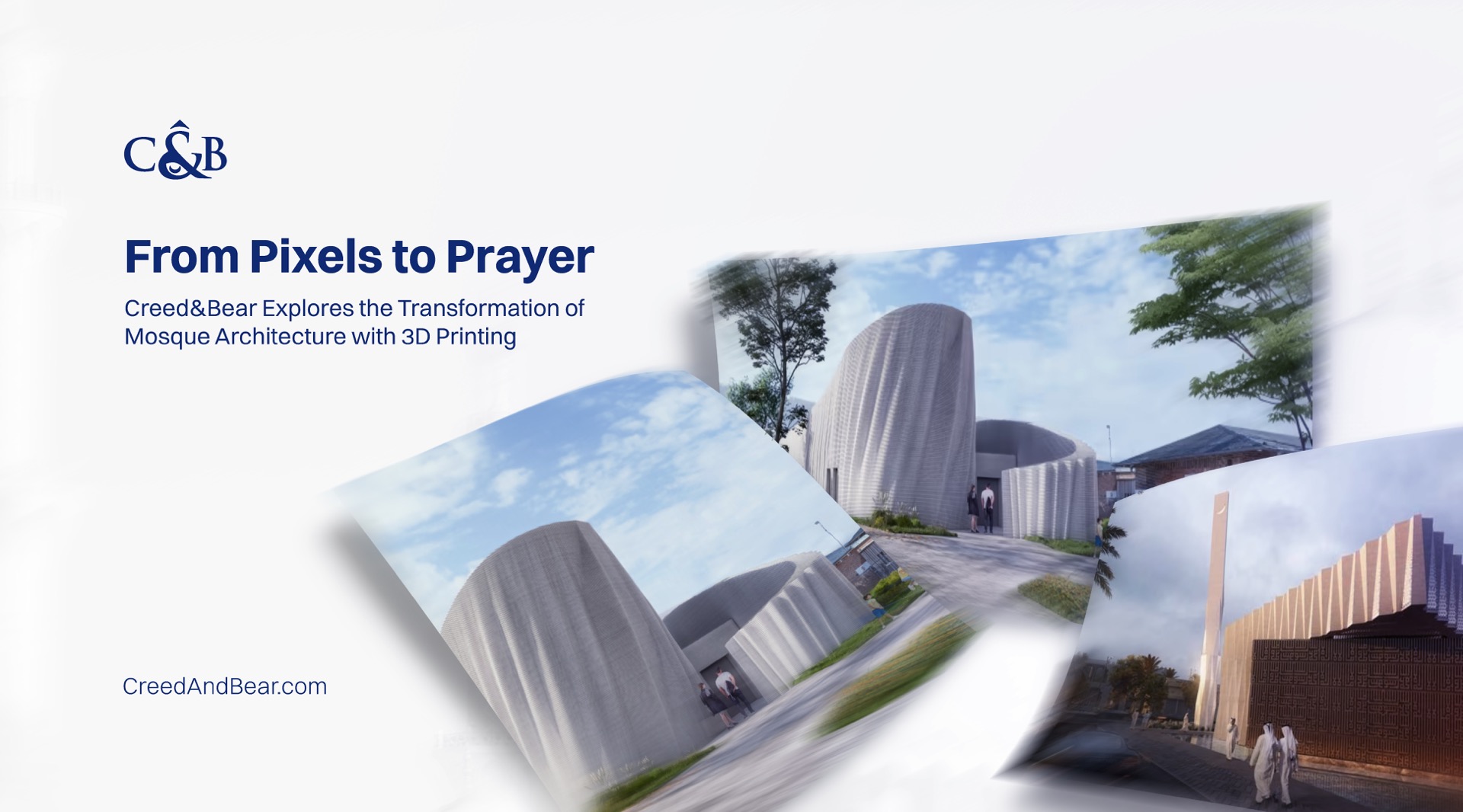
From Pixels to Prayer Creed and Bear Explores the Transformation of Mosque Architecture
Friday,07/07/2023|10:09GMTby
FM
We delve into the visionary plans of Dubai, a city renowned for its ambitious projects.
The enchanting melody of the Call to Prayer stirs deep devotion and connects believers to their spiritual essence. It traverses time and tradition, unifying communities with its soul-stirring resonance. In this article, we delve into the visionary plans of Dubai, a city renowned for its ambitious projects, as it leads the way in 3D printed mosque construction. At Creed and Bear, we are more than just an asset management company. We are delighted to be present in Dubai, supporting initiatives like the 3D printed mosque, as we envision a future in alignment with Dubai's 2030 vision.
Dubai's groundbreaking project involves the construction of the world's first 3D printed mosque. This remarkable endeavor showcases the transformative potential of 3D printed concrete, offering a glimpse into the future of mosque architecture as well as architecture in general. The mosque is expected to be completed in 2025 and will embody the fusion of innovation and spirituality, welcoming up to 600 worshippers.
3D printing, a process of creating three-dimensional objects from digital designs, presents a host of benefits for construction:
Affordability: 3D printing reduces the cost of construction by utilizing custom-made parts and optimizing material usage. This can make buildings more accessible to communities.
Sustainability: 3D printing creates energy-efficient buildings with reduced material waste and lower carbon emissions. This is beneficial for the environment.
Design flexibility: With 3D printing, architects can explore intricate and unique designs that push the boundaries of architecture, blending creativity with functionality.
Customization: 3D printing can be used to tailor buildings to specific community needs, enabling enhancements for accessibility and incorporating cultural nuances.
Adaptability: 3D printed buildings can easily adapt to changing community requirements, expanding or contracting as needed.
The future of 3D printed mosques holds tremendous promise:
Cultural Preservation: 3D printing preserves the rich heritage of historical mosques by faithfully replicating intricate architectural features and decorative elements, honoring the legacy of craftsmanship.
Adaptive Architecture: Mosque designs can evolve to meet the evolving needs of communities, fostering inclusivity and flexibility to accommodate changing congregation sizes and spatial requirements.
Collaborative Creation: By fostering collaboration between architects, engineers, and technologists, 3D printed mosques become captivating works of art, blending cultural heritage with innovative design concepts.
In conclusion, as we witness the mesmerizing interplay between technology and religion, the realm of mosque architecture stands on the cusp of a remarkable transformation. Through the visionary use of 3D printing, mosques can be constructed with unprecedented affordability, sustainability, and design flexibility. This harmonious fusion of ancient traditions and cutting-edge innovation ushers in a new era where spirituality and technological advancements dance in unison. Join us on this captivating journey, where the ethereal whispers of the Call to Prayer harmonize with the boundless possibilities of 3D printing.
Follow Creed and Bear on social media to stay up to date with the latest AI advances.
The enchanting melody of the Call to Prayer stirs deep devotion and connects believers to their spiritual essence. It traverses time and tradition, unifying communities with its soul-stirring resonance. In this article, we delve into the visionary plans of Dubai, a city renowned for its ambitious projects, as it leads the way in 3D printed mosque construction. At Creed and Bear, we are more than just an asset management company. We are delighted to be present in Dubai, supporting initiatives like the 3D printed mosque, as we envision a future in alignment with Dubai's 2030 vision.
Dubai's groundbreaking project involves the construction of the world's first 3D printed mosque. This remarkable endeavor showcases the transformative potential of 3D printed concrete, offering a glimpse into the future of mosque architecture as well as architecture in general. The mosque is expected to be completed in 2025 and will embody the fusion of innovation and spirituality, welcoming up to 600 worshippers.
3D printing, a process of creating three-dimensional objects from digital designs, presents a host of benefits for construction:
Affordability: 3D printing reduces the cost of construction by utilizing custom-made parts and optimizing material usage. This can make buildings more accessible to communities.
Sustainability: 3D printing creates energy-efficient buildings with reduced material waste and lower carbon emissions. This is beneficial for the environment.
Design flexibility: With 3D printing, architects can explore intricate and unique designs that push the boundaries of architecture, blending creativity with functionality.
Customization: 3D printing can be used to tailor buildings to specific community needs, enabling enhancements for accessibility and incorporating cultural nuances.
Adaptability: 3D printed buildings can easily adapt to changing community requirements, expanding or contracting as needed.
The future of 3D printed mosques holds tremendous promise:
Cultural Preservation: 3D printing preserves the rich heritage of historical mosques by faithfully replicating intricate architectural features and decorative elements, honoring the legacy of craftsmanship.
Adaptive Architecture: Mosque designs can evolve to meet the evolving needs of communities, fostering inclusivity and flexibility to accommodate changing congregation sizes and spatial requirements.
Collaborative Creation: By fostering collaboration between architects, engineers, and technologists, 3D printed mosques become captivating works of art, blending cultural heritage with innovative design concepts.
In conclusion, as we witness the mesmerizing interplay between technology and religion, the realm of mosque architecture stands on the cusp of a remarkable transformation. Through the visionary use of 3D printing, mosques can be constructed with unprecedented affordability, sustainability, and design flexibility. This harmonious fusion of ancient traditions and cutting-edge innovation ushers in a new era where spirituality and technological advancements dance in unison. Join us on this captivating journey, where the ethereal whispers of the Call to Prayer harmonize with the boundless possibilities of 3D printing.
Follow Creed and Bear on social media to stay up to date with the latest AI advances.
Hola Prime Recognized “Fastest Payout Prop Firm” by UF AWARDS MEA 2026
Finance Magnates Awards 2026 – Nominations Now Open
Finance Magnates Awards 2026 – Nominations Now Open
The Finance Magnates Awards 2026 nominations are now open. 🏆
From fintech innovators to leading brokers, this is where the finance industry celebrates its biggest achievements.
Winners will be announced at the Cyprus Gala Dinner on November 6, 2026.
Nominate your brand now.
https://awards.financemagnates.com/?utm_source=linkedin&utm_medium=video&utm_campaign=nominations-open
#FMAwards #FinanceMagnates #FintechAwards #Fintech #FinanceIndustry
The Finance Magnates Awards 2026 nominations are now open. 🏆
From fintech innovators to leading brokers, this is where the finance industry celebrates its biggest achievements.
Winners will be announced at the Cyprus Gala Dinner on November 6, 2026.
Nominate your brand now.
https://awards.financemagnates.com/?utm_source=linkedin&utm_medium=video&utm_campaign=nominations-open
#FMAwards #FinanceMagnates #FintechAwards #Fintech #FinanceIndustry
Finance Magnates Awards 2026 | Nominations Now Open 🏆#Fintech #FMAwards #TradingIndustry
Finance Magnates Awards 2026 | Nominations Now Open 🏆#Fintech #FMAwards #TradingIndustry
Lights on. Cameras ready. 🎬
Finance Magnates Awards 2026 nominations are now open. 🏆
#FMAwards #FinanceMagnates #FintechAwards #Fintech
Lights on. Cameras ready. 🎬
Finance Magnates Awards 2026 nominations are now open. 🏆
#FMAwards #FinanceMagnates #FintechAwards #Fintech
Exness sees trust as the key theme for growth in MENA Trading Growth for 2026
Exness sees trust as the key theme for growth in MENA Trading Growth for 2026
Mohammad Amer, Regional Commercial Director at Exness, sits down to discuss the booming MENA financial trading market. Find out why Dubai is key to the company's growth strategy, how a mobile-first generation is changing expectations, and why trust will be the defining theme for traders in 2026.
In this interview, you'll learn:
* Why Dubai and the MENA region are critical growth markets for fintech and online trading.
* How Exness is addressing the demands of mobile-first, younger traders through engineering, platform stability, and transparent conditions.
* The essential role local talent plays in providing a culturally relevant and compliant user experience.
* Mohammad Amer's outlook on the future of the online trading industry and why stronger controls and systems are necessary.
* Why "trust" isn't just a brand value, but has commercial value—and why he predicts 2026 will be the "Year of Trust."
Key Takeaways:
➡️ The MENA region is rapidly shaping global financial markets.
➡️ New traders expect stability, precise execution, and transparency.
➡️ Local expertise is key to regulatory compliance and user experience.
➡️ Future success belongs to firms capable of meeting rising standards across regulation and platform consistency.
Read the full article at: https://www.financemagnates.com/thought-leadership/exness-sees-trust-as-the-key-theme-for-growth-in-mena-trading-growth-for-2026/
#Exness #MENA #Trading #FinTech #Dubai #OnlineTrading #FinanceMagnates #MohammadAmer #Trust #MobileTrading
Mohammad Amer, Regional Commercial Director at Exness, sits down to discuss the booming MENA financial trading market. Find out why Dubai is key to the company's growth strategy, how a mobile-first generation is changing expectations, and why trust will be the defining theme for traders in 2026.
In this interview, you'll learn:
* Why Dubai and the MENA region are critical growth markets for fintech and online trading.
* How Exness is addressing the demands of mobile-first, younger traders through engineering, platform stability, and transparent conditions.
* The essential role local talent plays in providing a culturally relevant and compliant user experience.
* Mohammad Amer's outlook on the future of the online trading industry and why stronger controls and systems are necessary.
* Why "trust" isn't just a brand value, but has commercial value—and why he predicts 2026 will be the "Year of Trust."
Key Takeaways:
➡️ The MENA region is rapidly shaping global financial markets.
➡️ New traders expect stability, precise execution, and transparency.
➡️ Local expertise is key to regulatory compliance and user experience.
➡️ Future success belongs to firms capable of meeting rising standards across regulation and platform consistency.
Read the full article at: https://www.financemagnates.com/thought-leadership/exness-sees-trust-as-the-key-theme-for-growth-in-mena-trading-growth-for-2026/
#Exness #MENA #Trading #FinTech #Dubai #OnlineTrading #FinanceMagnates #MohammadAmer #Trust #MobileTrading
Paytiko CEO Razi Salih on Why Payment Orchestration is a MUST-HAVE for Brokers in 2026
Paytiko CEO Razi Salih on Why Payment Orchestration is a MUST-HAVE for Brokers in 2026
At iFX Expo Dubai, Finance Magnates spoke with Razi Salih, CEO at Paytiko, about the evolution of the payments ecosystem and why payment orchestration has shifted from an option to a necessity for brokers, prop firms, and exchanges.
Mr. Salih explains how global expansion, the need for deep localisation, and the sheer number of new payment methods, from instant banking to stablecoins, are driving this critical infrastructure shift.
#PaymentOrchestration #Fintech #Brokerage #TradingPayments #RaziSalih #Paytiko #iFXExpoDubai #Stablecoins #AIinFintech
At iFX Expo Dubai, Finance Magnates spoke with Razi Salih, CEO at Paytiko, about the evolution of the payments ecosystem and why payment orchestration has shifted from an option to a necessity for brokers, prop firms, and exchanges.
Mr. Salih explains how global expansion, the need for deep localisation, and the sheer number of new payment methods, from instant banking to stablecoins, are driving this critical infrastructure shift.
#PaymentOrchestration #Fintech #Brokerage #TradingPayments #RaziSalih #Paytiko #iFXExpoDubai #Stablecoins #AIinFintech
Altima CTO Sunil Jadhav: Solving Data Fragmentation & Lag for Brokers & Prop Firms
Altima CTO Sunil Jadhav: Solving Data Fragmentation & Lag for Brokers & Prop Firms
Altima CTO Sunil Jadhav sits down with Finance Magnates to discuss the core technology challenges facing CFD brokers and proprietary trading firms today.
Jadhav explains how the industry's reliance on batch processing and fragmented systems (where CRMs, risk tools, and trading platforms operate with separate 'sources of truth') leads to delayed data and inconsistent operational decisions. He argues that real-time event processing is essential for managing fast-moving trading activity and risk.
Learn how Altima's unified, event-driven architecture, connecting Altima CRM, Altima Prop, IB systems, and risk management through a single backbone, is designed to provide synchronous data and better operational coordination for modern brokerage and prop firm stacks.
Key Topics:
- Broker and Prop Firm Data Challenges
- The problem of delayed data processing (batch processing vs. real-time events)
- Fragmented systems and conflicting data sources
- Altima's unified, event-driven solution architecture
- The concept of a "risk-aware CRM"
- Built-in risk management in Altima Prop
#Altima #financemagnates #iFXDubai #FinTech #BrokerTech #PropFirm #CFDBroker #TradingTechnology #RealTimeData #RiskManagement #CRM #FinancialMarkets #EventDrivenArchitecture
Altima CTO Sunil Jadhav sits down with Finance Magnates to discuss the core technology challenges facing CFD brokers and proprietary trading firms today.
Jadhav explains how the industry's reliance on batch processing and fragmented systems (where CRMs, risk tools, and trading platforms operate with separate 'sources of truth') leads to delayed data and inconsistent operational decisions. He argues that real-time event processing is essential for managing fast-moving trading activity and risk.
Learn how Altima's unified, event-driven architecture, connecting Altima CRM, Altima Prop, IB systems, and risk management through a single backbone, is designed to provide synchronous data and better operational coordination for modern brokerage and prop firm stacks.
Key Topics:
- Broker and Prop Firm Data Challenges
- The problem of delayed data processing (batch processing vs. real-time events)
- Fragmented systems and conflicting data sources
- Altima's unified, event-driven solution architecture
- The concept of a "risk-aware CRM"
- Built-in risk management in Altima Prop
#Altima #financemagnates #iFXDubai #FinTech #BrokerTech #PropFirm #CFDBroker #TradingTechnology #RealTimeData #RiskManagement #CRM #FinancialMarkets #EventDrivenArchitecture