DeFi Yield Is Broken — Why RWAs Could be the Bridge to Generating Real Yield in Crypto
Wednesday,02/07/2025|09:12GMTby
FM
Crypto has finally come of age!
Decentralized Finance (DeFi) innovations rose in popularity back in 2020 when pioneer protocols, including Compound and Uniswap launched their governance tokens. What stood out about this particular crypto niche at the time was its lucrative yields, with some protocols like Yearn Finance (YFI) offering APY’s that were as high 1,000+%.
Fast forward to today, DeFi is no longer the powerhouse that it was at the height of the 2021 bull run when the total value locked (TVL) eclipsed $174 billion. In fact, most of the protocols which featured astronomical yields did not see the light of day post the FTX saga.
So what went wrong? Was the revenue generation model for DeFi protocols not sustainable or just like any other speculative market, hype and fleeting narratives could not keep gravy train running for long?
Real Yield from Real Assets
To understand what DeFi innovations missed in terms of a sustainable yield generation formula, one has to appreciate the upcoming Real World Asset (RWA) market. This nascent area of innovation solves the shortcomings in DeFi yield generation models by integrating real world assets with the crypto ecosystem to generate real yields with real impact. A fundamental deviation from DeFi’s typical inflationary tokenomics models where the production of new tokens is what drove the yield.
Imagine a world where investors across the globe can seamlessly participate and generate yield from privileged-access markets such as the U.S. treasuries and bond market or even the booming clean energy funding ecosystem. This is what tokenized RWA solutions like Blackrock’s BUIDL fund, Franklin Templeton’s BENJI and Ecoyield’s decentralized clean energy funding platform are designed to achieve.
To provide some more context, Templeton’s BENJI provides investors with an opportunity to get exposure in U.S. treasuries. The catch is that unlike traditional settlement desks, investors don’t have to go through a centralized intermediary to purchase U.S. securities; instead, BENJI supports multiple blockchain networks, including Solana, Stellar, Polygon, Ethereum and Base which allow investors to gain exposure without going through an intermediary.
Ecoyield is also building an RWA solution that operates in almost similar fashion but with a focus on the clean energy market. This decentralized platform is a pioneer in the tokenization of clean energy infrastructure. At the core, Ecoyield’s RWA model connects investors directly with vetted renewable energy projects, enabling them to deploy funds in verified solar and BESS (Battery Energy Storage System) projects.
So, how are these two RWA examples different from speculative DeFi yield? The real value proposition is that both projects generate yield from real assets; in the case of BENJI, the yield is derived from U.S. treasuries while in Ecoyield, the platform collects real-world revenue (via PPAs), and distributes yield (in ETH/USDC) back to the investors who deploy their capital.
Looking back at DeFi yield generation model, there have been some structural issues which can be attributed to the products or tokens being backed by thin air and the high volatility of digital assets:
Inflationary tokenomics: A huge number of DeFi protocols were only sustainable due to constant emission of tokens to reward users as APY. But when these tokens flooded the market, the value was inevitably diluted and ultimately devalued.
Impermanent Loss: Even when headline APY for DeFi protocols was impressive, the high volatility of token pairs meant actual loss was often lower or negative after accounting for the impermanent loss.
Looking Into the Future
Now that RWAs have emerged as a potential disruptor, one can only but wonder what the future of yield generation in crypto holds.
For starters, it is likely we will start seeing more realistic yields but achievable and backed by a real world revenue generating asset. Instead of scenarios where protocols feature over 1000% APY as was the case with prominent protocols like Sushiswap and Wonderland (TIME) which offered as high as 70,000% via rebase mechanics, the industry will usher in an era where conservative but sustainable APY’s make sense.
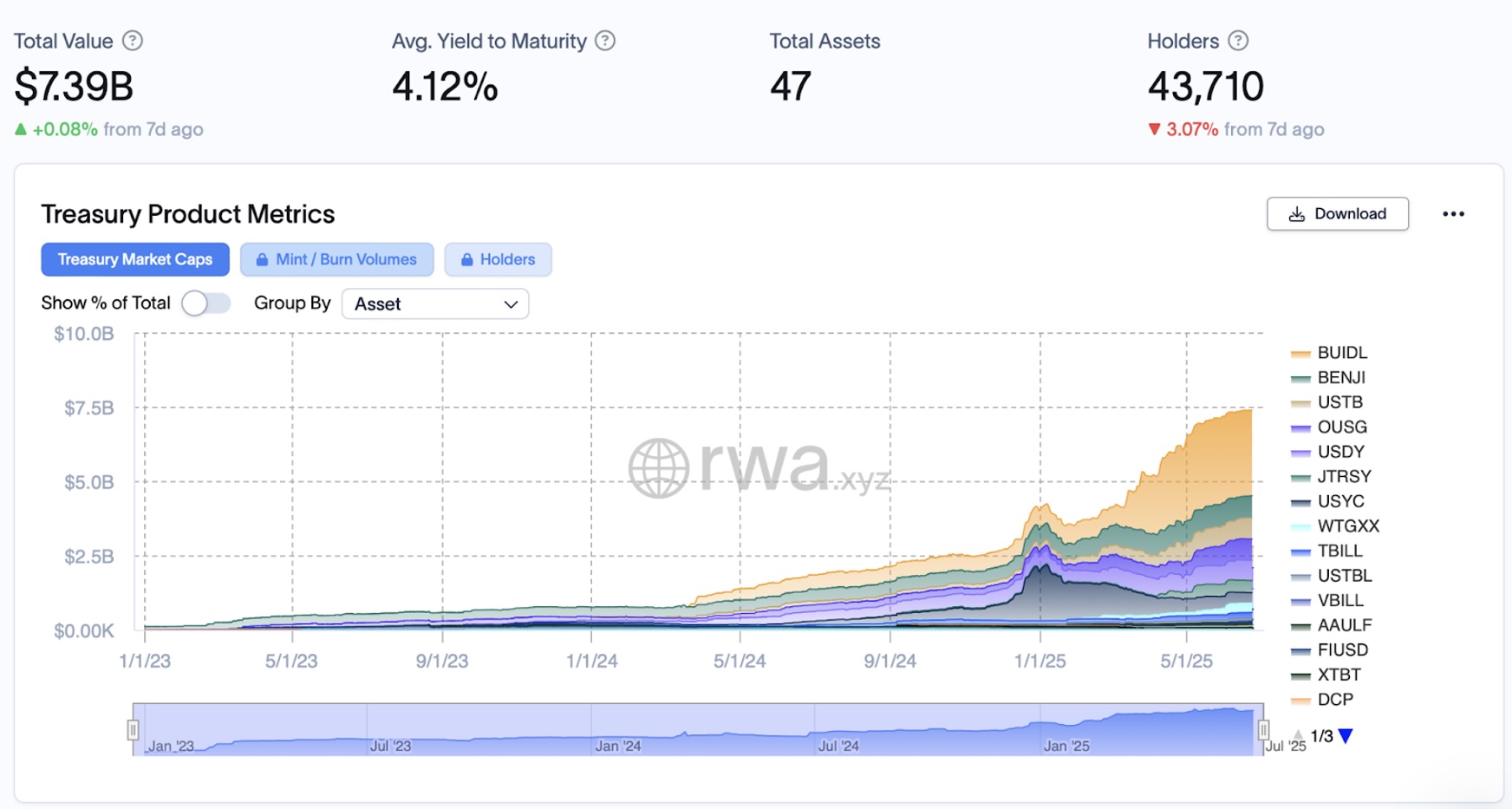
The shift is already happening, with U.S. treasuries tokenized RWAs emerging as a favorite amongst investors despite their low returns. For context, the average yield to maturity according to RWA.xyz currently stands at 4.12%; this is much lower than the highly lucrative DeFi yields we witnessed in 2021. But what’s worth noting is despite their conservative nature, the RWA market has been on an uptrend, with tokenized treasuries now at a value of $7.3 billion.
Source: RWA xyz
Meanwhile, DeFi protocols that lead the hype in 2021 continue to struggle with traction; Sushiswap’s TVL in 2021 hit an all-time high of $7.7 billion but has since dropped to a mere $117.36 million as of writing this piece.
Another interesting development that will likely happen is the adoption of real world assets by smaller players, including real estate investment vehicles looking to tokenize their properties to localize access in their specific markets. This particular development will likely revolutionize the concept of fractional ownership through blockchain technology. Instead of depending on third parties, RWAs will make it possible for investors to take up positions in sophisticated investments directly.
More importantly, crypto has finally come of age; an era where yield is not generated from speculative hype but rather real assets with real yield and real impact!
Decentralized Finance (DeFi) innovations rose in popularity back in 2020 when pioneer protocols, including Compound and Uniswap launched their governance tokens. What stood out about this particular crypto niche at the time was its lucrative yields, with some protocols like Yearn Finance (YFI) offering APY’s that were as high 1,000+%.
Fast forward to today, DeFi is no longer the powerhouse that it was at the height of the 2021 bull run when the total value locked (TVL) eclipsed $174 billion. In fact, most of the protocols which featured astronomical yields did not see the light of day post the FTX saga.
So what went wrong? Was the revenue generation model for DeFi protocols not sustainable or just like any other speculative market, hype and fleeting narratives could not keep gravy train running for long?
Real Yield from Real Assets
To understand what DeFi innovations missed in terms of a sustainable yield generation formula, one has to appreciate the upcoming Real World Asset (RWA) market. This nascent area of innovation solves the shortcomings in DeFi yield generation models by integrating real world assets with the crypto ecosystem to generate real yields with real impact. A fundamental deviation from DeFi’s typical inflationary tokenomics models where the production of new tokens is what drove the yield.
Imagine a world where investors across the globe can seamlessly participate and generate yield from privileged-access markets such as the U.S. treasuries and bond market or even the booming clean energy funding ecosystem. This is what tokenized RWA solutions like Blackrock’s BUIDL fund, Franklin Templeton’s BENJI and Ecoyield’s decentralized clean energy funding platform are designed to achieve.
To provide some more context, Templeton’s BENJI provides investors with an opportunity to get exposure in U.S. treasuries. The catch is that unlike traditional settlement desks, investors don’t have to go through a centralized intermediary to purchase U.S. securities; instead, BENJI supports multiple blockchain networks, including Solana, Stellar, Polygon, Ethereum and Base which allow investors to gain exposure without going through an intermediary.
Ecoyield is also building an RWA solution that operates in almost similar fashion but with a focus on the clean energy market. This decentralized platform is a pioneer in the tokenization of clean energy infrastructure. At the core, Ecoyield’s RWA model connects investors directly with vetted renewable energy projects, enabling them to deploy funds in verified solar and BESS (Battery Energy Storage System) projects.
So, how are these two RWA examples different from speculative DeFi yield? The real value proposition is that both projects generate yield from real assets; in the case of BENJI, the yield is derived from U.S. treasuries while in Ecoyield, the platform collects real-world revenue (via PPAs), and distributes yield (in ETH/USDC) back to the investors who deploy their capital.
Looking back at DeFi yield generation model, there have been some structural issues which can be attributed to the products or tokens being backed by thin air and the high volatility of digital assets:
Inflationary tokenomics: A huge number of DeFi protocols were only sustainable due to constant emission of tokens to reward users as APY. But when these tokens flooded the market, the value was inevitably diluted and ultimately devalued.
Impermanent Loss: Even when headline APY for DeFi protocols was impressive, the high volatility of token pairs meant actual loss was often lower or negative after accounting for the impermanent loss.
Looking Into the Future
Now that RWAs have emerged as a potential disruptor, one can only but wonder what the future of yield generation in crypto holds.
For starters, it is likely we will start seeing more realistic yields but achievable and backed by a real world revenue generating asset. Instead of scenarios where protocols feature over 1000% APY as was the case with prominent protocols like Sushiswap and Wonderland (TIME) which offered as high as 70,000% via rebase mechanics, the industry will usher in an era where conservative but sustainable APY’s make sense.
The shift is already happening, with U.S. treasuries tokenized RWAs emerging as a favorite amongst investors despite their low returns. For context, the average yield to maturity according to RWA.xyz currently stands at 4.12%; this is much lower than the highly lucrative DeFi yields we witnessed in 2021. But what’s worth noting is despite their conservative nature, the RWA market has been on an uptrend, with tokenized treasuries now at a value of $7.3 billion.
Source: RWA xyz
Meanwhile, DeFi protocols that lead the hype in 2021 continue to struggle with traction; Sushiswap’s TVL in 2021 hit an all-time high of $7.7 billion but has since dropped to a mere $117.36 million as of writing this piece.
Another interesting development that will likely happen is the adoption of real world assets by smaller players, including real estate investment vehicles looking to tokenize their properties to localize access in their specific markets. This particular development will likely revolutionize the concept of fractional ownership through blockchain technology. Instead of depending on third parties, RWAs will make it possible for investors to take up positions in sophisticated investments directly.
More importantly, crypto has finally come of age; an era where yield is not generated from speculative hype but rather real assets with real yield and real impact!
Engineered Trust – A Conversation with Adam Phillips, CEO of FXT
CMC Markets’ Artur Delijergijevs on Metals Demand, Volatility, & Stable Execution
CMC Markets’ Artur Delijergijevs on Metals Demand, Volatility, & Stable Execution
In this exclusive Executive Interview, Finance Magnates speaks with Artur Delijergijevs, Head of Systematic Market Making at CMC Markets, about the current state of metals demand and market volatility.
Delijergijevs offers a desk-level view on:
- Metals Demand: Why metals are seeing the strongest demand from both retail and institutional clients right now.
- The Safe-Haven Debate: Questioning whether gold still fits the classic safe-haven definition given large daily price movements.
- Volatile Market Prep: How a market-making desk prepares its systems and pricing for stressed market conditions and high-impact economic events.
- Hybrid Execution: Why the best execution model combines electronic speed with human relationship support, especially during volatility.
- AI in Workflow: Where CMC Markets is integrating machine learning for risk management and pricing, and the limitations of AI during stressed markets.
- Dubai's Role: The strategic importance of Dubai’s location for covering global trading sessions across Asia, Europe, and the US.
Watch to understand how CMC Markets maintains stable pricing and reliable execution quality in high-volatility environments.
#CMCmarkets #forex #metals #gold #trading #volatility #MarketMaking #iFXDubai #FinanceMagnates #Finance #Fintech #Execution #AlgorithmicTrading #RiskManagement
In this exclusive Executive Interview, Finance Magnates speaks with Artur Delijergijevs, Head of Systematic Market Making at CMC Markets, about the current state of metals demand and market volatility.
Delijergijevs offers a desk-level view on:
- Metals Demand: Why metals are seeing the strongest demand from both retail and institutional clients right now.
- The Safe-Haven Debate: Questioning whether gold still fits the classic safe-haven definition given large daily price movements.
- Volatile Market Prep: How a market-making desk prepares its systems and pricing for stressed market conditions and high-impact economic events.
- Hybrid Execution: Why the best execution model combines electronic speed with human relationship support, especially during volatility.
- AI in Workflow: Where CMC Markets is integrating machine learning for risk management and pricing, and the limitations of AI during stressed markets.
- Dubai's Role: The strategic importance of Dubai’s location for covering global trading sessions across Asia, Europe, and the US.
Watch to understand how CMC Markets maintains stable pricing and reliable execution quality in high-volatility environments.
#CMCmarkets #forex #metals #gold #trading #volatility #MarketMaking #iFXDubai #FinanceMagnates #Finance #Fintech #Execution #AlgorithmicTrading #RiskManagement
Finance Magnates Awards 2026 – Nominations Now Open
Finance Magnates Awards 2026 – Nominations Now Open
The Finance Magnates Awards 2026 nominations are now open. 🏆
From fintech innovators to leading brokers, this is where the finance industry celebrates its biggest achievements.
Winners will be announced at the Cyprus Gala Dinner on November 6, 2026.
Nominate your brand now.
https://awards.financemagnates.com/?utm_source=linkedin&utm_medium=video&utm_campaign=nominations-open
#FMAwards #FinanceMagnates #FintechAwards #Fintech #FinanceIndustry
The Finance Magnates Awards 2026 nominations are now open. 🏆
From fintech innovators to leading brokers, this is where the finance industry celebrates its biggest achievements.
Winners will be announced at the Cyprus Gala Dinner on November 6, 2026.
Nominate your brand now.
https://awards.financemagnates.com/?utm_source=linkedin&utm_medium=video&utm_campaign=nominations-open
#FMAwards #FinanceMagnates #FintechAwards #Fintech #FinanceIndustry
Finance Magnates Awards 2026 | Nominations Now Open 🏆#Fintech #FMAwards #TradingIndustry
Finance Magnates Awards 2026 | Nominations Now Open 🏆#Fintech #FMAwards #TradingIndustry
Lights on. Cameras ready. 🎬
Finance Magnates Awards 2026 nominations are now open. 🏆
#FMAwards #FinanceMagnates #FintechAwards #Fintech
Lights on. Cameras ready. 🎬
Finance Magnates Awards 2026 nominations are now open. 🏆
#FMAwards #FinanceMagnates #FintechAwards #Fintech
Exness sees trust as the key theme for growth in MENA Trading Growth for 2026
Exness sees trust as the key theme for growth in MENA Trading Growth for 2026
Mohammad Amer, Regional Commercial Director at Exness, sits down to discuss the booming MENA financial trading market. Find out why Dubai is key to the company's growth strategy, how a mobile-first generation is changing expectations, and why trust will be the defining theme for traders in 2026.
In this interview, you'll learn:
* Why Dubai and the MENA region are critical growth markets for fintech and online trading.
* How Exness is addressing the demands of mobile-first, younger traders through engineering, platform stability, and transparent conditions.
* The essential role local talent plays in providing a culturally relevant and compliant user experience.
* Mohammad Amer's outlook on the future of the online trading industry and why stronger controls and systems are necessary.
* Why "trust" isn't just a brand value, but has commercial value—and why he predicts 2026 will be the "Year of Trust."
Key Takeaways:
➡️ The MENA region is rapidly shaping global financial markets.
➡️ New traders expect stability, precise execution, and transparency.
➡️ Local expertise is key to regulatory compliance and user experience.
➡️ Future success belongs to firms capable of meeting rising standards across regulation and platform consistency.
Read the full article at: https://www.financemagnates.com/thought-leadership/exness-sees-trust-as-the-key-theme-for-growth-in-mena-trading-growth-for-2026/
#Exness #MENA #Trading #FinTech #Dubai #OnlineTrading #FinanceMagnates #MohammadAmer #Trust #MobileTrading
Mohammad Amer, Regional Commercial Director at Exness, sits down to discuss the booming MENA financial trading market. Find out why Dubai is key to the company's growth strategy, how a mobile-first generation is changing expectations, and why trust will be the defining theme for traders in 2026.
In this interview, you'll learn:
* Why Dubai and the MENA region are critical growth markets for fintech and online trading.
* How Exness is addressing the demands of mobile-first, younger traders through engineering, platform stability, and transparent conditions.
* The essential role local talent plays in providing a culturally relevant and compliant user experience.
* Mohammad Amer's outlook on the future of the online trading industry and why stronger controls and systems are necessary.
* Why "trust" isn't just a brand value, but has commercial value—and why he predicts 2026 will be the "Year of Trust."
Key Takeaways:
➡️ The MENA region is rapidly shaping global financial markets.
➡️ New traders expect stability, precise execution, and transparency.
➡️ Local expertise is key to regulatory compliance and user experience.
➡️ Future success belongs to firms capable of meeting rising standards across regulation and platform consistency.
Read the full article at: https://www.financemagnates.com/thought-leadership/exness-sees-trust-as-the-key-theme-for-growth-in-mena-trading-growth-for-2026/
#Exness #MENA #Trading #FinTech #Dubai #OnlineTrading #FinanceMagnates #MohammadAmer #Trust #MobileTrading
Paytiko CEO Razi Salih on Why Payment Orchestration is a MUST-HAVE for Brokers in 2026
Paytiko CEO Razi Salih on Why Payment Orchestration is a MUST-HAVE for Brokers in 2026
At iFX Expo Dubai, Finance Magnates spoke with Razi Salih, CEO at Paytiko, about the evolution of the payments ecosystem and why payment orchestration has shifted from an option to a necessity for brokers, prop firms, and exchanges.
Mr. Salih explains how global expansion, the need for deep localisation, and the sheer number of new payment methods, from instant banking to stablecoins, are driving this critical infrastructure shift.
#PaymentOrchestration #Fintech #Brokerage #TradingPayments #RaziSalih #Paytiko #iFXExpoDubai #Stablecoins #AIinFintech
At iFX Expo Dubai, Finance Magnates spoke with Razi Salih, CEO at Paytiko, about the evolution of the payments ecosystem and why payment orchestration has shifted from an option to a necessity for brokers, prop firms, and exchanges.
Mr. Salih explains how global expansion, the need for deep localisation, and the sheer number of new payment methods, from instant banking to stablecoins, are driving this critical infrastructure shift.
#PaymentOrchestration #Fintech #Brokerage #TradingPayments #RaziSalih #Paytiko #iFXExpoDubai #Stablecoins #AIinFintech