Risks for oil prices remain on the downside unless OPEC takes concrete steps towards output cap enforcement.
Bloomberg
With just weeks until the semiannual meeting of OPEC members in Vienna, a shaky output cap deal remains the looming risk factor for oil prices that refuses disappear. Assurances from members aside, OPEC’s production continues to expand, rising to 33.640 million barrels per day in September and climbing to 33.820 million bpd in October.
The question remains as to how much each member will have to cut to meet the 32.500 million bpd targeted by the accord forged in Algeria.
Producers may ramp production adding to oversupply
Discord remains unresolved, with the Gulf countries feeling the heat to cut production while other members largely maintain output. Despite several countries receiving exemptions, other countries are even questioning the math.
Furthermore, outside OPEC members, rising production from Russia alongside growing hedging by American producers suggests that any OPEC output cuts would be soaked up by other players. Considering the circumstances, the unstable foundation for the Algeria deal remains an impediment to any sustainable floor in oil prices.
Shrinking Common Ground
Despite ongoing working sessions to create a meaningful deal to help reduce oil oversupply, many factors stand in the way of OPEC progress. Looking at the membership in particular, several nations will be exempted from cutting output.
Ongoing conflicts and economic factors will see Nigeria, Libya, and Iran caps set at 2016 highs, giving the economies room to recover. Still, the generous treatment for these members has drawn the scorn and envy of others.
The GCC nations are especially concerned, believing that they will be the predominant source of output cuts. Any participation in such a deal may see them lose market share. Iraq has also pleaded to be excused from production cuts as the nation embarks on a showdown against IS forces in Mosul.
Few catalysts short of war could lift oil prices
While all OPEC members are especially willing to reap the rewards of higher oil prices, none seem excited about taking concrete steps to reach that end. In the meantime, the absence of common ground aside from the price issue remains a significant stumbling block, forcing oil prices lower.
Unworried about another imminent price dip, producers can ramp production higher or restart shuttered projects, adding to oversupply.
With US production rising to 8.504 million barrels during the week ended October 21st accompanied by an oil rig count that has risen 22 of the last 23 weeks, shale drilling is swiftly reemerging from hiding.
Outside of the United States, Russia has continued to take its own production higher, thinking that at most OPEC will request an output cap, not an output cut.
However, with no enforcement mechanism in place, Russia may seek to continue increasing its daily production while other producers relinquish market share after hitting a post-Soviet record of 11.180 million bpd in output.
Contemplating these factors, there remain few catalysts short of war which could imminently rebalance the market and lift oil prices.
Technically Speaking
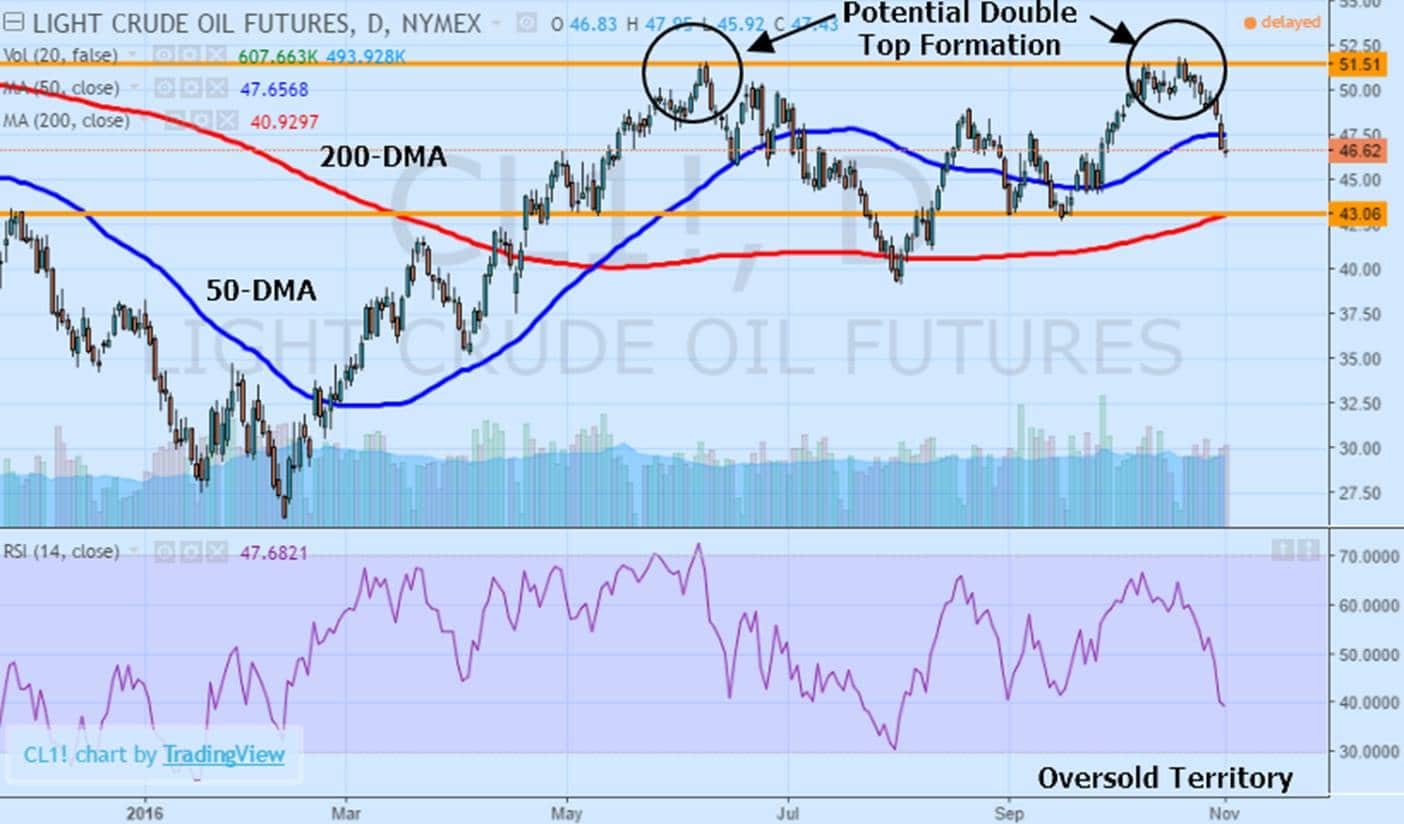
Looking at crude oil prices from a technical perspective, the latest acceleration lower in prices might not be concluded. For one, the Relative Strength Index remains above the 30.0 oversold level, indicating that momentum might not peak.
Second, the 50-day moving averages is currently keeping a lid on upside as evidenced by the earlier test of the 50-DMA before prices reversed lower.
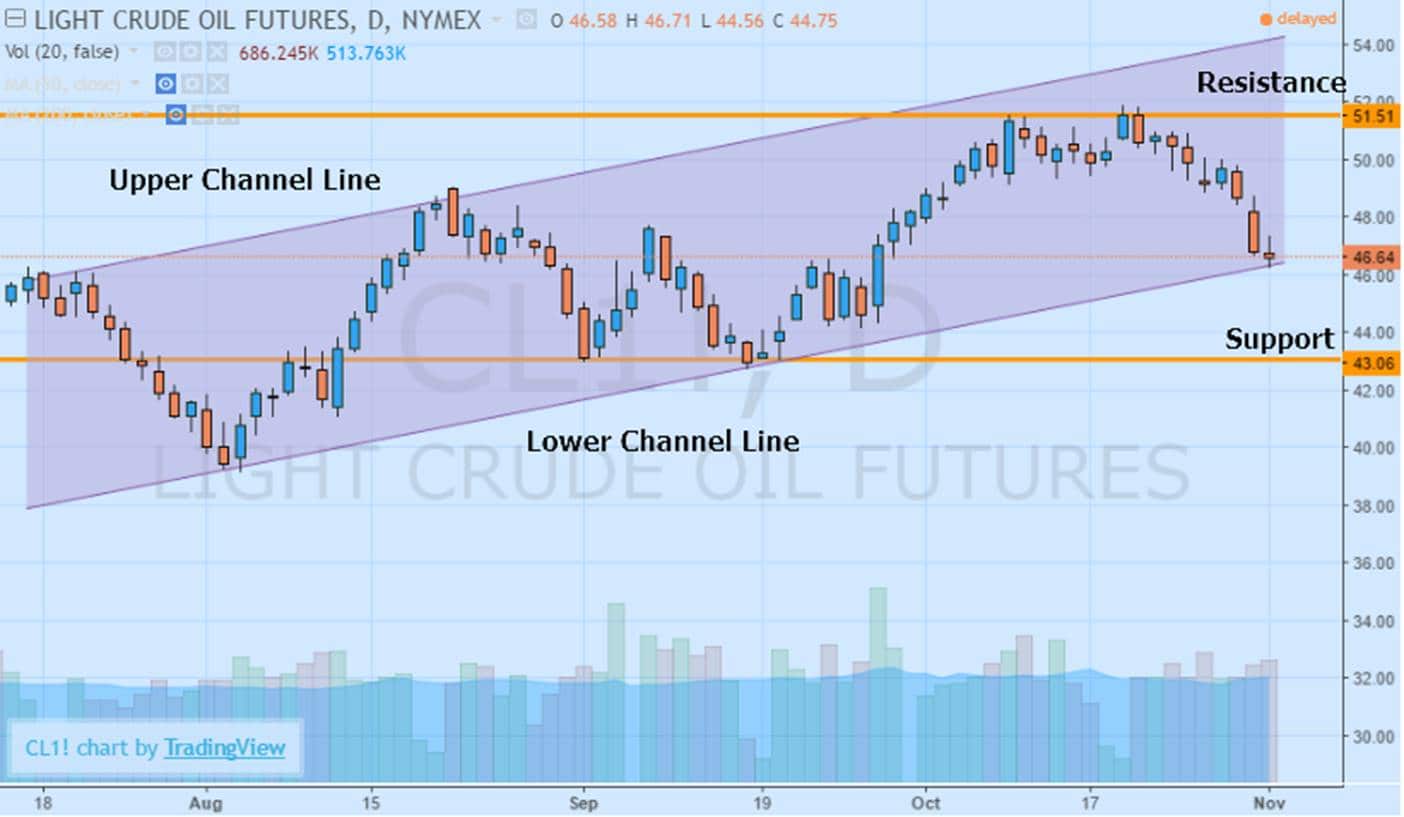
However, despite the room for oil prices to fall further, there are several supportive factors that may prevent an all-out collapse. For one, the 200-day moving average neatly coincides with an important support level at $43.06. A cross of this threshold could indicate that upward trend forming from August could be breaking down, but it could prove a challenging level.
Before testing support that converges with the 200-day moving average, crude must first see if the lower bound of the emerging equidistant channel formation holds up.
While potentially an ideal opportunity for a bullish trader to capitalize on the pattern by targeting the upper channel line, a candlestick close below the lower channel line could signify a breakout move.
Should the move be accompanied by higher trading volumes and momentum, it could be the beginning of a $5.00-6.00 point leg lower based on the existing channel range.
On the upside, the barrier remains at resistance of $51.51. Taken in the context of the June peak, it could indicate a double top formation in prices, which is typically interpreted as a bearish signal.
Looking Ahead
Unless a consensus is found leading up the official OPEC Meeting scheduled for November 30th and concrete steps are taken towards output cap enforcement, oil prices are likely to continue to find themselves under pressure with limited room to run to the upside.
Sustained argument over who will bear the brunt of the proposed output cuts may unravel any salvageable deal. Additionally, with other major producers using rising prices as an opportunity to expand production and hedge prices, any reduction from OPEC may prove meaningless to rebalancing the market.
Considering the current dynamic, risks for prices remain firmly to the downside unless OPEC is really able to form a grand bargain.
With just weeks until the semiannual meeting of OPEC members in Vienna, a shaky output cap deal remains the looming risk factor for oil prices that refuses disappear. Assurances from members aside, OPEC’s production continues to expand, rising to 33.640 million barrels per day in September and climbing to 33.820 million bpd in October.
The question remains as to how much each member will have to cut to meet the 32.500 million bpd targeted by the accord forged in Algeria.
Producers may ramp production adding to oversupply
Discord remains unresolved, with the Gulf countries feeling the heat to cut production while other members largely maintain output. Despite several countries receiving exemptions, other countries are even questioning the math.
Furthermore, outside OPEC members, rising production from Russia alongside growing hedging by American producers suggests that any OPEC output cuts would be soaked up by other players. Considering the circumstances, the unstable foundation for the Algeria deal remains an impediment to any sustainable floor in oil prices.
Shrinking Common Ground
Despite ongoing working sessions to create a meaningful deal to help reduce oil oversupply, many factors stand in the way of OPEC progress. Looking at the membership in particular, several nations will be exempted from cutting output.
Ongoing conflicts and economic factors will see Nigeria, Libya, and Iran caps set at 2016 highs, giving the economies room to recover. Still, the generous treatment for these members has drawn the scorn and envy of others.
The GCC nations are especially concerned, believing that they will be the predominant source of output cuts. Any participation in such a deal may see them lose market share. Iraq has also pleaded to be excused from production cuts as the nation embarks on a showdown against IS forces in Mosul.
Few catalysts short of war could lift oil prices
While all OPEC members are especially willing to reap the rewards of higher oil prices, none seem excited about taking concrete steps to reach that end. In the meantime, the absence of common ground aside from the price issue remains a significant stumbling block, forcing oil prices lower.
Unworried about another imminent price dip, producers can ramp production higher or restart shuttered projects, adding to oversupply.
With US production rising to 8.504 million barrels during the week ended October 21st accompanied by an oil rig count that has risen 22 of the last 23 weeks, shale drilling is swiftly reemerging from hiding.
Outside of the United States, Russia has continued to take its own production higher, thinking that at most OPEC will request an output cap, not an output cut.
However, with no enforcement mechanism in place, Russia may seek to continue increasing its daily production while other producers relinquish market share after hitting a post-Soviet record of 11.180 million bpd in output.
Contemplating these factors, there remain few catalysts short of war which could imminently rebalance the market and lift oil prices.
Technically Speaking
Looking at crude oil prices from a technical perspective, the latest acceleration lower in prices might not be concluded. For one, the Relative Strength Index remains above the 30.0 oversold level, indicating that momentum might not peak.
Second, the 50-day moving averages is currently keeping a lid on upside as evidenced by the earlier test of the 50-DMA before prices reversed lower.
However, despite the room for oil prices to fall further, there are several supportive factors that may prevent an all-out collapse. For one, the 200-day moving average neatly coincides with an important support level at $43.06. A cross of this threshold could indicate that upward trend forming from August could be breaking down, but it could prove a challenging level.
Before testing support that converges with the 200-day moving average, crude must first see if the lower bound of the emerging equidistant channel formation holds up.
While potentially an ideal opportunity for a bullish trader to capitalize on the pattern by targeting the upper channel line, a candlestick close below the lower channel line could signify a breakout move.
Should the move be accompanied by higher trading volumes and momentum, it could be the beginning of a $5.00-6.00 point leg lower based on the existing channel range.
On the upside, the barrier remains at resistance of $51.51. Taken in the context of the June peak, it could indicate a double top formation in prices, which is typically interpreted as a bearish signal.
Looking Ahead
Unless a consensus is found leading up the official OPEC Meeting scheduled for November 30th and concrete steps are taken towards output cap enforcement, oil prices are likely to continue to find themselves under pressure with limited room to run to the upside.
Sustained argument over who will bear the brunt of the proposed output cuts may unravel any salvageable deal. Additionally, with other major producers using rising prices as an opportunity to expand production and hedge prices, any reduction from OPEC may prove meaningless to rebalancing the market.
Considering the current dynamic, risks for prices remain firmly to the downside unless OPEC is really able to form a grand bargain.
Idan is the VP trading for anyoption.com. He is a seasoned professional with years of experience trading and has a vast knowledge of the financial markets. An expert in the binary options hedging field - Idan provides insights, guidance and coordination in business planning, risk management and technology strategies. He holds a BA in Economics Management and is now busy finishing his MBA in Finance. Idan is the VP trading for anyoption.com. He is a seasoned professional with years of experience and a vast knowledge of the financial markets. An expert in the binary options hedging field - Idan provides insights, guidance and coordination in business planning, risk management and technology strategies. He holds a BA in Economics Management and is now busy finishing his MBA in Finance.
TradingPRO Wins Best Customer Support – APAC 2026 at the UF Awards
Featured Videos
AvaTrade to Acquire Most of FXCM; NAGA Raises $8M
AvaTrade to Acquire Most of FXCM; NAGA Raises $8M
AvaTrade to Acquire Most of FXCM; NAGA Raises $8M
AvaTrade to Acquire Most of FXCM; NAGA Raises $8M
Today’s financial news recap covers AvaTrade agrees to acquire most of FXCM, NAGA secures eight million dollars in new financing, and Wise seeks a tax settlement in the UK.
Finance Magnates Daily Recap brings you the latest news from forex and CFD brokers, fintech, payments, cryptocurrency, digital assets, trading platforms, financial regulation and global markets.
Get the key company news, executive moves, deals, regulatory updates and market developments of the day, in just a few minutes. New episodes published every weekday.
Read more: https://www.financemagnates.com
#FinanceMagnates #ForexNews #FintechNews
Today’s financial news recap covers AvaTrade agrees to acquire most of FXCM, NAGA secures eight million dollars in new financing, and Wise seeks a tax settlement in the UK.
Finance Magnates Daily Recap brings you the latest news from forex and CFD brokers, fintech, payments, cryptocurrency, digital assets, trading platforms, financial regulation and global markets.
Get the key company news, executive moves, deals, regulatory updates and market developments of the day, in just a few minutes. New episodes published every weekday.
Read more: https://www.financemagnates.com
#FinanceMagnates #ForexNews #FintechNews
Today’s financial news recap covers AvaTrade agrees to acquire most of FXCM, NAGA secures eight million dollars in new financing, and Wise seeks a tax settlement in the UK.
Finance Magnates Daily Recap brings you the latest news from forex and CFD brokers, fintech, payments, cryptocurrency, digital assets, trading platforms, financial regulation and global markets.
Get the key company news, executive moves, deals, regulatory updates and market developments of the day, in just a few minutes. New episodes published every weekday.
Read more: https://www.financemagnates.com
#FinanceMagnates #ForexNews #FintechNews
Today’s financial news recap covers AvaTrade agrees to acquire most of FXCM, NAGA secures eight million dollars in new financing, and Wise seeks a tax settlement in the UK.
Finance Magnates Daily Recap brings you the latest news from forex and CFD brokers, fintech, payments, cryptocurrency, digital assets, trading platforms, financial regulation and global markets.
Get the key company news, executive moves, deals, regulatory updates and market developments of the day, in just a few minutes. New episodes published every weekday.
Read more: https://www.financemagnates.com
#FinanceMagnates #ForexNews #FintechNews
XTB Adds Overnight US Stock Trading; Nasdaq Ventures Invests in One Trading
XTB Adds Overnight US Stock Trading; Nasdaq Ventures Invests in One Trading
XTB Adds Overnight US Stock Trading; Nasdaq Ventures Invests in One Trading
XTB Adds Overnight US Stock Trading; Nasdaq Ventures Invests in One Trading
XTB Adds Overnight US Stock Trading; Nasdaq Ventures Invests in One Trading
XTB Adds Overnight US Stock Trading; Nasdaq Ventures Invests in One Trading
Today’s financial news recap covers XTB expands overnight US stock trading, Fortrade reports higher revenue, Nasdaq backs One Trading, and Vest Labs raises 13 million dollars.
Finance Magnates Daily Recap brings you the latest news from forex and CFD brokers, fintech, payments, cryptocurrency, digital assets, trading platforms, financial regulation and global markets.
Get the key company news, executive moves, deals, regulatory updates and market developments of the day, in just a few minutes. New episodes published every weekday.
Read more: https://www.financemagnates.com
#FinanceMagnates #ForexNews #FintechNews
Today’s financial news recap covers XTB expands overnight US stock trading, Fortrade reports higher revenue, Nasdaq backs One Trading, and Vest Labs raises 13 million dollars.
Finance Magnates Daily Recap brings you the latest news from forex and CFD brokers, fintech, payments, cryptocurrency, digital assets, trading platforms, financial regulation and global markets.
Get the key company news, executive moves, deals, regulatory updates and market developments of the day, in just a few minutes. New episodes published every weekday.
Read more: https://www.financemagnates.com
#FinanceMagnates #ForexNews #FintechNews
Today’s financial news recap covers XTB expands overnight US stock trading, Fortrade reports higher revenue, Nasdaq backs One Trading, and Vest Labs raises 13 million dollars.
Finance Magnates Daily Recap brings you the latest news from forex and CFD brokers, fintech, payments, cryptocurrency, digital assets, trading platforms, financial regulation and global markets.
Get the key company news, executive moves, deals, regulatory updates and market developments of the day, in just a few minutes. New episodes published every weekday.
Read more: https://www.financemagnates.com
#FinanceMagnates #ForexNews #FintechNews
Today’s financial news recap covers XTB expands overnight US stock trading, Fortrade reports higher revenue, Nasdaq backs One Trading, and Vest Labs raises 13 million dollars.
Finance Magnates Daily Recap brings you the latest news from forex and CFD brokers, fintech, payments, cryptocurrency, digital assets, trading platforms, financial regulation and global markets.
Get the key company news, executive moves, deals, regulatory updates and market developments of the day, in just a few minutes. New episodes published every weekday.
Read more: https://www.financemagnates.com
#FinanceMagnates #ForexNews #FintechNews
Today’s financial news recap covers XTB expands overnight US stock trading, Fortrade reports higher revenue, Nasdaq backs One Trading, and Vest Labs raises 13 million dollars.
Finance Magnates Daily Recap brings you the latest news from forex and CFD brokers, fintech, payments, cryptocurrency, digital assets, trading platforms, financial regulation and global markets.
Get the key company news, executive moves, deals, regulatory updates and market developments of the day, in just a few minutes. New episodes published every weekday.
Read more: https://www.financemagnates.com
#FinanceMagnates #ForexNews #FintechNews
Today’s financial news recap covers XTB expands overnight US stock trading, Fortrade reports higher revenue, Nasdaq backs One Trading, and Vest Labs raises 13 million dollars.
Finance Magnates Daily Recap brings you the latest news from forex and CFD brokers, fintech, payments, cryptocurrency, digital assets, trading platforms, financial regulation and global markets.
Get the key company news, executive moves, deals, regulatory updates and market developments of the day, in just a few minutes. New episodes published every weekday.
Read more: https://www.financemagnates.com
#FinanceMagnates #ForexNews #FintechNews
CMC Founder Downplays Volatility Hit; Devexperts Names CEO
CMC Founder Downplays Volatility Hit; Devexperts Names CEO
CMC Founder Downplays Volatility Hit; Devexperts Names CEO
CMC Founder Downplays Volatility Hit; Devexperts Names CEO
CMC Founder Downplays Volatility Hit; Devexperts Names CEO
CMC Founder Downplays Volatility Hit; Devexperts Names CEO
Today’s financial news recap covers low volatility pressures brokers, Devexperts names a new CEO, Saxo cuts onboarding time, and OKX reaches a 25 billion dollar valuation.
Finance Magnates Daily Recap brings you the latest news from forex and CFD brokers, fintech, payments, cryptocurrency, digital assets, trading platforms, financial regulation and global markets.
Get the key company news, executive moves, deals, regulatory updates and market developments of the day, in just a few minutes. New episodes published every weekday.
Read more: https://www.financemagnates.com
#FinanceMagnates #ForexNews #FintechNews
Today’s financial news recap covers low volatility pressures brokers, Devexperts names a new CEO, Saxo cuts onboarding time, and OKX reaches a 25 billion dollar valuation.
Finance Magnates Daily Recap brings you the latest news from forex and CFD brokers, fintech, payments, cryptocurrency, digital assets, trading platforms, financial regulation and global markets.
Get the key company news, executive moves, deals, regulatory updates and market developments of the day, in just a few minutes. New episodes published every weekday.
Read more: https://www.financemagnates.com
#FinanceMagnates #ForexNews #FintechNews
Today’s financial news recap covers low volatility pressures brokers, Devexperts names a new CEO, Saxo cuts onboarding time, and OKX reaches a 25 billion dollar valuation.
Finance Magnates Daily Recap brings you the latest news from forex and CFD brokers, fintech, payments, cryptocurrency, digital assets, trading platforms, financial regulation and global markets.
Get the key company news, executive moves, deals, regulatory updates and market developments of the day, in just a few minutes. New episodes published every weekday.
Read more: https://www.financemagnates.com
#FinanceMagnates #ForexNews #FintechNews
Today’s financial news recap covers low volatility pressures brokers, Devexperts names a new CEO, Saxo cuts onboarding time, and OKX reaches a 25 billion dollar valuation.
Finance Magnates Daily Recap brings you the latest news from forex and CFD brokers, fintech, payments, cryptocurrency, digital assets, trading platforms, financial regulation and global markets.
Get the key company news, executive moves, deals, regulatory updates and market developments of the day, in just a few minutes. New episodes published every weekday.
Read more: https://www.financemagnates.com
#FinanceMagnates #ForexNews #FintechNews
Today’s financial news recap covers low volatility pressures brokers, Devexperts names a new CEO, Saxo cuts onboarding time, and OKX reaches a 25 billion dollar valuation.
Finance Magnates Daily Recap brings you the latest news from forex and CFD brokers, fintech, payments, cryptocurrency, digital assets, trading platforms, financial regulation and global markets.
Get the key company news, executive moves, deals, regulatory updates and market developments of the day, in just a few minutes. New episodes published every weekday.
Read more: https://www.financemagnates.com
#FinanceMagnates #ForexNews #FintechNews
Today’s financial news recap covers low volatility pressures brokers, Devexperts names a new CEO, Saxo cuts onboarding time, and OKX reaches a 25 billion dollar valuation.
Finance Magnates Daily Recap brings you the latest news from forex and CFD brokers, fintech, payments, cryptocurrency, digital assets, trading platforms, financial regulation and global markets.
Get the key company news, executive moves, deals, regulatory updates and market developments of the day, in just a few minutes. New episodes published every weekday.
Read more: https://www.financemagnates.com
#FinanceMagnates #ForexNews #FintechNews
Today’s financial news recap covers Trade Nation buys FXCM's UK client book, Trading 212 reports higher revenue, the CFTC's move to allow perpetual index futures.
Finance Magnates Daily Recap brings you the latest news from forex and CFD brokers, fintech, payments, cryptocurrency, digital assets, trading platforms, financial regulation and global markets.
Get the key company news, executive moves, deals, regulatory updates and market developments of the day, in just a few minutes. New episodes published every weekday.
Read more: https://www.financemagnates.com
#FinanceMagnates #ForexNews #FintechNews
Today’s financial news recap covers Trade Nation buys FXCM's UK client book, Trading 212 reports higher revenue, the CFTC's move to allow perpetual index futures.
Finance Magnates Daily Recap brings you the latest news from forex and CFD brokers, fintech, payments, cryptocurrency, digital assets, trading platforms, financial regulation and global markets.
Get the key company news, executive moves, deals, regulatory updates and market developments of the day, in just a few minutes. New episodes published every weekday.
Read more: https://www.financemagnates.com
#FinanceMagnates #ForexNews #FintechNews
Today’s financial news recap covers Trade Nation buys FXCM's UK client book, Trading 212 reports higher revenue, the CFTC's move to allow perpetual index futures.
Finance Magnates Daily Recap brings you the latest news from forex and CFD brokers, fintech, payments, cryptocurrency, digital assets, trading platforms, financial regulation and global markets.
Get the key company news, executive moves, deals, regulatory updates and market developments of the day, in just a few minutes. New episodes published every weekday.
Read more: https://www.financemagnates.com
#FinanceMagnates #ForexNews #FintechNews
Today’s financial news recap covers Trade Nation buys FXCM's UK client book, Trading 212 reports higher revenue, the CFTC's move to allow perpetual index futures.
Finance Magnates Daily Recap brings you the latest news from forex and CFD brokers, fintech, payments, cryptocurrency, digital assets, trading platforms, financial regulation and global markets.
Get the key company news, executive moves, deals, regulatory updates and market developments of the day, in just a few minutes. New episodes published every weekday.
Read more: https://www.financemagnates.com
#FinanceMagnates #ForexNews #FintechNews
Today’s financial news recap covers Trade Nation buys FXCM's UK client book, Trading 212 reports higher revenue, the CFTC's move to allow perpetual index futures.
Finance Magnates Daily Recap brings you the latest news from forex and CFD brokers, fintech, payments, cryptocurrency, digital assets, trading platforms, financial regulation and global markets.
Get the key company news, executive moves, deals, regulatory updates and market developments of the day, in just a few minutes. New episodes published every weekday.
Read more: https://www.financemagnates.com
#FinanceMagnates #ForexNews #FintechNews
Today’s financial news recap covers Trade Nation buys FXCM's UK client book, Trading 212 reports higher revenue, the CFTC's move to allow perpetual index futures.
Finance Magnates Daily Recap brings you the latest news from forex and CFD brokers, fintech, payments, cryptocurrency, digital assets, trading platforms, financial regulation and global markets.
Get the key company news, executive moves, deals, regulatory updates and market developments of the day, in just a few minutes. New episodes published every weekday.
Read more: https://www.financemagnates.com
#FinanceMagnates #ForexNews #FintechNews
Your career isn’t a linear path.
Your career isn’t a linear path.
Your career isn’t a linear path.
Your career isn’t a linear path.
Your career isn’t a linear path.
Your career isn’t a linear path.
Roles change. Career goals change. Sometimes you want a completely new challenge.
But the skills and knowledge you build along the way can stay with you and give you something to build on.
For Jeff Patterson, that continued growth is key to long-term career development.
You bring the skills. FM Academy helps you build the knowledge.
#FMAcademy #FinanceMagnates #FinanceCareers #ProfessionalDevelopment #Fintech
Roles change. Career goals change. Sometimes you want a completely new challenge.
But the skills and knowledge you build along the way can stay with you and give you something to build on.
For Jeff Patterson, that continued growth is key to long-term career development.
You bring the skills. FM Academy helps you build the knowledge.
#FMAcademy #FinanceMagnates #FinanceCareers #ProfessionalDevelopment #Fintech
Roles change. Career goals change. Sometimes you want a completely new challenge.
But the skills and knowledge you build along the way can stay with you and give you something to build on.
For Jeff Patterson, that continued growth is key to long-term career development.
You bring the skills. FM Academy helps you build the knowledge.
#FMAcademy #FinanceMagnates #FinanceCareers #ProfessionalDevelopment #Fintech
Roles change. Career goals change. Sometimes you want a completely new challenge.
But the skills and knowledge you build along the way can stay with you and give you something to build on.
For Jeff Patterson, that continued growth is key to long-term career development.
You bring the skills. FM Academy helps you build the knowledge.
#FMAcademy #FinanceMagnates #FinanceCareers #ProfessionalDevelopment #Fintech
Roles change. Career goals change. Sometimes you want a completely new challenge.
But the skills and knowledge you build along the way can stay with you and give you something to build on.
For Jeff Patterson, that continued growth is key to long-term career development.
You bring the skills. FM Academy helps you build the knowledge.
#FMAcademy #FinanceMagnates #FinanceCareers #ProfessionalDevelopment #Fintech
Roles change. Career goals change. Sometimes you want a completely new challenge.
But the skills and knowledge you build along the way can stay with you and give you something to build on.
For Jeff Patterson, that continued growth is key to long-term career development.
You bring the skills. FM Academy helps you build the knowledge.
#FMAcademy #FinanceMagnates #FinanceCareers #ProfessionalDevelopment #Fintech