

Inside a forex brokerage, a risk manager notices an exposure spike. The trades are visible and the reports are there. The evidence should be clear for all to see, but nobody has been able to explain the pattern until after more than two hours of manual investigation. The all-important window of opportunity to take action has already closed.
Meanwhile, an investigation uncovers linked accounts operating across shared devices and IP clusters. By the time the relationship is identified, the activity has already affected operations. In a different scenario, an affiliate has been running suspicious referral patterns for several months, sending large numbers of similar accounts that stop trading quickly and appear connected. Nothing has been flagged internally.
In each of these cases, the information existed the entire time, but the intelligence did not. The key takeaway here is that most risk incidents are not sudden. Instead, they follow patterns that were discoverable long before the damage occurred. Better recognition of the connection between data is the best starting point and can be the difference between early intervention and ineffective action long after the consequences have been felt.
Most risk monitoring remains in a reactive loop
Risk teams operating in today’s environment now have access to more operational information than ever before. They can see alerts, account status, and exposure snapshots from their dashboard. Meanwhile, drawdowns, margin levels, account performance, and compliance alerts are also visible somewhere across the business.
However, what they cannot see as easily is behavioral patterns that build up across accounts over time. Nor can they quickly identify relationships between traders or the relationship between account activity, identity patterns, and historical operational records.
So as firms grow, this challenge compounds. A brokerage or prop firm managing thousands of active accounts generates a constant stream of behavioral, identity, and operational data. Manual reviews are still necessary, but they become increasingly dependent on the ability to pull information from multiple systems before a single decision can be made.
The brutal reality is that most of the time these teams are working with incomplete information, and this is a big problem. While the data already exists, it is scattered across the trading platform, the CRM, and the back office. Unless it flows into one place, there will always be a blind spot, which leads to risk teams responding after the fact. This is not a people problem. It is a data architecture problem.
Adopting a proactive approach to risk monitoring
Better outcomes in risk monitoring start with a clearer understanding of the data. When behavioral, identity, and exposure data all operate inside the same system, the workflow changes completely. For instance, a trader whose position sizing follows an all-or-nothing pattern and whose account is linked to a cluster of related devices now becomes an investigation priority while that pattern is still developing.
A client approaching elevated drawdown levels or displaying unusual trading behavior can be reviewed while the pattern is still developing, rather than after a loss event has already occurred. Here, a proactive approach dictates that their account is reviewed before any payout is sent for processing. When risk teams are able to join the dots, they begin to operate with greater clarity. So a group of traders sharing behavioral characteristics now stops looking like a coincidence and starts looking like a connection worth examining.
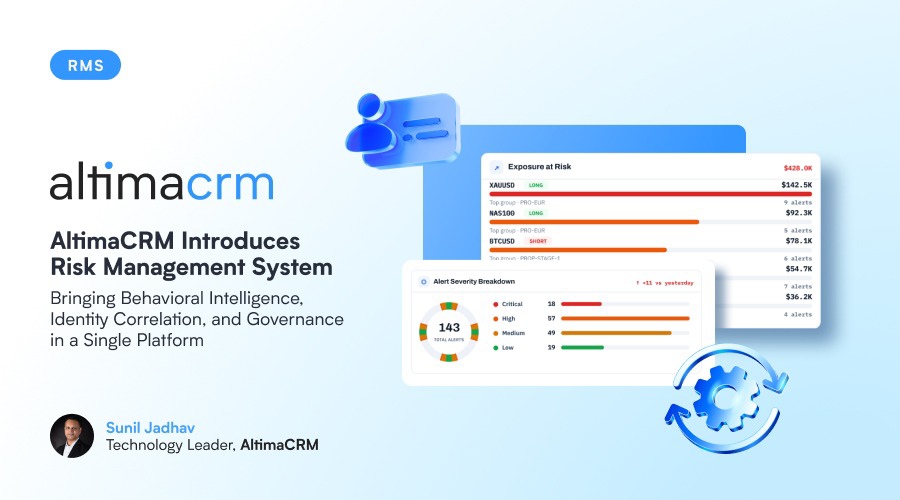
In each of these examples, the system acts because it can see the full picture of what is happening, not just in terms of one account, a single alert, or an isolated moment. For a more detailed look at how companies can connect behavioral signals, exposure data, account identity patterns, and operational activity into a single intelligence layer, the AltimaCRM Risk Management System offers risk teams the visibility they need to act on facts, not guesswork.
Ultimately, there is a broader shift that becomes visible at scale. When behavioral signals, identity data, and exposure patterns are viewed together inside the same system, patterns begin to emerge that would otherwise remain hidden. Similarities between accounts, recurring timing patterns, and relationships that initially appear insignificant become easier to identify when the data is connected. What starts as a risk monitoring framework gradually develops into a level of operational intelligence that most brokerages have never experienced before.
Operating with connected intelligence changes the role of the risk team. Instead of spending time gathering information from multiple systems and reconciling conflicting records, teams can focus on evaluating risk and making decisions. Investigations begin with context rather than assumptions. Relationships between accounts, behavioral signals, exposure changes, and operational history become visible within the same environment. The result is not simply faster investigations but a clearer understanding of what is happening across the business and why.
Introducing the AltimaCRM Risk Management System
AltimaCRM RMS connects behavioral monitoring, identity intelligence, exposure tracking, and governance workflows inside a single operational system. Built directly inside AltimaCRM, it links together four intelligence layers: behavioral, exposure, identity, and governance. Within the system, risk flags surface next to the client record, while each enforcement action is logged against the full client history.
Most risk systems stop at the alert. Existing tools monitor trading desk risk, P&L, exposure, and toxic flow. They can identify that something happened, but they often provide little context around why it happened, who was involved, or whether related activity exists elsewhere in the operation. AltimaCRM RMS was designed to connect those missing pieces, bringing together behavioral monitoring, identity intelligence, exposure tracking, and governance workflows within the same framework.
Proper and effective detection is only the beginning. AltimaCRM RMS was designed so that detection leads to investigation, investigation enables informed review, and review drives enforcement, creating a complete audit trail at every stage of the process.
Every decision is traceable, and every action is auditable. While AltimaCRM RMS is designed around the operational realities of modern brokerages, it also supports prop-firm-specific monitoring, including challenge gaming detection, account-passing investigations, and drawdown-related oversight. Across both environments, the objective remains the same: identify developing risk before it becomes a costly operational issue and act while there is still time remaining.
AltimaCRM RMS is built around the operational realities of a modern brokerage. See it running against a live environment at altimacrm.com.


