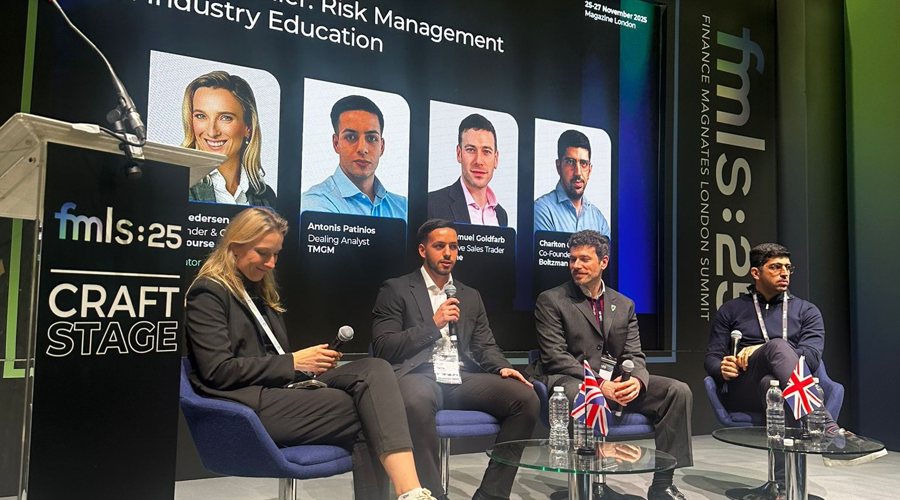
At the Craft Stage, experts explored the topic: Art of the Dealer, Risk Management, and Industry Education.
A key takeaway is that an information gap exists between retail brokers and institutional liquidity providers.
At the Finance Magnates London Summit (FMLS:25), while
discussing the topic “Art of the Dealer, Risk Management, and Industry
Education,” panelists painted a picture of the modern FX/CFD dealer as part
quant, part firefighter and part educator, operating in an environment where
poor risk discipline and weak internal understanding can still sink firms.
The discussion was moderated by Elina Pedersen, the
Co-Founder and CEO of Your Bourse, and brought together panelists: Antois
Patinios, Dealing Analyst at TMGM, Lee Goldfarb, the Executive Sales Trader at
B2Prime, and Chariton Christou, the Co-Founder and CEO at Boltzam Research.
From left: Elina Pedersen, Antois Patinios, Lee Goldfarb, and Chariton Christou
They stressed that while automation and analytics are
advancing, the core edge remains a disciplined grasp of risk, market structure
and client behavior – and the ability to communicate that across entire
brokerages.
“It's a lot less about instinct and a lot more about
understanding your underlying flows, who's trading, why they're trading, what
they're looking to trade and what kind of risk you can actually manage,”
Goldfarb said.
“So, you need to know your numbers very well,” he added. “What is
the net open position that you as a firm is comfortable in holding? What is the
actual trade flows, how they behave, and how this, how as a broker, how you
manage them.”
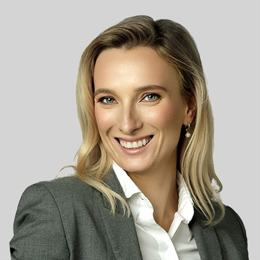
Elina Pedersen, Co-founder and CEO of Your Bourse
Patinios put adaptability and resilience under
pressure at the top of the list, noting that around 80% of his day is
structured around routine reporting, exposure checks and system monitoring,
with the remaining 20% reserved for handling breaks, outages and sudden market
moves.
“I think adaptability and not folding under pressure,” he stressed.
“Because as a CFD dealer, you have routine daily tasks, but you also have
monitoring system health, going through reports, analysis of client flow, how
to deal with flow if you have to take defensive measures.”
On the question of tools, Christou mentioned that
retail dealers increasingly share tools and concepts once reserved for
institutions, such as spread decay and markouts, but still face distinct
challenges around “toxic” or signal-driven flow.
The panel noted that dealers sit at the intersection
of pricing, risk and technology, making decisions on whether to internalise or
STP client trades while keeping spreads competitive and ensuring platform
health in real time.
Retail vs Institutional: An Information Gap
A recurring theme was the asymmetry of information
between retail brokers and institutional liquidity providers. Goldfarb
explained that on the institutional side, price-makers can see covariance
across flow – for example, identifying clusters of gold EA traders and
understanding when a signal is driving the market – giving them a visibility
advantage over retail brokers who often see only headline markout metrics.
“Institutional space is a kind of different and you
have to be sure that the liquidity is there, like kind of every single time you
have to understand the flow from a kind of different perspective,” Christou
agreed.
“You don't want actually to increase the spreads,” he added. “You
don't want to have unhappy brokers. While on the CFD retail space, you do care
about it, but you also care about consistency of the price.”
Lee Goldfarb, Executive Sales Trader at B2Prime
The panelists agreed that prime-of-prime providers sit
“in the middle” of these worlds and need to translate between two sets of
metrics and priorities to keep relationships sustainable.
Stress Testing, Concentration Risk and Smaller Brokers
The discussion turned sharper when the moderator
raised a comment from one partner that the industry should focus more on stress
testing.
In an environment where gold can move 5% in a day,
that blind spot can be fatal if a skewed book goes the wrong way. According to Goldfarb,
“that can be very, very damaging if you have a significant level of B book
exposure that goes one way.”
“So, it's looking at your book, looking at whether or
not the book itself is skewed and looking at how that affects payouts and net
open positions,” he explained. “I think a lot of smaller brokers don't look at that.”
Education and Opening Up the “Black Box”
The second half of the session shifted to industry
education, with Patinios offering a personal case study. He joined TMGM with no
dealing background and spent roughly three months shadowing senior dealers
before placing his first hedge, supported by internal training and regular
sessions with teams in Australia.
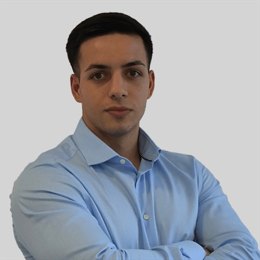
Antonis Patinios, Dealing Analyst at TMGM
“And I think that's the next step going forward to
also not just allow dealers, but let's say people in marketing to understand
what they're selling. It's very useful for the future,” he said.
Goldfarb described the industry as operating like a
“medieval guild,” where aspiring dealers must first be “brought in” by a firm
and often cannot obtain platform-specific certificates without an existing license.
“I think our industry kind of operates a bit of a
black box,” he pointed out. “It's like a medieval guild. You have to be bought in by a firm, you
have to shadow that firm. And then you can go even if you wanted, for example,
if you had a MetaTrader license, you can do the MetaTrader dealer certificate.”
Who Should Be Educated – and How
On the question of academic backgrounds, Christou favored
quantitative disciplines such as mathematics, physics, engineering, computer
science and finance, which equip dealers to reason about trade distributions
and exposure in a structured way.
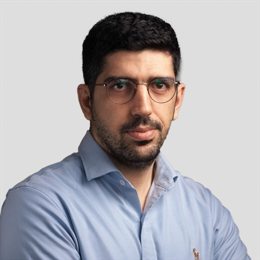
Chariton Christou, Co-Founder and CEO at Boltzman Research
Asked how to close the gap between dealing and risk
departments and the rest of the brokerage, Goldfarb argued that splitting them
too rigidly can create conflicts: sales-driven dealers might court high-volume
clients whose flow is nearly impossible to place profitably on the back end.
“The risk and the dealing kind of need to sit together
for the company to run well and for it to be profitable,” he explained. “So that conversation
has to be very, very tight. Separating them too much, so you get a conflict
between.”
Market Reality vs Retail Expectations
Patinios put real-time exposure dashboards and
internal controls at the top of the list, including clear NOP limits, dynamic
margin settings ahead of news and continuous monitoring of server and bridge
health rather than relying on periodic checks.
Responding to a question from the audience towards the end of the discussion, Christou
explained that AI plays an everyday operational role, noting that his team was
among the early adopters.
It includes having own in-house quantitative team to
develop advanced machine learning models trained on real GPUs to predict market
movements.
At the Finance Magnates London Summit (FMLS:25), while
discussing the topic “Art of the Dealer, Risk Management, and Industry
Education,” panelists painted a picture of the modern FX/CFD dealer as part
quant, part firefighter and part educator, operating in an environment where
poor risk discipline and weak internal understanding can still sink firms.
The discussion was moderated by Elina Pedersen, the
Co-Founder and CEO of Your Bourse, and brought together panelists: Antois
Patinios, Dealing Analyst at TMGM, Lee Goldfarb, the Executive Sales Trader at
B2Prime, and Chariton Christou, the Co-Founder and CEO at Boltzam Research.
From left: Elina Pedersen, Antois Patinios, Lee Goldfarb, and Chariton Christou
They stressed that while automation and analytics are
advancing, the core edge remains a disciplined grasp of risk, market structure
and client behavior – and the ability to communicate that across entire
brokerages.
“It's a lot less about instinct and a lot more about
understanding your underlying flows, who's trading, why they're trading, what
they're looking to trade and what kind of risk you can actually manage,”
Goldfarb said.
“So, you need to know your numbers very well,” he added. “What is
the net open position that you as a firm is comfortable in holding? What is the
actual trade flows, how they behave, and how this, how as a broker, how you
manage them.”
Elina Pedersen, Co-founder and CEO of Your Bourse
Patinios put adaptability and resilience under
pressure at the top of the list, noting that around 80% of his day is
structured around routine reporting, exposure checks and system monitoring,
with the remaining 20% reserved for handling breaks, outages and sudden market
moves.
“I think adaptability and not folding under pressure,” he stressed.
“Because as a CFD dealer, you have routine daily tasks, but you also have
monitoring system health, going through reports, analysis of client flow, how
to deal with flow if you have to take defensive measures.”
On the question of tools, Christou mentioned that
retail dealers increasingly share tools and concepts once reserved for
institutions, such as spread decay and markouts, but still face distinct
challenges around “toxic” or signal-driven flow.
The panel noted that dealers sit at the intersection
of pricing, risk and technology, making decisions on whether to internalise or
STP client trades while keeping spreads competitive and ensuring platform
health in real time.
Retail vs Institutional: An Information Gap
A recurring theme was the asymmetry of information
between retail brokers and institutional liquidity providers. Goldfarb
explained that on the institutional side, price-makers can see covariance
across flow – for example, identifying clusters of gold EA traders and
understanding when a signal is driving the market – giving them a visibility
advantage over retail brokers who often see only headline markout metrics.
“Institutional space is a kind of different and you
have to be sure that the liquidity is there, like kind of every single time you
have to understand the flow from a kind of different perspective,” Christou
agreed.
“You don't want actually to increase the spreads,” he added. “You
don't want to have unhappy brokers. While on the CFD retail space, you do care
about it, but you also care about consistency of the price.”
Lee Goldfarb, Executive Sales Trader at B2Prime
The panelists agreed that prime-of-prime providers sit
“in the middle” of these worlds and need to translate between two sets of
metrics and priorities to keep relationships sustainable.
Stress Testing, Concentration Risk and Smaller Brokers
The discussion turned sharper when the moderator
raised a comment from one partner that the industry should focus more on stress
testing.
In an environment where gold can move 5% in a day,
that blind spot can be fatal if a skewed book goes the wrong way. According to Goldfarb,
“that can be very, very damaging if you have a significant level of B book
exposure that goes one way.”
“So, it's looking at your book, looking at whether or
not the book itself is skewed and looking at how that affects payouts and net
open positions,” he explained. “I think a lot of smaller brokers don't look at that.”
Education and Opening Up the “Black Box”
The second half of the session shifted to industry
education, with Patinios offering a personal case study. He joined TMGM with no
dealing background and spent roughly three months shadowing senior dealers
before placing his first hedge, supported by internal training and regular
sessions with teams in Australia.
Antonis Patinios, Dealing Analyst at TMGM
“And I think that's the next step going forward to
also not just allow dealers, but let's say people in marketing to understand
what they're selling. It's very useful for the future,” he said.
Goldfarb described the industry as operating like a
“medieval guild,” where aspiring dealers must first be “brought in” by a firm
and often cannot obtain platform-specific certificates without an existing license.
“I think our industry kind of operates a bit of a
black box,” he pointed out. “It's like a medieval guild. You have to be bought in by a firm, you
have to shadow that firm. And then you can go even if you wanted, for example,
if you had a MetaTrader license, you can do the MetaTrader dealer certificate.”
Who Should Be Educated – and How
On the question of academic backgrounds, Christou favored
quantitative disciplines such as mathematics, physics, engineering, computer
science and finance, which equip dealers to reason about trade distributions
and exposure in a structured way.
Chariton Christou, Co-Founder and CEO at Boltzman Research
Asked how to close the gap between dealing and risk
departments and the rest of the brokerage, Goldfarb argued that splitting them
too rigidly can create conflicts: sales-driven dealers might court high-volume
clients whose flow is nearly impossible to place profitably on the back end.
“The risk and the dealing kind of need to sit together
for the company to run well and for it to be profitable,” he explained. “So that conversation
has to be very, very tight. Separating them too much, so you get a conflict
between.”
Market Reality vs Retail Expectations
Patinios put real-time exposure dashboards and
internal controls at the top of the list, including clear NOP limits, dynamic
margin settings ahead of news and continuous monitoring of server and bridge
health rather than relying on periodic checks.
Responding to a question from the audience towards the end of the discussion, Christou
explained that AI plays an everyday operational role, noting that his team was
among the early adopters.
It includes having own in-house quantitative team to
develop advanced machine learning models trained on real GPUs to predict market
movements.
Jared Kirui is an Editor at Finance Magnates with more than five years of experience in financial journalism. He covers online trading, fintech, payments, and crypto industries with a focus on companies, regulation and compliance, executive moves, trading technology, and market analysis.
His work has been featured in other media outlets, including Benzinga, ZyCrypto, The Distributed, and The Daily Hodl.
Education:
Bachelor of Commerce degree (Finance option), University of Nairobi
MetaTrader 5 Brokers Gain Direct Access to Vantage Liquidity via MetaQuotes’ Ultency
FP Markets Winner Spotlight 🏆 | Global Broker of the Year 2025 #Trading #Broker #Innovation #Shorts
FP Markets Winner Spotlight 🏆 | Global Broker of the Year 2025 #Trading #Broker #Innovation #Shorts
FP Markets takes the spotlight as Global Broker of the Year 2025 at the Finance Magnates Awards.
Martin Stoilov, Head of Client Experience, shares that trust, innovation, and people played a key role in the company’s success, supported by a strong foundation of integrity and client-centricity.
Following this milestone, FP Markets continues to focus on growth, technology investment, and its core values of transparency and excellence.
👉 Be part of FM Awards 2026: https://awards.financemagnates.com/#nominate
FP Markets takes the spotlight as Global Broker of the Year 2025 at the Finance Magnates Awards.
Martin Stoilov, Head of Client Experience, shares that trust, innovation, and people played a key role in the company’s success, supported by a strong foundation of integrity and client-centricity.
Following this milestone, FP Markets continues to focus on growth, technology investment, and its core values of transparency and excellence.
👉 Be part of FM Awards 2026: https://awards.financemagnates.com/#nominate
In this video, we review @HolaPrimeMarketsOfficial, a multi-asset forex and CFDs broker offering different account types, trading platforms, and flexible trading conditions.
We cover the broker’s overall offering, including account options, trading environment, platforms like MT4 and MT5, and additional services such as managed accounts and fast withdrawals.
Watch the full video to see if Hola Prime Markets fits your trading needs.
📣 Stay up to date with the latest in finance and trading. Follow Finance Magnates for industry news, insights, and global event coverage.
Connect with us:
🔗 LinkedIn: /financemagnates
👍 Facebook: /financemagnates
📸 Instagram: https://www.instagram.com/financemagnates
🐦 X: https://x.com/financemagnates
🎥 TikTok: https://www.tiktok.com/tag/financemagnates
▶️ YouTube: /@financemagnates_official
#HolaPrime #ForexBroker #CFDTrading #FinanceMagnates #Trading #Forex #BrokerReview
In this video, we review @HolaPrimeMarketsOfficial, a multi-asset forex and CFDs broker offering different account types, trading platforms, and flexible trading conditions.
We cover the broker’s overall offering, including account options, trading environment, platforms like MT4 and MT5, and additional services such as managed accounts and fast withdrawals.
Watch the full video to see if Hola Prime Markets fits your trading needs.
📣 Stay up to date with the latest in finance and trading. Follow Finance Magnates for industry news, insights, and global event coverage.
Connect with us:
🔗 LinkedIn: /financemagnates
👍 Facebook: /financemagnates
📸 Instagram: https://www.instagram.com/financemagnates
🐦 X: https://x.com/financemagnates
🎥 TikTok: https://www.tiktok.com/tag/financemagnates
▶️ YouTube: /@financemagnates_official
#HolaPrime #ForexBroker #CFDTrading #FinanceMagnates #Trading #Forex #BrokerReview
Hola Prime Review: What You Need to Know | Full Breakdown by Finance Magnates
Hola Prime Review: What You Need to Know | Full Breakdown by Finance Magnates
In this video, we review @HolaPrime_Global, a proprietary trading firm offering evaluation programs and performance-based payouts in simulated market environments.
We cover how the challenge model works, including account types, profit splits (up to 95%), trading rules, and what it takes to reach a funded account. You’ll also learn about available platforms like MT4, MT5, cTrader, and more, along with insights into payouts, support, and trading conditions.
Watch the full video to see if Hola Prime fits your trading style.
📣 Stay up to date with the latest in finance and trading. Follow Finance Magnates for industry news, insights, and global event coverage.
Connect with us:
🔗 LinkedIn: /financemagnates
👍 Facebook: /financemagnates
📸 Instagram: https://www.instagram.com/financemagnates
🐦 X: https://x.com/financemagnates
🎥 TikTok: https://www.tiktok.com/tag/financemagnates
▶️ YouTube: /@financemagnates_official
#HolaPrime #PropFirm #Trading #FinanceMagnates #Forex #FuturesTrading #TradingReview #PropFirmReview
In this video, we review @HolaPrime_Global, a proprietary trading firm offering evaluation programs and performance-based payouts in simulated market environments.
We cover how the challenge model works, including account types, profit splits (up to 95%), trading rules, and what it takes to reach a funded account. You’ll also learn about available platforms like MT4, MT5, cTrader, and more, along with insights into payouts, support, and trading conditions.
Watch the full video to see if Hola Prime fits your trading style.
📣 Stay up to date with the latest in finance and trading. Follow Finance Magnates for industry news, insights, and global event coverage.
Connect with us:
🔗 LinkedIn: /financemagnates
👍 Facebook: /financemagnates
📸 Instagram: https://www.instagram.com/financemagnates
🐦 X: https://x.com/financemagnates
🎥 TikTok: https://www.tiktok.com/tag/financemagnates
▶️ YouTube: /@financemagnates_official
#HolaPrime #PropFirm #Trading #FinanceMagnates #Forex #FuturesTrading #TradingReview #PropFirmReview
Axi Winner Spotlight 🏆 | Global Most Innovative Broker 2025 #Innovation #Trading #Fintech #Broker
Axi Winner Spotlight 🏆 | Global Most Innovative Broker 2025 #Innovation #Trading #Fintech #Broker
Axi takes the spotlight at the Finance Magnates Awards, winning Global Most Innovative Broker 2025.
Olivia Xenofontos and Ivanna Openko share how the team will feel: proud, motivated, and ready to keep delivering.
They also describe the night as well-organized, focused, and enjoyable for all.
👉 Be part of FM Awards 2026.
Axi takes the spotlight at the Finance Magnates Awards, winning Global Most Innovative Broker 2025.
Olivia Xenofontos and Ivanna Openko share how the team will feel: proud, motivated, and ready to keep delivering.
They also describe the night as well-organized, focused, and enjoyable for all.
👉 Be part of FM Awards 2026.
Recognition that matters.
Built on transparency.
Driven by the industry.
The Finance Magnates Awards 2026.
Nominations are now open.
🔗 https://awards.financemagnates.com/?utm_source=SM&utm_medium=social&utm_campaign=recognition-matters
Recognition that matters.
Built on transparency.
Driven by the industry.
The Finance Magnates Awards 2026.
Nominations are now open.
🔗 https://awards.financemagnates.com/?utm_source=SM&utm_medium=social&utm_campaign=recognition-matters