The surge in security breaches is attributed to increased digitalization and geopolitical tensions.
This trend could undermine confidence in the financial system, leading to market instability or bank runs.
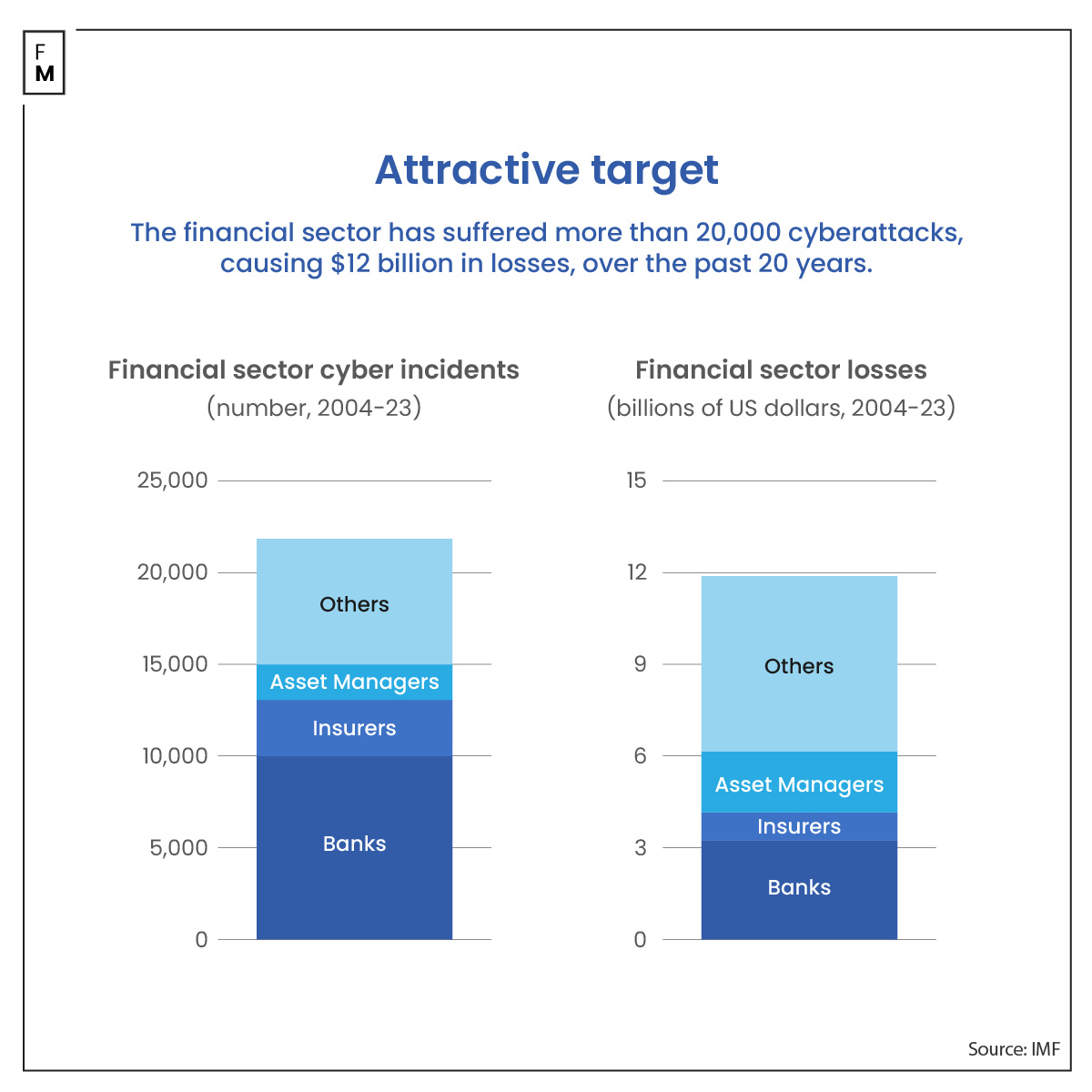
The financial sector has lost $12 billion in the last
20 years as a result of more than 20,000 cases of cyberattacks, according to
the latest report by the International Monetary Fund (IMF). This rising trend in cyberattacks is attributed to a surge in digitalization and geopolitical
tensions.
Since Covid-19 pandemic began, the incidences
of cyberattacks reported by financial firms have doubled. The direct losses incurred by companies in this sector have reportedly increased. In particular, the losses have more than
quadrupled since 2017 to $2.5 billion.
Vulnerability in the Financial Sector
Notably, financial institutions are
susceptible to the risk of cyberattacks due to the volume of sensitive data and
transactions they handle. Banks alone are prime targets, accounting
for a significant portion of cyber attacks.
These attacks pose immediate financial
threats and have the potential to erode confidence in the financial
system, leading to market instability or bank runs. Besides that, the repercussions of
cyber security violations could cause economic instability.
“Cyber incidents that disrupt critical services like
payment networks could also severely affect economic activity. For example, a
December attack at the Central Bank of Lesotho disrupted the national payment
system, preventing transactions by domestic bank,” the authors of the report Fabio Natalucci, Mahvash Qureshi, and Felix Suntheim mentioned.
Source: IMF
Challenges and Solutions
Addressing cyber risks requires concerted efforts at the national and international levels. While private incentives may fail to mitigate systemic risks, public intervention, effective
regulation, and supervision are essential.
To strengthen the resilience of the financial sector,
authorities must prioritize the development of comprehensive cybersecurity
strategies and regulations. This includes fostering cyber security among
financial firms and promoting information sharing.
IMF’s study is corroborated by a recent report by
Finance Magnates, which highlighted that the financial services sector in
Europe is facing a growing threat from cyberattacks, particularly distributed
denial-of-service attacks. These attacks have significantly increased in recent years, posing a serious
challenge to the stability and security of financial institutions across the
continent.
According to a report by Akamai Technologies, an
increase of 119% year-over-year was reported in web application and API attacks
towards the end of last year, with the financial sector ranking as the third
most targeted industry in the Europe, Middle East, and Africa region.
The banking and insurance sectors are particularly vulnerable due to the sensitive nature of the data they handle, making them
attractive targets for cybercriminals seeking to exploit vulnerabilities in
their systems.
The financial sector has lost $12 billion in the last
20 years as a result of more than 20,000 cases of cyberattacks, according to
the latest report by the International Monetary Fund (IMF). This rising trend in cyberattacks is attributed to a surge in digitalization and geopolitical
tensions.
Since Covid-19 pandemic began, the incidences
of cyberattacks reported by financial firms have doubled. The direct losses incurred by companies in this sector have reportedly increased. In particular, the losses have more than
quadrupled since 2017 to $2.5 billion.
Vulnerability in the Financial Sector
Notably, financial institutions are
susceptible to the risk of cyberattacks due to the volume of sensitive data and
transactions they handle. Banks alone are prime targets, accounting
for a significant portion of cyber attacks.
These attacks pose immediate financial
threats and have the potential to erode confidence in the financial
system, leading to market instability or bank runs. Besides that, the repercussions of
cyber security violations could cause economic instability.
“Cyber incidents that disrupt critical services like
payment networks could also severely affect economic activity. For example, a
December attack at the Central Bank of Lesotho disrupted the national payment
system, preventing transactions by domestic bank,” the authors of the report Fabio Natalucci, Mahvash Qureshi, and Felix Suntheim mentioned.
Source: IMF
Challenges and Solutions
Addressing cyber risks requires concerted efforts at the national and international levels. While private incentives may fail to mitigate systemic risks, public intervention, effective
regulation, and supervision are essential.
To strengthen the resilience of the financial sector,
authorities must prioritize the development of comprehensive cybersecurity
strategies and regulations. This includes fostering cyber security among
financial firms and promoting information sharing.
IMF’s study is corroborated by a recent report by
Finance Magnates, which highlighted that the financial services sector in
Europe is facing a growing threat from cyberattacks, particularly distributed
denial-of-service attacks. These attacks have significantly increased in recent years, posing a serious
challenge to the stability and security of financial institutions across the
continent.
According to a report by Akamai Technologies, an
increase of 119% year-over-year was reported in web application and API attacks
towards the end of last year, with the financial sector ranking as the third
most targeted industry in the Europe, Middle East, and Africa region.
The banking and insurance sectors are particularly vulnerable due to the sensitive nature of the data they handle, making them
attractive targets for cybercriminals seeking to exploit vulnerabilities in
their systems.
Jared Kirui is an Editor at Finance Magnates with more than five years of experience in financial journalism. He covers online trading, fintech, payments, and crypto industries with a focus on companies, regulation and compliance, executive moves, trading technology, and market analysis.
His work has been featured in other media outlets, including Benzinga, ZyCrypto, The Distributed, and The Daily Hodl.
Education:
Bachelor of Commerce degree (Finance option), University of Nairobi
MetaTrader 5 Brokers Gain Direct Access to Vantage Liquidity via MetaQuotes’ Ultency
FP Markets Winner Spotlight 🏆 | Global Broker of the Year 2025 #Trading #Broker #Innovation #Shorts
FP Markets Winner Spotlight 🏆 | Global Broker of the Year 2025 #Trading #Broker #Innovation #Shorts
FP Markets takes the spotlight as Global Broker of the Year 2025 at the Finance Magnates Awards.
Martin Stoilov, Head of Client Experience, shares that trust, innovation, and people played a key role in the company’s success, supported by a strong foundation of integrity and client-centricity.
Following this milestone, FP Markets continues to focus on growth, technology investment, and its core values of transparency and excellence.
👉 Be part of FM Awards 2026: https://awards.financemagnates.com/#nominate
FP Markets takes the spotlight as Global Broker of the Year 2025 at the Finance Magnates Awards.
Martin Stoilov, Head of Client Experience, shares that trust, innovation, and people played a key role in the company’s success, supported by a strong foundation of integrity and client-centricity.
Following this milestone, FP Markets continues to focus on growth, technology investment, and its core values of transparency and excellence.
👉 Be part of FM Awards 2026: https://awards.financemagnates.com/#nominate
In this video, we review @HolaPrimeMarketsOfficial, a multi-asset forex and CFDs broker offering different account types, trading platforms, and flexible trading conditions.
We cover the broker’s overall offering, including account options, trading environment, platforms like MT4 and MT5, and additional services such as managed accounts and fast withdrawals.
Watch the full video to see if Hola Prime Markets fits your trading needs.
📣 Stay up to date with the latest in finance and trading. Follow Finance Magnates for industry news, insights, and global event coverage.
Connect with us:
🔗 LinkedIn: /financemagnates
👍 Facebook: /financemagnates
📸 Instagram: https://www.instagram.com/financemagnates
🐦 X: https://x.com/financemagnates
🎥 TikTok: https://www.tiktok.com/tag/financemagnates
▶️ YouTube: /@financemagnates_official
#HolaPrime #ForexBroker #CFDTrading #FinanceMagnates #Trading #Forex #BrokerReview
In this video, we review @HolaPrimeMarketsOfficial, a multi-asset forex and CFDs broker offering different account types, trading platforms, and flexible trading conditions.
We cover the broker’s overall offering, including account options, trading environment, platforms like MT4 and MT5, and additional services such as managed accounts and fast withdrawals.
Watch the full video to see if Hola Prime Markets fits your trading needs.
📣 Stay up to date with the latest in finance and trading. Follow Finance Magnates for industry news, insights, and global event coverage.
Connect with us:
🔗 LinkedIn: /financemagnates
👍 Facebook: /financemagnates
📸 Instagram: https://www.instagram.com/financemagnates
🐦 X: https://x.com/financemagnates
🎥 TikTok: https://www.tiktok.com/tag/financemagnates
▶️ YouTube: /@financemagnates_official
#HolaPrime #ForexBroker #CFDTrading #FinanceMagnates #Trading #Forex #BrokerReview
Hola Prime Review: What You Need to Know | Full Breakdown by Finance Magnates
Hola Prime Review: What You Need to Know | Full Breakdown by Finance Magnates
In this video, we review @HolaPrime_Global, a proprietary trading firm offering evaluation programs and performance-based payouts in simulated market environments.
We cover how the challenge model works, including account types, profit splits (up to 95%), trading rules, and what it takes to reach a funded account. You’ll also learn about available platforms like MT4, MT5, cTrader, and more, along with insights into payouts, support, and trading conditions.
Watch the full video to see if Hola Prime fits your trading style.
📣 Stay up to date with the latest in finance and trading. Follow Finance Magnates for industry news, insights, and global event coverage.
Connect with us:
🔗 LinkedIn: /financemagnates
👍 Facebook: /financemagnates
📸 Instagram: https://www.instagram.com/financemagnates
🐦 X: https://x.com/financemagnates
🎥 TikTok: https://www.tiktok.com/tag/financemagnates
▶️ YouTube: /@financemagnates_official
#HolaPrime #PropFirm #Trading #FinanceMagnates #Forex #FuturesTrading #TradingReview #PropFirmReview
In this video, we review @HolaPrime_Global, a proprietary trading firm offering evaluation programs and performance-based payouts in simulated market environments.
We cover how the challenge model works, including account types, profit splits (up to 95%), trading rules, and what it takes to reach a funded account. You’ll also learn about available platforms like MT4, MT5, cTrader, and more, along with insights into payouts, support, and trading conditions.
Watch the full video to see if Hola Prime fits your trading style.
📣 Stay up to date with the latest in finance and trading. Follow Finance Magnates for industry news, insights, and global event coverage.
Connect with us:
🔗 LinkedIn: /financemagnates
👍 Facebook: /financemagnates
📸 Instagram: https://www.instagram.com/financemagnates
🐦 X: https://x.com/financemagnates
🎥 TikTok: https://www.tiktok.com/tag/financemagnates
▶️ YouTube: /@financemagnates_official
#HolaPrime #PropFirm #Trading #FinanceMagnates #Forex #FuturesTrading #TradingReview #PropFirmReview
Axi Winner Spotlight 🏆 | Global Most Innovative Broker 2025 #Innovation #Trading #Fintech #Broker
Axi Winner Spotlight 🏆 | Global Most Innovative Broker 2025 #Innovation #Trading #Fintech #Broker
Axi takes the spotlight at the Finance Magnates Awards, winning Global Most Innovative Broker 2025.
Olivia Xenofontos and Ivanna Openko share how the team will feel: proud, motivated, and ready to keep delivering.
They also describe the night as well-organized, focused, and enjoyable for all.
👉 Be part of FM Awards 2026.
Axi takes the spotlight at the Finance Magnates Awards, winning Global Most Innovative Broker 2025.
Olivia Xenofontos and Ivanna Openko share how the team will feel: proud, motivated, and ready to keep delivering.
They also describe the night as well-organized, focused, and enjoyable for all.
👉 Be part of FM Awards 2026.
Recognition that matters.
Built on transparency.
Driven by the industry.
The Finance Magnates Awards 2026.
Nominations are now open.
🔗 https://awards.financemagnates.com/?utm_source=SM&utm_medium=social&utm_campaign=recognition-matters
Recognition that matters.
Built on transparency.
Driven by the industry.
The Finance Magnates Awards 2026.
Nominations are now open.
🔗 https://awards.financemagnates.com/?utm_source=SM&utm_medium=social&utm_campaign=recognition-matters