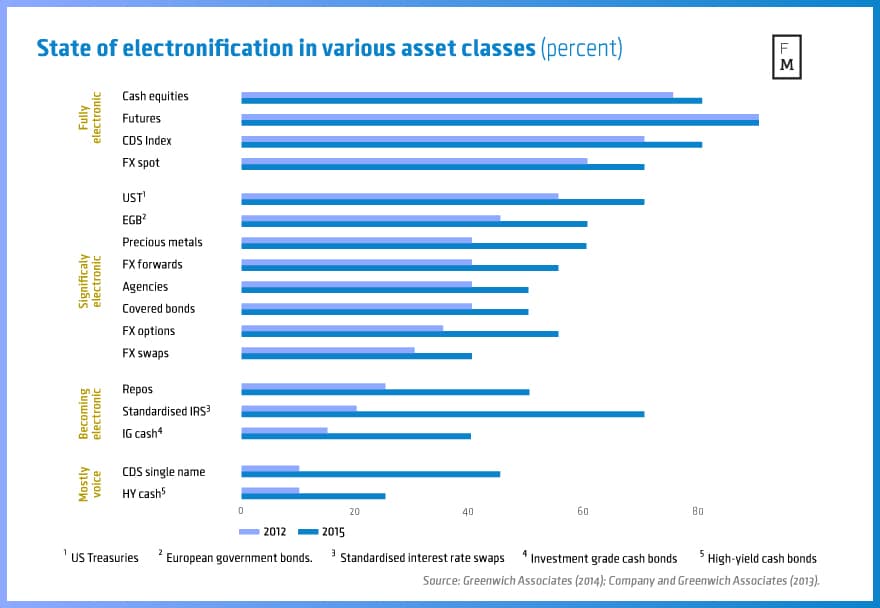
Looking further afield in the search for yield could mean FX traders need to consider technologies already popular in other markets.
The more FX markets move to electronic trading, the more algos are deployed. And while any discussions of algorithmic trading continue to be dominated by latency, at this point speed has become mostly commoditized.
“Everybody is always trying to get faster, and closer to the physical limits that any given infrastructure can offer them,” said James Dalton, Global Head of Algorithmic Execution at CitiFX.
The innovation is that we start to see algos on all these derivative products...
Six or seven years ago, he added, there was a gap between many sell-side firms market connectivity compared to the ultra-high frequency trading community, but that gap has narrowed: “There has been a lot of convergence in terms of capabilities there.”
In the FX markets, Quant Hedge uses high and medium frequency trading strategies for the most liquid pairs. On the research side, the firm is looking at artificial intelligence applied to capital markets for price forecasting.
Victor Lebreton, Director at Quant Hedge, said that, alongside spot FX, he sees a surge in demand for derivatives - NDFs and futures - to hedge an uncertain economic environment.
Each product develops a bit differently from the spot market, he explained. For example, NDFs are becoming extremely popular to hedge emerging markets currency positions.
“If you are doing a deal and there’s a lot of volatility in the market, you want to be hedged. So it’s not only a single trade but also the overall portfolio,” he said.
There is a question mark over the rate of adoption, however: “There is a lot of change for FX people who use it to hedge their long-term and short-term positions.”
One specific trend Lebreton pointed to is outsourcing. In the market, he finds himself trading with an increasing number of independent execution providers using the same kind of algos.
“Most people don’t want to buy tools and software directly, only large banks and (asset managers) are doing that. Most FX managers don’t want to manage the technology and personnel. Also, they can push transaction cost analysis towards the broker,” he said.
About four years ago, cloud provider Beeks Financial started providing low latency for retail traders running algos on popular platforms such as MT4. They’ve since moved into the institutional space for FX and futures, hosting for some 100 funds and brokers.
CEO Gordon McArthur said that a lot of the bigger hedge funds, money and asset managers are moving into multi-asset class trading: “People who used to trade primarily forex, (now) arbitrage against futures, against equity…that is the biggest change we see at the moment.”
That’s partially because as single asset classes or futures markets mature, latency arbitrage opportunities become fewer and farther between. So algo funds are checking out new markets.
Source: Bank for International Settlements, January 2016
FX Into the Cloud
There’s also fewer barriers to entry. McArthur said setting up in data centres has become cheaper, while testing algorithms or systems on different venues is easier.
Although Beeks’ clients tended to be on the buy side, McArthur noted that more sell side is coming into the cloud. Security remains a big hurdle to overcome, particularly in the wake of a number of Denial-of-Service (DDoS) attacks late last year and Beeks caters to these concerns with a specialized service, he added.
Most people don’t want to buy tools and software directly...
Still, the low cost is trumping concerns in some aspects. “We are seeing people take the first steps in using cloud environments to do high performance computing – taking a pile of data, and back test data, running some scenarios on it,” he explained.
It’s a product Beeks is keen to stay on top of, but there’s still a lot of buzz words around next generation technology such as machine learning.
Portware’s Head of FX Trading Services, Chris Matsko, said that artificial intelligence developments in equities have already gathered significant momentum. A number of clients are using it to make decisions between different algos – how aggressively to trade, for example, given market conditions.
“We can take that and we can apply it to our algo suite for FX, however, I don’t think that the community is quite ready for that yet, given that institutional FX, or at least tier one global asset managers, just don’t have that appetite just yet,” he said.
The more FX markets move to electronic trading, the more algos are deployed. And while any discussions of algorithmic trading continue to be dominated by latency, at this point speed has become mostly commoditized.
“Everybody is always trying to get faster, and closer to the physical limits that any given infrastructure can offer them,” said James Dalton, Global Head of Algorithmic Execution at CitiFX.
The innovation is that we start to see algos on all these derivative products...
Six or seven years ago, he added, there was a gap between many sell-side firms market connectivity compared to the ultra-high frequency trading community, but that gap has narrowed: “There has been a lot of convergence in terms of capabilities there.”
In the FX markets, Quant Hedge uses high and medium frequency trading strategies for the most liquid pairs. On the research side, the firm is looking at artificial intelligence applied to capital markets for price forecasting.
Victor Lebreton, Director at Quant Hedge, said that, alongside spot FX, he sees a surge in demand for derivatives - NDFs and futures - to hedge an uncertain economic environment.
Each product develops a bit differently from the spot market, he explained. For example, NDFs are becoming extremely popular to hedge emerging markets currency positions.
“If you are doing a deal and there’s a lot of volatility in the market, you want to be hedged. So it’s not only a single trade but also the overall portfolio,” he said.
There is a question mark over the rate of adoption, however: “There is a lot of change for FX people who use it to hedge their long-term and short-term positions.”
One specific trend Lebreton pointed to is outsourcing. In the market, he finds himself trading with an increasing number of independent execution providers using the same kind of algos.
“Most people don’t want to buy tools and software directly, only large banks and (asset managers) are doing that. Most FX managers don’t want to manage the technology and personnel. Also, they can push transaction cost analysis towards the broker,” he said.
About four years ago, cloud provider Beeks Financial started providing low latency for retail traders running algos on popular platforms such as MT4. They’ve since moved into the institutional space for FX and futures, hosting for some 100 funds and brokers.
CEO Gordon McArthur said that a lot of the bigger hedge funds, money and asset managers are moving into multi-asset class trading: “People who used to trade primarily forex, (now) arbitrage against futures, against equity…that is the biggest change we see at the moment.”
That’s partially because as single asset classes or futures markets mature, latency arbitrage opportunities become fewer and farther between. So algo funds are checking out new markets.
Source: Bank for International Settlements, January 2016
FX Into the Cloud
There’s also fewer barriers to entry. McArthur said setting up in data centres has become cheaper, while testing algorithms or systems on different venues is easier.
Although Beeks’ clients tended to be on the buy side, McArthur noted that more sell side is coming into the cloud. Security remains a big hurdle to overcome, particularly in the wake of a number of Denial-of-Service (DDoS) attacks late last year and Beeks caters to these concerns with a specialized service, he added.
Most people don’t want to buy tools and software directly...
Still, the low cost is trumping concerns in some aspects. “We are seeing people take the first steps in using cloud environments to do high performance computing – taking a pile of data, and back test data, running some scenarios on it,” he explained.
It’s a product Beeks is keen to stay on top of, but there’s still a lot of buzz words around next generation technology such as machine learning.
Portware’s Head of FX Trading Services, Chris Matsko, said that artificial intelligence developments in equities have already gathered significant momentum. A number of clients are using it to make decisions between different algos – how aggressively to trade, for example, given market conditions.
“We can take that and we can apply it to our algo suite for FX, however, I don’t think that the community is quite ready for that yet, given that institutional FX, or at least tier one global asset managers, just don’t have that appetite just yet,” he said.
NYSE Owner Starts Gold Futures in London, a Market Without One Since 2022
Featured Videos
CMC Founder Downplays Volatility Hit; Devexperts Names CEO
CMC Founder Downplays Volatility Hit; Devexperts Names CEO
CMC Founder Downplays Volatility Hit; Devexperts Names CEO
CMC Founder Downplays Volatility Hit; Devexperts Names CEO
Today’s financial news recap covers low volatility pressures brokers, Devexperts names a new CEO, Saxo cuts onboarding time, and OKX reaches a 25 billion dollar valuation.
Finance Magnates Daily Recap brings you the latest news from forex and CFD brokers, fintech, payments, cryptocurrency, digital assets, trading platforms, financial regulation and global markets.
Get the key company news, executive moves, deals, regulatory updates and market developments of the day, in just a few minutes. New episodes published every weekday.
Read more: https://www.financemagnates.com
#FinanceMagnates #ForexNews #FintechNews
Today’s financial news recap covers low volatility pressures brokers, Devexperts names a new CEO, Saxo cuts onboarding time, and OKX reaches a 25 billion dollar valuation.
Finance Magnates Daily Recap brings you the latest news from forex and CFD brokers, fintech, payments, cryptocurrency, digital assets, trading platforms, financial regulation and global markets.
Get the key company news, executive moves, deals, regulatory updates and market developments of the day, in just a few minutes. New episodes published every weekday.
Read more: https://www.financemagnates.com
#FinanceMagnates #ForexNews #FintechNews
Today’s financial news recap covers low volatility pressures brokers, Devexperts names a new CEO, Saxo cuts onboarding time, and OKX reaches a 25 billion dollar valuation.
Finance Magnates Daily Recap brings you the latest news from forex and CFD brokers, fintech, payments, cryptocurrency, digital assets, trading platforms, financial regulation and global markets.
Get the key company news, executive moves, deals, regulatory updates and market developments of the day, in just a few minutes. New episodes published every weekday.
Read more: https://www.financemagnates.com
#FinanceMagnates #ForexNews #FintechNews
Today’s financial news recap covers low volatility pressures brokers, Devexperts names a new CEO, Saxo cuts onboarding time, and OKX reaches a 25 billion dollar valuation.
Finance Magnates Daily Recap brings you the latest news from forex and CFD brokers, fintech, payments, cryptocurrency, digital assets, trading platforms, financial regulation and global markets.
Get the key company news, executive moves, deals, regulatory updates and market developments of the day, in just a few minutes. New episodes published every weekday.
Read more: https://www.financemagnates.com
#FinanceMagnates #ForexNews #FintechNews
Today’s financial news recap covers Trade Nation buys FXCM's UK client book, Trading 212 reports higher revenue, the CFTC's move to allow perpetual index futures.
Finance Magnates Daily Recap brings you the latest news from forex and CFD brokers, fintech, payments, cryptocurrency, digital assets, trading platforms, financial regulation and global markets.
Get the key company news, executive moves, deals, regulatory updates and market developments of the day, in just a few minutes. New episodes published every weekday.
Read more: https://www.financemagnates.com
#FinanceMagnates #ForexNews #FintechNews
Today’s financial news recap covers Trade Nation buys FXCM's UK client book, Trading 212 reports higher revenue, the CFTC's move to allow perpetual index futures.
Finance Magnates Daily Recap brings you the latest news from forex and CFD brokers, fintech, payments, cryptocurrency, digital assets, trading platforms, financial regulation and global markets.
Get the key company news, executive moves, deals, regulatory updates and market developments of the day, in just a few minutes. New episodes published every weekday.
Read more: https://www.financemagnates.com
#FinanceMagnates #ForexNews #FintechNews
Today’s financial news recap covers Trade Nation buys FXCM's UK client book, Trading 212 reports higher revenue, the CFTC's move to allow perpetual index futures.
Finance Magnates Daily Recap brings you the latest news from forex and CFD brokers, fintech, payments, cryptocurrency, digital assets, trading platforms, financial regulation and global markets.
Get the key company news, executive moves, deals, regulatory updates and market developments of the day, in just a few minutes. New episodes published every weekday.
Read more: https://www.financemagnates.com
#FinanceMagnates #ForexNews #FintechNews
Today’s financial news recap covers Trade Nation buys FXCM's UK client book, Trading 212 reports higher revenue, the CFTC's move to allow perpetual index futures.
Finance Magnates Daily Recap brings you the latest news from forex and CFD brokers, fintech, payments, cryptocurrency, digital assets, trading platforms, financial regulation and global markets.
Get the key company news, executive moves, deals, regulatory updates and market developments of the day, in just a few minutes. New episodes published every weekday.
Read more: https://www.financemagnates.com
#FinanceMagnates #ForexNews #FintechNews
Today’s financial news recap covers Trade Nation buys FXCM's UK client book, Trading 212 reports higher revenue, the CFTC's move to allow perpetual index futures.
Finance Magnates Daily Recap brings you the latest news from forex and CFD brokers, fintech, payments, cryptocurrency, digital assets, trading platforms, financial regulation and global markets.
Get the key company news, executive moves, deals, regulatory updates and market developments of the day, in just a few minutes. New episodes published every weekday.
Read more: https://www.financemagnates.com
#FinanceMagnates #ForexNews #FintechNews
Today’s financial news recap covers Trade Nation buys FXCM's UK client book, Trading 212 reports higher revenue, the CFTC's move to allow perpetual index futures.
Finance Magnates Daily Recap brings you the latest news from forex and CFD brokers, fintech, payments, cryptocurrency, digital assets, trading platforms, financial regulation and global markets.
Get the key company news, executive moves, deals, regulatory updates and market developments of the day, in just a few minutes. New episodes published every weekday.
Read more: https://www.financemagnates.com
#FinanceMagnates #ForexNews #FintechNews
Your career isn’t a linear path.
Your career isn’t a linear path.
Your career isn’t a linear path.
Your career isn’t a linear path.
Your career isn’t a linear path.
Your career isn’t a linear path.
Roles change. Career goals change. Sometimes you want a completely new challenge.
But the skills and knowledge you build along the way can stay with you and give you something to build on.
For Jeff Patterson, that continued growth is key to long-term career development.
You bring the skills. FM Academy helps you build the knowledge.
#FMAcademy #FinanceMagnates #FinanceCareers #ProfessionalDevelopment #Fintech
Roles change. Career goals change. Sometimes you want a completely new challenge.
But the skills and knowledge you build along the way can stay with you and give you something to build on.
For Jeff Patterson, that continued growth is key to long-term career development.
You bring the skills. FM Academy helps you build the knowledge.
#FMAcademy #FinanceMagnates #FinanceCareers #ProfessionalDevelopment #Fintech
Roles change. Career goals change. Sometimes you want a completely new challenge.
But the skills and knowledge you build along the way can stay with you and give you something to build on.
For Jeff Patterson, that continued growth is key to long-term career development.
You bring the skills. FM Academy helps you build the knowledge.
#FMAcademy #FinanceMagnates #FinanceCareers #ProfessionalDevelopment #Fintech
Roles change. Career goals change. Sometimes you want a completely new challenge.
But the skills and knowledge you build along the way can stay with you and give you something to build on.
For Jeff Patterson, that continued growth is key to long-term career development.
You bring the skills. FM Academy helps you build the knowledge.
#FMAcademy #FinanceMagnates #FinanceCareers #ProfessionalDevelopment #Fintech
Roles change. Career goals change. Sometimes you want a completely new challenge.
But the skills and knowledge you build along the way can stay with you and give you something to build on.
For Jeff Patterson, that continued growth is key to long-term career development.
You bring the skills. FM Academy helps you build the knowledge.
#FMAcademy #FinanceMagnates #FinanceCareers #ProfessionalDevelopment #Fintech
Roles change. Career goals change. Sometimes you want a completely new challenge.
But the skills and knowledge you build along the way can stay with you and give you something to build on.
For Jeff Patterson, that continued growth is key to long-term career development.
You bring the skills. FM Academy helps you build the knowledge.
#FMAcademy #FinanceMagnates #FinanceCareers #ProfessionalDevelopment #Fintech
IG Group Tech Chiefs Exit; Pepperstone Revenue Grows
IG Group Tech Chiefs Exit; Pepperstone Revenue Grows
IG Group Tech Chiefs Exit; Pepperstone Revenue Grows
IG Group Tech Chiefs Exit; Pepperstone Revenue Grows
IG Group Tech Chiefs Exit; Pepperstone Revenue Grows
IG Group Tech Chiefs Exit; Pepperstone Revenue Grows
Today’s financial news recap covers IG Group loses two technology chiefs, Pepperstone reports double-digit growth, and eToro backs a euro stablecoin.
Finance Magnates Daily Recap brings you the latest news from forex and CFD brokers, fintech, payments, cryptocurrency, digital assets, trading platforms, financial regulation and global markets.
Get the key company news, executive moves, deals, regulatory updates and market developments of the day, in just a few minutes. New episodes published every weekday.
Read more: https://www.financemagnates.com
#FinanceMagnates #ForexNews #FintechNews
Today’s financial news recap covers IG Group loses two technology chiefs, Pepperstone reports double-digit growth, and eToro backs a euro stablecoin.
Finance Magnates Daily Recap brings you the latest news from forex and CFD brokers, fintech, payments, cryptocurrency, digital assets, trading platforms, financial regulation and global markets.
Get the key company news, executive moves, deals, regulatory updates and market developments of the day, in just a few minutes. New episodes published every weekday.
Read more: https://www.financemagnates.com
#FinanceMagnates #ForexNews #FintechNews
Today’s financial news recap covers IG Group loses two technology chiefs, Pepperstone reports double-digit growth, and eToro backs a euro stablecoin.
Finance Magnates Daily Recap brings you the latest news from forex and CFD brokers, fintech, payments, cryptocurrency, digital assets, trading platforms, financial regulation and global markets.
Get the key company news, executive moves, deals, regulatory updates and market developments of the day, in just a few minutes. New episodes published every weekday.
Read more: https://www.financemagnates.com
#FinanceMagnates #ForexNews #FintechNews
Today’s financial news recap covers IG Group loses two technology chiefs, Pepperstone reports double-digit growth, and eToro backs a euro stablecoin.
Finance Magnates Daily Recap brings you the latest news from forex and CFD brokers, fintech, payments, cryptocurrency, digital assets, trading platforms, financial regulation and global markets.
Get the key company news, executive moves, deals, regulatory updates and market developments of the day, in just a few minutes. New episodes published every weekday.
Read more: https://www.financemagnates.com
#FinanceMagnates #ForexNews #FintechNews
Today’s financial news recap covers IG Group loses two technology chiefs, Pepperstone reports double-digit growth, and eToro backs a euro stablecoin.
Finance Magnates Daily Recap brings you the latest news from forex and CFD brokers, fintech, payments, cryptocurrency, digital assets, trading platforms, financial regulation and global markets.
Get the key company news, executive moves, deals, regulatory updates and market developments of the day, in just a few minutes. New episodes published every weekday.
Read more: https://www.financemagnates.com
#FinanceMagnates #ForexNews #FintechNews
Today’s financial news recap covers IG Group loses two technology chiefs, Pepperstone reports double-digit growth, and eToro backs a euro stablecoin.
Finance Magnates Daily Recap brings you the latest news from forex and CFD brokers, fintech, payments, cryptocurrency, digital assets, trading platforms, financial regulation and global markets.
Get the key company news, executive moves, deals, regulatory updates and market developments of the day, in just a few minutes. New episodes published every weekday.
Read more: https://www.financemagnates.com
#FinanceMagnates #ForexNews #FintechNews
Today’s financial news recap covers IG Group expects lower Q3 revenue, MetaQuotes adds Benzinga news, Match-Trader launches an MCP, and brokers weigh build versus buy.
Finance Magnates Daily Recap brings you the latest news from forex and CFD brokers, fintech, payments, cryptocurrency, digital assets, trading platforms, financial regulation and global markets.
Get the key company news, executive moves, deals, regulatory updates and market developments of the day, in just a few minutes. New episodes published every weekday.
Read more: https://www.financemagnates.com
#FinanceMagnates #ForexNews #FintechNews
Today’s financial news recap covers IG Group expects lower Q3 revenue, MetaQuotes adds Benzinga news, Match-Trader launches an MCP, and brokers weigh build versus buy.
Finance Magnates Daily Recap brings you the latest news from forex and CFD brokers, fintech, payments, cryptocurrency, digital assets, trading platforms, financial regulation and global markets.
Get the key company news, executive moves, deals, regulatory updates and market developments of the day, in just a few minutes. New episodes published every weekday.
Read more: https://www.financemagnates.com
#FinanceMagnates #ForexNews #FintechNews
Today’s financial news recap covers IG Group expects lower Q3 revenue, MetaQuotes adds Benzinga news, Match-Trader launches an MCP, and brokers weigh build versus buy.
Finance Magnates Daily Recap brings you the latest news from forex and CFD brokers, fintech, payments, cryptocurrency, digital assets, trading platforms, financial regulation and global markets.
Get the key company news, executive moves, deals, regulatory updates and market developments of the day, in just a few minutes. New episodes published every weekday.
Read more: https://www.financemagnates.com
#FinanceMagnates #ForexNews #FintechNews
Today’s financial news recap covers IG Group expects lower Q3 revenue, MetaQuotes adds Benzinga news, Match-Trader launches an MCP, and brokers weigh build versus buy.
Finance Magnates Daily Recap brings you the latest news from forex and CFD brokers, fintech, payments, cryptocurrency, digital assets, trading platforms, financial regulation and global markets.
Get the key company news, executive moves, deals, regulatory updates and market developments of the day, in just a few minutes. New episodes published every weekday.
Read more: https://www.financemagnates.com
#FinanceMagnates #ForexNews #FintechNews
Today’s financial news recap covers IG Group expects lower Q3 revenue, MetaQuotes adds Benzinga news, Match-Trader launches an MCP, and brokers weigh build versus buy.
Finance Magnates Daily Recap brings you the latest news from forex and CFD brokers, fintech, payments, cryptocurrency, digital assets, trading platforms, financial regulation and global markets.
Get the key company news, executive moves, deals, regulatory updates and market developments of the day, in just a few minutes. New episodes published every weekday.
Read more: https://www.financemagnates.com
#FinanceMagnates #ForexNews #FintechNews
Today’s financial news recap covers IG Group expects lower Q3 revenue, MetaQuotes adds Benzinga news, Match-Trader launches an MCP, and brokers weigh build versus buy.
Finance Magnates Daily Recap brings you the latest news from forex and CFD brokers, fintech, payments, cryptocurrency, digital assets, trading platforms, financial regulation and global markets.
Get the key company news, executive moves, deals, regulatory updates and market developments of the day, in just a few minutes. New episodes published every weekday.
Read more: https://www.financemagnates.com
#FinanceMagnates #ForexNews #FintechNews