FX Futures Drop 2.9% in 2013 According to World Federation of Exchanges Report
Monday,10/03/2014|21:23GMTby
Adil Siddiqui
Global derivatives exchanges trade association reports exchange traded derivatives activity for 2013. The World Federation of Exchanges report shows currency futures volumes falling however overall volumes were in the green.
Trading activity in the world's largest derivatives exchanges saw mixed results in 2013, exchanges saw a slight uptake in overall trading volumes, after a bleak 2012, according to the World Federation of Exchanges (WFE) annual survey.
FX futures dropped 2.9% as traders were on the sidelines, in a year that was marked by harsh moves in emerging market currencies and the on-going tapering dilemma falling in the hands of the new Fed chairperson.
Exchanges saw 2.08 billion contracts exchange hands in 2013, a drop of 2.9% from figures reported a year earlier where exchanges saw 2.143 billion contracts trade. On the other hand, currency options fared well with an increase of 40.1%, with 403 million contracts traded, compared to 288 million in 2012.
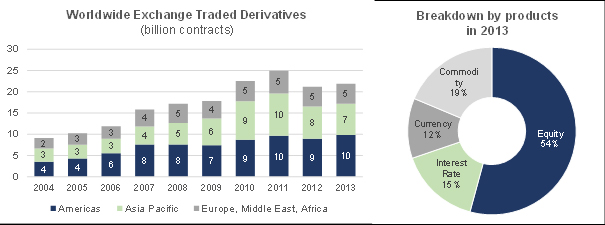
Across all asset classes, data complied by the WFE shows that exchange traded derivatives volumes increased by 3% to 22 billion. The report shows that the Americas region saw the highest amount of growth, this was followed by Europe, Africa and Middle East. On the other hand, Asia-Pacific performed poorly with a drop in numbers, a total of 7.3 billion contracts were traded in the region, a 2.7% drop from the 7.56 billion traded in 2012.
Exchange traded derivatives peaked in 2011, with the total number of contracts exceeding the 25 billion mark. Asia-Pacific was one of the best performing regions, with a number of exchanges setting up post 2008 recession, including the Singapore Mercantile Exchange and the United Stock Exchange (India). However, India's rupee suffered on the back of poor fundamental data and rising inflation in 2013, the currency weakened 20%. According to the WFE's report, 70% of Asia-Pacific's trading activity is from India.
"Government interventions coupled with a weak rupee severely impacted India's trading volumes, the currency is still trading above 60 to the greenback, which makes it difficult for traders to trade on the popular arbitrage; rupee - gold - dollar triangle," explained Asad Hussain, a Mumbai-based proprietary trader, to Forex Magnates.
India's capital markets regulator, the Securities Exchange Board of India (SEBI) intended to remove position limits on currency futures that were implemented in July 2013 to manage speculation in the currency.
"Markets are hitting a bull run in the run up to elections, we have seen the SENSEX hit a 12 month high, in addition trading volumes on all currency exchanges have spiked, and are expected to trade at record highs during the next 2 months," stated Chandan Singh, a technical analyst trainer from Delhi, in a comment to Forex Magnates.
Trading activity in the world's largest derivatives exchanges saw mixed results in 2013, exchanges saw a slight uptake in overall trading volumes, after a bleak 2012, according to the World Federation of Exchanges (WFE) annual survey.
FX futures dropped 2.9% as traders were on the sidelines, in a year that was marked by harsh moves in emerging market currencies and the on-going tapering dilemma falling in the hands of the new Fed chairperson.
Exchanges saw 2.08 billion contracts exchange hands in 2013, a drop of 2.9% from figures reported a year earlier where exchanges saw 2.143 billion contracts trade. On the other hand, currency options fared well with an increase of 40.1%, with 403 million contracts traded, compared to 288 million in 2012.
Across all asset classes, data complied by the WFE shows that exchange traded derivatives volumes increased by 3% to 22 billion. The report shows that the Americas region saw the highest amount of growth, this was followed by Europe, Africa and Middle East. On the other hand, Asia-Pacific performed poorly with a drop in numbers, a total of 7.3 billion contracts were traded in the region, a 2.7% drop from the 7.56 billion traded in 2012.
Exchange traded derivatives peaked in 2011, with the total number of contracts exceeding the 25 billion mark. Asia-Pacific was one of the best performing regions, with a number of exchanges setting up post 2008 recession, including the Singapore Mercantile Exchange and the United Stock Exchange (India). However, India's rupee suffered on the back of poor fundamental data and rising inflation in 2013, the currency weakened 20%. According to the WFE's report, 70% of Asia-Pacific's trading activity is from India.
"Government interventions coupled with a weak rupee severely impacted India's trading volumes, the currency is still trading above 60 to the greenback, which makes it difficult for traders to trade on the popular arbitrage; rupee - gold - dollar triangle," explained Asad Hussain, a Mumbai-based proprietary trader, to Forex Magnates.
India's capital markets regulator, the Securities Exchange Board of India (SEBI) intended to remove position limits on currency futures that were implemented in July 2013 to manage speculation in the currency.
"Markets are hitting a bull run in the run up to elections, we have seen the SENSEX hit a 12 month high, in addition trading volumes on all currency exchanges have spiked, and are expected to trade at record highs during the next 2 months," stated Chandan Singh, a technical analyst trainer from Delhi, in a comment to Forex Magnates.
Singapore Independent Wealth Sector Has Less Than 10% Market Share, but Vast Room for Growth
FP Markets Winner Spotlight 🏆 | Global Broker of the Year 2025 #Trading #Broker #Innovation #Shorts
FP Markets Winner Spotlight 🏆 | Global Broker of the Year 2025 #Trading #Broker #Innovation #Shorts
FP Markets takes the spotlight as Global Broker of the Year 2025 at the Finance Magnates Awards.
Martin Stoilov, Head of Client Experience, shares that trust, innovation, and people played a key role in the company’s success, supported by a strong foundation of integrity and client-centricity.
Following this milestone, FP Markets continues to focus on growth, technology investment, and its core values of transparency and excellence.
👉 Be part of FM Awards 2026: https://awards.financemagnates.com/#nominate
FP Markets takes the spotlight as Global Broker of the Year 2025 at the Finance Magnates Awards.
Martin Stoilov, Head of Client Experience, shares that trust, innovation, and people played a key role in the company’s success, supported by a strong foundation of integrity and client-centricity.
Following this milestone, FP Markets continues to focus on growth, technology investment, and its core values of transparency and excellence.
👉 Be part of FM Awards 2026: https://awards.financemagnates.com/#nominate
In this video, we review @HolaPrimeMarketsOfficial, a multi-asset forex and CFDs broker offering different account types, trading platforms, and flexible trading conditions.
We cover the broker’s overall offering, including account options, trading environment, platforms like MT4 and MT5, and additional services such as managed accounts and fast withdrawals.
Watch the full video to see if Hola Prime Markets fits your trading needs.
📣 Stay up to date with the latest in finance and trading. Follow Finance Magnates for industry news, insights, and global event coverage.
Connect with us:
🔗 LinkedIn: /financemagnates
👍 Facebook: /financemagnates
📸 Instagram: https://www.instagram.com/financemagnates
🐦 X: https://x.com/financemagnates
🎥 TikTok: https://www.tiktok.com/tag/financemagnates
▶️ YouTube: /@financemagnates_official
#HolaPrime #ForexBroker #CFDTrading #FinanceMagnates #Trading #Forex #BrokerReview
In this video, we review @HolaPrimeMarketsOfficial, a multi-asset forex and CFDs broker offering different account types, trading platforms, and flexible trading conditions.
We cover the broker’s overall offering, including account options, trading environment, platforms like MT4 and MT5, and additional services such as managed accounts and fast withdrawals.
Watch the full video to see if Hola Prime Markets fits your trading needs.
📣 Stay up to date with the latest in finance and trading. Follow Finance Magnates for industry news, insights, and global event coverage.
Connect with us:
🔗 LinkedIn: /financemagnates
👍 Facebook: /financemagnates
📸 Instagram: https://www.instagram.com/financemagnates
🐦 X: https://x.com/financemagnates
🎥 TikTok: https://www.tiktok.com/tag/financemagnates
▶️ YouTube: /@financemagnates_official
#HolaPrime #ForexBroker #CFDTrading #FinanceMagnates #Trading #Forex #BrokerReview
Hola Prime Review: What You Need to Know | Full Breakdown by Finance Magnates
Hola Prime Review: What You Need to Know | Full Breakdown by Finance Magnates
In this video, we review @HolaPrime_Global, a proprietary trading firm offering evaluation programs and performance-based payouts in simulated market environments.
We cover how the challenge model works, including account types, profit splits (up to 95%), trading rules, and what it takes to reach a funded account. You’ll also learn about available platforms like MT4, MT5, cTrader, and more, along with insights into payouts, support, and trading conditions.
Watch the full video to see if Hola Prime fits your trading style.
📣 Stay up to date with the latest in finance and trading. Follow Finance Magnates for industry news, insights, and global event coverage.
Connect with us:
🔗 LinkedIn: /financemagnates
👍 Facebook: /financemagnates
📸 Instagram: https://www.instagram.com/financemagnates
🐦 X: https://x.com/financemagnates
🎥 TikTok: https://www.tiktok.com/tag/financemagnates
▶️ YouTube: /@financemagnates_official
#HolaPrime #PropFirm #Trading #FinanceMagnates #Forex #FuturesTrading #TradingReview #PropFirmReview
In this video, we review @HolaPrime_Global, a proprietary trading firm offering evaluation programs and performance-based payouts in simulated market environments.
We cover how the challenge model works, including account types, profit splits (up to 95%), trading rules, and what it takes to reach a funded account. You’ll also learn about available platforms like MT4, MT5, cTrader, and more, along with insights into payouts, support, and trading conditions.
Watch the full video to see if Hola Prime fits your trading style.
📣 Stay up to date with the latest in finance and trading. Follow Finance Magnates for industry news, insights, and global event coverage.
Connect with us:
🔗 LinkedIn: /financemagnates
👍 Facebook: /financemagnates
📸 Instagram: https://www.instagram.com/financemagnates
🐦 X: https://x.com/financemagnates
🎥 TikTok: https://www.tiktok.com/tag/financemagnates
▶️ YouTube: /@financemagnates_official
#HolaPrime #PropFirm #Trading #FinanceMagnates #Forex #FuturesTrading #TradingReview #PropFirmReview
Axi Winner Spotlight 🏆 | Global Most Innovative Broker 2025 #Innovation #Trading #Fintech #Broker
Axi Winner Spotlight 🏆 | Global Most Innovative Broker 2025 #Innovation #Trading #Fintech #Broker
Axi takes the spotlight at the Finance Magnates Awards, winning Global Most Innovative Broker 2025.
Olivia Xenofontos and Ivanna Openko share how the team will feel: proud, motivated, and ready to keep delivering.
They also describe the night as well-organized, focused, and enjoyable for all.
👉 Be part of FM Awards 2026.
Axi takes the spotlight at the Finance Magnates Awards, winning Global Most Innovative Broker 2025.
Olivia Xenofontos and Ivanna Openko share how the team will feel: proud, motivated, and ready to keep delivering.
They also describe the night as well-organized, focused, and enjoyable for all.
👉 Be part of FM Awards 2026.
Recognition that matters.
Built on transparency.
Driven by the industry.
The Finance Magnates Awards 2026.
Nominations are now open.
🔗 https://awards.financemagnates.com/?utm_source=SM&utm_medium=social&utm_campaign=recognition-matters
Recognition that matters.
Built on transparency.
Driven by the industry.
The Finance Magnates Awards 2026.
Nominations are now open.
🔗 https://awards.financemagnates.com/?utm_source=SM&utm_medium=social&utm_campaign=recognition-matters