Foreign Traders Increase Market Share in Tokyo Commodity Exchange
Wednesday,21/01/2015|18:53GMTby
Adil Siddiqui
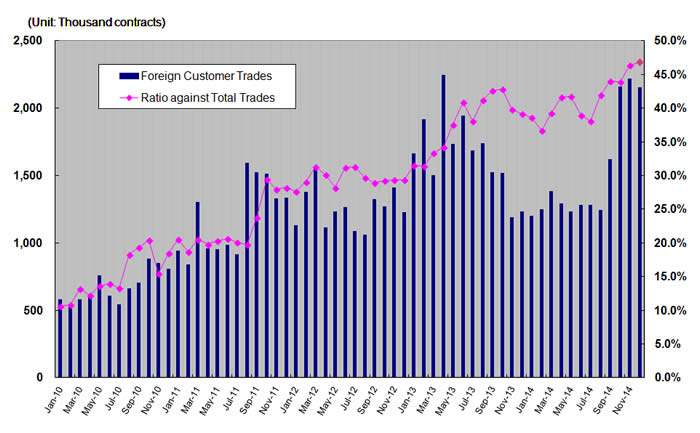
Japan’s main commodity bourse, TOCOM, is gaining traction among international traders as a viable venue for commodity derivatives trading. The venue saw December volumes from overseas participants accounting for 46.8%.
The Tokyo Commodity Exchange , the largest and most diverse commodity derivatives trading venue in Japan, has reported that the proportion of international investors transacting on the exchange has increased significantly with December 2014’s figures showing 46.8% of total volumes. The figure highlights the venue’s commitment on creating an open market place for global traders.
The total number of orders, both long and short, was positive for overseas participants, thus supporting the venue’s notion of internationalization. The firm commented about its extension plans in its midterm management plan issued in March 2014, stating: “Intensifying competition with other exchanges in Japan and overseas (is part of its objectives).”
The venue has seen cumulative growth in its overseas segment since launching the popular X_Trader platform in 2009, achieving a strong position with global traders. International markets have been on the agenda for the venue for a long time, as was reiterated by the current CEO Tadashi Ezaki, pictured, in his New Year message: “We will continue to promote our market to a diverse set of market participants, including retail investors, commercials and international participants. We will continue to improve the range of listed commodities to meet investor needs and carry on with educational activities to achieve this goal.”
Overseas Volumes
The latest news adds to recent reports that TOCOM received approval under the CFTC to operate in the US as a Foreign Board of Trade (FBOT). Reports state that the watchdog sanctioned the Japan origin venue, which permits TOCOM to provide its Members and market participants located in the US with direct access to its electronic order entry and trade matching system, a function that is expected to further enhance the overseas participation in the exchange.
The CFTC allows non-US trading venues to offers its solutions to US investors if the regulator can determine that the exchange’s regulatory procedures are in line with those of CFC authorized ones. A foreign board of trade registered with the CFTC must demonstrate that it meets regulatory requirements comparable to those required of US futures exchanges.
Furthermore, the CFTC must determine that the foreign board of trade’s regulatory authorities support and enforce regulatory objectives that are substantially equivalent to the CFTC’s objectives, in particular, with respect to market integrity, customer protection, Clearing and settlement and the enforcement of the rules of the foreign board of trade and its clearing organization.
Mr. Ezaki commented in a statement about the approval: “We are proud to receive FBOT registration, which confirms the soundness and reliability of our exchange and our market and will enhance confidence in TOCOM as the exchange of choice for trading commodities in Asia. As a result of our efforts to increase our global competitiveness, we have seen a significant increase in market participation from overseas, which has reached as much as 46% of total volume. We are poised to use the FBOT registration to further expand global participation from the U.S.”
The Tokyo Commodity Exchange , the largest and most diverse commodity derivatives trading venue in Japan, has reported that the proportion of international investors transacting on the exchange has increased significantly with December 2014’s figures showing 46.8% of total volumes. The figure highlights the venue’s commitment on creating an open market place for global traders.
The total number of orders, both long and short, was positive for overseas participants, thus supporting the venue’s notion of internationalization. The firm commented about its extension plans in its midterm management plan issued in March 2014, stating: “Intensifying competition with other exchanges in Japan and overseas (is part of its objectives).”
The venue has seen cumulative growth in its overseas segment since launching the popular X_Trader platform in 2009, achieving a strong position with global traders. International markets have been on the agenda for the venue for a long time, as was reiterated by the current CEO Tadashi Ezaki, pictured, in his New Year message: “We will continue to promote our market to a diverse set of market participants, including retail investors, commercials and international participants. We will continue to improve the range of listed commodities to meet investor needs and carry on with educational activities to achieve this goal.”
Overseas Volumes
The latest news adds to recent reports that TOCOM received approval under the CFTC to operate in the US as a Foreign Board of Trade (FBOT). Reports state that the watchdog sanctioned the Japan origin venue, which permits TOCOM to provide its Members and market participants located in the US with direct access to its electronic order entry and trade matching system, a function that is expected to further enhance the overseas participation in the exchange.
The CFTC allows non-US trading venues to offers its solutions to US investors if the regulator can determine that the exchange’s regulatory procedures are in line with those of CFC authorized ones. A foreign board of trade registered with the CFTC must demonstrate that it meets regulatory requirements comparable to those required of US futures exchanges.
Furthermore, the CFTC must determine that the foreign board of trade’s regulatory authorities support and enforce regulatory objectives that are substantially equivalent to the CFTC’s objectives, in particular, with respect to market integrity, customer protection, Clearing and settlement and the enforcement of the rules of the foreign board of trade and its clearing organization.
Mr. Ezaki commented in a statement about the approval: “We are proud to receive FBOT registration, which confirms the soundness and reliability of our exchange and our market and will enhance confidence in TOCOM as the exchange of choice for trading commodities in Asia. As a result of our efforts to increase our global competitiveness, we have seen a significant increase in market participation from overseas, which has reached as much as 46% of total volume. We are poised to use the FBOT registration to further expand global participation from the U.S.”
Singapore Independent Wealth Sector Has Less Than 10% Market Share, but Vast Room for Growth
FP Markets Winner Spotlight 🏆 | Global Broker of the Year 2025 #Trading #Broker #Innovation #Shorts
FP Markets Winner Spotlight 🏆 | Global Broker of the Year 2025 #Trading #Broker #Innovation #Shorts
FP Markets takes the spotlight as Global Broker of the Year 2025 at the Finance Magnates Awards.
Martin Stoilov, Head of Client Experience, shares that trust, innovation, and people played a key role in the company’s success, supported by a strong foundation of integrity and client-centricity.
Following this milestone, FP Markets continues to focus on growth, technology investment, and its core values of transparency and excellence.
👉 Be part of FM Awards 2026: https://awards.financemagnates.com/#nominate
FP Markets takes the spotlight as Global Broker of the Year 2025 at the Finance Magnates Awards.
Martin Stoilov, Head of Client Experience, shares that trust, innovation, and people played a key role in the company’s success, supported by a strong foundation of integrity and client-centricity.
Following this milestone, FP Markets continues to focus on growth, technology investment, and its core values of transparency and excellence.
👉 Be part of FM Awards 2026: https://awards.financemagnates.com/#nominate
In this video, we review @HolaPrimeMarketsOfficial, a multi-asset forex and CFDs broker offering different account types, trading platforms, and flexible trading conditions.
We cover the broker’s overall offering, including account options, trading environment, platforms like MT4 and MT5, and additional services such as managed accounts and fast withdrawals.
Watch the full video to see if Hola Prime Markets fits your trading needs.
📣 Stay up to date with the latest in finance and trading. Follow Finance Magnates for industry news, insights, and global event coverage.
Connect with us:
🔗 LinkedIn: /financemagnates
👍 Facebook: /financemagnates
📸 Instagram: https://www.instagram.com/financemagnates
🐦 X: https://x.com/financemagnates
🎥 TikTok: https://www.tiktok.com/tag/financemagnates
▶️ YouTube: /@financemagnates_official
#HolaPrime #ForexBroker #CFDTrading #FinanceMagnates #Trading #Forex #BrokerReview
In this video, we review @HolaPrimeMarketsOfficial, a multi-asset forex and CFDs broker offering different account types, trading platforms, and flexible trading conditions.
We cover the broker’s overall offering, including account options, trading environment, platforms like MT4 and MT5, and additional services such as managed accounts and fast withdrawals.
Watch the full video to see if Hola Prime Markets fits your trading needs.
📣 Stay up to date with the latest in finance and trading. Follow Finance Magnates for industry news, insights, and global event coverage.
Connect with us:
🔗 LinkedIn: /financemagnates
👍 Facebook: /financemagnates
📸 Instagram: https://www.instagram.com/financemagnates
🐦 X: https://x.com/financemagnates
🎥 TikTok: https://www.tiktok.com/tag/financemagnates
▶️ YouTube: /@financemagnates_official
#HolaPrime #ForexBroker #CFDTrading #FinanceMagnates #Trading #Forex #BrokerReview
Hola Prime Review: What You Need to Know | Full Breakdown by Finance Magnates
Hola Prime Review: What You Need to Know | Full Breakdown by Finance Magnates
In this video, we review @HolaPrime_Global, a proprietary trading firm offering evaluation programs and performance-based payouts in simulated market environments.
We cover how the challenge model works, including account types, profit splits (up to 95%), trading rules, and what it takes to reach a funded account. You’ll also learn about available platforms like MT4, MT5, cTrader, and more, along with insights into payouts, support, and trading conditions.
Watch the full video to see if Hola Prime fits your trading style.
📣 Stay up to date with the latest in finance and trading. Follow Finance Magnates for industry news, insights, and global event coverage.
Connect with us:
🔗 LinkedIn: /financemagnates
👍 Facebook: /financemagnates
📸 Instagram: https://www.instagram.com/financemagnates
🐦 X: https://x.com/financemagnates
🎥 TikTok: https://www.tiktok.com/tag/financemagnates
▶️ YouTube: /@financemagnates_official
#HolaPrime #PropFirm #Trading #FinanceMagnates #Forex #FuturesTrading #TradingReview #PropFirmReview
In this video, we review @HolaPrime_Global, a proprietary trading firm offering evaluation programs and performance-based payouts in simulated market environments.
We cover how the challenge model works, including account types, profit splits (up to 95%), trading rules, and what it takes to reach a funded account. You’ll also learn about available platforms like MT4, MT5, cTrader, and more, along with insights into payouts, support, and trading conditions.
Watch the full video to see if Hola Prime fits your trading style.
📣 Stay up to date with the latest in finance and trading. Follow Finance Magnates for industry news, insights, and global event coverage.
Connect with us:
🔗 LinkedIn: /financemagnates
👍 Facebook: /financemagnates
📸 Instagram: https://www.instagram.com/financemagnates
🐦 X: https://x.com/financemagnates
🎥 TikTok: https://www.tiktok.com/tag/financemagnates
▶️ YouTube: /@financemagnates_official
#HolaPrime #PropFirm #Trading #FinanceMagnates #Forex #FuturesTrading #TradingReview #PropFirmReview
Axi Winner Spotlight 🏆 | Global Most Innovative Broker 2025 #Innovation #Trading #Fintech #Broker
Axi Winner Spotlight 🏆 | Global Most Innovative Broker 2025 #Innovation #Trading #Fintech #Broker
Axi takes the spotlight at the Finance Magnates Awards, winning Global Most Innovative Broker 2025.
Olivia Xenofontos and Ivanna Openko share how the team will feel: proud, motivated, and ready to keep delivering.
They also describe the night as well-organized, focused, and enjoyable for all.
👉 Be part of FM Awards 2026.
Axi takes the spotlight at the Finance Magnates Awards, winning Global Most Innovative Broker 2025.
Olivia Xenofontos and Ivanna Openko share how the team will feel: proud, motivated, and ready to keep delivering.
They also describe the night as well-organized, focused, and enjoyable for all.
👉 Be part of FM Awards 2026.
Recognition that matters.
Built on transparency.
Driven by the industry.
The Finance Magnates Awards 2026.
Nominations are now open.
🔗 https://awards.financemagnates.com/?utm_source=SM&utm_medium=social&utm_campaign=recognition-matters
Recognition that matters.
Built on transparency.
Driven by the industry.
The Finance Magnates Awards 2026.
Nominations are now open.
🔗 https://awards.financemagnates.com/?utm_source=SM&utm_medium=social&utm_campaign=recognition-matters