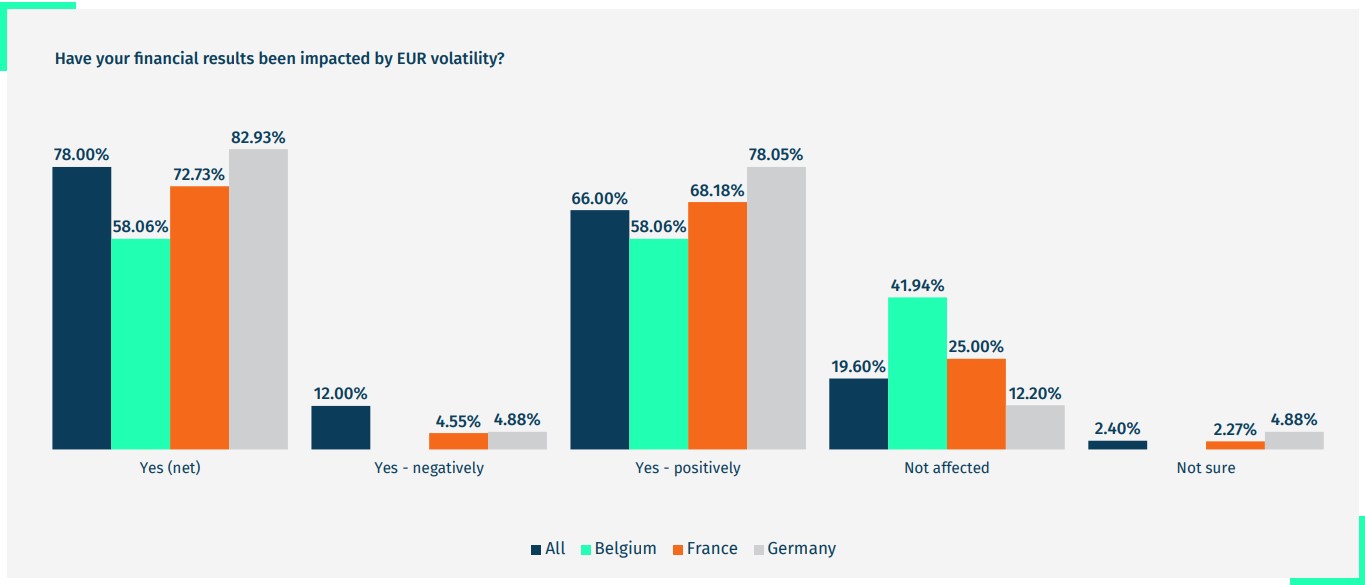
78% of the respondents in a recent study targeting European businesses have been affected by the volatility of the euro.
Manual FX processes are common in Europe despite the high cost.
In the past year, there has been a significant fluctuation in
major currencies, impacting European corporate finances, with the Netherlands being affected the most at 94%. Despite the collapse of several financial
institutions, European Chief Financial Officers are adapting their strategies to effectively manage foreign exchange (FX) risks.
According to the MillTechFX European Corporate CFO FX
Report 2024, the volatility of the euro has been a central concern for European
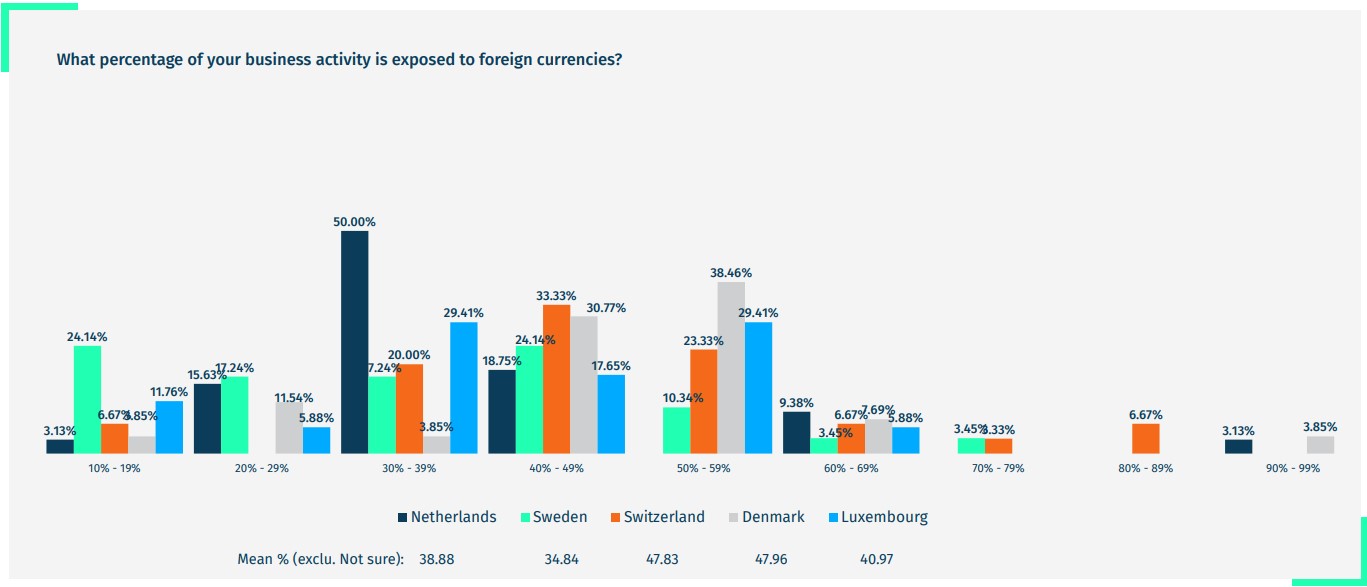
businesses, with nearly 40% of their activities exposed to foreign currencies. The fluctuation of the euro has directly affected
financial results, with 78% of European corporates reporting the impact of the euro's volatility. This trend is most pronounced in countries like the
Netherlands, Switzerland, and Denmark.
Euro Volatility and Its Impact on European Corporates
Besides the challenges posed by the volatility of the
euro, many European corporates still rely on manual FX processes, which are inefficient and resource-intensive. The reliance on manual methods for
price discovery, trade execution, and settlement has resulted in a significant cost
for most organizations.
Source: MillTechFX
Meanwhile, the institutions in Europe face transparency
challenges in the FX market, with 59% expressing concerns.
Hidden costs and tailored pricing models often obscure the true cost of FX
transactions, making it difficult for corporates to gauge whether they are
getting the best deal.
In response to the inefficiencies of manual processes,
European corporations are increasingly exploring automation and outsourcing
solutions for their FX operations. Digital platforms offer centralized price
discovery, streamlined workflows, and enhanced transparency, driving efficiency across the FX space.
Additionally, the consideration for environmental, social, and governance (ESG) objectives are reshaping the FX landscape,
influencing the selection of FX counterparties and service providers by corporations. With stakeholders placing greater emphasis on sustainability, most corporations are
integrating ESG criteria into their FX practices.
Some of the steps taken by businesses to enhance ESG compliance, include embracing initiatives like the FX Global Code and
partnering with ESG-compliant service providers.
Source: MillTechFX
Interest Rates and Inflation
Euro volatility continues to sway the financial
landscape for European corporates, with the past year presenting a blend of
challenges and opportunities.
Amid rising interest rates, inflationary pressures,
geopolitical uncertainties, and banking sector crises, CFOs have been compelled
to reassess their risk management strategies and FX practices.
The fluctuation of the euro over the past year
underscores the significance of FX risk management for European businesses.
From hitting six-month lows to substantial gains against the dollar, the volatility of the euro has left a tangible impact on corporate financial results. Notably, 78% of the European firms surveyed reported being affected by this trend.
In the past year, there has been a significant fluctuation in
major currencies, impacting European corporate finances, with the Netherlands being affected the most at 94%. Despite the collapse of several financial
institutions, European Chief Financial Officers are adapting their strategies to effectively manage foreign exchange (FX) risks.
According to the MillTechFX European Corporate CFO FX
Report 2024, the volatility of the euro has been a central concern for European
businesses, with nearly 40% of their activities exposed to foreign currencies. The fluctuation of the euro has directly affected
financial results, with 78% of European corporates reporting the impact of the euro's volatility. This trend is most pronounced in countries like the
Netherlands, Switzerland, and Denmark.
Euro Volatility and Its Impact on European Corporates
Besides the challenges posed by the volatility of the
euro, many European corporates still rely on manual FX processes, which are inefficient and resource-intensive. The reliance on manual methods for
price discovery, trade execution, and settlement has resulted in a significant cost
for most organizations.
Source: MillTechFX
Meanwhile, the institutions in Europe face transparency
challenges in the FX market, with 59% expressing concerns.
Hidden costs and tailored pricing models often obscure the true cost of FX
transactions, making it difficult for corporates to gauge whether they are
getting the best deal.
In response to the inefficiencies of manual processes,
European corporations are increasingly exploring automation and outsourcing
solutions for their FX operations. Digital platforms offer centralized price
discovery, streamlined workflows, and enhanced transparency, driving efficiency across the FX space.
Additionally, the consideration for environmental, social, and governance (ESG) objectives are reshaping the FX landscape,
influencing the selection of FX counterparties and service providers by corporations. With stakeholders placing greater emphasis on sustainability, most corporations are
integrating ESG criteria into their FX practices.
Some of the steps taken by businesses to enhance ESG compliance, include embracing initiatives like the FX Global Code and
partnering with ESG-compliant service providers.
Source: MillTechFX
Interest Rates and Inflation
Euro volatility continues to sway the financial
landscape for European corporates, with the past year presenting a blend of
challenges and opportunities.
Amid rising interest rates, inflationary pressures,
geopolitical uncertainties, and banking sector crises, CFOs have been compelled
to reassess their risk management strategies and FX practices.
The fluctuation of the euro over the past year
underscores the significance of FX risk management for European businesses.
From hitting six-month lows to substantial gains against the dollar, the volatility of the euro has left a tangible impact on corporate financial results. Notably, 78% of the European firms surveyed reported being affected by this trend.
Jared Kirui is an Editor at Finance Magnates with more than five years of experience in financial journalism. He covers online trading, fintech, payments, and crypto industries with a focus on companies, regulation and compliance, executive moves, trading technology, and market analysis.
His work has been featured in other media outlets, including Benzinga, ZyCrypto, The Distributed, and The Daily Hodl.
Education:
Bachelor of Commerce degree (Finance option), University of Nairobi
Cboe Files SEC Proposal for 24x5 Trading on EDGX: Also Plans Partial-Payout Prediction Markets
Finance Magnates Awards 2026 – Nominations Now Open
Finance Magnates Awards 2026 – Nominations Now Open
The Finance Magnates Awards 2026 nominations are now open. 🏆
From fintech innovators to leading brokers, this is where the finance industry celebrates its biggest achievements.
Winners will be announced at the Cyprus Gala Dinner on November 6, 2026.
Nominate your brand now.
https://awards.financemagnates.com/?utm_source=linkedin&utm_medium=video&utm_campaign=nominations-open
#FMAwards #FinanceMagnates #FintechAwards #Fintech #FinanceIndustry
The Finance Magnates Awards 2026 nominations are now open. 🏆
From fintech innovators to leading brokers, this is where the finance industry celebrates its biggest achievements.
Winners will be announced at the Cyprus Gala Dinner on November 6, 2026.
Nominate your brand now.
https://awards.financemagnates.com/?utm_source=linkedin&utm_medium=video&utm_campaign=nominations-open
#FMAwards #FinanceMagnates #FintechAwards #Fintech #FinanceIndustry
Finance Magnates Awards 2026 | Nominations Now Open 🏆#Fintech #FMAwards #TradingIndustry
Finance Magnates Awards 2026 | Nominations Now Open 🏆#Fintech #FMAwards #TradingIndustry
Lights on. Cameras ready. 🎬
Finance Magnates Awards 2026 nominations are now open. 🏆
#FMAwards #FinanceMagnates #FintechAwards #Fintech
Lights on. Cameras ready. 🎬
Finance Magnates Awards 2026 nominations are now open. 🏆
#FMAwards #FinanceMagnates #FintechAwards #Fintech
Exness sees trust as the key theme for growth in MENA Trading Growth for 2026
Exness sees trust as the key theme for growth in MENA Trading Growth for 2026
Mohammad Amer, Regional Commercial Director at Exness, sits down to discuss the booming MENA financial trading market. Find out why Dubai is key to the company's growth strategy, how a mobile-first generation is changing expectations, and why trust will be the defining theme for traders in 2026.
In this interview, you'll learn:
* Why Dubai and the MENA region are critical growth markets for fintech and online trading.
* How Exness is addressing the demands of mobile-first, younger traders through engineering, platform stability, and transparent conditions.
* The essential role local talent plays in providing a culturally relevant and compliant user experience.
* Mohammad Amer's outlook on the future of the online trading industry and why stronger controls and systems are necessary.
* Why "trust" isn't just a brand value, but has commercial value—and why he predicts 2026 will be the "Year of Trust."
Key Takeaways:
➡️ The MENA region is rapidly shaping global financial markets.
➡️ New traders expect stability, precise execution, and transparency.
➡️ Local expertise is key to regulatory compliance and user experience.
➡️ Future success belongs to firms capable of meeting rising standards across regulation and platform consistency.
Read the full article at: https://www.financemagnates.com/thought-leadership/exness-sees-trust-as-the-key-theme-for-growth-in-mena-trading-growth-for-2026/
#Exness #MENA #Trading #FinTech #Dubai #OnlineTrading #FinanceMagnates #MohammadAmer #Trust #MobileTrading
Mohammad Amer, Regional Commercial Director at Exness, sits down to discuss the booming MENA financial trading market. Find out why Dubai is key to the company's growth strategy, how a mobile-first generation is changing expectations, and why trust will be the defining theme for traders in 2026.
In this interview, you'll learn:
* Why Dubai and the MENA region are critical growth markets for fintech and online trading.
* How Exness is addressing the demands of mobile-first, younger traders through engineering, platform stability, and transparent conditions.
* The essential role local talent plays in providing a culturally relevant and compliant user experience.
* Mohammad Amer's outlook on the future of the online trading industry and why stronger controls and systems are necessary.
* Why "trust" isn't just a brand value, but has commercial value—and why he predicts 2026 will be the "Year of Trust."
Key Takeaways:
➡️ The MENA region is rapidly shaping global financial markets.
➡️ New traders expect stability, precise execution, and transparency.
➡️ Local expertise is key to regulatory compliance and user experience.
➡️ Future success belongs to firms capable of meeting rising standards across regulation and platform consistency.
Read the full article at: https://www.financemagnates.com/thought-leadership/exness-sees-trust-as-the-key-theme-for-growth-in-mena-trading-growth-for-2026/
#Exness #MENA #Trading #FinTech #Dubai #OnlineTrading #FinanceMagnates #MohammadAmer #Trust #MobileTrading
Paytiko CEO Razi Salih on Why Payment Orchestration is a MUST-HAVE for Brokers in 2026
Paytiko CEO Razi Salih on Why Payment Orchestration is a MUST-HAVE for Brokers in 2026
At iFX Expo Dubai, Finance Magnates spoke with Razi Salih, CEO at Paytiko, about the evolution of the payments ecosystem and why payment orchestration has shifted from an option to a necessity for brokers, prop firms, and exchanges.
Mr. Salih explains how global expansion, the need for deep localisation, and the sheer number of new payment methods, from instant banking to stablecoins, are driving this critical infrastructure shift.
#PaymentOrchestration #Fintech #Brokerage #TradingPayments #RaziSalih #Paytiko #iFXExpoDubai #Stablecoins #AIinFintech
At iFX Expo Dubai, Finance Magnates spoke with Razi Salih, CEO at Paytiko, about the evolution of the payments ecosystem and why payment orchestration has shifted from an option to a necessity for brokers, prop firms, and exchanges.
Mr. Salih explains how global expansion, the need for deep localisation, and the sheer number of new payment methods, from instant banking to stablecoins, are driving this critical infrastructure shift.
#PaymentOrchestration #Fintech #Brokerage #TradingPayments #RaziSalih #Paytiko #iFXExpoDubai #Stablecoins #AIinFintech
Altima CTO Sunil Jadhav: Solving Data Fragmentation & Lag for Brokers & Prop Firms
Altima CTO Sunil Jadhav: Solving Data Fragmentation & Lag for Brokers & Prop Firms
Altima CTO Sunil Jadhav sits down with Finance Magnates to discuss the core technology challenges facing CFD brokers and proprietary trading firms today.
Jadhav explains how the industry's reliance on batch processing and fragmented systems (where CRMs, risk tools, and trading platforms operate with separate 'sources of truth') leads to delayed data and inconsistent operational decisions. He argues that real-time event processing is essential for managing fast-moving trading activity and risk.
Learn how Altima's unified, event-driven architecture, connecting Altima CRM, Altima Prop, IB systems, and risk management through a single backbone, is designed to provide synchronous data and better operational coordination for modern brokerage and prop firm stacks.
Key Topics:
- Broker and Prop Firm Data Challenges
- The problem of delayed data processing (batch processing vs. real-time events)
- Fragmented systems and conflicting data sources
- Altima's unified, event-driven solution architecture
- The concept of a "risk-aware CRM"
- Built-in risk management in Altima Prop
#Altima #financemagnates #iFXDubai #FinTech #BrokerTech #PropFirm #CFDBroker #TradingTechnology #RealTimeData #RiskManagement #CRM #FinancialMarkets #EventDrivenArchitecture
Altima CTO Sunil Jadhav sits down with Finance Magnates to discuss the core technology challenges facing CFD brokers and proprietary trading firms today.
Jadhav explains how the industry's reliance on batch processing and fragmented systems (where CRMs, risk tools, and trading platforms operate with separate 'sources of truth') leads to delayed data and inconsistent operational decisions. He argues that real-time event processing is essential for managing fast-moving trading activity and risk.
Learn how Altima's unified, event-driven architecture, connecting Altima CRM, Altima Prop, IB systems, and risk management through a single backbone, is designed to provide synchronous data and better operational coordination for modern brokerage and prop firm stacks.
Key Topics:
- Broker and Prop Firm Data Challenges
- The problem of delayed data processing (batch processing vs. real-time events)
- Fragmented systems and conflicting data sources
- Altima's unified, event-driven solution architecture
- The concept of a "risk-aware CRM"
- Built-in risk management in Altima Prop
#Altima #financemagnates #iFXDubai #FinTech #BrokerTech #PropFirm #CFDBroker #TradingTechnology #RealTimeData #RiskManagement #CRM #FinancialMarkets #EventDrivenArchitecture