Post-Lehman Brothers, many European officials believe that a bailout is the lesser of two evils.
Bloomberg
This article was written by Lucas Hell, a student at the Frankfurt School of Finance & Management. He has worked in development finance and asset management and is currently working in restructuring. His interests concern Fintech, environmental finance and Microfinance.
Lucas Hell
Rumors
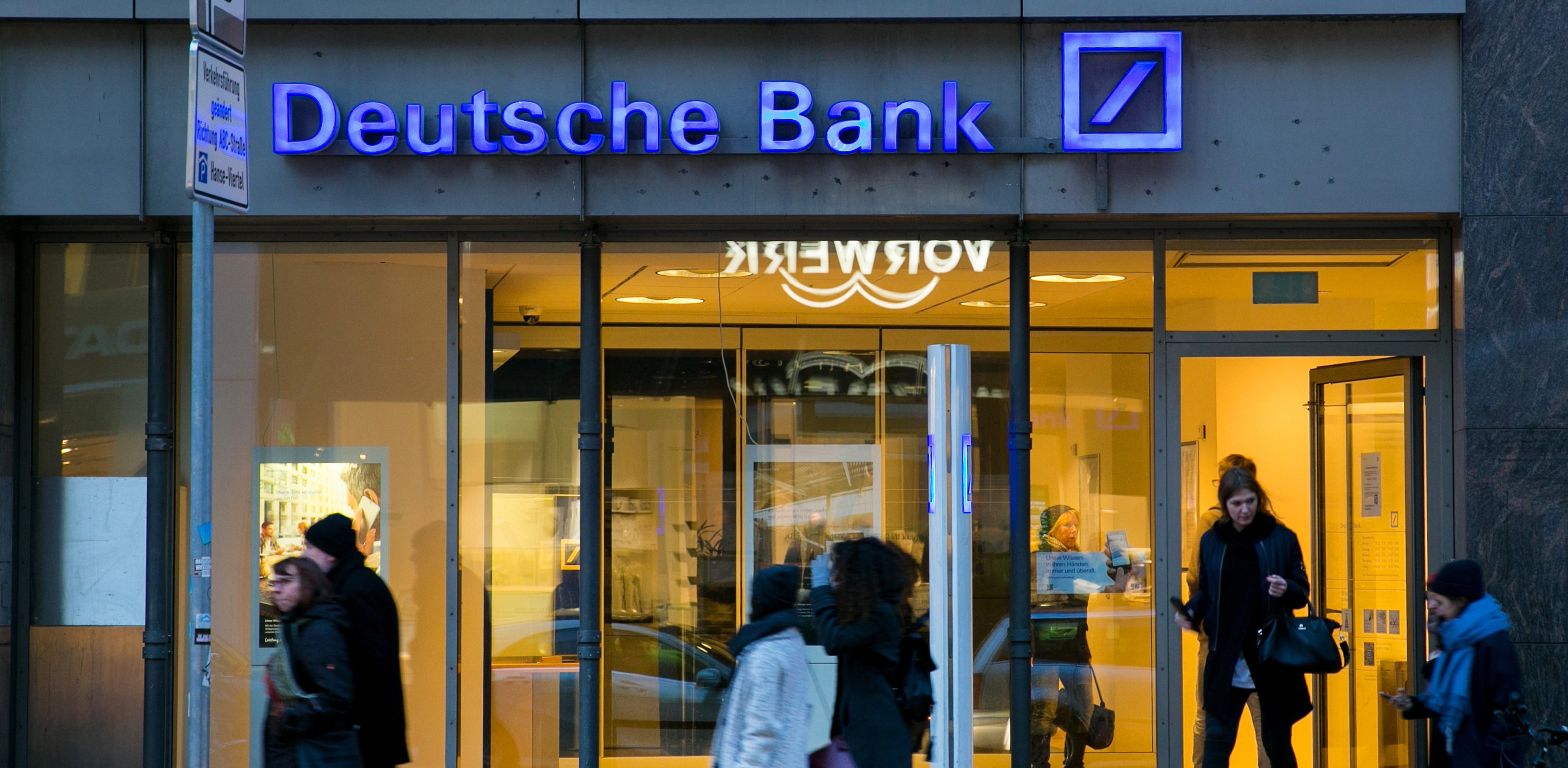
Last week saw rumors that Deutsche Bank might need a state bailout after the DOJ’s threat of a $14 billion penalty.
The allegations over residential mortgage-backed securities (RMBS) date back as far as 2005. The fine however was seen by many political analysts as a first step in more intricate negotiations to follow. Deutsche Bank is likely to see its prospective payment reduced in the end.
For the DOJ , it was important to show its tough stance at the beginning of the negotiations, as Deutsche Bank's case is one of the first cases of a European bank over RMBS. Barclays and Credit Suisse, among others, are to follow.
Nevertheless, with its stock price falling to €10 per share at the end of September, investors started to become wary of whether Deutsche Bank would be strong enough to cope with the financial burden of future litigation. Deutsche Bank’s market cap is around $19 billion and it has laid back $5.5 billion in provisions for legal settlements.
Bailout
Last week, German press speculated about a state bailout which was immediately denied by government officials. However, as several newspapers reported, employees at the German Finance Ministry are working on an emergency plan in case Deutsche Bank runs out of money.
The harsh and instant denials of these plans show the nervousness of the German government. Chancellor Merkel faces a dilemma in foreign as well as interior policy. In the EU Merkel has spoken out several times against a bailout of Italian banks which are still sitting on bad loans amounting to €360 billion.
Her harsh stance in this matter has not only brought her strong criticism from Italian premier Matteo Renzi but also from the French president Francois Hollande. A state bailout of Deutsche Bank now might be seen as hypocrisy and weakness. The consequence would definitely be a strengthening of the Southern European bloc and bank bailouts in further states. For Chancellor Merkel this is equal to opening Pandora's box and further derailing the stability of the eurozone.
Political Climate
Apart from the problems a Deutsche Bank bailout poses regarding foreign policy, one should not underestimate the domestic political climate.
As in the whole Western world, German voter sentiment regarding banks has become increasingly hostile since the financial crisis. In 2009, Germany’s second largest private bank, Commerzbank, was partly nationalized and up to today the state has not sold all of its shares. Additionally, several federal states had to step in with taxpayer money to save federal state banks which would have otherwise collapsed.
A bailout of Deutsche Bank would definitely cause uproar among Merkel`s traditional CDU voters. In 2017 Germany will hold elections for the Bundestag and although Merkel has not officially declared whether she will run again, it is widely expected. Therefore she would under no circumstance want to give the impression that she is frivolously wasting taxpayers’ money for saving 'greedy bankers'.
In the recent federal elections this year, the far-right anti-immigrant party AFD (Alternative for Germany) was able to score highly, thanks to a great degree to disappointed Merkel voters and nonvoters. Merkel`s CDU is thus under enormous pressure from the right.
Lehman Brothers
To come back to the headline, despite pressure from the national and international level, there might be under certain circumstance no other recourse for Germany than to bail out Deutsche Bank. The bank still has the biggest derivative exposure in the world, with around $47 trillion, and one would not want to imagine the effects on the financial markets if Deutsche goes down uncontrolled.
The experience with Lehman Brothers (which had a tiny derivative exposure compared to Deutsche Bank) has led many officials in Europe to believe that a bank bailout is the lesser evil, and pressure on Germany to bail out Deutsche Bank will substantially increase once the market has lost confidence.
The IMF in its latest summit branded Deutsche Bank as one of the biggest threats to the global economy. No matter how desperately the German government tries to give credible assurance that it does not consider any government intervention, in the end it will have to if Deutsche Bank cannot manage its problems on its own.
Nonetheless, it is clear that a potential government step-in will not only have consequences for Germany, but also be a blueprint for the newly created institutions in Europe for banking supervision following the financial crisis.
This article was written by Lucas Hell, a student at the Frankfurt School of Finance & Management. He has worked in development finance and asset management and is currently working in restructuring. His interests concern Fintech, environmental finance and Microfinance.
Lucas Hell
Rumors
Last week saw rumors that Deutsche Bank might need a state bailout after the DOJ’s threat of a $14 billion penalty.
The allegations over residential mortgage-backed securities (RMBS) date back as far as 2005. The fine however was seen by many political analysts as a first step in more intricate negotiations to follow. Deutsche Bank is likely to see its prospective payment reduced in the end.
For the DOJ , it was important to show its tough stance at the beginning of the negotiations, as Deutsche Bank's case is one of the first cases of a European bank over RMBS. Barclays and Credit Suisse, among others, are to follow.
Nevertheless, with its stock price falling to €10 per share at the end of September, investors started to become wary of whether Deutsche Bank would be strong enough to cope with the financial burden of future litigation. Deutsche Bank’s market cap is around $19 billion and it has laid back $5.5 billion in provisions for legal settlements.
Bailout
Last week, German press speculated about a state bailout which was immediately denied by government officials. However, as several newspapers reported, employees at the German Finance Ministry are working on an emergency plan in case Deutsche Bank runs out of money.
The harsh and instant denials of these plans show the nervousness of the German government. Chancellor Merkel faces a dilemma in foreign as well as interior policy. In the EU Merkel has spoken out several times against a bailout of Italian banks which are still sitting on bad loans amounting to €360 billion.
Her harsh stance in this matter has not only brought her strong criticism from Italian premier Matteo Renzi but also from the French president Francois Hollande. A state bailout of Deutsche Bank now might be seen as hypocrisy and weakness. The consequence would definitely be a strengthening of the Southern European bloc and bank bailouts in further states. For Chancellor Merkel this is equal to opening Pandora's box and further derailing the stability of the eurozone.
Political Climate
Apart from the problems a Deutsche Bank bailout poses regarding foreign policy, one should not underestimate the domestic political climate.
As in the whole Western world, German voter sentiment regarding banks has become increasingly hostile since the financial crisis. In 2009, Germany’s second largest private bank, Commerzbank, was partly nationalized and up to today the state has not sold all of its shares. Additionally, several federal states had to step in with taxpayer money to save federal state banks which would have otherwise collapsed.
A bailout of Deutsche Bank would definitely cause uproar among Merkel`s traditional CDU voters. In 2017 Germany will hold elections for the Bundestag and although Merkel has not officially declared whether she will run again, it is widely expected. Therefore she would under no circumstance want to give the impression that she is frivolously wasting taxpayers’ money for saving 'greedy bankers'.
In the recent federal elections this year, the far-right anti-immigrant party AFD (Alternative for Germany) was able to score highly, thanks to a great degree to disappointed Merkel voters and nonvoters. Merkel`s CDU is thus under enormous pressure from the right.
Lehman Brothers
To come back to the headline, despite pressure from the national and international level, there might be under certain circumstance no other recourse for Germany than to bail out Deutsche Bank. The bank still has the biggest derivative exposure in the world, with around $47 trillion, and one would not want to imagine the effects on the financial markets if Deutsche goes down uncontrolled.
The experience with Lehman Brothers (which had a tiny derivative exposure compared to Deutsche Bank) has led many officials in Europe to believe that a bank bailout is the lesser evil, and pressure on Germany to bail out Deutsche Bank will substantially increase once the market has lost confidence.
The IMF in its latest summit branded Deutsche Bank as one of the biggest threats to the global economy. No matter how desperately the German government tries to give credible assurance that it does not consider any government intervention, in the end it will have to if Deutsche Bank cannot manage its problems on its own.
Nonetheless, it is clear that a potential government step-in will not only have consequences for Germany, but also be a blueprint for the newly created institutions in Europe for banking supervision following the financial crisis.
Institutional FX Volumes Surge 25% in January 2026 as Dollar Volatility Returns
Hannah Hill on Innovation, Branding & Award-Winning Technology | Executive Interview | AXI
Hannah Hill on Innovation, Branding & Award-Winning Technology | Executive Interview | AXI
Recorded live at FMLS:25, this executive interview features Hannah Hill, Head of Brand and Sponsorship at AXI, in conversation with Finance Magnates, following AXI’s win for Most Innovative Broker of the Year 2025.
In this wide-ranging discussion, Hannah shares insights on:
🔹What winning the Finance Magnates award means for AXI’s credibility and innovation
🔹How the launch of AXI Select, the capital allocation program, is redefining industry standards
🔹The development and rollout of the AXI trading app across multiple markets
🔹Driving brand evolution alongside technological advancements
🔹Encouraging and recognizing teams behind the scenes
🔹The role of marketing, content, and social media in building product awareness
Hannah explains why standout products, strategic branding, and a focus on innovation are key to growing visibility and staying ahead in a competitive brokerage landscape.
🏆 Award Highlight: Most Innovative Broker of the Year 2025
👉 Subscribe to Finance Magnates for more executive interviews, industry insights, and exclusive coverage from the world’s leading financial events.
#FMLS25 #FinanceMagnates #MostInnovativeBroker #TradingTechnology #FinTech #Brokerage #ExecutiveInterview #AXI
Recorded live at FMLS:25, this executive interview features Hannah Hill, Head of Brand and Sponsorship at AXI, in conversation with Finance Magnates, following AXI’s win for Most Innovative Broker of the Year 2025.
In this wide-ranging discussion, Hannah shares insights on:
🔹What winning the Finance Magnates award means for AXI’s credibility and innovation
🔹How the launch of AXI Select, the capital allocation program, is redefining industry standards
🔹The development and rollout of the AXI trading app across multiple markets
🔹Driving brand evolution alongside technological advancements
🔹Encouraging and recognizing teams behind the scenes
🔹The role of marketing, content, and social media in building product awareness
Hannah explains why standout products, strategic branding, and a focus on innovation are key to growing visibility and staying ahead in a competitive brokerage landscape.
🏆 Award Highlight: Most Innovative Broker of the Year 2025
👉 Subscribe to Finance Magnates for more executive interviews, industry insights, and exclusive coverage from the world’s leading financial events.
#FMLS25 #FinanceMagnates #MostInnovativeBroker #TradingTechnology #FinTech #Brokerage #ExecutiveInterview #AXI
Executive Interview | Dor Eligula | Co-Founder & Chief Business Officer, BridgeWise | FMLS:25
Executive Interview | Dor Eligula | Co-Founder & Chief Business Officer, BridgeWise | FMLS:25
In this session, Jonathan Fine form Ultimate Group speaks with Dor Eligula from Bridgewise, a fast-growing AI-powered research and analytics firm supporting brokers and exchanges worldwide.
We start with Dor’s reaction to the Summit and then move to broker growth and the quick wins brokers often overlook. Dor shares where he sees “blue ocean” growth across Asian markets and how local client behaviour shapes demand.
We also discuss the rollout of AI across investment research. Dor gives real examples of how automation and human judgment meet at Bridgewise — including moments when analysts corrected AI output, and times when AI prevented an error.
We close with a practical question: how retail investors can actually use AI without falling into common traps.
In this session, Jonathan Fine form Ultimate Group speaks with Dor Eligula from Bridgewise, a fast-growing AI-powered research and analytics firm supporting brokers and exchanges worldwide.
We start with Dor’s reaction to the Summit and then move to broker growth and the quick wins brokers often overlook. Dor shares where he sees “blue ocean” growth across Asian markets and how local client behaviour shapes demand.
We also discuss the rollout of AI across investment research. Dor gives real examples of how automation and human judgment meet at Bridgewise — including moments when analysts corrected AI output, and times when AI prevented an error.
We close with a practical question: how retail investors can actually use AI without falling into common traps.
Brendan Callan joined us fresh off the Summit’s most anticipated debate: “Is Prop Trading Good for the Industry?” Brendan argued against the motion — and the audience voted him the winner.
In this interview, Brendan explains the reasoning behind his position. He walks through the message he believes many firms avoid: that the current prop trading model is too dependent on fees, too loose on risk, and too confusing for retail audiences.
We discuss why he thinks the model grew fast, why it may run into walls, and what he believes is needed for a cleaner, more responsible version of prop trading.
This is Brendan at his frankest — sharp, grounded, and very clear about what changes are overdue.
Brendan Callan joined us fresh off the Summit’s most anticipated debate: “Is Prop Trading Good for the Industry?” Brendan argued against the motion — and the audience voted him the winner.
In this interview, Brendan explains the reasoning behind his position. He walks through the message he believes many firms avoid: that the current prop trading model is too dependent on fees, too loose on risk, and too confusing for retail audiences.
We discuss why he thinks the model grew fast, why it may run into walls, and what he believes is needed for a cleaner, more responsible version of prop trading.
This is Brendan at his frankest — sharp, grounded, and very clear about what changes are overdue.
Elina Pedersen on Growth, Stability & Ultra-Low Latency | Executive Interview | Your Bourse
Elina Pedersen on Growth, Stability & Ultra-Low Latency | Executive Interview | Your Bourse
Recorded live at FMLS:25 London, this executive interview features Elina Pedersen, in conversation with Finance Magnates, following her company’s win for Best Connectivity 2025.
🔹In this wide-ranging discussion, Elina shares insights on:
🔹What winning a Finance Magnates award means for credibility and reputation
🔹How broker demand for stability and reliability is driving rapid growth
🔹The launch of a new trade server enabling flexible front-end integrations
🔹Why ultra-low latency must be proven with data, not buzzwords
🔹Common mistakes brokers make when scaling globally
🔹Educating the industry through a newly launched Dealers Academy
🔹Where AI fits into trading infrastructure and where it doesn’t
Elina explains why resilient back-end infrastructure, deep client partnerships, and disciplined focus are critical for brokers looking to scale sustainably in today’s competitive market.
🏆 Award Highlight: Best Connectivity 2025
👉 Subscribe to Finance Magnates for more executive interviews, industry insights, and exclusive coverage from the world’s leading financial events.
#FMLS25 #FinanceMagnates #BestConnectivity #TradingTechnology #UltraLowLatency #FinTech #Brokerage #ExecutiveInterview
Recorded live at FMLS:25 London, this executive interview features Elina Pedersen, in conversation with Finance Magnates, following her company’s win for Best Connectivity 2025.
🔹In this wide-ranging discussion, Elina shares insights on:
🔹What winning a Finance Magnates award means for credibility and reputation
🔹How broker demand for stability and reliability is driving rapid growth
🔹The launch of a new trade server enabling flexible front-end integrations
🔹Why ultra-low latency must be proven with data, not buzzwords
🔹Common mistakes brokers make when scaling globally
🔹Educating the industry through a newly launched Dealers Academy
🔹Where AI fits into trading infrastructure and where it doesn’t
Elina explains why resilient back-end infrastructure, deep client partnerships, and disciplined focus are critical for brokers looking to scale sustainably in today’s competitive market.
🏆 Award Highlight: Best Connectivity 2025
👉 Subscribe to Finance Magnates for more executive interviews, industry insights, and exclusive coverage from the world’s leading financial events.
#FMLS25 #FinanceMagnates #BestConnectivity #TradingTechnology #UltraLowLatency #FinTech #Brokerage #ExecutiveInterview
In this video, we take an in-depth look at @BlueberryMarketsForex , a forex and CFD broker operating since 2016, offering access to multiple trading platforms, over 1,000 instruments, and flexible account types for different trading styles.
We break down Blueberry’s regulatory structure, including its Australian Financial Services License (AFSL), as well as its authorisation and registrations in other jurisdictions. The review also covers supported platforms such as MetaTrader 4, MetaTrader 5, cTrader, TradingView, Blueberry.X, and web-based trading.
You’ll learn about available instruments across forex, commodities, indices, share CFDs, and crypto CFDs, along with leverage options, minimum and maximum trade sizes, and how Blueberry structures its Standard and Raw accounts.
We also explain spreads, commissions, swap rates, swap-free account availability, funding and withdrawal methods, processing times, and what traders can expect from customer support and additional services.
Watch the full review to see whether Blueberry’s trading setup aligns with your experience level, strategy, and risk tolerance.
📣 Stay up to date with the latest in finance and trading. Follow Finance Magnates for industry news, insights, and global event coverage.
Connect with us:
🔗 LinkedIn: /financemagnates
👍 Facebook: /financemagnates
📸 Instagram: https://www.instagram.com/financemagnates
🐦 X: https://x.com/financemagnates
🎥 TikTok: https://www.tiktok.com/tag/financemagnates
▶️ YouTube: /@financemagnates_official
#Blueberry #BlueberryMarkets #BrokerReview #ForexBroker #CFDTrading #OnlineTrading #FinanceMagnates #TradingPlatforms #MarketInsights
In this video, we take an in-depth look at @BlueberryMarketsForex , a forex and CFD broker operating since 2016, offering access to multiple trading platforms, over 1,000 instruments, and flexible account types for different trading styles.
We break down Blueberry’s regulatory structure, including its Australian Financial Services License (AFSL), as well as its authorisation and registrations in other jurisdictions. The review also covers supported platforms such as MetaTrader 4, MetaTrader 5, cTrader, TradingView, Blueberry.X, and web-based trading.
You’ll learn about available instruments across forex, commodities, indices, share CFDs, and crypto CFDs, along with leverage options, minimum and maximum trade sizes, and how Blueberry structures its Standard and Raw accounts.
We also explain spreads, commissions, swap rates, swap-free account availability, funding and withdrawal methods, processing times, and what traders can expect from customer support and additional services.
Watch the full review to see whether Blueberry’s trading setup aligns with your experience level, strategy, and risk tolerance.
📣 Stay up to date with the latest in finance and trading. Follow Finance Magnates for industry news, insights, and global event coverage.
Connect with us:
🔗 LinkedIn: /financemagnates
👍 Facebook: /financemagnates
📸 Instagram: https://www.instagram.com/financemagnates
🐦 X: https://x.com/financemagnates
🎥 TikTok: https://www.tiktok.com/tag/financemagnates
▶️ YouTube: /@financemagnates_official
#Blueberry #BlueberryMarkets #BrokerReview #ForexBroker #CFDTrading #OnlineTrading #FinanceMagnates #TradingPlatforms #MarketInsights