Mid-caps are increasingly on the radar of institutional investors in Singapore and with listing activity set to rise again this year, opportunities for diversification will also increase. Institutional interest in Singapore’s small- and mid-cap segment has strengthened meaningfully over the past year.
Singapore Summit: Meet the largest APAC brokers you know (and those you still don't!).
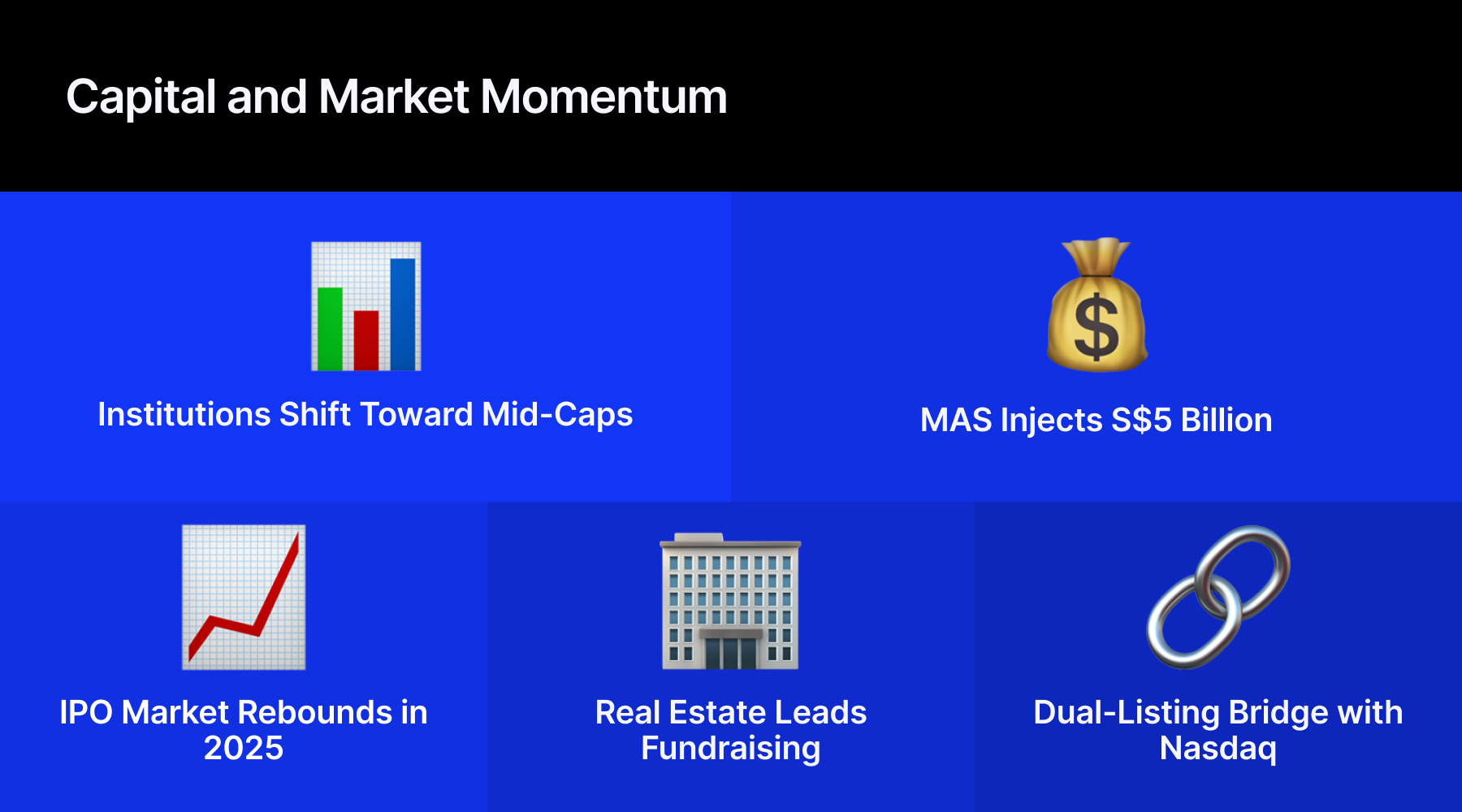
The Monetary Authority of Singapore’s equity market development programme has been a major catalyst, directing capital to strategies with a significant allocation to locally listed equities - particularly those outside the large-cap universe.
The equity market development programme was launched in February 2025 with a S$5 billion investment to bolster the local fund management ecosystem, deploying $3.95 billion across two batches of appointed asset managers, with a third allocation expected in the second quarter of this year.
In addition, tax exemptions were introduced for fund managers investing substantially in Singapore-listed equities , while adjustments to the Global Investor Programme targeting Singapore-based single family offices were made to encourage capital inflows.
The grant for the equity market Singapore scheme, enhanced by S$50 million from the Financial Sector Development Fund, now includes research coverage on pre-IPO companies and mid- to small-cap enterprises.
According to Yain Wang, AEW managing director and chief investment officer for Asia Pacific, these initiatives have helped to broaden market liquidity and improve price discovery for smaller companies.
- “Little Margin for Error”: Firms See MAS Enforcement as Market-Wide Lesson
- CFD Broker SBCFX Joins Financial Commission, Offers Clients Dispute Platform Access
- Hong Kong Races to Stop Lightning-Fast Money Flows Fueling New Laundering Schemes
“With S$3.95 billion already allocated to nine asset managers, momentum is building and many investors now view small and mid-cap companies as a key theme for 2026 as liquidity improves and structural reforms take hold,” she says.
Value Unlock and Market Support
Complementary initiatives such as the Value Unlock programme further support this segment of the market by strengthening corporate engagement and transparency.
Value Unlock is a strategic initiative by the Monetary Authority of Singapore and the Singapore Exchange that helps listed companies realise their full valuation potential by encouraging them to think beyond ‘business as usual’, identify opportunities for improvement, and implement and communicate actionable strategies that create sustainable shareholder value.
IPO Activity Rebounds Strongly
According to PwC’s latest equity capital markets watch report, after a decline over the past three years, Singapore’s IPO activities experienced a strong rebound in 2025 with 12 IPO deals.
Deloitte’s Southeast Asia IPO capital market report 2025 notes that the real estate sector saw two key listings in Singapore, with assets for data centre and accommodation purposes. While the consumer sector accounted for the highest number of public offerings last year, it was real estate that fuelled the massive increase in funds raised – S$2 billion compared to just S$34 million in 2024.
According to the report, these listings reflect a broader regional shift toward niche asset classes. Investors are drawn to these sectors for their resilience and growth potential.
IPO activity in Singapore is expected to progress in its recovery this year, supported by regulatory and market reforms and specifically measures implemented by the equities market review group.
The more accommodative interest rate environment has supported the return of REIT listings on the Singapore Exchange, and healthcare and technology companies are also expected to pursue listings on the SGX. Investors will remain selective, focusing on companies with strong fundamentals, well-prepared offerings and decent valuations.
Dual Listing and Structural Reforms
Wang agrees that the universe of listed companies in Singapore is expected to increase further and that structural reforms will also influence listing activity.
“The MAS-SGX proposal for a dual-listing bridge with Nasdaq, aimed at attracting high-growth Asian companies, could draw more issuers to Singapore from mid-2026 onward,” she says. “Combined with the Value Unlock programme, these efforts should support a modest but steady expansion of SGX’s issuer base.
The real estate sector, in particular, is at an interesting inflection point. Alternative-living platforms are already active with additional vehicles and potential listings in the pipeline.”
ETF Flows and Pipeline Growth
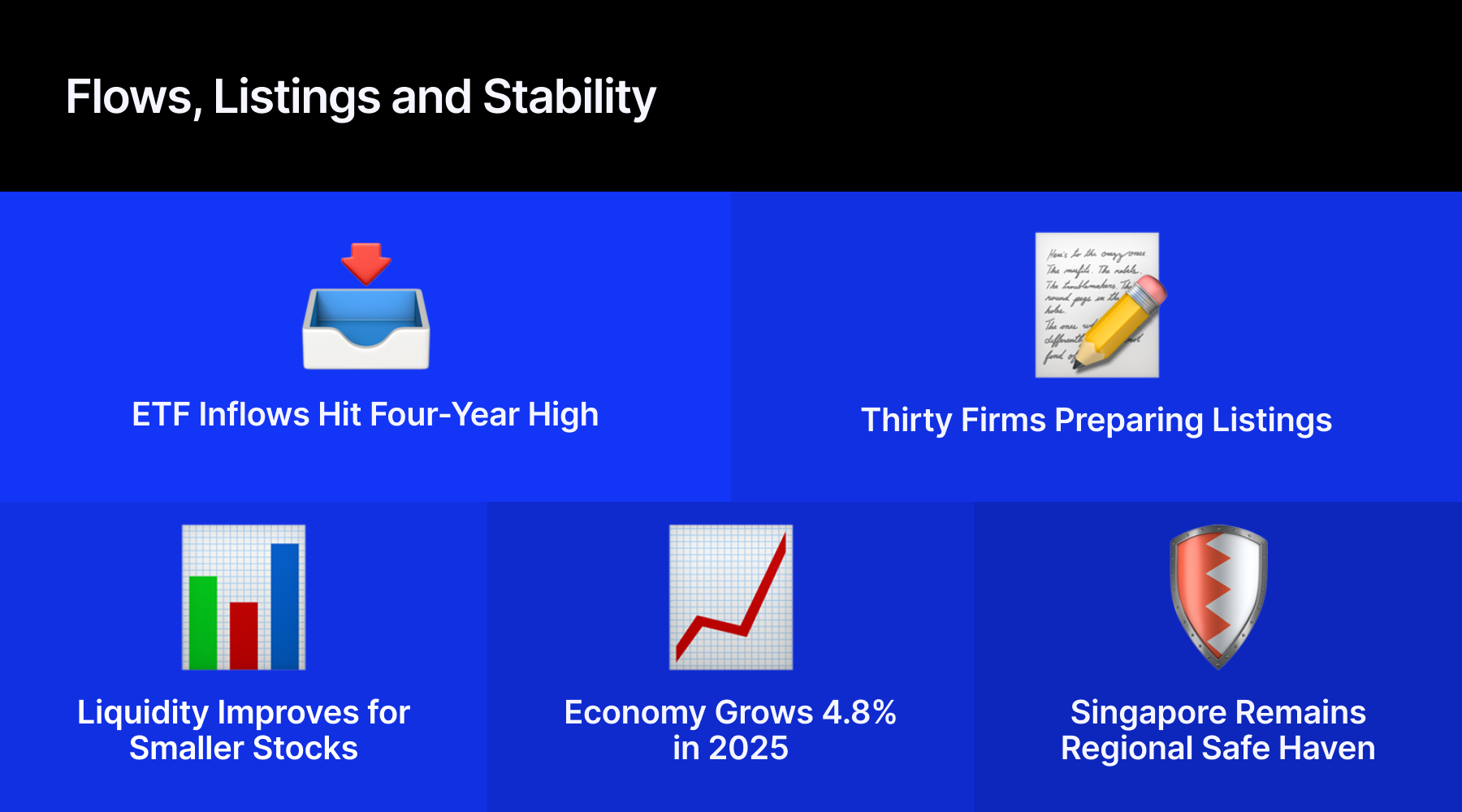
Shawn Ang, portfolio manager of the Fullerton Singapore Value-Up Fund, also refers to increased engagement with Singapore’s emerging mid-cap segment from institutional investors, noting that flows into Singapore securities picked up in 2025 with overall ETF fund flows reaching their highest level since 2021.
Ang (who co-manages the fund with Michelle Sim) says that since its inception the firm has received a number of reverse enquiries about the fund and its strategies, both locally and across the region.
“In terms of listings, Singapore’s IPO pipeline has been picking up,” he says. “SGX recorded 15 IPOs in 2025 - up significantly from 2024 – and as of the first week of January 2026 more than 30 companies have begun preparing for listings across the Mainboard and Catalist [which has no quantitative entry criteria].”
Ang shares the view that initiatives such as the SGX-Nasdaq dual listing bridge, which will allow companies to list on both bourses concurrently with a single set of offering documents, can help to sustain a healthy IPO pipeline by attracting high-quality growth companies.
“SGX has also been proactive in its outreach for IPOs from Chinese companies, especially those pursuing a China + 1 strategy and looking at expansion to Singapore,” he says. “This allows us to continue to grow our pipeline of listings and is a trend that benefits the fund in terms of broadening the investable universe and opening up more opportunities for investment in quality stocks.”
Strong Fundamentals Attract Institutions
According to Robert St Clair, head of investment strategy at Fullerton Fund Management, institutional investors may turn to domestic assets due to Singapore’s strong economic fundamentals.
“The economy expanded by 4.8% in 2025, more than the Government’s forecast of 4%, marking its best performance since 2021’s bounce back from the pandemic-induced recession,” he observes. “Supported by strong productivity, external demand and trade momentum, Singapore is a valuable anchor in this disruptive realpolitik environment.”
Singapore’s AAA sovereign rating, stable currency, strong rule of law and fiscal soundness continue to make local assets highly attractive to institutional investors seeking safe, predictable returns - especially against a backdrop of volatile global geopolitics and rising scrutiny on fiscal sustainability across developed markets, says Wang.
“Investor appetite has remained robust across sectors, supported by sound market fundamentals and lower financing costs,” Wang concludes. “These characteristics reinforce Singapore’s status as a regional safe haven and strengthen the case for sustained institutional overweighting to domestic assets.”