Financial and Business News

Why Oil Prices Increase 74% in Three Weeks and Why Brokers Are Hitting Risk Limits for the First Time Since 2020

Monday, 09/03/2026 | 09:02 GMT by Damian Chmiel
  • CFD brokers scramble to contain exposure as crude prices post their biggest weekly gain since records began.
  • Brent crude price tests the $120-per-barrel area, the highest level in nearly four years.
Iran

WTI crude oil has climbed roughly 74% in under three weeks, from around $66 per barrel to near $115 on Monday, 9 March 2026. It is, by CME records going back to 1983, the largest weekly gain in the history of crude oil futures. The speed and scale of the move have put CFD brokers, many of whom act as the direct counterparty to their clients' trades, under extraordinary financial pressure.

When US and Israeli forces launched coordinated strikes on Iran in late February, the fallout reached well beyond the Middle East. Within hours of trading reopening, brokers serving millions of retail investors worldwide were racing to tighten oil trading conditions, cut leverage, and push up margin requirements before clients could fully load up on positions.

The Strike That Upended Global Oil Markets

The catalyst was a US-Israeli military operation launched on February 28, designated "Operation Epic Fury," which targeted Iranian nuclear sites and senior leadership. Iran's Supreme Leader Ayatollah Ali Khamenei was killed in the opening hours.

Iran's Revolutionary Guard Corps responded by effectively closing the Strait of Hormuz, with daily tanker transits falling from an average of 24 vessels to just four by March 1. The strait typically handles around 20% of the world's oil supply, or approximately 14 million barrels per day.

Goldman Sachs said the disruption to the Strait of Hormuz is 17 times larger than the peak supply impact from Russia's invasion of Ukraine in 2022, a comparison that underscores just how rapidly brokers needed to act.
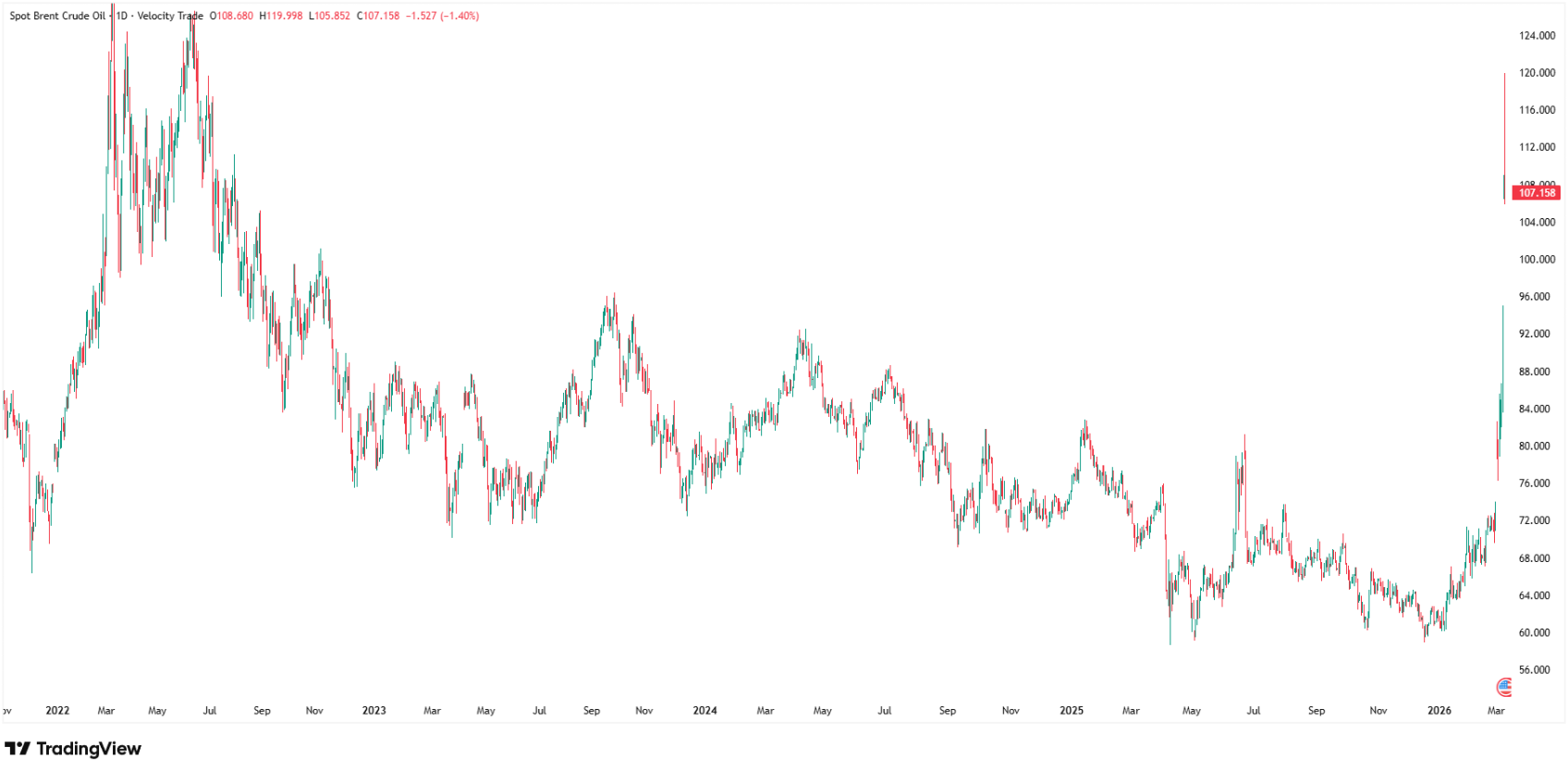
Why oil prices are going up today. Source: Tradingview.com

Brokers Moved Before Markets Opened

The first wave of industry action came before the March 2 Asian market open. TMGM, the Australian-headquartered broker also known as TradeMax Global Markets, raised minimum margin levels for client withdrawals and internal transfers from 200% to 500%, effective immediately.

The5ers, a proprietary trading firm, cut leverage on oil, metals, and indices from 1:33 to 1:5, an 85% reduction, after sending notifications to traders on March 1. Screenshots of the notice spread quickly on social media.

FinanceMagnates.com reported at the time that brokers had "already started sending notices to traders, informing them of higher margin requirements and leverage limits from Monday's trading session." We flagged that brokers "especially those heavily exposed to B-book models" were the most aggressive movers, noting that many had already been "reeling from a massive gap in their P&L after the one-sided rally in gold earlier this year."

IG Group's Japanese subsidiary had actually moved even earlier. It raised minimum maintenance margin requirements for crude oil, gold, silver, and other energy instruments to 5% for corporate accounts effective February 21, before the strikes took place, citing rising US-Iran tensions. The firm had done something similar in October 2024 when earlier Middle East tensions flared.

CME Hikes Cascade Through the Broker Food Chain

On March 5-6, CME Clearing issued Advisory 26-095, mandating performance bond increases across a range of energy products. Crude oil spread margins rose 25-33%, with Mars versus WTI jumping from $800 to $1,050 per contract, for example. Freight route margins climbed 15-30% as shipping costs surged as vessels avoided the Persian Gulf.

Beyond discrete advisory notices, CME's automated SPAN 2 margin methodology recalculates outright futures margins in real time based on volatility and price levels. Standard WTI margins that CME pegs at 3-12% of contract value would have risen from roughly $4,000-8,000 per contract to approximately $7,500-13,000 at current prices, purely because of where oil is trading. Every CFD broker that hedges client positions through futures markets or references CME pricing faces these increases directly.

In a notable side effect, CME simultaneously cut precious metals margins on March 6, trimming silver from 18% to 14% and gold from 9% to 7%, as capital rotated aggressively out of metals and into energy.

Automated Systems Triggered Industry-Wide

Several of the world's largest retail brokers operate risk management systems designed to activate automatically in precisely these conditions, without requiring formal announcements.

Exness, maintains a High Margin Requirement system that the firm says automatically reduces leverage during periods of heightened volatility . Under standard conditions, Exness says it offers leverage of up to 1:1,000 on USOIL and 1:200 on UKOIL. When the system activates, both instruments default to a maximum of 1:20.

AvaTrade's published conditions state that "maximum position limits may be reduced during periods of volatility" and that "margins may be increased on any instrument, without prior notice." FXCM reserves "the final right, in its sole discretion, to change leverage settings." Tickmill uses dynamic leverage that scales down in real time as position sizes grow.

Interactive Brokers, which calculates daily exposure fees through thousands of simulated price scenarios, remains a relevant case study. During the 2020 negative oil price event, when WTI briefly traded at minus $37 per barrel, the firm absorbed $88 million in client losses after its systems failed to contain the move quickly enough.

Retail Traders Rushed In as Conditions Tightened

The margin tightening coincided with a sharp increase in retail interest. Capital.com published internal platform data showing the number of active oil traders on its platform jumped 276% between February 27 and March 2, while volumes surged 649%. The number of first-time oil traders on a single day spiked 1,255%, the firm said.

Oil moved from sixth or seventh place in the platform's most-traded rankings to second. Client sentiment shifted from 51% long on Friday to 75% long by Monday.

Dubai's Broker Hub Hit by Missiles and Market Chaos

The oil crisis carried a dimension unlike previous commodity shocks: physical disruption to broker offices. FinanceMagnates.com reported on March 4 that Iranian missiles struck near Dubai business centers that house offices for IG Group, CMC Markets, Pepperstone, Saxo Bank, Plus500, Capital.com, Equiti, and Forex.com, among others.

No major regulator, including ESMA, the FCA, ASIC, or CySEC, has issued emergency measures specifically targeting oil trading. Existing post-2018 product intervention rules already cap retail oil CFD leverage at 10:1 in the EU and UK, and 20:1 in Australia.

The most aggressive tightening has come from offshore brokers, regulated in places like Seychelles or St. Vincent that permit leverage ratios of 100:1 or more, and from prop trading firms that fall outside standard retail leverage frameworks.

CySEC was separately reported to be planning raids on CFD broker offices as part of an EU-wide conflict-of-interest review, adding a layer of regulatory scrutiny on top of the market-driven margin increases.

$150 Oil Price Prediction and What It Means for Broker Exposure

Analysts are not ruling out further price increases. Qatar's energy minister has publicly said crude could reach $150 per barrel within weeks. Kpler's head of oil analysis agreed with that target. J.P. Morgan has warned that production cuts could approach 6 million barrels per day if the Strait of Hormuz stays closed.

Goldman Sachs said on March 6 that prices were "likely to exceed $100 next week," a forecast that proved accurate within 48 hours.

For brokers, the math compounds quickly. With WTI 74% above its pre-crisis level, a standard one-lot position that required roughly $6,700 in margin at $67 per barrel now demands approximately $11,500, even before any additional broker-level tightening.

The 2020 negative oil price episode remains the clearest reference point. During that event, several brokers including IC Markets moved to "close only" mode for WTI spot positions, halting new trades and modifications to existing orders.

The current shock runs in the opposite direction, but the structural vulnerabilities are similar. The industry's emergency margin increases, while already among the most aggressive on record, may be only the first phase of a more prolonged adjustment.


WTI crude oil has climbed roughly 74% in under three weeks, from around $66 per barrel to near $115 on Monday, 9 March 2026. It is, by CME records going back to 1983, the largest weekly gain in the history of crude oil futures. The speed and scale of the move have put CFD brokers, many of whom act as the direct counterparty to their clients' trades, under extraordinary financial pressure.

When US and Israeli forces launched coordinated strikes on Iran in late February, the fallout reached well beyond the Middle East. Within hours of trading reopening, brokers serving millions of retail investors worldwide were racing to tighten oil trading conditions, cut leverage, and push up margin requirements before clients could fully load up on positions.

The Strike That Upended Global Oil Markets

The catalyst was a US-Israeli military operation launched on February 28, designated "Operation Epic Fury," which targeted Iranian nuclear sites and senior leadership. Iran's Supreme Leader Ayatollah Ali Khamenei was killed in the opening hours.

Iran's Revolutionary Guard Corps responded by effectively closing the Strait of Hormuz, with daily tanker transits falling from an average of 24 vessels to just four by March 1. The strait typically handles around 20% of the world's oil supply, or approximately 14 million barrels per day.

Goldman Sachs said the disruption to the Strait of Hormuz is 17 times larger than the peak supply impact from Russia's invasion of Ukraine in 2022, a comparison that underscores just how rapidly brokers needed to act.

Why oil prices are going up today. Source: Tradingview.com

Brokers Moved Before Markets Opened

The first wave of industry action came before the March 2 Asian market open. TMGM, the Australian-headquartered broker also known as TradeMax Global Markets, raised minimum margin levels for client withdrawals and internal transfers from 200% to 500%, effective immediately.

The5ers, a proprietary trading firm, cut leverage on oil, metals, and indices from 1:33 to 1:5, an 85% reduction, after sending notifications to traders on March 1. Screenshots of the notice spread quickly on social media.

FinanceMagnates.com reported at the time that brokers had "already started sending notices to traders, informing them of higher margin requirements and leverage limits from Monday's trading session." We flagged that brokers "especially those heavily exposed to B-book models" were the most aggressive movers, noting that many had already been "reeling from a massive gap in their P&L after the one-sided rally in gold earlier this year."

IG Group's Japanese subsidiary had actually moved even earlier. It raised minimum maintenance margin requirements for crude oil, gold, silver, and other energy instruments to 5% for corporate accounts effective February 21, before the strikes took place, citing rising US-Iran tensions. The firm had done something similar in October 2024 when earlier Middle East tensions flared.

CME Hikes Cascade Through the Broker Food Chain

On March 5-6, CME Clearing issued Advisory 26-095, mandating performance bond increases across a range of energy products. Crude oil spread margins rose 25-33%, with Mars versus WTI jumping from $800 to $1,050 per contract, for example. Freight route margins climbed 15-30% as shipping costs surged as vessels avoided the Persian Gulf.

Beyond discrete advisory notices, CME's automated SPAN 2 margin methodology recalculates outright futures margins in real time based on volatility and price levels. Standard WTI margins that CME pegs at 3-12% of contract value would have risen from roughly $4,000-8,000 per contract to approximately $7,500-13,000 at current prices, purely because of where oil is trading. Every CFD broker that hedges client positions through futures markets or references CME pricing faces these increases directly.

In a notable side effect, CME simultaneously cut precious metals margins on March 6, trimming silver from 18% to 14% and gold from 9% to 7%, as capital rotated aggressively out of metals and into energy.

Automated Systems Triggered Industry-Wide

Several of the world's largest retail brokers operate risk management systems designed to activate automatically in precisely these conditions, without requiring formal announcements.

Exness, maintains a High Margin Requirement system that the firm says automatically reduces leverage during periods of heightened volatility . Under standard conditions, Exness says it offers leverage of up to 1:1,000 on USOIL and 1:200 on UKOIL. When the system activates, both instruments default to a maximum of 1:20.

AvaTrade's published conditions state that "maximum position limits may be reduced during periods of volatility" and that "margins may be increased on any instrument, without prior notice." FXCM reserves "the final right, in its sole discretion, to change leverage settings." Tickmill uses dynamic leverage that scales down in real time as position sizes grow.

Interactive Brokers, which calculates daily exposure fees through thousands of simulated price scenarios, remains a relevant case study. During the 2020 negative oil price event, when WTI briefly traded at minus $37 per barrel, the firm absorbed $88 million in client losses after its systems failed to contain the move quickly enough.

Retail Traders Rushed In as Conditions Tightened

The margin tightening coincided with a sharp increase in retail interest. Capital.com published internal platform data showing the number of active oil traders on its platform jumped 276% between February 27 and March 2, while volumes surged 649%. The number of first-time oil traders on a single day spiked 1,255%, the firm said.

Oil moved from sixth or seventh place in the platform's most-traded rankings to second. Client sentiment shifted from 51% long on Friday to 75% long by Monday.

Dubai's Broker Hub Hit by Missiles and Market Chaos

The oil crisis carried a dimension unlike previous commodity shocks: physical disruption to broker offices. FinanceMagnates.com reported on March 4 that Iranian missiles struck near Dubai business centers that house offices for IG Group, CMC Markets, Pepperstone, Saxo Bank, Plus500, Capital.com, Equiti, and Forex.com, among others.

No major regulator, including ESMA, the FCA, ASIC, or CySEC, has issued emergency measures specifically targeting oil trading. Existing post-2018 product intervention rules already cap retail oil CFD leverage at 10:1 in the EU and UK, and 20:1 in Australia.

The most aggressive tightening has come from offshore brokers, regulated in places like Seychelles or St. Vincent that permit leverage ratios of 100:1 or more, and from prop trading firms that fall outside standard retail leverage frameworks.

CySEC was separately reported to be planning raids on CFD broker offices as part of an EU-wide conflict-of-interest review, adding a layer of regulatory scrutiny on top of the market-driven margin increases.

$150 Oil Price Prediction and What It Means for Broker Exposure

Analysts are not ruling out further price increases. Qatar's energy minister has publicly said crude could reach $150 per barrel within weeks. Kpler's head of oil analysis agreed with that target. J.P. Morgan has warned that production cuts could approach 6 million barrels per day if the Strait of Hormuz stays closed.

Goldman Sachs said on March 6 that prices were "likely to exceed $100 next week," a forecast that proved accurate within 48 hours.

For brokers, the math compounds quickly. With WTI 74% above its pre-crisis level, a standard one-lot position that required roughly $6,700 in margin at $67 per barrel now demands approximately $11,500, even before any additional broker-level tightening.

The 2020 negative oil price episode remains the clearest reference point. During that event, several brokers including IC Markets moved to "close only" mode for WTI spot positions, halting new trades and modifications to existing orders.

The current shock runs in the opposite direction, but the structural vulnerabilities are similar. The industry's emergency margin increases, while already among the most aggressive on record, may be only the first phase of a more prolonged adjustment.

About the Author: Damian Chmiel
Damian Chmiel
  • 3310 Articles
  • 104 Followers
Damian's adventure with financial markets began at the Cracow University of Economics, where he obtained his MA in finance and accounting. Starting from the retail trader perspective, he collaborated with brokerage houses and financial portals in Poland as an independent editor and content manager. His adventure with Finance Magnates began in 2016, where he is working as a business intelligence analyst.

More from the Author

Retail FX