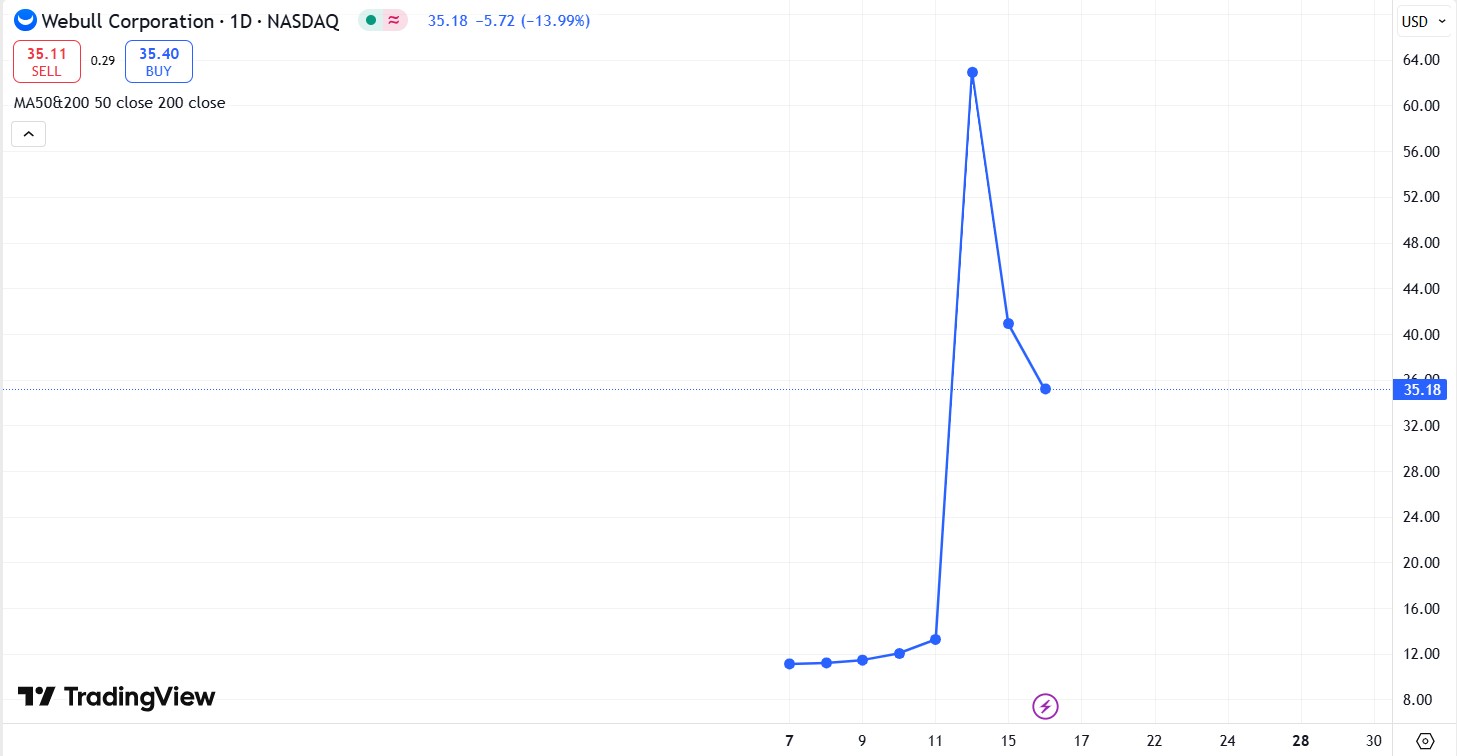
Despite the initial spike, Webull's stock has since dropped over 76%, currently trading at around $35 under the ticker “BULL.”
Webull has grown rapidly since gaining popularity in 2020, now reportedly operating in 15 regions with over 23 million users.
Webull entered the public markets this week, sending
its stock price soaring nearly 372% just a day after its Nasdaq debut. The stock-trading app's explosive rise follows its
merger with SK Growth Opportunities Corp., a special-purpose acquisition
company, pushing Webull’s valuation to almost $30 billion in record time.
Stock Price Drops Over 76%
However, the price has since declined from its peak.
According to TradingView data, BULL is changing hands for $35, a decline of 76%
from its peak. With its shares now listed under the ticker “BULL,”
Webull's market entry signals both investor appetite for digital brokerage
platforms and renewed interest in select SPAC deals, even as the broader SPAC
trend has cooled.
BULL price, Source: TradingView
Webull first gained traction in the U.S. in 2020 when
retail investors, many flush with stimulus checks, turned to the app for
commission-free trading. It now operates in 15 regions globally, claiming over
23 million registered users and more than 50 million app downloads.
The company offers trading in stocks, ETFs, options,
and cryptocurrencies, along with charting tools, watchlists, and a premium tier
that costs $40 annually. Founded by former Alibaba and Xiaomi executive Wang
Anquan, Webull now sits alongside Robinhood, Charles Schwab, and E-Trade in the
increasingly crowded retail trading space.
Questions Around Global Operations
Webull’s path to Nasdaq came through its combination
with SK Growth Opportunities Corp., whose shareholders approved the deal on
March 30. As part of the transaction, SK Growth became a wholly owned
subsidiary, and its securities were converted into Webull shares and warrants.
Trading under the symbols “BULL,” “BULLW,” and “BULLZ,” Webull marked its
market debut by ringing the opening bell at Nasdaq on April 11.
Despite the market enthusiasm, Webull faces scrutiny
over its international ties. In November, the U.S. House Select Committee on
the Chinese Communist Party contacted Denier regarding the company’s
potential links to China, CNBC reported.
Still, with a multibillion-dollar valuation and fresh
visibility, Webull appears well-positioned for the next chapter. As trading
apps continue to reshape how individual investors engage with markets, Webull's
meteoric rise could signal a broader shift in how fintech companies approach
public listings in a post-SPAC-boom world.
Webull entered the public markets this week, sending
its stock price soaring nearly 372% just a day after its Nasdaq debut. The stock-trading app's explosive rise follows its
merger with SK Growth Opportunities Corp., a special-purpose acquisition
company, pushing Webull’s valuation to almost $30 billion in record time.
Stock Price Drops Over 76%
However, the price has since declined from its peak.
According to TradingView data, BULL is changing hands for $35, a decline of 76%
from its peak. With its shares now listed under the ticker “BULL,”
Webull's market entry signals both investor appetite for digital brokerage
platforms and renewed interest in select SPAC deals, even as the broader SPAC
trend has cooled.
BULL price, Source: TradingView
Webull first gained traction in the U.S. in 2020 when
retail investors, many flush with stimulus checks, turned to the app for
commission-free trading. It now operates in 15 regions globally, claiming over
23 million registered users and more than 50 million app downloads.
The company offers trading in stocks, ETFs, options,
and cryptocurrencies, along with charting tools, watchlists, and a premium tier
that costs $40 annually. Founded by former Alibaba and Xiaomi executive Wang
Anquan, Webull now sits alongside Robinhood, Charles Schwab, and E-Trade in the
increasingly crowded retail trading space.
Questions Around Global Operations
Webull’s path to Nasdaq came through its combination
with SK Growth Opportunities Corp., whose shareholders approved the deal on
March 30. As part of the transaction, SK Growth became a wholly owned
subsidiary, and its securities were converted into Webull shares and warrants.
Trading under the symbols “BULL,” “BULLW,” and “BULLZ,” Webull marked its
market debut by ringing the opening bell at Nasdaq on April 11.
Despite the market enthusiasm, Webull faces scrutiny
over its international ties. In November, the U.S. House Select Committee on
the Chinese Communist Party contacted Denier regarding the company’s
potential links to China, CNBC reported.
Still, with a multibillion-dollar valuation and fresh
visibility, Webull appears well-positioned for the next chapter. As trading
apps continue to reshape how individual investors engage with markets, Webull's
meteoric rise could signal a broader shift in how fintech companies approach
public listings in a post-SPAC-boom world.
Jared Kirui is an Editor at Finance Magnates with more than five years of experience in financial journalism. He covers online trading, fintech, payments, and crypto industries with a focus on companies, regulation and compliance, executive moves, trading technology, and market analysis.
His work has been featured in other media outlets, including Benzinga, ZyCrypto, The Distributed, and The Daily Hodl.
Education:
Bachelor of Commerce degree (Finance option), University of Nairobi
Can Prop Trading Work Without Leverage? A Handful of Firms Are Finding Out
FP Markets Winner Spotlight 🏆 | Global Broker of the Year 2025 #Trading #Broker #Innovation #Shorts
FP Markets Winner Spotlight 🏆 | Global Broker of the Year 2025 #Trading #Broker #Innovation #Shorts
FP Markets takes the spotlight as Global Broker of the Year 2025 at the Finance Magnates Awards.
Martin Stoilov, Head of Client Experience, shares that trust, innovation, and people played a key role in the company’s success, supported by a strong foundation of integrity and client-centricity.
Following this milestone, FP Markets continues to focus on growth, technology investment, and its core values of transparency and excellence.
👉 Be part of FM Awards 2026: https://awards.financemagnates.com/#nominate
FP Markets takes the spotlight as Global Broker of the Year 2025 at the Finance Magnates Awards.
Martin Stoilov, Head of Client Experience, shares that trust, innovation, and people played a key role in the company’s success, supported by a strong foundation of integrity and client-centricity.
Following this milestone, FP Markets continues to focus on growth, technology investment, and its core values of transparency and excellence.
👉 Be part of FM Awards 2026: https://awards.financemagnates.com/#nominate
In this video, we review @HolaPrimeMarketsOfficial, a multi-asset forex and CFDs broker offering different account types, trading platforms, and flexible trading conditions.
We cover the broker’s overall offering, including account options, trading environment, platforms like MT4 and MT5, and additional services such as managed accounts and fast withdrawals.
Watch the full video to see if Hola Prime Markets fits your trading needs.
📣 Stay up to date with the latest in finance and trading. Follow Finance Magnates for industry news, insights, and global event coverage.
Connect with us:
🔗 LinkedIn: /financemagnates
👍 Facebook: /financemagnates
📸 Instagram: https://www.instagram.com/financemagnates
🐦 X: https://x.com/financemagnates
🎥 TikTok: https://www.tiktok.com/tag/financemagnates
▶️ YouTube: /@financemagnates_official
#HolaPrime #ForexBroker #CFDTrading #FinanceMagnates #Trading #Forex #BrokerReview
In this video, we review @HolaPrimeMarketsOfficial, a multi-asset forex and CFDs broker offering different account types, trading platforms, and flexible trading conditions.
We cover the broker’s overall offering, including account options, trading environment, platforms like MT4 and MT5, and additional services such as managed accounts and fast withdrawals.
Watch the full video to see if Hola Prime Markets fits your trading needs.
📣 Stay up to date with the latest in finance and trading. Follow Finance Magnates for industry news, insights, and global event coverage.
Connect with us:
🔗 LinkedIn: /financemagnates
👍 Facebook: /financemagnates
📸 Instagram: https://www.instagram.com/financemagnates
🐦 X: https://x.com/financemagnates
🎥 TikTok: https://www.tiktok.com/tag/financemagnates
▶️ YouTube: /@financemagnates_official
#HolaPrime #ForexBroker #CFDTrading #FinanceMagnates #Trading #Forex #BrokerReview
Hola Prime Review: What You Need to Know | Full Breakdown by Finance Magnates
Hola Prime Review: What You Need to Know | Full Breakdown by Finance Magnates
In this video, we review @HolaPrime_Global, a proprietary trading firm offering evaluation programs and performance-based payouts in simulated market environments.
We cover how the challenge model works, including account types, profit splits (up to 95%), trading rules, and what it takes to reach a funded account. You’ll also learn about available platforms like MT4, MT5, cTrader, and more, along with insights into payouts, support, and trading conditions.
Watch the full video to see if Hola Prime fits your trading style.
📣 Stay up to date with the latest in finance and trading. Follow Finance Magnates for industry news, insights, and global event coverage.
Connect with us:
🔗 LinkedIn: /financemagnates
👍 Facebook: /financemagnates
📸 Instagram: https://www.instagram.com/financemagnates
🐦 X: https://x.com/financemagnates
🎥 TikTok: https://www.tiktok.com/tag/financemagnates
▶️ YouTube: /@financemagnates_official
#HolaPrime #PropFirm #Trading #FinanceMagnates #Forex #FuturesTrading #TradingReview #PropFirmReview
In this video, we review @HolaPrime_Global, a proprietary trading firm offering evaluation programs and performance-based payouts in simulated market environments.
We cover how the challenge model works, including account types, profit splits (up to 95%), trading rules, and what it takes to reach a funded account. You’ll also learn about available platforms like MT4, MT5, cTrader, and more, along with insights into payouts, support, and trading conditions.
Watch the full video to see if Hola Prime fits your trading style.
📣 Stay up to date with the latest in finance and trading. Follow Finance Magnates for industry news, insights, and global event coverage.
Connect with us:
🔗 LinkedIn: /financemagnates
👍 Facebook: /financemagnates
📸 Instagram: https://www.instagram.com/financemagnates
🐦 X: https://x.com/financemagnates
🎥 TikTok: https://www.tiktok.com/tag/financemagnates
▶️ YouTube: /@financemagnates_official
#HolaPrime #PropFirm #Trading #FinanceMagnates #Forex #FuturesTrading #TradingReview #PropFirmReview
Axi Winner Spotlight 🏆 | Global Most Innovative Broker 2025 #Innovation #Trading #Fintech #Broker
Axi Winner Spotlight 🏆 | Global Most Innovative Broker 2025 #Innovation #Trading #Fintech #Broker
Axi takes the spotlight at the Finance Magnates Awards, winning Global Most Innovative Broker 2025.
Olivia Xenofontos and Ivanna Openko share how the team will feel: proud, motivated, and ready to keep delivering.
They also describe the night as well-organized, focused, and enjoyable for all.
👉 Be part of FM Awards 2026.
Axi takes the spotlight at the Finance Magnates Awards, winning Global Most Innovative Broker 2025.
Olivia Xenofontos and Ivanna Openko share how the team will feel: proud, motivated, and ready to keep delivering.
They also describe the night as well-organized, focused, and enjoyable for all.
👉 Be part of FM Awards 2026.
Recognition that matters.
Built on transparency.
Driven by the industry.
The Finance Magnates Awards 2026.
Nominations are now open.
🔗 https://awards.financemagnates.com/?utm_source=SM&utm_medium=social&utm_campaign=recognition-matters
Recognition that matters.
Built on transparency.
Driven by the industry.
The Finance Magnates Awards 2026.
Nominations are now open.
🔗 https://awards.financemagnates.com/?utm_source=SM&utm_medium=social&utm_campaign=recognition-matters