
TRY/JPY Volume Jumps 235% on Click 365, but Dollar-Yen Still Rules by Value

Tuesday, 01/09/2026 | 21:40 GMT by Tanya Chepkova
  • TRY/JPY held Click 365’s top contract ranking from April through August.
  • USD/JPY’s ¥601.5 billion trading value dwarfed TRY/JPY’s ¥22.1 billion.
Japan, image source (shutterstock)

Trading in Turkish lira against the yen reached 666,619 contracts on Tokyo Financial Exchange’s Click 365 in August, up 235.4% from a year earlier.

TRY/JPY ranked first by contract count for a fifth consecutive month, while the Mexican peso, South African rand and Hungarian forint also remained ahead of the euro and pound on the same measure.

The ranking does not make TRY/JPY the platform’s largest market by monetary exposure as its August trading value was about ¥22.1 billion, compared with ¥601.5 billion for USD/JPY, which remained dominant by trading value.

TRY/JPY Holds Top Spot despite Volatile Monthly Activity

The lira’s lead has persisted, though activity has not risen in a straight line. Monthly volume moved from 612,981 contracts in April to 498,911 in May, 701,623 in June and more than 1.14 million in July, before falling 41.7% month on month in August.

It nevertheless remained first by contract count throughout the period. Total Click 365 FX Daily Futures volume reached 1.737 million contracts in August, 45.9% higher year on year but 34.1% below July.

USD/JPY recorded 376,532 contracts, while MXN/JPY and ZAR/JPY generated 166,441 and 161,502, respectively. ZAR/JPY volume more than doubled from a year earlier.

Contract specifications explain why these rankings require care. One Click 365 contract represents 10,000 Turkish lira or US dollars, but 100,000 Mexican pesos, South African rand or Hungarian forints.

Currency prices also vary substantially, preventing contract counts from serving as a common measure of notional exposure.
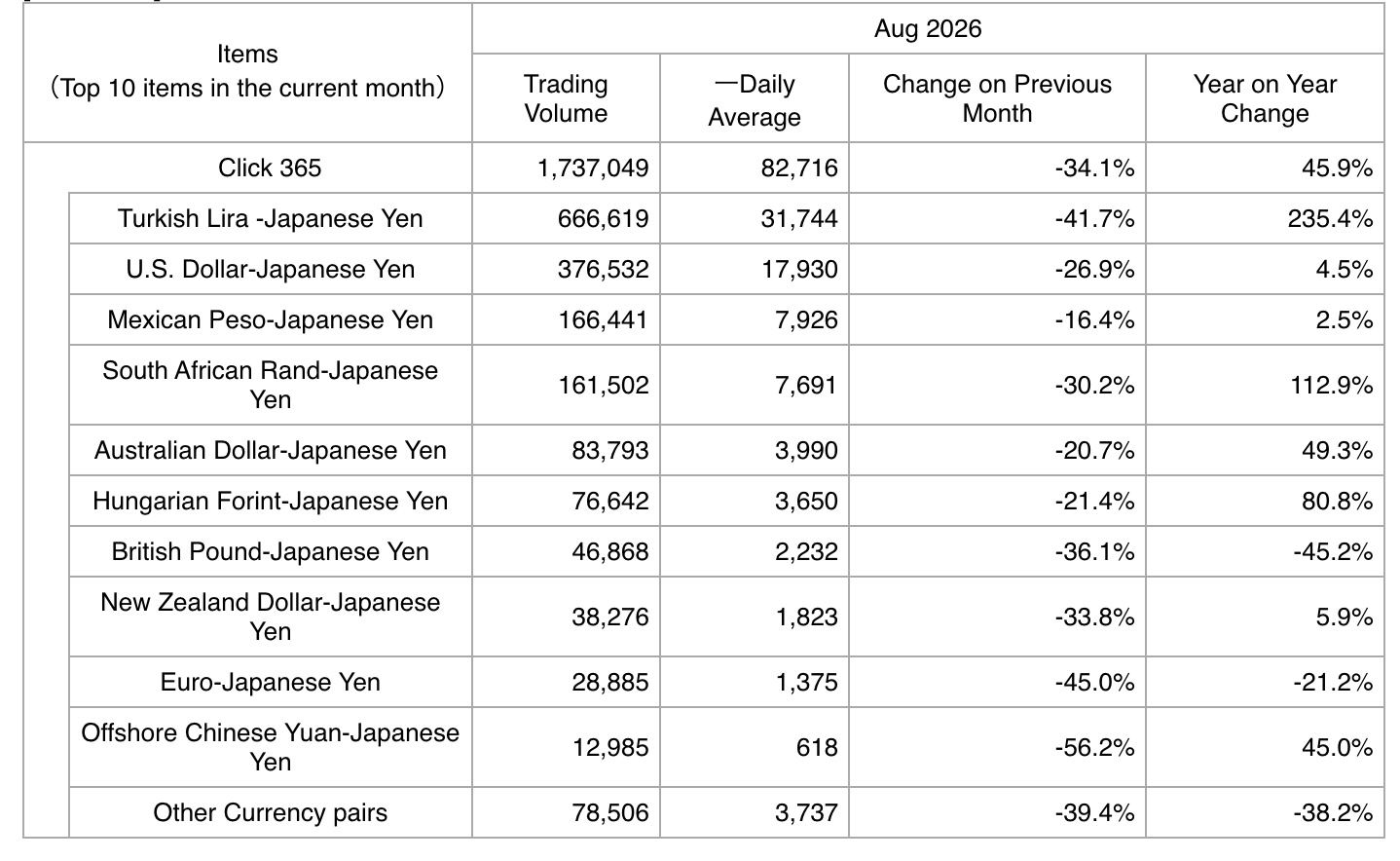
The total trading volume of FX Daily Futures contracts (Click 365) in August

Wide Rate Gaps Put Carry Trade in Focus

In each monthly table from April to August, TRY/JPY, MXN/JPY, ZAR/JPY and HUF/JPY all ranked above EUR/JPY and GBP/JPY by contract count.

The same conclusion doesn't apply uniformly to trading value: in August, for example, the lira pair’s much larger contract count still represented only a fraction of USD/JPY’s monetary value.

Wide interest-rate differentials offer one possible explanation for the high-yield currencies’ position. Turkey’s central bank kept its one-week repo rate at 37% in July, while the Bank of Japan maintained its overnight rate guideline at around 1%.

A carry trade seeks to capture such a rate differential while retaining exposure to exchange-rate movements.

TFX does not provide strategy-level data, so the figures cannot establish that carry trades caused the increase. The pattern is consistent with carry demand, although adverse currency moves can offset swap income and the lira pair’s sharp monthly swings underline that exposure.

TRY/JPY’s five-month run at the top of the contract rankings therefore matters more than any single monthly reading.

USD/JPY’s far larger trading value sets the boundary: high-yield crosses occupy a prominent place in Click 365 activity without displacing the dollar as its largest monetary exposure.

Trading in Turkish lira against the yen reached 666,619 contracts on Tokyo Financial Exchange’s Click 365 in August, up 235.4% from a year earlier.

TRY/JPY ranked first by contract count for a fifth consecutive month, while the Mexican peso, South African rand and Hungarian forint also remained ahead of the euro and pound on the same measure.

The ranking does not make TRY/JPY the platform’s largest market by monetary exposure as its August trading value was about ¥22.1 billion, compared with ¥601.5 billion for USD/JPY, which remained dominant by trading value.

TRY/JPY Holds Top Spot despite Volatile Monthly Activity

The lira’s lead has persisted, though activity has not risen in a straight line. Monthly volume moved from 612,981 contracts in April to 498,911 in May, 701,623 in June and more than 1.14 million in July, before falling 41.7% month on month in August.

It nevertheless remained first by contract count throughout the period. Total Click 365 FX Daily Futures volume reached 1.737 million contracts in August, 45.9% higher year on year but 34.1% below July.

USD/JPY recorded 376,532 contracts, while MXN/JPY and ZAR/JPY generated 166,441 and 161,502, respectively. ZAR/JPY volume more than doubled from a year earlier.

Contract specifications explain why these rankings require care. One Click 365 contract represents 10,000 Turkish lira or US dollars, but 100,000 Mexican pesos, South African rand or Hungarian forints.

Currency prices also vary substantially, preventing contract counts from serving as a common measure of notional exposure.

The total trading volume of FX Daily Futures contracts (Click 365) in August

Wide Rate Gaps Put Carry Trade in Focus

In each monthly table from April to August, TRY/JPY, MXN/JPY, ZAR/JPY and HUF/JPY all ranked above EUR/JPY and GBP/JPY by contract count.

The same conclusion doesn't apply uniformly to trading value: in August, for example, the lira pair’s much larger contract count still represented only a fraction of USD/JPY’s monetary value.

Wide interest-rate differentials offer one possible explanation for the high-yield currencies’ position. Turkey’s central bank kept its one-week repo rate at 37% in July, while the Bank of Japan maintained its overnight rate guideline at around 1%.

A carry trade seeks to capture such a rate differential while retaining exposure to exchange-rate movements.

TFX does not provide strategy-level data, so the figures cannot establish that carry trades caused the increase. The pattern is consistent with carry demand, although adverse currency moves can offset swap income and the lira pair’s sharp monthly swings underline that exposure.

TRY/JPY’s five-month run at the top of the contract rankings therefore matters more than any single monthly reading.

USD/JPY’s far larger trading value sets the boundary: high-yield crosses occupy a prominent place in Click 365 activity without displacing the dollar as its largest monetary exposure.

About the Author: Tanya Chepkova
Tanya Chepkova
  • 422 Articles
  • 3 Followers
About the Author: Tanya Chepkova
Tanya Chepkova is a News Editor at Finance Magnates with more than 16 years of experience in financial journalism, covering forex, crypto, and digital asset markets. Her work spans daily industry reporting and data-driven, long-form explainers focused on market structure, trading models, and regulatory shifts. Before joining Finance Magnates, she led the editorial team of a cryptocurrency-focused media outlet for six years. Her reporting combines analytical depth with clear storytelling, with particular attention to how structural changes in trading, stablecoin infrastructure, and emerging products such as prediction markets reshape the broader financial ecosystem. She covers global developments and provides additional insight into CIS markets. Areas of Coverage: Crypto and digital asset markets Prediction markets Stablecoins and cross-border payments Industry analysis and long-form explainers
  • 422 Articles
  • 3 Followers

More from the Author

Retail FX

!"#$%&'()*+,-./0123456789:;<=>?@ABCDEFGHIJKLMNOPQRSTUVWXYZ[\]^_`abcdefghijklmnopqrstuvwxyz{|} !"#$%&'()*+,-./0123456789:;<=>?@ABCDEFGHIJKLMNOPQRSTUVWXYZ[\]^_`abcdefghijklmnopqrstuvwxyz{|}