

Up to 100 prop trading firms did not survive 2024. That shake-out continued into a trend in 2025. Out of 376 prop firms in my personal database, too, 84 firms were no longer active, and another 30 show no signs of active operation. A solid third of the market seems to be gone in under two years.
Singapore Summit: Meet the largest APAC brokers you know (and those you still don't!)
The industry has moved past the gold rush phase. What remains is a more mature market where growth requires a 360-degree approach. We now need to factor in way more groundwork than it was several years ago, when we could simply choose advertising platforms or markets based on cheap CPA.
What are those factors, and how do you build a geo strategy that keeps you out of that list of 84 firms? Below is my attempt to break that down: a market-by-market analysis, a portfolio framework, the risks worth planning for, and the KPIs a leadership team should be tracking to know whether the strategy is working.
Read more: 80–100 Prop Firms Shut Down in 2024's Industry Reshuffle
The Economics of Geo Expansion in 2026
The biggest mistake when choosing markets is focusing only on cost-per-acquisition. A low CPA means nothing if the payback period is six months and your cash flow cannot support it, or if compliance issues prevent you from advertising consistently.
The right questions for 2026 are:
What starting budget is needed to gather statistically meaningful data?
What ROAS can we realistically sustain at scale?
What payment infrastructure do we need to avoid checkout abandonment?
What compliance preparation is required before we can advertise?
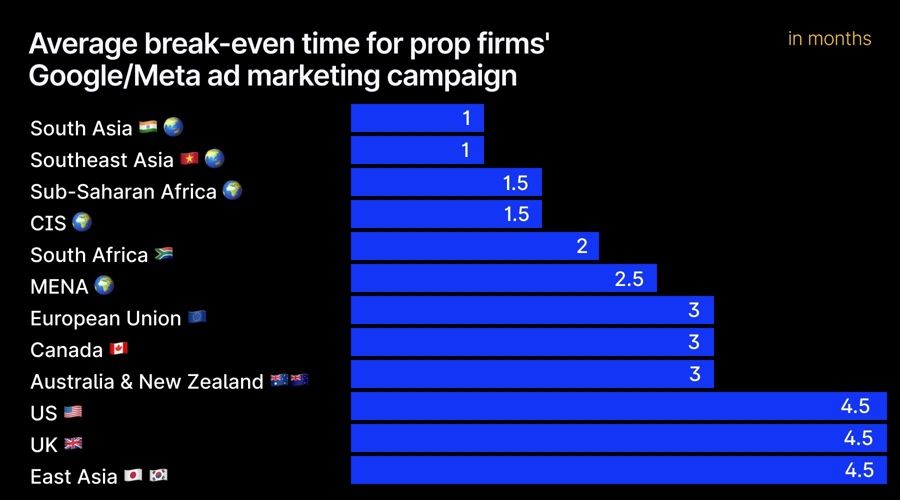
Here is how the economics look across major regions, based on geo benchmarks for paid advertising:
Region | Min. Starting Budget | Break-even | ROAS Range | Key Consideration |
Tier-1 English (US) | $10k - $15k+ | 3-6 months | Up to 3x (for stronger brands, up to 4x) | Expensive and competitive, but good LTV and long payback |
Tier-1 English (Canada) | $4k - $6k | 2-4 months | Peak ~4x | Pragmatic bridge between scale and payback |
Core Europe (DE/FR/ES/IT) | $10k - $15k | 2-4 months | 2–3x typical, ~4x peak | High competition, strong compliance requirements |
UK | $8k - $10k | 3-6 months | Peak >4x | High competition, promotion constraints |
AU/NZ | $4k - $6k | 2-4 months | Peak >3x | Similar to Core Europe in behavior, different policy dynamics |
Spanish LATAM | $1k - $2k per country | 1-2 months | Peak >3x | Peak CPA can reach $30–$40 (paid) |
Brazil | $2k - $5k | 1-2 months | Up to 5x typical, up to 10x peak | Strong ROAS upside, requires localization and local payments |
South Asia (IN/PK/BD) | $4k - $6k | ~1 month | 2-4x typical, up to 12x peak | Very fast payback, has legal and payment nuances |
SEA emerging (ID/VN/PH) | $4k - $6k | ~1 month | Up to 3x | Localization + community works |
East Asia developed (JP/KR/SG) | $6k - $8k | 3-6 months | Up to 5x | Long learning curve, trust-building required, higher entry cost |
MENA (MA/EG) | $4k - $6k | 1-3 months | Up to 5x | Requires strong compliance and payment coverage |
GCC | $6k - $8k | ~3 months | Up to 5x | Closer to slower markets |
Sub-Saharan (NG/KE/GH/ZA) | $3k - $5k | 1-2 months | Up to 2x | High lead volume, requires trust and payment strategy |
What pattern do we see here? Markets with fast payback (South Asia, emerging SEA, LATAM, Sub-Saharan Africa) provide cash flow and quick learning cycles, while premium markets (US, UK, Core Europe, developed East Asia) offer stronger LTV and brand positioning at the cost of longer payback periods and higher starting budgets.
- Andreas Pilavakis Leaves FunderPro for COO Role at GOAT Funded Futures
- Spotware Systems Expands cTrader Into LATAM Prop Trading via TFunded Deal
- TTT Markets Declares 200 Demo Sign-Ups in a Day: So Why Aren't More Prop Firms Doing This?
Building a Geo Portfolio
The most effective approach for 2026 is to think like a portfolio manager rather than picking a single market. A balanced portfolio includes:
2-3 fast payback markets that generate cash flow and allow rapid testing
1-2 brand anchor markets that build credibility and access higher LTV traders
1 experimental market that provides optionality for future growth
When comparing markets, use a weighted scorecard (I'm adding mine below). A market can look attractive on CPA alone, but score poorly on compliance or trust cost. The scorecard forces a more complete picture before scaling.
Applying this framework, here is how I would prioritise markets for 2026:
Priority | Region | Why Now | Must-Have Before Scaling | Common Mistake |
1 | India / Pakistan / Bangladesh | Fastest payback, peak ROAS up to 12x | Ad policy compliance, localisation, KYC/anti-fraud, payment infrastructure | Grey-area messaging that triggers ad bans |
1 | Indonesia / Vietnam / Philippines | Under one month to positive ROAS, strong communities | Local language creatives, local payments, community partnerships | Launching with English-only creatives, which leads to budget burn |
1 | Mexico + Spanish LATAM | 1-2 months to positive ROAS, known paid CPA purchase $30–$40 (peak) | Spanish localisation, local support, education-first positioning | Underestimating the importance of trust: CR drops without content and social proof |
1 | Brazil | 1-2 months break-even, peak ROAS up to 10x | Portuguese localisation, instant payment methods (PIX) | Using translated creatives instead of native-tone content |
2 | Nigeria / Kenya / Ghana / South Africa | Cheap lead volume, 1-2 months to break-even | Anti-fraud systems, payout reliability, and local support | Chasing cheap leads without quality controls, which leads to churn and negative feedback |
2 | Morocco / Egypt | 1-3 months to break-even, existing broker culture | Payment coverage, policy readiness | Payment failures and chargeback issues |
3 | United States / Canada | Large market, credibility marker for global audience | Higher compliance and tech standards, longer budget runway | Expecting fast payback leads to disappointment and chaotic offer changes |
3 | UK / Germany / France / Spain / Italy | Strategic markets, but expensive + for long-term positioning | Legal review of promotions, verification readiness, proper risk disclaimers | “Get rich quick” messaging that leads to bans and reputational damage |
4 | Japan / South Korea / Singapore | Strong ROAS potential, premium trader base | Established brand, local partnerships, strict policy operations | Treating these markets like emerging SEA |
What Markets to Treat with Caution
Some markets and their conditions are either expensive or risky for ROI. This does not mean avoiding them entirely, but they require extra preparation to turn into managed risk. I'd divide them into four categories:
Highly regulated markets with active enforcement carry a higher chance of policy rejections, verifications, bans, and slower creative cycles. To manage this risk, consider building policy ops, a legal playbook, and white-hat communication before entering.
Markets where the product looks like gambling present a tricky balance. Gamification can increase engagement, but it can also raise the risk of bans and complaints. To manage this risk, consider establishing clear rules, risk disclosures, and responsible communication upfront.
Markets with high platform dependence (one provider for platform, data, or payments) mean that one breach or rule change can stop revenue entirely. To manage this risk, consider a multi-vendor strategy and a business continuity plan (BCP).
Markets where cheap leads dominate over quality can look great on CPA, but payback often does not work out due to churn and fraud. To manage this risk, consider focusing on quality metrics like activation, second purchase, and payout-healthy cohorts.
Trust Infrastructure as Part of Growth Engine
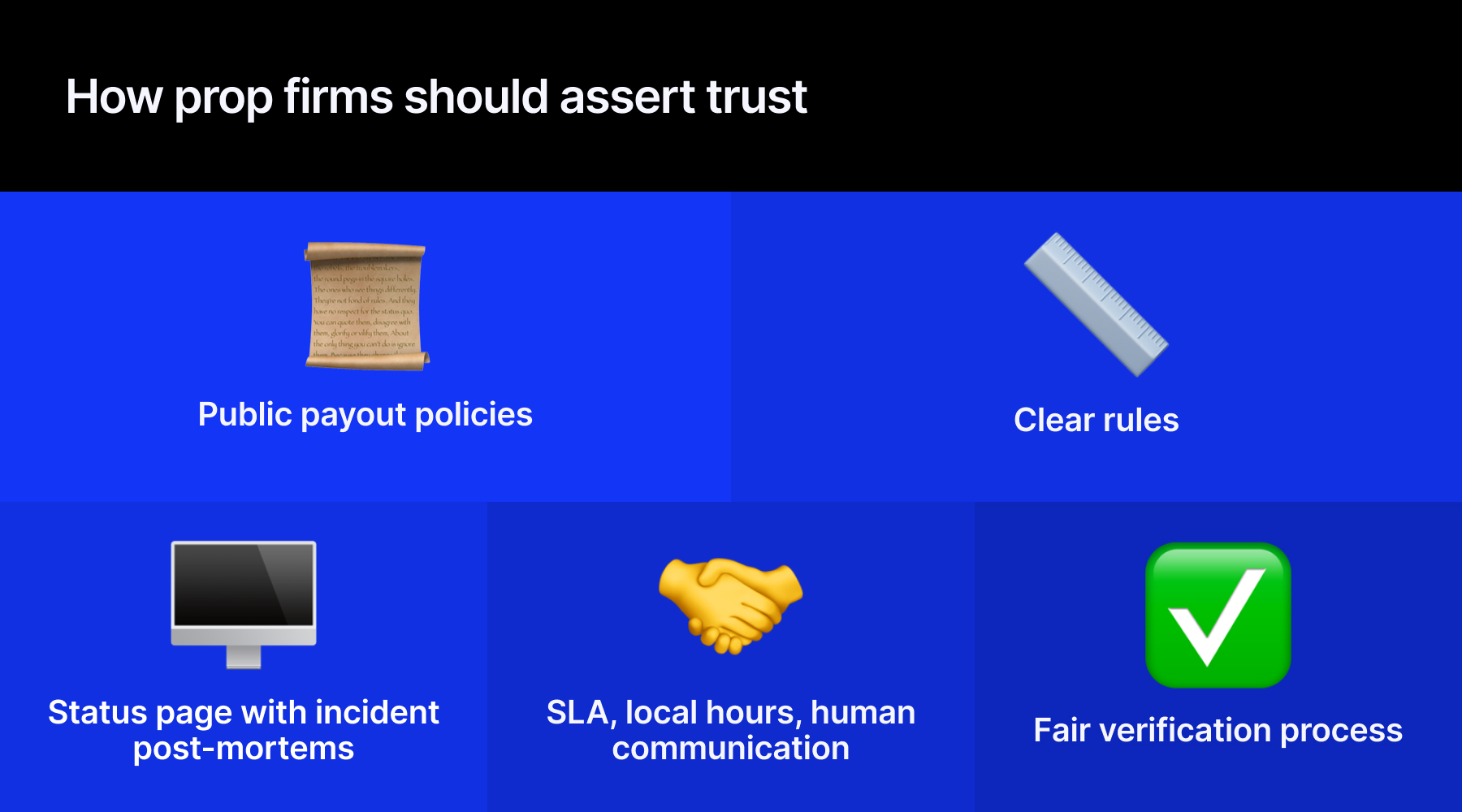
When traders see complaints about rule changes, delayed payouts, or account issues, their skepticism rises. This shows up in lower conversion rates, higher CPAs, and reduced repeat purchases. The FundingTicks wind-down in January 2026, following rule changes and Trustpilot rating declines, illustrates how quickly trust erosion can spiral.
Here is what trust infrastructure looks like in practice and how it affects paid performance.
Element | What It Means | Impact on Paid Performance |
Transparent payout logic | Public payout policy with verified examples | Removes the "is this a scam?" barrier → improves conversion |
No retroactive rule changes | Clear rules with changelog and transition periods | Less backlash → less negativity → cheaper brand traffic |
Platform stability | Status page with incident postmortems | Technical issues in prop trading mean direct trader losses and reputational damage |
Local support | SLA, local hours, human communication | Trust scales through a good service, not through banners |
Anti-fraud that protects honest traders | Fair verification with fast payouts for clean cohorts | Enables more aggressive scaling without risk model blow-ups |
What Can Go Wrong (and How to Prepare)
A 2026 growth strategy should account for several risk categories. Industry analysis captures a key idea: many props are "e-commerce brained," dependent on paid ads, running small teams, and if regulatory pressure arrives like it did for brokers, the model becomes less profitable.
Here is a minimum risk register for your growth strategy:
Ad platform policy changes can disrupt scaling at any time. Google requires financial services verification for advertising in many countries, with separate verification needed for each target location. Meta has introduced stricter rules for financial advertisers in markets like Australia. Prepare with policy ops and a multi-channel portfolio.
Regulatory pressure on promotions means enforcement against illegal promos and influencers. Prepare with legal review, partner/affiliate controls, and white-hat messaging.
Platform/vendor risk means a vendor changes terms or cuts off access. Prepare with a multi-vendor strategy, contractual safeguards, and a business continuity plan.
Risk model blow-ups happen when 0.5–1% of traders break your P&L. Prepare by investing in risk analytics as a product.
Reputation cascades occur when social media negativity tanks your CR. Prepare with trust infrastructure, fast response, and transparency.
Scam context on social platforms leads to stricter requirements for financial ads overall. Prepare by being the most verified brand in your category.
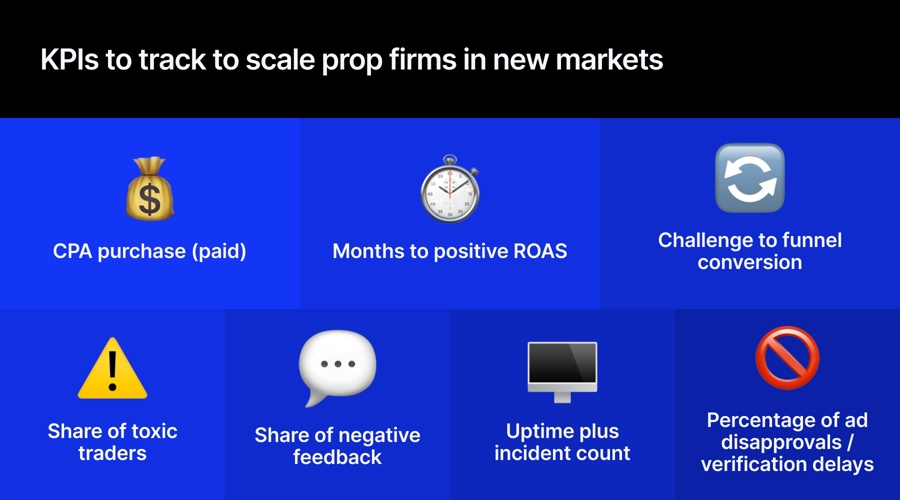
The reset over the past two years shows this is no longer a volume game but an execution one. The firms that survived are those that treat expansion as a full system, not just a paid acquisition play: balancing fast-payback and premium markets, planning for realistic ROAS timelines, and building compliance, payments, and trust into the core of the model from day one. In 2026, growth comes from managing trade-offs, not chasing cheap CPA, and the firms that last will be those that can align acquisition, product, and reputation into one consistent engine rather than relying on any single lever.


