According to a new report by Vermiculus and GreySpark Partners, European firms trading in U.S. markets now face a shorter window to allocate and affirm trades.
Asian firms, especially in Japan, face even greater challenges due to a lack of business hour overlap with U.S. markets.
When the US and Canadian markets slashed their settlement
window to just one day, the change promised faster trade finality and reduced
counterparty risk.
But for financial firms across Europe and Asia, it has
triggered a logistical scramble, compressing timelines, inflating costs, and
straining cross-border trade operations like never before.
T+1: A Reform Born in Crisis
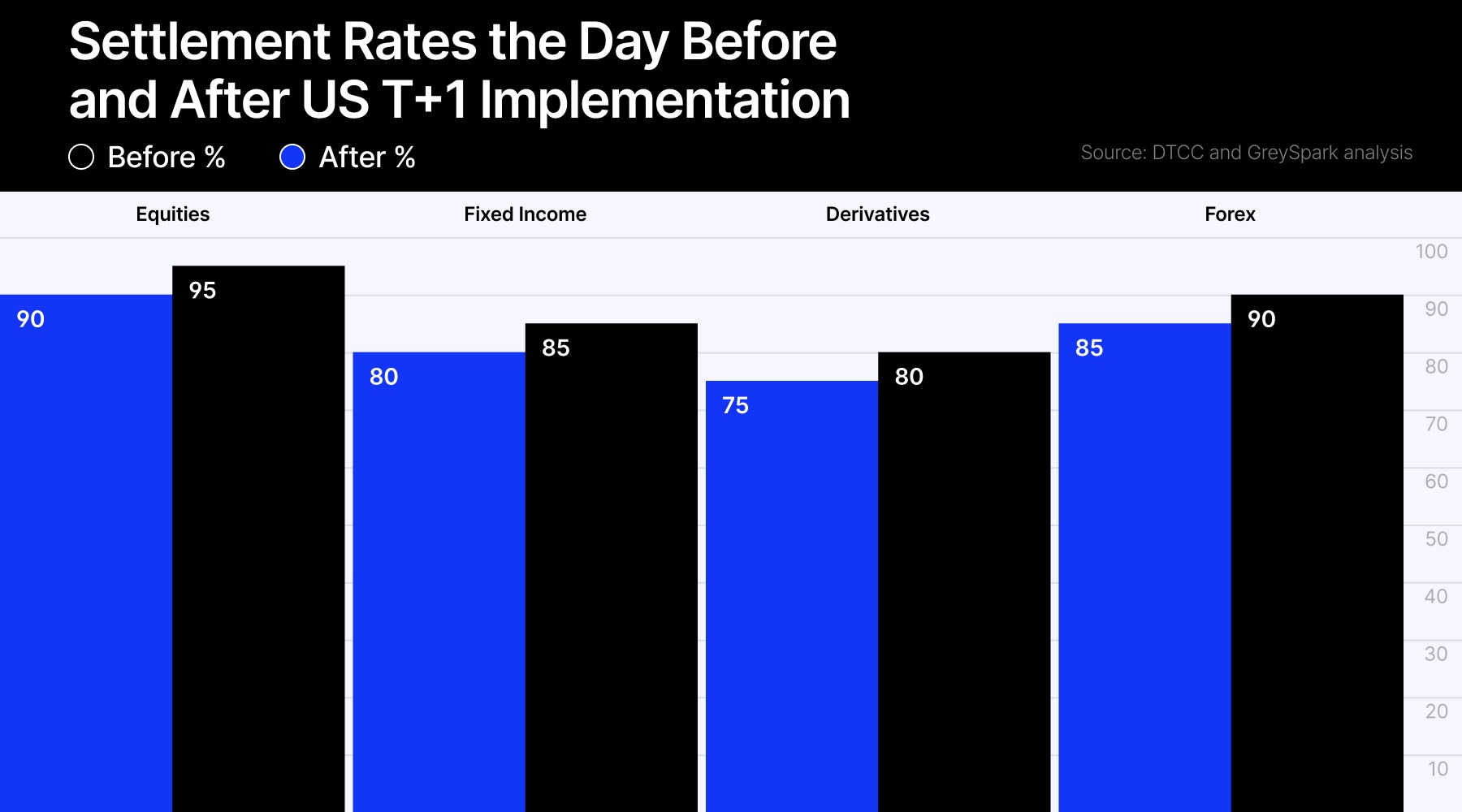
This is according to research by Vermiculus and GreySpark Partners, which pointed out that the transition set off a chain
reaction for global firms with exposure to American markets.
The idea of moving to T+1 settlement started in 2020
and 2021. Market volatility during the COVID-19 pandemic and the meme stock
mania exposed the fragility of a two-day settlement system. U.S. regulators
pushed for a faster cycle to limit risk.
Source: Vermiculus and GreySpark Partners
While North America, Argentina, and India now operate
on a T+1 basis, most of the world—including the EU, UK, Singapore, and Hong
Kong—still adheres to a T+2 cycle. This divergence means that firms operating
across borders must now reconcile vastly different trade deadlines.
Allocating and affirming trades by 21:00 ET on the trade
date is now mandatory. That creates a serious overlap problem for firms in
Europe and Asia, where business hours end before U.S. markets close. European firms now have just three working hours to
process trades, compared to ten under the previous regime.
Europe’s Compressed Clock
For UK and EU firms trading in U.S. markets, the time
available to finalize trades has been cut nearly in half. This shift forces
firms to either stretch working hours into the night or reconfigure operations
to include global teams. Smaller firms without international coverage face
higher risks of settlement failure, and heavier costs to avoid it.
In Asia, time zones prove even more unforgiving.
Japanese firms, for instance, must now process U.S. trades after local business
hours. The working-hour overlap is nonexistent. Without night shifts or
relocated operations, these firms risk missing settlement deadlines altogether.
The FX dimension adds to the stress. Many APAC
institutions are being forced to pre-fund trades or outsource foreign exchange
processes due to tight timeframes and unfavorable conversion rates.
Nasdaq and the Intercontinental Exchange are betting
on even longer trading hours. Nasdaq plans to roll out a 24/5 schedule by late
2026, targeting global investors used to the always-on crypto markets.
Toward Real-Time Trading?
Digital asset markets offer real-time settlement and
24/7 trading—features that traditional markets are slowly inching toward. The
U.S. T+1 rule may be a step in that direction.
The EU and UK plan to shift to T+1 by October 2027.
However, their fragmented market structures mean their transition may prove even more complex. In the meantime, global firms must consider whether to build costly night operations or embrace automation to survive the faster pace set by North America.
When the US and Canadian markets slashed their settlement
window to just one day, the change promised faster trade finality and reduced
counterparty risk.
But for financial firms across Europe and Asia, it has
triggered a logistical scramble, compressing timelines, inflating costs, and
straining cross-border trade operations like never before.
T+1: A Reform Born in Crisis
This is according to research by Vermiculus and GreySpark Partners, which pointed out that the transition set off a chain
reaction for global firms with exposure to American markets.
The idea of moving to T+1 settlement started in 2020
and 2021. Market volatility during the COVID-19 pandemic and the meme stock
mania exposed the fragility of a two-day settlement system. U.S. regulators
pushed for a faster cycle to limit risk.
Source: Vermiculus and GreySpark Partners
While North America, Argentina, and India now operate
on a T+1 basis, most of the world—including the EU, UK, Singapore, and Hong
Kong—still adheres to a T+2 cycle. This divergence means that firms operating
across borders must now reconcile vastly different trade deadlines.
Allocating and affirming trades by 21:00 ET on the trade
date is now mandatory. That creates a serious overlap problem for firms in
Europe and Asia, where business hours end before U.S. markets close. European firms now have just three working hours to
process trades, compared to ten under the previous regime.
Europe’s Compressed Clock
For UK and EU firms trading in U.S. markets, the time
available to finalize trades has been cut nearly in half. This shift forces
firms to either stretch working hours into the night or reconfigure operations
to include global teams. Smaller firms without international coverage face
higher risks of settlement failure, and heavier costs to avoid it.
In Asia, time zones prove even more unforgiving.
Japanese firms, for instance, must now process U.S. trades after local business
hours. The working-hour overlap is nonexistent. Without night shifts or
relocated operations, these firms risk missing settlement deadlines altogether.
The FX dimension adds to the stress. Many APAC
institutions are being forced to pre-fund trades or outsource foreign exchange
processes due to tight timeframes and unfavorable conversion rates.
Nasdaq and the Intercontinental Exchange are betting
on even longer trading hours. Nasdaq plans to roll out a 24/5 schedule by late
2026, targeting global investors used to the always-on crypto markets.
Toward Real-Time Trading?
Digital asset markets offer real-time settlement and
24/7 trading—features that traditional markets are slowly inching toward. The
U.S. T+1 rule may be a step in that direction.
The EU and UK plan to shift to T+1 by October 2027.
However, their fragmented market structures mean their transition may prove even more complex. In the meantime, global firms must consider whether to build costly night operations or embrace automation to survive the faster pace set by North America.
Jared Kirui is an Editor at Finance Magnates with more than five years of experience in financial journalism. He covers online trading, fintech, payments, and crypto industries with a focus on companies, regulation and compliance, executive moves, trading technology, and market analysis.
His work has been featured in other media outlets, including Benzinga, ZyCrypto, The Distributed, and The Daily Hodl.
Education:
Bachelor of Commerce degree (Finance option), University of Nairobi
Prop Firm E8 Markets Warns Retail Traders Off CFD Brokers as Industry Leans Harder on "Educational" Labels
Finance Magnates Daily Brief: 21 April 2026
Finance Magnates Daily Brief: 21 April 2026
It's Tuesday, the twenty-first of April, twenty twenty-six. You're listening to the Finance Magnates Daily Brief. Today's lead: the Bank for International Settlements has put dollar stablecoins on the regulatory hot seat. Also ahead: first quarter earnings from Capital.com and Plus500, Revolut pushes its IPO to twenty twenty-eight, and a look at where Singapore hedge funds are really moving.
It's Tuesday, the twenty-first of April, twenty twenty-six. You're listening to the Finance Magnates Daily Brief. Today's lead: the Bank for International Settlements has put dollar stablecoins on the regulatory hot seat. Also ahead: first quarter earnings from Capital.com and Plus500, Revolut pushes its IPO to twenty twenty-eight, and a look at where Singapore hedge funds are really moving.
In this video, we review @FundedNext a proprietary trading firm offering evaluation challenges for CFD and futures traders using simulated accounts.
We cover how the model works, including challenge types, profit targets, loss limits, and performance-based rewards. You’ll also learn about payout structures, supported platforms, and key features such as the firm’s 24-hour payout policy and flexible challenge formats.
Watch the full video to see if FundedNext fits your trading approach.
#FundedNext #PropFirm #PropTrading #FinanceMagnates #Trading #CFDTrading #FuturesTrading #TradingReview
In this video, we review @FundedNext a proprietary trading firm offering evaluation challenges for CFD and futures traders using simulated accounts.
We cover how the model works, including challenge types, profit targets, loss limits, and performance-based rewards. You’ll also learn about payout structures, supported platforms, and key features such as the firm’s 24-hour payout policy and flexible challenge formats.
Watch the full video to see if FundedNext fits your trading approach.
#FundedNext #PropFirm #PropTrading #FinanceMagnates #Trading #CFDTrading #FuturesTrading #TradingReview
TradingPro Winner Spotlight 🏆 | Global Best Overall Broker 2025
TradingPro Winner Spotlight 🏆 | Global Best Overall Broker 2025
TradingPro takes the spotlight as Global Best Overall Broker 2025 at the Finance Magnates Awards.
Yusna Yusman, Head of Global Marketing, describes the night as inspiring, elegant, and full of energy.
She also shares a message of appreciation to the clients and community whose support made this achievement possible.
👉 Be part of FM Awards 2026.
#FinanceMagnatesAwards #TradingPro #Trading #Fintech #Broker #WinnerSpotlight #Shorts
TradingPro takes the spotlight as Global Best Overall Broker 2025 at the Finance Magnates Awards.
Yusna Yusman, Head of Global Marketing, describes the night as inspiring, elegant, and full of energy.
She also shares a message of appreciation to the clients and community whose support made this achievement possible.
👉 Be part of FM Awards 2026.
#FinanceMagnatesAwards #TradingPro #Trading #Fintech #Broker #WinnerSpotlight #Shorts
In this video, we review @deriv an online broker offering CFDs and options across a wide range of markets, including forex, stocks, indices, commodities, cryptocurrencies, and derived indices.
We cover the broker’s overall offering, including its multi-jurisdiction regulatory structure, platform ecosystem, and range of account types. We also explore key features such as product availability, funding options, and trading conditions.
Watch the full video to see if Deriv fits your trading needs.
#Deriv #ForexBroker #CFDTrading #FinanceMagnates #Trading #BrokerReview #OnlineTrading
In this video, we review @deriv an online broker offering CFDs and options across a wide range of markets, including forex, stocks, indices, commodities, cryptocurrencies, and derived indices.
We cover the broker’s overall offering, including its multi-jurisdiction regulatory structure, platform ecosystem, and range of account types. We also explore key features such as product availability, funding options, and trading conditions.
Watch the full video to see if Deriv fits your trading needs.
#Deriv #ForexBroker #CFDTrading #FinanceMagnates #Trading #BrokerReview #OnlineTrading
Opening-Up eWallets’ Future: The Enduring Value of eWallets in the Trading Space ︳FM Talks x Paysafe
Opening-Up eWallets’ Future: The Enduring Value of eWallets in the Trading Space ︳FM Talks x Paysafe
eWallets aren’t just moving money anymore, they’re running the show.
In this episode of FM Talks, Adonis Adoni (News Editor at Finance Magnates) sits down with Paysafe 's:
•Bob Legters, Chief Product Officer
•Jeannie Lam, VP of Sales & Account Management for Forex & Financial Trading
to break down how wallets evolved from simple payment tools into core trading infrastructure.
💥 Inside the conversation:
•Why wallets now drive growth, retention, and global scale for brokers
•The hidden power behind deposit success, fraud prevention, and UX
•Stablecoins: hype, reality, and where they actually fit today
•AI in wallets: smarter flows vs rising fraud risks
•The rise of white-label wallets and full ecosystem control
•What the future looks like when wallets become your financial brain
🔗 Learn more about @PaysafeGroup : https://www.paysafe.com/en/optimize-forex-payments-for-growth-in-2026/fm/?utm_source=fm&utm_medium=podcast&utm_campaign=2026-q1-fx-demand-gen&utm_content=podcast
From fiat to crypto, payments to trading, everything is converging and wallets are right at the center of it.
#Fintech #eWallets #Trading #DigitalPayments #Stablecoins #Crypto #AIinFintech #FutureOfFinance #Paysafe #FMtalks
eWallets aren’t just moving money anymore, they’re running the show.
In this episode of FM Talks, Adonis Adoni (News Editor at Finance Magnates) sits down with Paysafe 's:
•Bob Legters, Chief Product Officer
•Jeannie Lam, VP of Sales & Account Management for Forex & Financial Trading
to break down how wallets evolved from simple payment tools into core trading infrastructure.
💥 Inside the conversation:
•Why wallets now drive growth, retention, and global scale for brokers
•The hidden power behind deposit success, fraud prevention, and UX
•Stablecoins: hype, reality, and where they actually fit today
•AI in wallets: smarter flows vs rising fraud risks
•The rise of white-label wallets and full ecosystem control
•What the future looks like when wallets become your financial brain
🔗 Learn more about @PaysafeGroup : https://www.paysafe.com/en/optimize-forex-payments-for-growth-in-2026/fm/?utm_source=fm&utm_medium=podcast&utm_campaign=2026-q1-fx-demand-gen&utm_content=podcast
From fiat to crypto, payments to trading, everything is converging and wallets are right at the center of it.
#Fintech #eWallets #Trading #DigitalPayments #Stablecoins #Crypto #AIinFintech #FutureOfFinance #Paysafe #FMtalks