According to a new report by Vermiculus and GreySpark Partners, European firms trading in U.S. markets now face a shorter window to allocate and affirm trades.
Asian firms, especially in Japan, face even greater challenges due to a lack of business hour overlap with U.S. markets.
When the US and Canadian markets slashed their settlement
window to just one day, the change promised faster trade finality and reduced
counterparty risk.
But for financial firms across Europe and Asia, it has
triggered a logistical scramble, compressing timelines, inflating costs, and
straining cross-border trade operations like never before.
T+1: A Reform Born in Crisis
This is according to research by Vermiculus and GreySpark Partners, which pointed out that the transition set off a chain
reaction for global firms with exposure to American markets.
The idea of moving to T+1 settlement started in 2020
and 2021. Market volatility during the COVID-19 pandemic and the meme stock
mania exposed the fragility of a two-day settlement system. U.S. regulators
pushed for a faster cycle to limit risk.
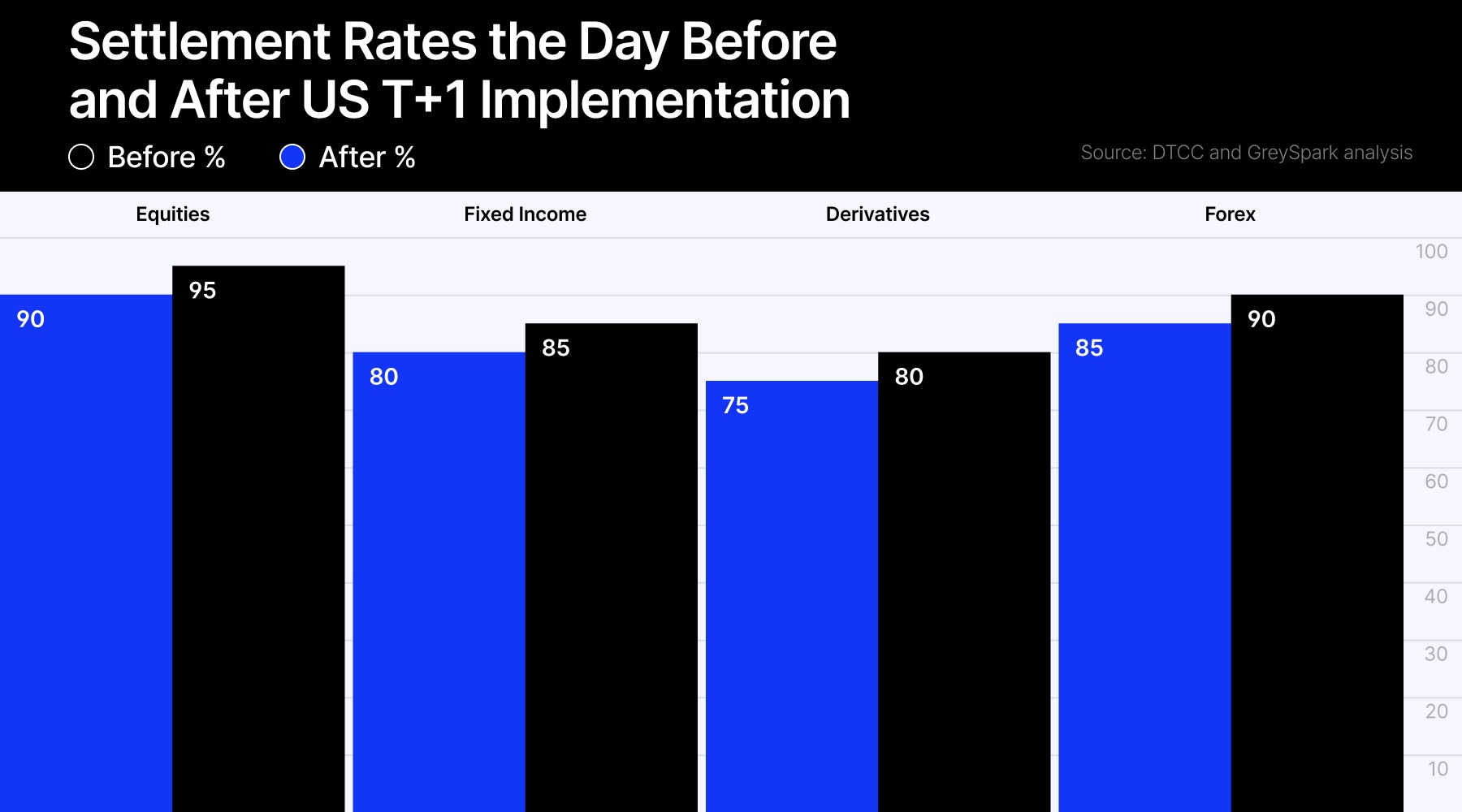
Source: Vermiculus and GreySpark Partners
While North America, Argentina, and India now operate
on a T+1 basis, most of the world—including the EU, UK, Singapore, and Hong
Kong—still adheres to a T+2 cycle. This divergence means that firms operating
across borders must now reconcile vastly different trade deadlines.
Allocating and affirming trades by 21:00 ET on the trade
date is now mandatory. That creates a serious overlap problem for firms in
Europe and Asia, where business hours end before U.S. markets close. European firms now have just three working hours to
process trades, compared to ten under the previous regime.
Europe’s Compressed Clock
For UK and EU firms trading in U.S. markets, the time
available to finalize trades has been cut nearly in half. This shift forces
firms to either stretch working hours into the night or reconfigure operations
to include global teams. Smaller firms without international coverage face
higher risks of settlement failure, and heavier costs to avoid it.
In Asia, time zones prove even more unforgiving.
Japanese firms, for instance, must now process U.S. trades after local business
hours. The working-hour overlap is nonexistent. Without night shifts or
relocated operations, these firms risk missing settlement deadlines altogether.
The FX dimension adds to the stress. Many APAC
institutions are being forced to pre-fund trades or outsource foreign exchange
processes due to tight timeframes and unfavorable conversion rates.
Nasdaq and the Intercontinental Exchange are betting
on even longer trading hours. Nasdaq plans to roll out a 24/5 schedule by late
2026, targeting global investors used to the always-on crypto markets.
Toward Real-Time Trading?
Digital asset markets offer real-time settlement and
24/7 trading—features that traditional markets are slowly inching toward. The
U.S. T+1 rule may be a step in that direction.
The EU and UK plan to shift to T+1 by October 2027.
However, their fragmented market structures mean their transition may prove even more complex. In the meantime, global firms must consider whether to build costly night operations or embrace automation to survive the faster pace set by North America.
When the US and Canadian markets slashed their settlement
window to just one day, the change promised faster trade finality and reduced
counterparty risk.
But for financial firms across Europe and Asia, it has
triggered a logistical scramble, compressing timelines, inflating costs, and
straining cross-border trade operations like never before.
T+1: A Reform Born in Crisis
This is according to research by Vermiculus and GreySpark Partners, which pointed out that the transition set off a chain
reaction for global firms with exposure to American markets.
The idea of moving to T+1 settlement started in 2020
and 2021. Market volatility during the COVID-19 pandemic and the meme stock
mania exposed the fragility of a two-day settlement system. U.S. regulators
pushed for a faster cycle to limit risk.
Source: Vermiculus and GreySpark Partners
While North America, Argentina, and India now operate
on a T+1 basis, most of the world—including the EU, UK, Singapore, and Hong
Kong—still adheres to a T+2 cycle. This divergence means that firms operating
across borders must now reconcile vastly different trade deadlines.
Allocating and affirming trades by 21:00 ET on the trade
date is now mandatory. That creates a serious overlap problem for firms in
Europe and Asia, where business hours end before U.S. markets close. European firms now have just three working hours to
process trades, compared to ten under the previous regime.
Europe’s Compressed Clock
For UK and EU firms trading in U.S. markets, the time
available to finalize trades has been cut nearly in half. This shift forces
firms to either stretch working hours into the night or reconfigure operations
to include global teams. Smaller firms without international coverage face
higher risks of settlement failure, and heavier costs to avoid it.
In Asia, time zones prove even more unforgiving.
Japanese firms, for instance, must now process U.S. trades after local business
hours. The working-hour overlap is nonexistent. Without night shifts or
relocated operations, these firms risk missing settlement deadlines altogether.
The FX dimension adds to the stress. Many APAC
institutions are being forced to pre-fund trades or outsource foreign exchange
processes due to tight timeframes and unfavorable conversion rates.
Nasdaq and the Intercontinental Exchange are betting
on even longer trading hours. Nasdaq plans to roll out a 24/5 schedule by late
2026, targeting global investors used to the always-on crypto markets.
Toward Real-Time Trading?
Digital asset markets offer real-time settlement and
24/7 trading—features that traditional markets are slowly inching toward. The
U.S. T+1 rule may be a step in that direction.
The EU and UK plan to shift to T+1 by October 2027.
However, their fragmented market structures mean their transition may prove even more complex. In the meantime, global firms must consider whether to build costly night operations or embrace automation to survive the faster pace set by North America.
Jared Kirui is an Editor at Finance Magnates with more than five years of experience in financial journalism. He covers online trading, fintech, payments, and crypto industries with a focus on companies, regulation and compliance, executive moves, trading technology, and market analysis.
His work has been featured in other media outlets, including Benzinga, ZyCrypto, The Distributed, and The Daily Hodl.
Education:
Bachelor of Commerce degree (Finance option), University of Nairobi
DXtrade Adds Automated Scalper Detection and A/B-Booking Tool via Gold-i Deal
CMC Markets’ Artur Delijergijevs on Metals Demand, Volatility, & Stable Execution
CMC Markets’ Artur Delijergijevs on Metals Demand, Volatility, & Stable Execution
In this exclusive Executive Interview, Finance Magnates speaks with Artur Delijergijevs, Head of Systematic Market Making at CMC Markets, about the current state of metals demand and market volatility.
Delijergijevs offers a desk-level view on:
- Metals Demand: Why metals are seeing the strongest demand from both retail and institutional clients right now.
- The Safe-Haven Debate: Questioning whether gold still fits the classic safe-haven definition given large daily price movements.
- Volatile Market Prep: How a market-making desk prepares its systems and pricing for stressed market conditions and high-impact economic events.
- Hybrid Execution: Why the best execution model combines electronic speed with human relationship support, especially during volatility.
- AI in Workflow: Where CMC Markets is integrating machine learning for risk management and pricing, and the limitations of AI during stressed markets.
- Dubai's Role: The strategic importance of Dubai’s location for covering global trading sessions across Asia, Europe, and the US.
Watch to understand how CMC Markets maintains stable pricing and reliable execution quality in high-volatility environments.
#CMCmarkets #forex #metals #gold #trading #volatility #MarketMaking #iFXDubai #FinanceMagnates #Finance #Fintech #Execution #AlgorithmicTrading #RiskManagement
In this exclusive Executive Interview, Finance Magnates speaks with Artur Delijergijevs, Head of Systematic Market Making at CMC Markets, about the current state of metals demand and market volatility.
Delijergijevs offers a desk-level view on:
- Metals Demand: Why metals are seeing the strongest demand from both retail and institutional clients right now.
- The Safe-Haven Debate: Questioning whether gold still fits the classic safe-haven definition given large daily price movements.
- Volatile Market Prep: How a market-making desk prepares its systems and pricing for stressed market conditions and high-impact economic events.
- Hybrid Execution: Why the best execution model combines electronic speed with human relationship support, especially during volatility.
- AI in Workflow: Where CMC Markets is integrating machine learning for risk management and pricing, and the limitations of AI during stressed markets.
- Dubai's Role: The strategic importance of Dubai’s location for covering global trading sessions across Asia, Europe, and the US.
Watch to understand how CMC Markets maintains stable pricing and reliable execution quality in high-volatility environments.
#CMCmarkets #forex #metals #gold #trading #volatility #MarketMaking #iFXDubai #FinanceMagnates #Finance #Fintech #Execution #AlgorithmicTrading #RiskManagement
Finance Magnates Awards 2026 – Nominations Now Open
Finance Magnates Awards 2026 – Nominations Now Open
The Finance Magnates Awards 2026 nominations are now open. 🏆
From fintech innovators to leading brokers, this is where the finance industry celebrates its biggest achievements.
Winners will be announced at the Cyprus Gala Dinner on November 6, 2026.
Nominate your brand now.
https://awards.financemagnates.com/?utm_source=linkedin&utm_medium=video&utm_campaign=nominations-open
#FMAwards #FinanceMagnates #FintechAwards #Fintech #FinanceIndustry
The Finance Magnates Awards 2026 nominations are now open. 🏆
From fintech innovators to leading brokers, this is where the finance industry celebrates its biggest achievements.
Winners will be announced at the Cyprus Gala Dinner on November 6, 2026.
Nominate your brand now.
https://awards.financemagnates.com/?utm_source=linkedin&utm_medium=video&utm_campaign=nominations-open
#FMAwards #FinanceMagnates #FintechAwards #Fintech #FinanceIndustry
Finance Magnates Awards 2026 | Nominations Now Open 🏆#Fintech #FMAwards #TradingIndustry
Finance Magnates Awards 2026 | Nominations Now Open 🏆#Fintech #FMAwards #TradingIndustry
Lights on. Cameras ready. 🎬
Finance Magnates Awards 2026 nominations are now open. 🏆
#FMAwards #FinanceMagnates #FintechAwards #Fintech
Lights on. Cameras ready. 🎬
Finance Magnates Awards 2026 nominations are now open. 🏆
#FMAwards #FinanceMagnates #FintechAwards #Fintech
Exness sees trust as the key theme for growth in MENA Trading Growth for 2026
Exness sees trust as the key theme for growth in MENA Trading Growth for 2026
Mohammad Amer, Regional Commercial Director at Exness, sits down to discuss the booming MENA financial trading market. Find out why Dubai is key to the company's growth strategy, how a mobile-first generation is changing expectations, and why trust will be the defining theme for traders in 2026.
In this interview, you'll learn:
* Why Dubai and the MENA region are critical growth markets for fintech and online trading.
* How Exness is addressing the demands of mobile-first, younger traders through engineering, platform stability, and transparent conditions.
* The essential role local talent plays in providing a culturally relevant and compliant user experience.
* Mohammad Amer's outlook on the future of the online trading industry and why stronger controls and systems are necessary.
* Why "trust" isn't just a brand value, but has commercial value—and why he predicts 2026 will be the "Year of Trust."
Key Takeaways:
➡️ The MENA region is rapidly shaping global financial markets.
➡️ New traders expect stability, precise execution, and transparency.
➡️ Local expertise is key to regulatory compliance and user experience.
➡️ Future success belongs to firms capable of meeting rising standards across regulation and platform consistency.
Read the full article at: https://www.financemagnates.com/thought-leadership/exness-sees-trust-as-the-key-theme-for-growth-in-mena-trading-growth-for-2026/
#Exness #MENA #Trading #FinTech #Dubai #OnlineTrading #FinanceMagnates #MohammadAmer #Trust #MobileTrading
Mohammad Amer, Regional Commercial Director at Exness, sits down to discuss the booming MENA financial trading market. Find out why Dubai is key to the company's growth strategy, how a mobile-first generation is changing expectations, and why trust will be the defining theme for traders in 2026.
In this interview, you'll learn:
* Why Dubai and the MENA region are critical growth markets for fintech and online trading.
* How Exness is addressing the demands of mobile-first, younger traders through engineering, platform stability, and transparent conditions.
* The essential role local talent plays in providing a culturally relevant and compliant user experience.
* Mohammad Amer's outlook on the future of the online trading industry and why stronger controls and systems are necessary.
* Why "trust" isn't just a brand value, but has commercial value—and why he predicts 2026 will be the "Year of Trust."
Key Takeaways:
➡️ The MENA region is rapidly shaping global financial markets.
➡️ New traders expect stability, precise execution, and transparency.
➡️ Local expertise is key to regulatory compliance and user experience.
➡️ Future success belongs to firms capable of meeting rising standards across regulation and platform consistency.
Read the full article at: https://www.financemagnates.com/thought-leadership/exness-sees-trust-as-the-key-theme-for-growth-in-mena-trading-growth-for-2026/
#Exness #MENA #Trading #FinTech #Dubai #OnlineTrading #FinanceMagnates #MohammadAmer #Trust #MobileTrading
Paytiko CEO Razi Salih on Why Payment Orchestration is a MUST-HAVE for Brokers in 2026
Paytiko CEO Razi Salih on Why Payment Orchestration is a MUST-HAVE for Brokers in 2026
At iFX Expo Dubai, Finance Magnates spoke with Razi Salih, CEO at Paytiko, about the evolution of the payments ecosystem and why payment orchestration has shifted from an option to a necessity for brokers, prop firms, and exchanges.
Mr. Salih explains how global expansion, the need for deep localisation, and the sheer number of new payment methods, from instant banking to stablecoins, are driving this critical infrastructure shift.
#PaymentOrchestration #Fintech #Brokerage #TradingPayments #RaziSalih #Paytiko #iFXExpoDubai #Stablecoins #AIinFintech
At iFX Expo Dubai, Finance Magnates spoke with Razi Salih, CEO at Paytiko, about the evolution of the payments ecosystem and why payment orchestration has shifted from an option to a necessity for brokers, prop firms, and exchanges.
Mr. Salih explains how global expansion, the need for deep localisation, and the sheer number of new payment methods, from instant banking to stablecoins, are driving this critical infrastructure shift.
#PaymentOrchestration #Fintech #Brokerage #TradingPayments #RaziSalih #Paytiko #iFXExpoDubai #Stablecoins #AIinFintech