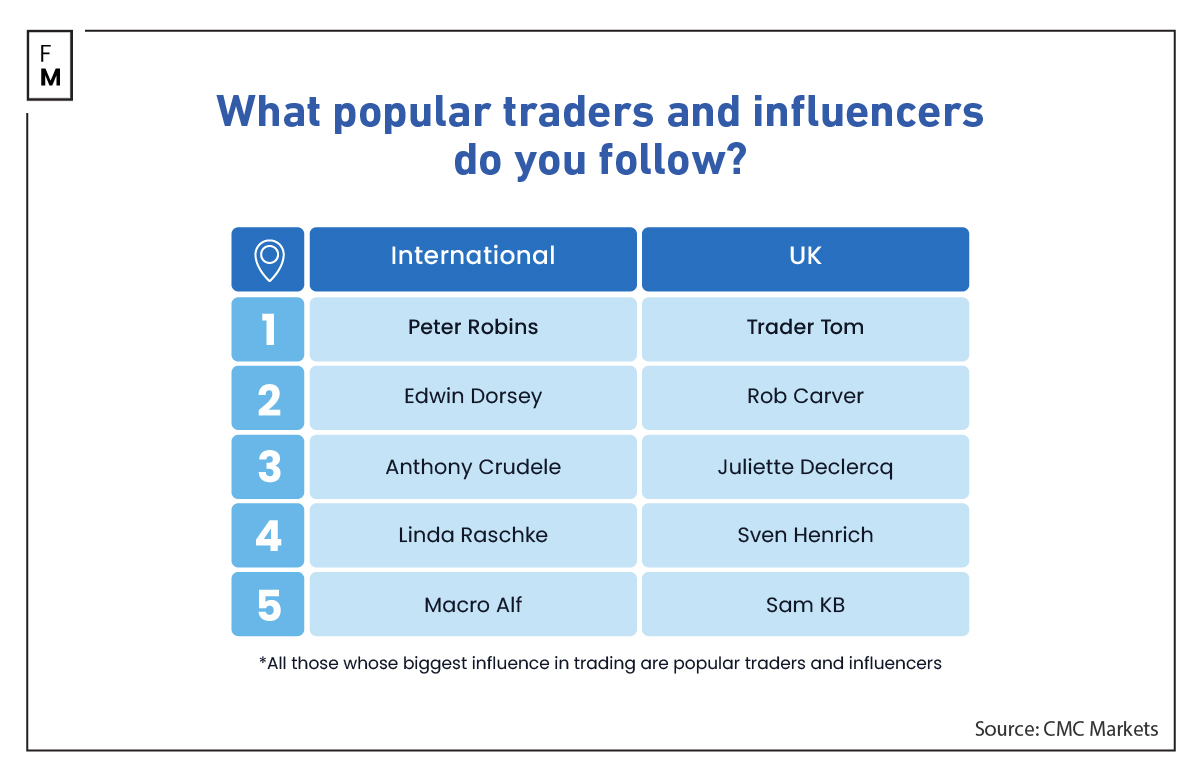
Peter Robinson is the most popular finfluencer internally, while Trader Ton leads among Britons.
Male traders are more likely to listen to friends’ recommendations, while female traders trust family more.
The influence of financial influencers (popularly known as finfluencers) over the life of retail traders is tremendous. As many as 33 percent of the traders agree that they’re likely to trade when an influencer they follow highlights an opportunity, a report by CMC Markets revealed.
Influence on Retail Traders
The London-headquartered broker revealed that 59 percent of female traders are more likely to follow the recommendations of influencers than 53 percent of men. Meanwhile, traders above 55 years of age are least likely to be swayed by the influencers’ opinions.
Jochen Stanzl, Chief Market Analyst at CMC Markets
Explaining the popular picks of the finfluencers, Jochen Stanzl, the Chief Market Analyst at CMC Markets, told Finance Magnates: “While it can vary depending on what asset classes influencers specialise in, typically they seek out context like economic calendars and earnings reports to develop their content. This, combined with an awareness of wider news, like world conflicts influencing oil and gold prices or Elon Musk’s latest headlines affecting the stock prices of Tesla, will help shape their view of commentary and research.”
“They also keep track of popular stocks like the “Magnificent Seven” for example that consistently draw the most attention, so they can keep their audience up to date whilst securing the most clicks/interactions. Although this can lead to a crowding effect on specific stocks, it also opens the door for many first-time investors and retail traders who might not have bought their first stock without the advice of a ‘finfluencer’.”
After influencers, family and friends exert the biggest trading influence, with 24 percent and 21 percent, respectively. Other retail traders online manage to influence the trading decisions of 20 percent of traders.
Interestingly, male traders are more likely to listen to friends, at 28 percent, than family, at 21 percent. On the other hand, female traders rely more on family, at 26 percent, rather than their friends, at 15 percent. Furthermore, young traders aged between 18 and 24 years are most likely to listen to their families at 30 percent. Meanwhile, traders between 25 and 34 years of age are more likely to be influenced by other traders they meet online.
Top Finfluencers and Their Revenue Streams
When it comes to the popularity of finfluencers, Peter Robinson leads globally, while Trader Ton has the most influence over the traders in the United Kingdom, according to the responses of the survey participants.
However, the finfluencers, most of whom provide recommendations without holding financial advisory licenses, have attracted the attention of global regulators. In many countries, several finfleuencers are even facing enforcement actions for unlicensed operations and raising discussion on whether they should be licensed or not.
In response to such a crackdown, many finfluencers are getting cautious and are expressing their views on stocks with the disclaimer of “educational purpose only.”
When it comes to making money, influencers earn handsomely; of course, it depends on their number of followers. Although influencers gain popularity because of their public recommendations, some of them “make money through posting their insights though (sometimes paywalled) channels like Telegram/Discord groups or online webinars for clients,” Stanzl pointed out.
“Another avenue is selling insights to financial institutions for those companies to promote within their content, like videos to feature on their platforms or newsletters they send out to their customers. However, these affiliations do tend to be limited to finfluencers with a larger audience base, and the smaller influencers might lack the relationships with financial institutions for these opportunities, at least when they’re starting out,” he added.
“Smaller influencers tend to make money from social media ads while also offering paid services or educational content to viewers and followers interested in learning more about trading.”
The influence of financial influencers (popularly known as finfluencers) over the life of retail traders is tremendous. As many as 33 percent of the traders agree that they’re likely to trade when an influencer they follow highlights an opportunity, a report by CMC Markets revealed.
Influence on Retail Traders
The London-headquartered broker revealed that 59 percent of female traders are more likely to follow the recommendations of influencers than 53 percent of men. Meanwhile, traders above 55 years of age are least likely to be swayed by the influencers’ opinions.
Jochen Stanzl, Chief Market Analyst at CMC Markets
Explaining the popular picks of the finfluencers, Jochen Stanzl, the Chief Market Analyst at CMC Markets, told Finance Magnates: “While it can vary depending on what asset classes influencers specialise in, typically they seek out context like economic calendars and earnings reports to develop their content. This, combined with an awareness of wider news, like world conflicts influencing oil and gold prices or Elon Musk’s latest headlines affecting the stock prices of Tesla, will help shape their view of commentary and research.”
“They also keep track of popular stocks like the “Magnificent Seven” for example that consistently draw the most attention, so they can keep their audience up to date whilst securing the most clicks/interactions. Although this can lead to a crowding effect on specific stocks, it also opens the door for many first-time investors and retail traders who might not have bought their first stock without the advice of a ‘finfluencer’.”
After influencers, family and friends exert the biggest trading influence, with 24 percent and 21 percent, respectively. Other retail traders online manage to influence the trading decisions of 20 percent of traders.
Interestingly, male traders are more likely to listen to friends, at 28 percent, than family, at 21 percent. On the other hand, female traders rely more on family, at 26 percent, rather than their friends, at 15 percent. Furthermore, young traders aged between 18 and 24 years are most likely to listen to their families at 30 percent. Meanwhile, traders between 25 and 34 years of age are more likely to be influenced by other traders they meet online.
Top Finfluencers and Their Revenue Streams
When it comes to the popularity of finfluencers, Peter Robinson leads globally, while Trader Ton has the most influence over the traders in the United Kingdom, according to the responses of the survey participants.
However, the finfluencers, most of whom provide recommendations without holding financial advisory licenses, have attracted the attention of global regulators. In many countries, several finfleuencers are even facing enforcement actions for unlicensed operations and raising discussion on whether they should be licensed or not.
In response to such a crackdown, many finfluencers are getting cautious and are expressing their views on stocks with the disclaimer of “educational purpose only.”
When it comes to making money, influencers earn handsomely; of course, it depends on their number of followers. Although influencers gain popularity because of their public recommendations, some of them “make money through posting their insights though (sometimes paywalled) channels like Telegram/Discord groups or online webinars for clients,” Stanzl pointed out.
“Another avenue is selling insights to financial institutions for those companies to promote within their content, like videos to feature on their platforms or newsletters they send out to their customers. However, these affiliations do tend to be limited to finfluencers with a larger audience base, and the smaller influencers might lack the relationships with financial institutions for these opportunities, at least when they’re starting out,” he added.
“Smaller influencers tend to make money from social media ads while also offering paid services or educational content to viewers and followers interested in learning more about trading.”
Arnab Shome is an electronics engineer-turned-financial editor. He holds a Bachelor of Technology from the National Institute of Technology, Agartala. He entered the retail trading industry about a decade ago, covering the cryptocurrency market for Finance Magnates, and later expanded his coverage to include forex and CFDs as well.
His work at Finance Magnates includes C-level interviews, data-driven analysis, opinion pieces, and scoops of industry exclusives. He also contributes to Finance Magnates’ quarterly industry report.
Area of coverage:
1. CFD broker-related news
2. Industry-related Regulatory updates and developments
3. New retail trading trends
4. Prop trading industry updates
5. Executive interviews
Education:
Bachelor of Technology - National Institute of Technology, Agartala (India)
Webull Spent Big to Hit Record Revenue, and the Bill Is in the Fine Print
FP Markets Winner Spotlight 🏆 | Global Broker of the Year 2025 #Trading #Broker #Innovation #Shorts
FP Markets Winner Spotlight 🏆 | Global Broker of the Year 2025 #Trading #Broker #Innovation #Shorts
FP Markets takes the spotlight as Global Broker of the Year 2025 at the Finance Magnates Awards.
Martin Stoilov, Head of Client Experience, shares that trust, innovation, and people played a key role in the company’s success, supported by a strong foundation of integrity and client-centricity.
Following this milestone, FP Markets continues to focus on growth, technology investment, and its core values of transparency and excellence.
👉 Be part of FM Awards 2026: https://awards.financemagnates.com/#nominate
FP Markets takes the spotlight as Global Broker of the Year 2025 at the Finance Magnates Awards.
Martin Stoilov, Head of Client Experience, shares that trust, innovation, and people played a key role in the company’s success, supported by a strong foundation of integrity and client-centricity.
Following this milestone, FP Markets continues to focus on growth, technology investment, and its core values of transparency and excellence.
👉 Be part of FM Awards 2026: https://awards.financemagnates.com/#nominate
In this video, we review @HolaPrimeMarketsOfficial, a multi-asset forex and CFDs broker offering different account types, trading platforms, and flexible trading conditions.
We cover the broker’s overall offering, including account options, trading environment, platforms like MT4 and MT5, and additional services such as managed accounts and fast withdrawals.
Watch the full video to see if Hola Prime Markets fits your trading needs.
📣 Stay up to date with the latest in finance and trading. Follow Finance Magnates for industry news, insights, and global event coverage.
Connect with us:
🔗 LinkedIn: /financemagnates
👍 Facebook: /financemagnates
📸 Instagram: https://www.instagram.com/financemagnates
🐦 X: https://x.com/financemagnates
🎥 TikTok: https://www.tiktok.com/tag/financemagnates
▶️ YouTube: /@financemagnates_official
#HolaPrime #ForexBroker #CFDTrading #FinanceMagnates #Trading #Forex #BrokerReview
In this video, we review @HolaPrimeMarketsOfficial, a multi-asset forex and CFDs broker offering different account types, trading platforms, and flexible trading conditions.
We cover the broker’s overall offering, including account options, trading environment, platforms like MT4 and MT5, and additional services such as managed accounts and fast withdrawals.
Watch the full video to see if Hola Prime Markets fits your trading needs.
📣 Stay up to date with the latest in finance and trading. Follow Finance Magnates for industry news, insights, and global event coverage.
Connect with us:
🔗 LinkedIn: /financemagnates
👍 Facebook: /financemagnates
📸 Instagram: https://www.instagram.com/financemagnates
🐦 X: https://x.com/financemagnates
🎥 TikTok: https://www.tiktok.com/tag/financemagnates
▶️ YouTube: /@financemagnates_official
#HolaPrime #ForexBroker #CFDTrading #FinanceMagnates #Trading #Forex #BrokerReview
Hola Prime Review: What You Need to Know | Full Breakdown by Finance Magnates
Hola Prime Review: What You Need to Know | Full Breakdown by Finance Magnates
In this video, we review @HolaPrime_Global, a proprietary trading firm offering evaluation programs and performance-based payouts in simulated market environments.
We cover how the challenge model works, including account types, profit splits (up to 95%), trading rules, and what it takes to reach a funded account. You’ll also learn about available platforms like MT4, MT5, cTrader, and more, along with insights into payouts, support, and trading conditions.
Watch the full video to see if Hola Prime fits your trading style.
📣 Stay up to date with the latest in finance and trading. Follow Finance Magnates for industry news, insights, and global event coverage.
Connect with us:
🔗 LinkedIn: /financemagnates
👍 Facebook: /financemagnates
📸 Instagram: https://www.instagram.com/financemagnates
🐦 X: https://x.com/financemagnates
🎥 TikTok: https://www.tiktok.com/tag/financemagnates
▶️ YouTube: /@financemagnates_official
#HolaPrime #PropFirm #Trading #FinanceMagnates #Forex #FuturesTrading #TradingReview #PropFirmReview
In this video, we review @HolaPrime_Global, a proprietary trading firm offering evaluation programs and performance-based payouts in simulated market environments.
We cover how the challenge model works, including account types, profit splits (up to 95%), trading rules, and what it takes to reach a funded account. You’ll also learn about available platforms like MT4, MT5, cTrader, and more, along with insights into payouts, support, and trading conditions.
Watch the full video to see if Hola Prime fits your trading style.
📣 Stay up to date with the latest in finance and trading. Follow Finance Magnates for industry news, insights, and global event coverage.
Connect with us:
🔗 LinkedIn: /financemagnates
👍 Facebook: /financemagnates
📸 Instagram: https://www.instagram.com/financemagnates
🐦 X: https://x.com/financemagnates
🎥 TikTok: https://www.tiktok.com/tag/financemagnates
▶️ YouTube: /@financemagnates_official
#HolaPrime #PropFirm #Trading #FinanceMagnates #Forex #FuturesTrading #TradingReview #PropFirmReview
Axi Winner Spotlight 🏆 | Global Most Innovative Broker 2025 #Innovation #Trading #Fintech #Broker
Axi Winner Spotlight 🏆 | Global Most Innovative Broker 2025 #Innovation #Trading #Fintech #Broker
Axi takes the spotlight at the Finance Magnates Awards, winning Global Most Innovative Broker 2025.
Olivia Xenofontos and Ivanna Openko share how the team will feel: proud, motivated, and ready to keep delivering.
They also describe the night as well-organized, focused, and enjoyable for all.
👉 Be part of FM Awards 2026.
Axi takes the spotlight at the Finance Magnates Awards, winning Global Most Innovative Broker 2025.
Olivia Xenofontos and Ivanna Openko share how the team will feel: proud, motivated, and ready to keep delivering.
They also describe the night as well-organized, focused, and enjoyable for all.
👉 Be part of FM Awards 2026.
Recognition that matters.
Built on transparency.
Driven by the industry.
The Finance Magnates Awards 2026.
Nominations are now open.
🔗 https://awards.financemagnates.com/?utm_source=SM&utm_medium=social&utm_campaign=recognition-matters
Recognition that matters.
Built on transparency.
Driven by the industry.
The Finance Magnates Awards 2026.
Nominations are now open.
🔗 https://awards.financemagnates.com/?utm_source=SM&utm_medium=social&utm_campaign=recognition-matters