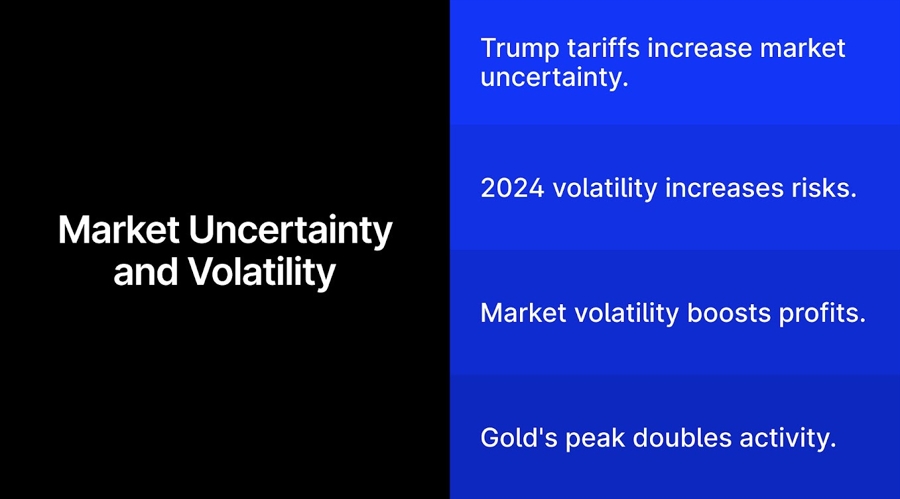
Liquidity challenges in volatile markets stress the need for stable brokers and deep liquidity pools.
AI-driven trading technology is growing, with a $2.2 billion market, as traders automate decisions.
The Trump administration’s policies are introducing new
uncertainties into global markets. Tariff threats and regulatory shifts are
affecting trade flows, creating both risks and opportunities for retail
traders. Increased volatility can lead to higher profit potential but also
requires careful risk management to mitigate losses. Traders need to adjust
their strategies to navigate these conditions effectively.
The rise of “Prime of Prime” brokers has
introduced additional complexity, as some firms recycle liquidity rather than
offering direct market access.
The collapse of several proprietary trading firms in 2024
has further underscored the importance of stable and well-capitalized brokers.
Traders are increasingly seeking firms that provide access to tier-one
liquidity sources, reducing the risk of execution delays and unexpected price
gaps.
Technology’s Role in Managing Volatility
The fast-paced nature of market changes has driven demand
for advanced trading technology. Many traders are shifting to shorter
timeframes and avoiding overnight positions due to concerns over sudden news
events. This has led to increased reliance on stop-loss orders and automated
trading systems designed to respond to rapid market shifts.
Shifting market dynamics have influenced traders' asset
preferences. Major currency pairs such as EUR/USD and GBP/USD have experienced
periods of low volatility, prompting some traders to explore alternative
instruments. Increased interest has been seen in commodities, cryptocurrencies,
and less commonly traded forex pairs like NZD, AUD, and JPY.
Retail investor activity has surged, particularly among
younger demographics. In early 2024, brokerage industry trading volumes saw
strong growth, especially on desktop and mobile platforms. This expansion was
accompanied by a demographic shift, with investors aged 35–54 increasing their
participation in mobile web brokerage activities.
Social trading has also gained popularity, allowing users to
follow and replicate the trades of experienced investors. With rising mobile
adoption, real-time market updates and interactive trading communities are
becoming essential components of trader engagement strategies.
The Importance of Market Data and Education
In an environment of economic uncertainty, traders are
placing greater emphasis on data-driven decision-making. Brokers offering
real-time sentiment analysis, predictive analytics, and market intelligence
tools are positioning themselves as critical partners for their clients.
Risk management has also gained prominence. Retail traders
are increasingly seeking platforms with enhanced risk controls, including
improved stop-loss mechanisms and automated risk alerts. Brokers investing in
trader education—through webinars, market simulations, and strategy guides—are
experiencing higher engagement from traders aiming to refine their market
strategies.
Mitigating Emotional Trading & Encouraging a
Disciplined Trading Approach
We are seeing traders shift toward more defensive
strategies, and for good reason—market conditions are ruthless. The Trump era
is set to challenge retail traders in ways we haven’t seen before, and only
those who truly embrace volatility, sharpen their strategies and stay
relentlessly informed but with a disciplined approach, will come out ahead.
Markets expected Trump to push deregulation, tax relief, and use trade threats as negotiation tactics. But his economic team includes old-school protectionists pushing a full-blown trade war. That’s a misguided approach to U.S. trade. pic.twitter.com/wEolJn8vFu
For brokers, mitigating emotional trading isn’t just about
offering tools—it’s about creating an environment that instills discipline and
long-term thinking. Traders who let emotions dictate their decisions won’t
last, and neither will the brokers who fail to equip them with the right
safeguards.
Brokers who double down on data-driven insights, real-time risk
management, and hands-on trader support aren’t just doing their clients a
favor—they’re future-proofing their own business. A stable, well-equipped trader
base isn’t just a benefit; it’s the backbone of a sustainable brokerage.
For brokers, the message is that those who prioritize deep
liquidity, cutting-edge technology, and a multi-asset trading experience will
dominate. In an industry where traders demand seamless execution and powerful
risk management tools, the brokers who deliver will define the next era of
trading.
The Trump administration’s policies are introducing new
uncertainties into global markets. Tariff threats and regulatory shifts are
affecting trade flows, creating both risks and opportunities for retail
traders. Increased volatility can lead to higher profit potential but also
requires careful risk management to mitigate losses. Traders need to adjust
their strategies to navigate these conditions effectively.
The rise of “Prime of Prime” brokers has
introduced additional complexity, as some firms recycle liquidity rather than
offering direct market access.
The collapse of several proprietary trading firms in 2024
has further underscored the importance of stable and well-capitalized brokers.
Traders are increasingly seeking firms that provide access to tier-one
liquidity sources, reducing the risk of execution delays and unexpected price
gaps.
Technology’s Role in Managing Volatility
The fast-paced nature of market changes has driven demand
for advanced trading technology. Many traders are shifting to shorter
timeframes and avoiding overnight positions due to concerns over sudden news
events. This has led to increased reliance on stop-loss orders and automated
trading systems designed to respond to rapid market shifts.
Shifting market dynamics have influenced traders' asset
preferences. Major currency pairs such as EUR/USD and GBP/USD have experienced
periods of low volatility, prompting some traders to explore alternative
instruments. Increased interest has been seen in commodities, cryptocurrencies,
and less commonly traded forex pairs like NZD, AUD, and JPY.
Retail investor activity has surged, particularly among
younger demographics. In early 2024, brokerage industry trading volumes saw
strong growth, especially on desktop and mobile platforms. This expansion was
accompanied by a demographic shift, with investors aged 35–54 increasing their
participation in mobile web brokerage activities.
Social trading has also gained popularity, allowing users to
follow and replicate the trades of experienced investors. With rising mobile
adoption, real-time market updates and interactive trading communities are
becoming essential components of trader engagement strategies.
The Importance of Market Data and Education
In an environment of economic uncertainty, traders are
placing greater emphasis on data-driven decision-making. Brokers offering
real-time sentiment analysis, predictive analytics, and market intelligence
tools are positioning themselves as critical partners for their clients.
Risk management has also gained prominence. Retail traders
are increasingly seeking platforms with enhanced risk controls, including
improved stop-loss mechanisms and automated risk alerts. Brokers investing in
trader education—through webinars, market simulations, and strategy guides—are
experiencing higher engagement from traders aiming to refine their market
strategies.
Mitigating Emotional Trading & Encouraging a
Disciplined Trading Approach
We are seeing traders shift toward more defensive
strategies, and for good reason—market conditions are ruthless. The Trump era
is set to challenge retail traders in ways we haven’t seen before, and only
those who truly embrace volatility, sharpen their strategies and stay
relentlessly informed but with a disciplined approach, will come out ahead.
Markets expected Trump to push deregulation, tax relief, and use trade threats as negotiation tactics. But his economic team includes old-school protectionists pushing a full-blown trade war. That’s a misguided approach to U.S. trade. pic.twitter.com/wEolJn8vFu
For brokers, mitigating emotional trading isn’t just about
offering tools—it’s about creating an environment that instills discipline and
long-term thinking. Traders who let emotions dictate their decisions won’t
last, and neither will the brokers who fail to equip them with the right
safeguards.
Brokers who double down on data-driven insights, real-time risk
management, and hands-on trader support aren’t just doing their clients a
favor—they’re future-proofing their own business. A stable, well-equipped trader
base isn’t just a benefit; it’s the backbone of a sustainable brokerage.
For brokers, the message is that those who prioritize deep
liquidity, cutting-edge technology, and a multi-asset trading experience will
dominate. In an industry where traders demand seamless execution and powerful
risk management tools, the brokers who deliver will define the next era of
trading.
Thiago Garcia Duarte is a market analyst at Axi. He specialises in Forex, commodities, indices and global macroeconomic analysis, helping traders and investors navigate market opportunities with a data-driven approach. Thiago regularly hosts webinars and podcasts delivering key market updates.
73% of Young Investors Say Traditional Wealth Building Is Broken – Here’s How They Trade Instead
Featured Videos
Executive Interview | Charlotte Bullock | Chief Product Officer, Bank of London | FMLS:25
In this interview, we sat down with Charlotte Bullock, Head of Product at The Bank of London, previously at SAP and now shaping product at one of the sector’s most ambitious new banking players.
Charlotte reflects on the Summit so far and talks about the culture inside fintech banks today. We look at the pressures that come with scaling, and how firms can hold onto the nimble approach that made them stand out early on.
We also cover the state of payments ahead of her appearance on the payments roundtable: the blockages financial firms face, the areas that still need fixing, and what a realistic solution looks like in 2026.
In this interview, we sat down with Charlotte Bullock, Head of Product at The Bank of London, previously at SAP and now shaping product at one of the sector’s most ambitious new banking players.
Charlotte reflects on the Summit so far and talks about the culture inside fintech banks today. We look at the pressures that come with scaling, and how firms can hold onto the nimble approach that made them stand out early on.
We also cover the state of payments ahead of her appearance on the payments roundtable: the blockages financial firms face, the areas that still need fixing, and what a realistic solution looks like in 2026.
In this interview, we sat down with Charlotte Bullock, Head of Product at The Bank of London, previously at SAP and now shaping product at one of the sector’s most ambitious new banking players.
Charlotte reflects on the Summit so far and talks about the culture inside fintech banks today. We look at the pressures that come with scaling, and how firms can hold onto the nimble approach that made them stand out early on.
We also cover the state of payments ahead of her appearance on the payments roundtable: the blockages financial firms face, the areas that still need fixing, and what a realistic solution looks like in 2026.
In this interview, we sat down with Charlotte Bullock, Head of Product at The Bank of London, previously at SAP and now shaping product at one of the sector’s most ambitious new banking players.
Charlotte reflects on the Summit so far and talks about the culture inside fintech banks today. We look at the pressures that come with scaling, and how firms can hold onto the nimble approach that made them stand out early on.
We also cover the state of payments ahead of her appearance on the payments roundtable: the blockages financial firms face, the areas that still need fixing, and what a realistic solution looks like in 2026.
In this conversation, we sit down with Drew Niv, CSO at ATFX Connect and one of the most influential figures in modern FX.
We speak about market structure, the institutional view on liquidity, and the sharp rise of prop trading, a sector Drew has been commenting on in recent months. Drew explains why he once dismissed prop trading, why his view changed, and what he now thinks the model means for brokers, clients and risk managers.
We explore subscription-fee dependency, the high reneging rate, and the long-term challenge: how brokers can build a more stable and honest version of the model. Drew also talks about the traffic advantage standalone prop firms have built and why brokers may still win in the long run if they take the right approach.
In this conversation, we sit down with Drew Niv, CSO at ATFX Connect and one of the most influential figures in modern FX.
We speak about market structure, the institutional view on liquidity, and the sharp rise of prop trading, a sector Drew has been commenting on in recent months. Drew explains why he once dismissed prop trading, why his view changed, and what he now thinks the model means for brokers, clients and risk managers.
We explore subscription-fee dependency, the high reneging rate, and the long-term challenge: how brokers can build a more stable and honest version of the model. Drew also talks about the traffic advantage standalone prop firms have built and why brokers may still win in the long run if they take the right approach.
In this conversation, we sit down with Drew Niv, CSO at ATFX Connect and one of the most influential figures in modern FX.
We speak about market structure, the institutional view on liquidity, and the sharp rise of prop trading, a sector Drew has been commenting on in recent months. Drew explains why he once dismissed prop trading, why his view changed, and what he now thinks the model means for brokers, clients and risk managers.
We explore subscription-fee dependency, the high reneging rate, and the long-term challenge: how brokers can build a more stable and honest version of the model. Drew also talks about the traffic advantage standalone prop firms have built and why brokers may still win in the long run if they take the right approach.
In this conversation, we sit down with Drew Niv, CSO at ATFX Connect and one of the most influential figures in modern FX.
We speak about market structure, the institutional view on liquidity, and the sharp rise of prop trading, a sector Drew has been commenting on in recent months. Drew explains why he once dismissed prop trading, why his view changed, and what he now thinks the model means for brokers, clients and risk managers.
We explore subscription-fee dependency, the high reneging rate, and the long-term challenge: how brokers can build a more stable and honest version of the model. Drew also talks about the traffic advantage standalone prop firms have built and why brokers may still win in the long run if they take the right approach.
In this conversation, we sit down with Drew Niv, CSO at ATFX Connect and one of the most influential figures in modern FX.
We speak about market structure, the institutional view on liquidity, and the sharp rise of prop trading, a sector Drew has been commenting on in recent months. Drew explains why he once dismissed prop trading, why his view changed, and what he now thinks the model means for brokers, clients and risk managers.
We explore subscription-fee dependency, the high reneging rate, and the long-term challenge: how brokers can build a more stable and honest version of the model. Drew also talks about the traffic advantage standalone prop firms have built and why brokers may still win in the long run if they take the right approach.
In this conversation, we sit down with Drew Niv, CSO at ATFX Connect and one of the most influential figures in modern FX.
We speak about market structure, the institutional view on liquidity, and the sharp rise of prop trading, a sector Drew has been commenting on in recent months. Drew explains why he once dismissed prop trading, why his view changed, and what he now thinks the model means for brokers, clients and risk managers.
We explore subscription-fee dependency, the high reneging rate, and the long-term challenge: how brokers can build a more stable and honest version of the model. Drew also talks about the traffic advantage standalone prop firms have built and why brokers may still win in the long run if they take the right approach.
Executive Interview | Remonda Z. Kirketerp Møller| CEO & Founder Muinmos | FMLS:25
In this interview, Remonda Z. Kirketerp Møller, founder of Muinmos, breaks down the state of AI in regtech and what responsible adoption really looks like for brokers. We talk about rising fragmentation, the pressures around compliance accuracy, and why most firms are still in the early stages of AI maturity.
Ramanda also shares insights on regulator sandboxes, shifting expectations around accountability, and the current reality of MiCA licensing and passporting in Europe.
A concise look at where compliance, onboarding, and AI-driven processes are heading next.
In this interview, Remonda Z. Kirketerp Møller, founder of Muinmos, breaks down the state of AI in regtech and what responsible adoption really looks like for brokers. We talk about rising fragmentation, the pressures around compliance accuracy, and why most firms are still in the early stages of AI maturity.
Ramanda also shares insights on regulator sandboxes, shifting expectations around accountability, and the current reality of MiCA licensing and passporting in Europe.
A concise look at where compliance, onboarding, and AI-driven processes are heading next.
In this interview, Remonda Z. Kirketerp Møller, founder of Muinmos, breaks down the state of AI in regtech and what responsible adoption really looks like for brokers. We talk about rising fragmentation, the pressures around compliance accuracy, and why most firms are still in the early stages of AI maturity.
Ramanda also shares insights on regulator sandboxes, shifting expectations around accountability, and the current reality of MiCA licensing and passporting in Europe.
A concise look at where compliance, onboarding, and AI-driven processes are heading next.
In this interview, Remonda Z. Kirketerp Møller, founder of Muinmos, breaks down the state of AI in regtech and what responsible adoption really looks like for brokers. We talk about rising fragmentation, the pressures around compliance accuracy, and why most firms are still in the early stages of AI maturity.
Ramanda also shares insights on regulator sandboxes, shifting expectations around accountability, and the current reality of MiCA licensing and passporting in Europe.
A concise look at where compliance, onboarding, and AI-driven processes are heading next.
In this interview, Remonda Z. Kirketerp Møller, founder of Muinmos, breaks down the state of AI in regtech and what responsible adoption really looks like for brokers. We talk about rising fragmentation, the pressures around compliance accuracy, and why most firms are still in the early stages of AI maturity.
Ramanda also shares insights on regulator sandboxes, shifting expectations around accountability, and the current reality of MiCA licensing and passporting in Europe.
A concise look at where compliance, onboarding, and AI-driven processes are heading next.
In this interview, Remonda Z. Kirketerp Møller, founder of Muinmos, breaks down the state of AI in regtech and what responsible adoption really looks like for brokers. We talk about rising fragmentation, the pressures around compliance accuracy, and why most firms are still in the early stages of AI maturity.
Ramanda also shares insights on regulator sandboxes, shifting expectations around accountability, and the current reality of MiCA licensing and passporting in Europe.
A concise look at where compliance, onboarding, and AI-driven processes are heading next.
In this conversation, we speak with Aydin Bonabi, CEO and co-founder of Surveill, a firm focused on fraud detection and AI-driven compliance tools for financial institutions.
We start with Aydin’s view of the Summit and the challenges brokers face as fraud tactics grow more complex. He explains how firms can stay ahead through real-time signals, data patterns, and early-stage detection.
We also talk about AI training and why compliance teams often struggle to keep models accurate, fair, and aligned with regulatory expectations. Aydin breaks down what “good” AI training looks like inside a financial environment, including the importance of clean data, domain expertise, and human oversight.
He closes with a clear message: fraud is scaling, and so must the tools that stop it.
In this conversation, we speak with Aydin Bonabi, CEO and co-founder of Surveill, a firm focused on fraud detection and AI-driven compliance tools for financial institutions.
We start with Aydin’s view of the Summit and the challenges brokers face as fraud tactics grow more complex. He explains how firms can stay ahead through real-time signals, data patterns, and early-stage detection.
We also talk about AI training and why compliance teams often struggle to keep models accurate, fair, and aligned with regulatory expectations. Aydin breaks down what “good” AI training looks like inside a financial environment, including the importance of clean data, domain expertise, and human oversight.
He closes with a clear message: fraud is scaling, and so must the tools that stop it.
In this conversation, we speak with Aydin Bonabi, CEO and co-founder of Surveill, a firm focused on fraud detection and AI-driven compliance tools for financial institutions.
We start with Aydin’s view of the Summit and the challenges brokers face as fraud tactics grow more complex. He explains how firms can stay ahead through real-time signals, data patterns, and early-stage detection.
We also talk about AI training and why compliance teams often struggle to keep models accurate, fair, and aligned with regulatory expectations. Aydin breaks down what “good” AI training looks like inside a financial environment, including the importance of clean data, domain expertise, and human oversight.
He closes with a clear message: fraud is scaling, and so must the tools that stop it.
In this conversation, we speak with Aydin Bonabi, CEO and co-founder of Surveill, a firm focused on fraud detection and AI-driven compliance tools for financial institutions.
We start with Aydin’s view of the Summit and the challenges brokers face as fraud tactics grow more complex. He explains how firms can stay ahead through real-time signals, data patterns, and early-stage detection.
We also talk about AI training and why compliance teams often struggle to keep models accurate, fair, and aligned with regulatory expectations. Aydin breaks down what “good” AI training looks like inside a financial environment, including the importance of clean data, domain expertise, and human oversight.
He closes with a clear message: fraud is scaling, and so must the tools that stop it.
In this conversation, we speak with Aydin Bonabi, CEO and co-founder of Surveill, a firm focused on fraud detection and AI-driven compliance tools for financial institutions.
We start with Aydin’s view of the Summit and the challenges brokers face as fraud tactics grow more complex. He explains how firms can stay ahead through real-time signals, data patterns, and early-stage detection.
We also talk about AI training and why compliance teams often struggle to keep models accurate, fair, and aligned with regulatory expectations. Aydin breaks down what “good” AI training looks like inside a financial environment, including the importance of clean data, domain expertise, and human oversight.
He closes with a clear message: fraud is scaling, and so must the tools that stop it.
In this conversation, we speak with Aydin Bonabi, CEO and co-founder of Surveill, a firm focused on fraud detection and AI-driven compliance tools for financial institutions.
We start with Aydin’s view of the Summit and the challenges brokers face as fraud tactics grow more complex. He explains how firms can stay ahead through real-time signals, data patterns, and early-stage detection.
We also talk about AI training and why compliance teams often struggle to keep models accurate, fair, and aligned with regulatory expectations. Aydin breaks down what “good” AI training looks like inside a financial environment, including the importance of clean data, domain expertise, and human oversight.
He closes with a clear message: fraud is scaling, and so must the tools that stop it.
Exness expands its presence in Africa: Inside our interview with Paul Margarites in Cape Town
Finance Magnates met with Paul Margarites, Exness regional commercial director for Sub-Saharan Africa, during a visit to the firm’s office opening in Cape Town. In this talk, led by Andrea Badiola Mateos, Co-CEO at Finance Magnates, Paul shares views on the South African trading space, local user behavior, mobile trends, regulation, team growth, and how Exness plans to grow in more markets across the region. @Exness
Read the article at: https://www.financemagnates.com/thought-leadership/exness-expands-its-presence-in-africa-inside-our-interview-with-paul-margarites/
#exness #financemagnates #exnesstrading #CFDtrading #tradeonline #africanews #capetown
Finance Magnates met with Paul Margarites, Exness regional commercial director for Sub-Saharan Africa, during a visit to the firm’s office opening in Cape Town. In this talk, led by Andrea Badiola Mateos, Co-CEO at Finance Magnates, Paul shares views on the South African trading space, local user behavior, mobile trends, regulation, team growth, and how Exness plans to grow in more markets across the region. @Exness
Read the article at: https://www.financemagnates.com/thought-leadership/exness-expands-its-presence-in-africa-inside-our-interview-with-paul-margarites/
#exness #financemagnates #exnesstrading #CFDtrading #tradeonline #africanews #capetown
Finance Magnates met with Paul Margarites, Exness regional commercial director for Sub-Saharan Africa, during a visit to the firm’s office opening in Cape Town. In this talk, led by Andrea Badiola Mateos, Co-CEO at Finance Magnates, Paul shares views on the South African trading space, local user behavior, mobile trends, regulation, team growth, and how Exness plans to grow in more markets across the region. @Exness
Read the article at: https://www.financemagnates.com/thought-leadership/exness-expands-its-presence-in-africa-inside-our-interview-with-paul-margarites/
#exness #financemagnates #exnesstrading #CFDtrading #tradeonline #africanews #capetown
Finance Magnates met with Paul Margarites, Exness regional commercial director for Sub-Saharan Africa, during a visit to the firm’s office opening in Cape Town. In this talk, led by Andrea Badiola Mateos, Co-CEO at Finance Magnates, Paul shares views on the South African trading space, local user behavior, mobile trends, regulation, team growth, and how Exness plans to grow in more markets across the region. @Exness
Read the article at: https://www.financemagnates.com/thought-leadership/exness-expands-its-presence-in-africa-inside-our-interview-with-paul-margarites/
#exness #financemagnates #exnesstrading #CFDtrading #tradeonline #africanews #capetown
Finance Magnates met with Paul Margarites, Exness regional commercial director for Sub-Saharan Africa, during a visit to the firm’s office opening in Cape Town. In this talk, led by Andrea Badiola Mateos, Co-CEO at Finance Magnates, Paul shares views on the South African trading space, local user behavior, mobile trends, regulation, team growth, and how Exness plans to grow in more markets across the region. @Exness
Read the article at: https://www.financemagnates.com/thought-leadership/exness-expands-its-presence-in-africa-inside-our-interview-with-paul-margarites/
#exness #financemagnates #exnesstrading #CFDtrading #tradeonline #africanews #capetown
Finance Magnates met with Paul Margarites, Exness regional commercial director for Sub-Saharan Africa, during a visit to the firm’s office opening in Cape Town. In this talk, led by Andrea Badiola Mateos, Co-CEO at Finance Magnates, Paul shares views on the South African trading space, local user behavior, mobile trends, regulation, team growth, and how Exness plans to grow in more markets across the region. @Exness
Read the article at: https://www.financemagnates.com/thought-leadership/exness-expands-its-presence-in-africa-inside-our-interview-with-paul-margarites/
#exness #financemagnates #exnesstrading #CFDtrading #tradeonline #africanews #capetown