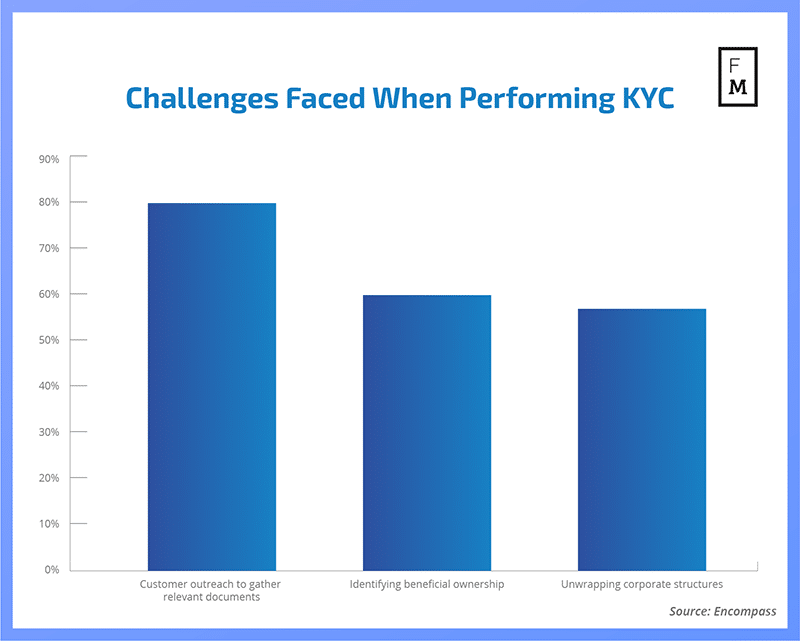
At a time when most industries are suffering from the economic stresses of the global Coronavirus pandemic, the KYC industry is enjoying solid growth. Travel restrictions and social distancing rules are forcing businesses to conduct most of their work and client interaction remotely.
This, however, requires proper authentication and identity verification, and that fuels the growing interest in KYC solutions. How can this trend influence the financial industry, and which trends in KYC are we going to see in the nearest future? Finance Magnates Intelligence took a closer look at the KYC sector.
Looking at the current financial industry, one can see how the KYC sphere has evolved. The changes are seen on three different levels — first of all, the regulatory level. It is obvious today that a stringent KYC policy is one of the key elements of a sound financial environment in most countries. From a regulatory perspective, it allows for combating possible financial crimes better. The more reputable a given regulatory regime is, the more it will demand from industry participants when it comes to collecting information on their clients.
Victor Fredung, CEO of Shufti Pro, shared with Finance Magnates his observation on this matter: "KYC has changed significantly over the last five years. There have been many regulatory and technological advancements," he said. "Also, there has been a rise in KYC compliance awareness among businesses. Some new regulations are passed, such as AMLD5 of EU, and several amendments are made in previous laws/recommendations by FATF and national authorities such as FINMA, FINCEN, FINTRAC, etc."
Automation in KYC solutions
Today, everything in the KYC sphere is more automatic and is being taken care of by specialist or tailored software. Automation procedures seem to be more important today than ever before. With the COVID-19 pandemic paralyzing world economies, special measures had to be taken. One of them was social distancing, which is the main tool in combating the pandemic. This, of course, had to influence the way business is being conducted.
The coronavirus pandemic made people more aware of how quickly many things can be done without leaving your home or office. It also made people more aware of how serious the security of financial transactions and agreements should be taken. All of these developments had been growing slowly in the KYC/AML industry and will now speed up because of the pandemic.
What we want to see is minimal input from customers and more innovative financial businesses. The Leverage of multiple sources to validate the data provided by the customers will be seen more often.
To get the full article and the bigger-picture perspective on how the industry evolved in 2019, get our latest Quarterly Intelligence Report.
At a time when most industries are suffering from the economic stresses of the global Coronavirus pandemic, the KYC industry is enjoying solid growth. Travel restrictions and social distancing rules are forcing businesses to conduct most of their work and client interaction remotely.
This, however, requires proper authentication and identity verification, and that fuels the growing interest in KYC solutions. How can this trend influence the financial industry, and which trends in KYC are we going to see in the nearest future? Finance Magnates Intelligence took a closer look at the KYC sector.
Looking at the current financial industry, one can see how the KYC sphere has evolved. The changes are seen on three different levels — first of all, the regulatory level. It is obvious today that a stringent KYC policy is one of the key elements of a sound financial environment in most countries. From a regulatory perspective, it allows for combating possible financial crimes better. The more reputable a given regulatory regime is, the more it will demand from industry participants when it comes to collecting information on their clients.
Victor Fredung, CEO of Shufti Pro, shared with Finance Magnates his observation on this matter: "KYC has changed significantly over the last five years. There have been many regulatory and technological advancements," he said. "Also, there has been a rise in KYC compliance awareness among businesses. Some new regulations are passed, such as AMLD5 of EU, and several amendments are made in previous laws/recommendations by FATF and national authorities such as FINMA, FINCEN, FINTRAC, etc."
Automation in KYC solutions
Today, everything in the KYC sphere is more automatic and is being taken care of by specialist or tailored software. Automation procedures seem to be more important today than ever before. With the COVID-19 pandemic paralyzing world economies, special measures had to be taken. One of them was social distancing, which is the main tool in combating the pandemic. This, of course, had to influence the way business is being conducted.
The coronavirus pandemic made people more aware of how quickly many things can be done without leaving your home or office. It also made people more aware of how serious the security of financial transactions and agreements should be taken. All of these developments had been growing slowly in the KYC/AML industry and will now speed up because of the pandemic.
What we want to see is minimal input from customers and more innovative financial businesses. The Leverage of multiple sources to validate the data provided by the customers will be seen more often.
To get the full article and the bigger-picture perspective on how the industry evolved in 2019, get our latest Quarterly Intelligence Report.
Sylwester is a graduate of the Warsaw School of Economics, holding an MA in Finance and Banking. He currently serves as Head of the Insights & Reporting Hub at Finance Magnates. He is also a former minority partner in an NFA-registered US forex broker and has been involved in numerous forex and trading industry projects since 2003.
Privately, Sylwester is a husband and father to a 7-year-old daughter, as well as an enthusiast of trading and Formula 1.
Italy’s Consob Tightens Net on AI-Fueled Scams With Fresh Website Bans
FP Markets Winner Spotlight 🏆 | Global Broker of the Year 2025 #Trading #Broker #Innovation #Shorts
FP Markets Winner Spotlight 🏆 | Global Broker of the Year 2025 #Trading #Broker #Innovation #Shorts
FP Markets takes the spotlight as Global Broker of the Year 2025 at the Finance Magnates Awards.
Martin Stoilov, Head of Client Experience, shares that trust, innovation, and people played a key role in the company’s success, supported by a strong foundation of integrity and client-centricity.
Following this milestone, FP Markets continues to focus on growth, technology investment, and its core values of transparency and excellence.
👉 Be part of FM Awards 2026: https://awards.financemagnates.com/#nominate
FP Markets takes the spotlight as Global Broker of the Year 2025 at the Finance Magnates Awards.
Martin Stoilov, Head of Client Experience, shares that trust, innovation, and people played a key role in the company’s success, supported by a strong foundation of integrity and client-centricity.
Following this milestone, FP Markets continues to focus on growth, technology investment, and its core values of transparency and excellence.
👉 Be part of FM Awards 2026: https://awards.financemagnates.com/#nominate
In this video, we review @HolaPrimeMarketsOfficial, a multi-asset forex and CFDs broker offering different account types, trading platforms, and flexible trading conditions.
We cover the broker’s overall offering, including account options, trading environment, platforms like MT4 and MT5, and additional services such as managed accounts and fast withdrawals.
Watch the full video to see if Hola Prime Markets fits your trading needs.
📣 Stay up to date with the latest in finance and trading. Follow Finance Magnates for industry news, insights, and global event coverage.
Connect with us:
🔗 LinkedIn: /financemagnates
👍 Facebook: /financemagnates
📸 Instagram: https://www.instagram.com/financemagnates
🐦 X: https://x.com/financemagnates
🎥 TikTok: https://www.tiktok.com/tag/financemagnates
▶️ YouTube: /@financemagnates_official
#HolaPrime #ForexBroker #CFDTrading #FinanceMagnates #Trading #Forex #BrokerReview
In this video, we review @HolaPrimeMarketsOfficial, a multi-asset forex and CFDs broker offering different account types, trading platforms, and flexible trading conditions.
We cover the broker’s overall offering, including account options, trading environment, platforms like MT4 and MT5, and additional services such as managed accounts and fast withdrawals.
Watch the full video to see if Hola Prime Markets fits your trading needs.
📣 Stay up to date with the latest in finance and trading. Follow Finance Magnates for industry news, insights, and global event coverage.
Connect with us:
🔗 LinkedIn: /financemagnates
👍 Facebook: /financemagnates
📸 Instagram: https://www.instagram.com/financemagnates
🐦 X: https://x.com/financemagnates
🎥 TikTok: https://www.tiktok.com/tag/financemagnates
▶️ YouTube: /@financemagnates_official
#HolaPrime #ForexBroker #CFDTrading #FinanceMagnates #Trading #Forex #BrokerReview
Hola Prime Review: What You Need to Know | Full Breakdown by Finance Magnates
Hola Prime Review: What You Need to Know | Full Breakdown by Finance Magnates
In this video, we review @HolaPrime_Global, a proprietary trading firm offering evaluation programs and performance-based payouts in simulated market environments.
We cover how the challenge model works, including account types, profit splits (up to 95%), trading rules, and what it takes to reach a funded account. You’ll also learn about available platforms like MT4, MT5, cTrader, and more, along with insights into payouts, support, and trading conditions.
Watch the full video to see if Hola Prime fits your trading style.
📣 Stay up to date with the latest in finance and trading. Follow Finance Magnates for industry news, insights, and global event coverage.
Connect with us:
🔗 LinkedIn: /financemagnates
👍 Facebook: /financemagnates
📸 Instagram: https://www.instagram.com/financemagnates
🐦 X: https://x.com/financemagnates
🎥 TikTok: https://www.tiktok.com/tag/financemagnates
▶️ YouTube: /@financemagnates_official
#HolaPrime #PropFirm #Trading #FinanceMagnates #Forex #FuturesTrading #TradingReview #PropFirmReview
In this video, we review @HolaPrime_Global, a proprietary trading firm offering evaluation programs and performance-based payouts in simulated market environments.
We cover how the challenge model works, including account types, profit splits (up to 95%), trading rules, and what it takes to reach a funded account. You’ll also learn about available platforms like MT4, MT5, cTrader, and more, along with insights into payouts, support, and trading conditions.
Watch the full video to see if Hola Prime fits your trading style.
📣 Stay up to date with the latest in finance and trading. Follow Finance Magnates for industry news, insights, and global event coverage.
Connect with us:
🔗 LinkedIn: /financemagnates
👍 Facebook: /financemagnates
📸 Instagram: https://www.instagram.com/financemagnates
🐦 X: https://x.com/financemagnates
🎥 TikTok: https://www.tiktok.com/tag/financemagnates
▶️ YouTube: /@financemagnates_official
#HolaPrime #PropFirm #Trading #FinanceMagnates #Forex #FuturesTrading #TradingReview #PropFirmReview
Axi Winner Spotlight 🏆 | Global Most Innovative Broker 2025 #Innovation #Trading #Fintech #Broker
Axi Winner Spotlight 🏆 | Global Most Innovative Broker 2025 #Innovation #Trading #Fintech #Broker
Axi takes the spotlight at the Finance Magnates Awards, winning Global Most Innovative Broker 2025.
Olivia Xenofontos and Ivanna Openko share how the team will feel: proud, motivated, and ready to keep delivering.
They also describe the night as well-organized, focused, and enjoyable for all.
👉 Be part of FM Awards 2026.
Axi takes the spotlight at the Finance Magnates Awards, winning Global Most Innovative Broker 2025.
Olivia Xenofontos and Ivanna Openko share how the team will feel: proud, motivated, and ready to keep delivering.
They also describe the night as well-organized, focused, and enjoyable for all.
👉 Be part of FM Awards 2026.
Recognition that matters.
Built on transparency.
Driven by the industry.
The Finance Magnates Awards 2026.
Nominations are now open.
🔗 https://awards.financemagnates.com/?utm_source=SM&utm_medium=social&utm_campaign=recognition-matters
Recognition that matters.
Built on transparency.
Driven by the industry.
The Finance Magnates Awards 2026.
Nominations are now open.
🔗 https://awards.financemagnates.com/?utm_source=SM&utm_medium=social&utm_campaign=recognition-matters