Indian Banking Sector to Get Injection of New Accounts - Prime Minister Proposes
Saturday,16/08/2014|14:24GMTby
Adil Siddiqui
In a historic independence-day speech, India’s prime minister, Narendar Modi plans to strengthen the country’s banking sector as he rolls out a mechanism to remove the country’s cash economy, bank accounts for all.
As emerging market economies migrate their economic policies to cater to the changing needs of individuals, countries often miss out on maintaining 100% financial inclusion, particularly due to poverty, lack of facilities and low financial literacy. However, India's recently elected prime minister, Narendar Modi, vows to challenge the current climate and rid the BRICS nation of its unknown, unaccounted and non-banking economy.
During an emotional speech on India’s independence day, on the 15th of August, Mr. Modi promised to change the landscape. The prime minister spoke in his inaugural speech to the nation, since taking over from Manmohan Singh in May. The leader aims to ramp-up the number of Indian individuals holding a bank account, thus strengthening the industry.
India, the world’s second most populous country, has one of the lowest rates of bank account holders among its population, as compared to other emerging market economies, particularly affecting its rural community.
Under the new pledge, India is expected to invigorate its economy as more funds will be injected into the system. India’s banking sector has undergone a number of changes since it gained independence from the British Empire, 2014 marking the 68th anniversary of the country.
“Banks won't be the only beneficiaries of the change, the financial markets will gain as more individuals will have access to investment products,” explained Jaswinder Kaler, a Punjab-based businessman, to Forex Magnates.
Among the 1.2 billion individuals residing in the country, only 50% hold bank accounts, with individuals living in rural areas affected the most, according to statistics compiled during the 2011 census. The data shows that of the fifty percent holding accounts, most are basic saving accounts with limited facilities such as debit cards, internet banking and lending facilities.
The lack of banking facilities affects individuals on the lowest levels. "Why are our farmers committing suicide? It's because they have to take money at huge interest rates from the money-lenders," Mr. Modi said in a speech on India's Independence Day. Indian farmers face difficulties raising funds to manage and maintain their crops, due to lack of a structured lending regime, resulting in several suicides.
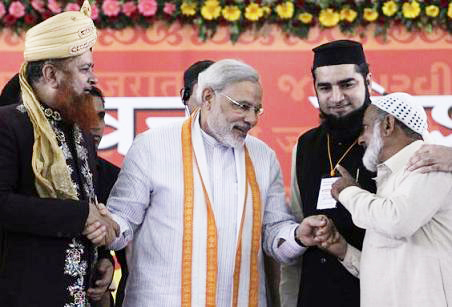
Image: AP Photo - Narendar Modi Centre
Benefits of Banking for All
Banking facilities for all residents will be a step-up for the country, with an efficient and audited operating environment. Furthermore, as India competes with rival China, the inclusion of residents in its banking sector will help it compete with China where over 74% of the population hold bank accounts.
India’s financial markets are expected to benefit from the new wealth entering the banking sector as individuals will have the means to access stock and derivatives trading. For investors to set up a stock trading account, brokers require bank account details.
There are around 20 million Indians who hold stock trading accounts (demat accounts). If compared to developed markets such as the UK, there are over 60 million banks accounts with over 90% holding at least one bank account. In addition, UK investors are highly financially literate and data from the country’s bourse shows that over 12 million Brits have stocks or shareholding. China’s figure outperforms India, with over 70 million investing in the country's stock market.
Comparative country data clearly shows that India needs to evolve its current policies and framework to ensure that its residents are included in the financial and banking system. The new path which follows on from a speech made by Mr. Singh in 2012 is a step in the right direction for the Asian giant.
ICICI and HDFC are two of India’s largest private banks, ICICI Bank has over 17 million customers with HDFC having nearly 10 million banking clients.
India’s central bank, RBI, governs the banking and financial sector. On its website, it outlines the wider banking sector and the role RBI plays, it states: “While fostering a multi-tier structure, the regulatory effort has been to ensure stability and soundness by addressing weaknesses as and when they arose. The soundness of the system was evident from the way it withstood the recent financial crisis rather well, even as the banking systems in many countries across the world were adversely affected.”
As emerging market economies migrate their economic policies to cater to the changing needs of individuals, countries often miss out on maintaining 100% financial inclusion, particularly due to poverty, lack of facilities and low financial literacy. However, India's recently elected prime minister, Narendar Modi, vows to challenge the current climate and rid the BRICS nation of its unknown, unaccounted and non-banking economy.
During an emotional speech on India’s independence day, on the 15th of August, Mr. Modi promised to change the landscape. The prime minister spoke in his inaugural speech to the nation, since taking over from Manmohan Singh in May. The leader aims to ramp-up the number of Indian individuals holding a bank account, thus strengthening the industry.
India, the world’s second most populous country, has one of the lowest rates of bank account holders among its population, as compared to other emerging market economies, particularly affecting its rural community.
Under the new pledge, India is expected to invigorate its economy as more funds will be injected into the system. India’s banking sector has undergone a number of changes since it gained independence from the British Empire, 2014 marking the 68th anniversary of the country.
“Banks won't be the only beneficiaries of the change, the financial markets will gain as more individuals will have access to investment products,” explained Jaswinder Kaler, a Punjab-based businessman, to Forex Magnates.
Among the 1.2 billion individuals residing in the country, only 50% hold bank accounts, with individuals living in rural areas affected the most, according to statistics compiled during the 2011 census. The data shows that of the fifty percent holding accounts, most are basic saving accounts with limited facilities such as debit cards, internet banking and lending facilities.
The lack of banking facilities affects individuals on the lowest levels. "Why are our farmers committing suicide? It's because they have to take money at huge interest rates from the money-lenders," Mr. Modi said in a speech on India's Independence Day. Indian farmers face difficulties raising funds to manage and maintain their crops, due to lack of a structured lending regime, resulting in several suicides.
Image: AP Photo - Narendar Modi Centre
Benefits of Banking for All
Banking facilities for all residents will be a step-up for the country, with an efficient and audited operating environment. Furthermore, as India competes with rival China, the inclusion of residents in its banking sector will help it compete with China where over 74% of the population hold bank accounts.
India’s financial markets are expected to benefit from the new wealth entering the banking sector as individuals will have the means to access stock and derivatives trading. For investors to set up a stock trading account, brokers require bank account details.
There are around 20 million Indians who hold stock trading accounts (demat accounts). If compared to developed markets such as the UK, there are over 60 million banks accounts with over 90% holding at least one bank account. In addition, UK investors are highly financially literate and data from the country’s bourse shows that over 12 million Brits have stocks or shareholding. China’s figure outperforms India, with over 70 million investing in the country's stock market.
Comparative country data clearly shows that India needs to evolve its current policies and framework to ensure that its residents are included in the financial and banking system. The new path which follows on from a speech made by Mr. Singh in 2012 is a step in the right direction for the Asian giant.
ICICI and HDFC are two of India’s largest private banks, ICICI Bank has over 17 million customers with HDFC having nearly 10 million banking clients.
India’s central bank, RBI, governs the banking and financial sector. On its website, it outlines the wider banking sector and the role RBI plays, it states: “While fostering a multi-tier structure, the regulatory effort has been to ensure stability and soundness by addressing weaknesses as and when they arose. The soundness of the system was evident from the way it withstood the recent financial crisis rather well, even as the banking systems in many countries across the world were adversely affected.”
Italy’s Consob Tightens Net on AI-Fueled Scams With Fresh Website Bans
FP Markets Winner Spotlight 🏆 | Global Broker of the Year 2025 #Trading #Broker #Innovation #Shorts
FP Markets Winner Spotlight 🏆 | Global Broker of the Year 2025 #Trading #Broker #Innovation #Shorts
FP Markets takes the spotlight as Global Broker of the Year 2025 at the Finance Magnates Awards.
Martin Stoilov, Head of Client Experience, shares that trust, innovation, and people played a key role in the company’s success, supported by a strong foundation of integrity and client-centricity.
Following this milestone, FP Markets continues to focus on growth, technology investment, and its core values of transparency and excellence.
👉 Be part of FM Awards 2026: https://awards.financemagnates.com/#nominate
FP Markets takes the spotlight as Global Broker of the Year 2025 at the Finance Magnates Awards.
Martin Stoilov, Head of Client Experience, shares that trust, innovation, and people played a key role in the company’s success, supported by a strong foundation of integrity and client-centricity.
Following this milestone, FP Markets continues to focus on growth, technology investment, and its core values of transparency and excellence.
👉 Be part of FM Awards 2026: https://awards.financemagnates.com/#nominate
In this video, we review @HolaPrimeMarketsOfficial, a multi-asset forex and CFDs broker offering different account types, trading platforms, and flexible trading conditions.
We cover the broker’s overall offering, including account options, trading environment, platforms like MT4 and MT5, and additional services such as managed accounts and fast withdrawals.
Watch the full video to see if Hola Prime Markets fits your trading needs.
📣 Stay up to date with the latest in finance and trading. Follow Finance Magnates for industry news, insights, and global event coverage.
Connect with us:
🔗 LinkedIn: /financemagnates
👍 Facebook: /financemagnates
📸 Instagram: https://www.instagram.com/financemagnates
🐦 X: https://x.com/financemagnates
🎥 TikTok: https://www.tiktok.com/tag/financemagnates
▶️ YouTube: /@financemagnates_official
#HolaPrime #ForexBroker #CFDTrading #FinanceMagnates #Trading #Forex #BrokerReview
In this video, we review @HolaPrimeMarketsOfficial, a multi-asset forex and CFDs broker offering different account types, trading platforms, and flexible trading conditions.
We cover the broker’s overall offering, including account options, trading environment, platforms like MT4 and MT5, and additional services such as managed accounts and fast withdrawals.
Watch the full video to see if Hola Prime Markets fits your trading needs.
📣 Stay up to date with the latest in finance and trading. Follow Finance Magnates for industry news, insights, and global event coverage.
Connect with us:
🔗 LinkedIn: /financemagnates
👍 Facebook: /financemagnates
📸 Instagram: https://www.instagram.com/financemagnates
🐦 X: https://x.com/financemagnates
🎥 TikTok: https://www.tiktok.com/tag/financemagnates
▶️ YouTube: /@financemagnates_official
#HolaPrime #ForexBroker #CFDTrading #FinanceMagnates #Trading #Forex #BrokerReview
Hola Prime Review: What You Need to Know | Full Breakdown by Finance Magnates
Hola Prime Review: What You Need to Know | Full Breakdown by Finance Magnates
In this video, we review @HolaPrime_Global, a proprietary trading firm offering evaluation programs and performance-based payouts in simulated market environments.
We cover how the challenge model works, including account types, profit splits (up to 95%), trading rules, and what it takes to reach a funded account. You’ll also learn about available platforms like MT4, MT5, cTrader, and more, along with insights into payouts, support, and trading conditions.
Watch the full video to see if Hola Prime fits your trading style.
📣 Stay up to date with the latest in finance and trading. Follow Finance Magnates for industry news, insights, and global event coverage.
Connect with us:
🔗 LinkedIn: /financemagnates
👍 Facebook: /financemagnates
📸 Instagram: https://www.instagram.com/financemagnates
🐦 X: https://x.com/financemagnates
🎥 TikTok: https://www.tiktok.com/tag/financemagnates
▶️ YouTube: /@financemagnates_official
#HolaPrime #PropFirm #Trading #FinanceMagnates #Forex #FuturesTrading #TradingReview #PropFirmReview
In this video, we review @HolaPrime_Global, a proprietary trading firm offering evaluation programs and performance-based payouts in simulated market environments.
We cover how the challenge model works, including account types, profit splits (up to 95%), trading rules, and what it takes to reach a funded account. You’ll also learn about available platforms like MT4, MT5, cTrader, and more, along with insights into payouts, support, and trading conditions.
Watch the full video to see if Hola Prime fits your trading style.
📣 Stay up to date with the latest in finance and trading. Follow Finance Magnates for industry news, insights, and global event coverage.
Connect with us:
🔗 LinkedIn: /financemagnates
👍 Facebook: /financemagnates
📸 Instagram: https://www.instagram.com/financemagnates
🐦 X: https://x.com/financemagnates
🎥 TikTok: https://www.tiktok.com/tag/financemagnates
▶️ YouTube: /@financemagnates_official
#HolaPrime #PropFirm #Trading #FinanceMagnates #Forex #FuturesTrading #TradingReview #PropFirmReview
Axi Winner Spotlight 🏆 | Global Most Innovative Broker 2025 #Innovation #Trading #Fintech #Broker
Axi Winner Spotlight 🏆 | Global Most Innovative Broker 2025 #Innovation #Trading #Fintech #Broker
Axi takes the spotlight at the Finance Magnates Awards, winning Global Most Innovative Broker 2025.
Olivia Xenofontos and Ivanna Openko share how the team will feel: proud, motivated, and ready to keep delivering.
They also describe the night as well-organized, focused, and enjoyable for all.
👉 Be part of FM Awards 2026.
Axi takes the spotlight at the Finance Magnates Awards, winning Global Most Innovative Broker 2025.
Olivia Xenofontos and Ivanna Openko share how the team will feel: proud, motivated, and ready to keep delivering.
They also describe the night as well-organized, focused, and enjoyable for all.
👉 Be part of FM Awards 2026.
Recognition that matters.
Built on transparency.
Driven by the industry.
The Finance Magnates Awards 2026.
Nominations are now open.
🔗 https://awards.financemagnates.com/?utm_source=SM&utm_medium=social&utm_campaign=recognition-matters
Recognition that matters.
Built on transparency.
Driven by the industry.
The Finance Magnates Awards 2026.
Nominations are now open.
🔗 https://awards.financemagnates.com/?utm_source=SM&utm_medium=social&utm_campaign=recognition-matters