The firm reportedly operated using an A-book model, which involved mirroring funded traders' positions in the actual market rather than relying on simulated or internalized trades.
Funded Unicorn blamed the abrupt end of its operations on “massive losses” and “bureaucratic hurdles.”
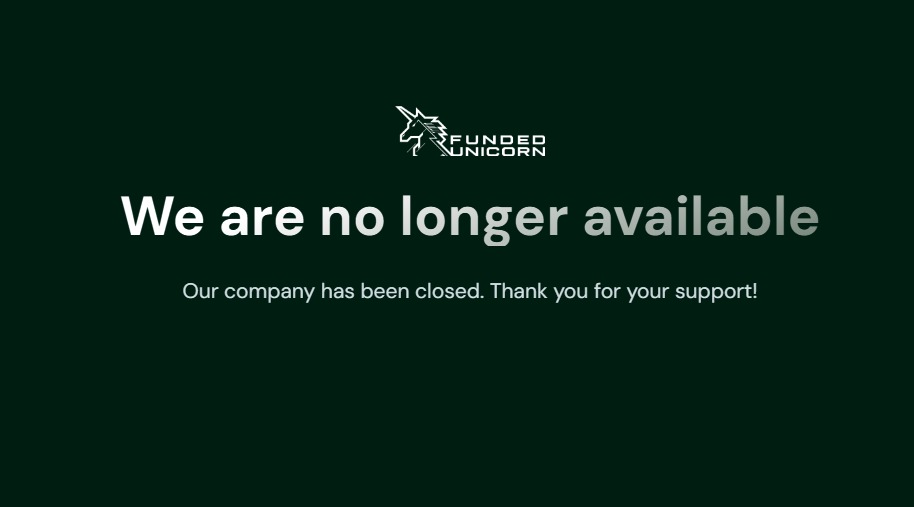
A screenshot of Funded Unicorn's website
One of the biggest prop trading firms in Germany, Funded Unicorn, has closed its operations, shaking the prop trading community and raising deeper questions about the sustainability of certain risk models.
Unique A-Book Strategy
According to a blog by proptraders, unlike most prop
trading firms that rely on challenge fees and operate largely on a simulated
trading basis, Funded Unicorn used what’s known as an “A-book” model. The firm
mirrored every trade made by its funded traders on the actual market.
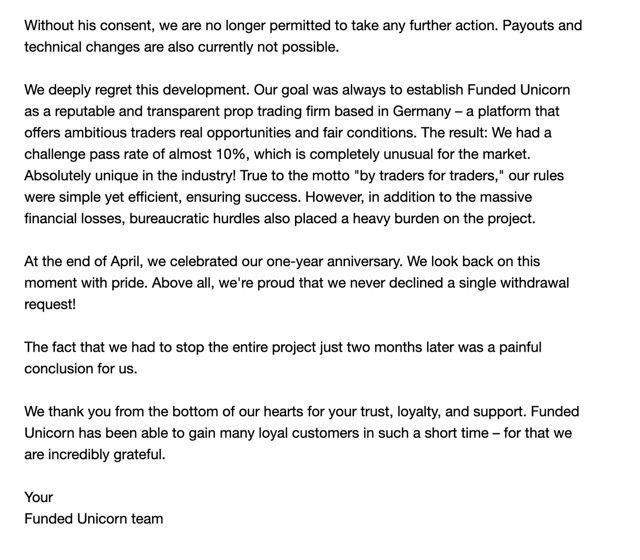
“We deeply regret this development. Our goal was always to
establish Funded Unicorn as a reputable and transparent prop trading firm based
in Germany – a platform that offers ambitious traders real opportunities and
fair conditions,” the company wrote in a statement circulated to its users.
A screenshot of the message forwarded to Funded Unicorn users
No Recovery Plans Yet
Funded Unicorn has yet to announce any recovery plans or future restructuring. In the message circulated to users, Funded Unicorn partly blamed what it described as bureaucratic hurdles for its business's closure. The company joins several other prop trading companies that have been forced to shut operations recently.
Towards the end of last year, Smart Prop Trader, a prop firm
offering funded trading accounts, announced it would stop accepting new traders
as it prepares to wind down operations by year-end.
And before that, Funded Engineer, another troubled prop
trading firm, also announced a “permanent closure” of its operations last year and
the decision to file for bankruptcy amid heightened volatility in the space. Around the same time, another prop trading firm, Karma
Capital, unexpectedly closed its operations.
The turmoil in the prop trading space claimed many companies
last year. According to estimates gathered by Finance Magnates Intelligence, between
80 and 100 proprietary trading firms may have disappeared from the market in 2024. What seemingly triggered the volatility was MetaQuotes' decision to step
back from supporting prop firms.
One of the biggest prop trading firms in Germany, Funded Unicorn, has closed its operations, shaking the prop trading community and raising deeper questions about the sustainability of certain risk models.
Unique A-Book Strategy
According to a blog by proptraders, unlike most prop
trading firms that rely on challenge fees and operate largely on a simulated
trading basis, Funded Unicorn used what’s known as an “A-book” model. The firm
mirrored every trade made by its funded traders on the actual market.
“We deeply regret this development. Our goal was always to
establish Funded Unicorn as a reputable and transparent prop trading firm based
in Germany – a platform that offers ambitious traders real opportunities and
fair conditions,” the company wrote in a statement circulated to its users.
A screenshot of the message forwarded to Funded Unicorn users
No Recovery Plans Yet
Funded Unicorn has yet to announce any recovery plans or future restructuring. In the message circulated to users, Funded Unicorn partly blamed what it described as bureaucratic hurdles for its business's closure. The company joins several other prop trading companies that have been forced to shut operations recently.
Towards the end of last year, Smart Prop Trader, a prop firm
offering funded trading accounts, announced it would stop accepting new traders
as it prepares to wind down operations by year-end.
And before that, Funded Engineer, another troubled prop
trading firm, also announced a “permanent closure” of its operations last year and
the decision to file for bankruptcy amid heightened volatility in the space. Around the same time, another prop trading firm, Karma
Capital, unexpectedly closed its operations.
The turmoil in the prop trading space claimed many companies
last year. According to estimates gathered by Finance Magnates Intelligence, between
80 and 100 proprietary trading firms may have disappeared from the market in 2024. What seemingly triggered the volatility was MetaQuotes' decision to step
back from supporting prop firms.
Jared Kirui is an Editor at Finance Magnates with more than five years of experience in financial journalism. He covers online trading, fintech, payments, and crypto industries with a focus on companies, regulation and compliance, executive moves, trading technology, and market analysis.
His work has been featured in other media outlets, including Benzinga, ZyCrypto, The Distributed, and The Daily Hodl.
Education:
Bachelor of Commerce degree (Finance option), University of Nairobi
Retail Traders Can Now Access Prediction Markets Through Binance Wallet
FP Markets Winner Spotlight 🏆 | Global Broker of the Year 2025 #Trading #Broker #Innovation #Shorts
FP Markets Winner Spotlight 🏆 | Global Broker of the Year 2025 #Trading #Broker #Innovation #Shorts
FP Markets takes the spotlight as Global Broker of the Year 2025 at the Finance Magnates Awards.
Martin Stoilov, Head of Client Experience, shares that trust, innovation, and people played a key role in the company’s success, supported by a strong foundation of integrity and client-centricity.
Following this milestone, FP Markets continues to focus on growth, technology investment, and its core values of transparency and excellence.
👉 Be part of FM Awards 2026: https://awards.financemagnates.com/#nominate
FP Markets takes the spotlight as Global Broker of the Year 2025 at the Finance Magnates Awards.
Martin Stoilov, Head of Client Experience, shares that trust, innovation, and people played a key role in the company’s success, supported by a strong foundation of integrity and client-centricity.
Following this milestone, FP Markets continues to focus on growth, technology investment, and its core values of transparency and excellence.
👉 Be part of FM Awards 2026: https://awards.financemagnates.com/#nominate
In this video, we review @HolaPrimeMarketsOfficial, a multi-asset forex and CFDs broker offering different account types, trading platforms, and flexible trading conditions.
We cover the broker’s overall offering, including account options, trading environment, platforms like MT4 and MT5, and additional services such as managed accounts and fast withdrawals.
Watch the full video to see if Hola Prime Markets fits your trading needs.
📣 Stay up to date with the latest in finance and trading. Follow Finance Magnates for industry news, insights, and global event coverage.
Connect with us:
🔗 LinkedIn: /financemagnates
👍 Facebook: /financemagnates
📸 Instagram: https://www.instagram.com/financemagnates
🐦 X: https://x.com/financemagnates
🎥 TikTok: https://www.tiktok.com/tag/financemagnates
▶️ YouTube: /@financemagnates_official
#HolaPrime #ForexBroker #CFDTrading #FinanceMagnates #Trading #Forex #BrokerReview
In this video, we review @HolaPrimeMarketsOfficial, a multi-asset forex and CFDs broker offering different account types, trading platforms, and flexible trading conditions.
We cover the broker’s overall offering, including account options, trading environment, platforms like MT4 and MT5, and additional services such as managed accounts and fast withdrawals.
Watch the full video to see if Hola Prime Markets fits your trading needs.
📣 Stay up to date with the latest in finance and trading. Follow Finance Magnates for industry news, insights, and global event coverage.
Connect with us:
🔗 LinkedIn: /financemagnates
👍 Facebook: /financemagnates
📸 Instagram: https://www.instagram.com/financemagnates
🐦 X: https://x.com/financemagnates
🎥 TikTok: https://www.tiktok.com/tag/financemagnates
▶️ YouTube: /@financemagnates_official
#HolaPrime #ForexBroker #CFDTrading #FinanceMagnates #Trading #Forex #BrokerReview
Hola Prime Review: What You Need to Know | Full Breakdown by Finance Magnates
Hola Prime Review: What You Need to Know | Full Breakdown by Finance Magnates
In this video, we review @HolaPrime_Global, a proprietary trading firm offering evaluation programs and performance-based payouts in simulated market environments.
We cover how the challenge model works, including account types, profit splits (up to 95%), trading rules, and what it takes to reach a funded account. You’ll also learn about available platforms like MT4, MT5, cTrader, and more, along with insights into payouts, support, and trading conditions.
Watch the full video to see if Hola Prime fits your trading style.
📣 Stay up to date with the latest in finance and trading. Follow Finance Magnates for industry news, insights, and global event coverage.
Connect with us:
🔗 LinkedIn: /financemagnates
👍 Facebook: /financemagnates
📸 Instagram: https://www.instagram.com/financemagnates
🐦 X: https://x.com/financemagnates
🎥 TikTok: https://www.tiktok.com/tag/financemagnates
▶️ YouTube: /@financemagnates_official
#HolaPrime #PropFirm #Trading #FinanceMagnates #Forex #FuturesTrading #TradingReview #PropFirmReview
In this video, we review @HolaPrime_Global, a proprietary trading firm offering evaluation programs and performance-based payouts in simulated market environments.
We cover how the challenge model works, including account types, profit splits (up to 95%), trading rules, and what it takes to reach a funded account. You’ll also learn about available platforms like MT4, MT5, cTrader, and more, along with insights into payouts, support, and trading conditions.
Watch the full video to see if Hola Prime fits your trading style.
📣 Stay up to date with the latest in finance and trading. Follow Finance Magnates for industry news, insights, and global event coverage.
Connect with us:
🔗 LinkedIn: /financemagnates
👍 Facebook: /financemagnates
📸 Instagram: https://www.instagram.com/financemagnates
🐦 X: https://x.com/financemagnates
🎥 TikTok: https://www.tiktok.com/tag/financemagnates
▶️ YouTube: /@financemagnates_official
#HolaPrime #PropFirm #Trading #FinanceMagnates #Forex #FuturesTrading #TradingReview #PropFirmReview
Axi Winner Spotlight 🏆 | Global Most Innovative Broker 2025 #Innovation #Trading #Fintech #Broker
Axi Winner Spotlight 🏆 | Global Most Innovative Broker 2025 #Innovation #Trading #Fintech #Broker
Axi takes the spotlight at the Finance Magnates Awards, winning Global Most Innovative Broker 2025.
Olivia Xenofontos and Ivanna Openko share how the team will feel: proud, motivated, and ready to keep delivering.
They also describe the night as well-organized, focused, and enjoyable for all.
👉 Be part of FM Awards 2026.
Axi takes the spotlight at the Finance Magnates Awards, winning Global Most Innovative Broker 2025.
Olivia Xenofontos and Ivanna Openko share how the team will feel: proud, motivated, and ready to keep delivering.
They also describe the night as well-organized, focused, and enjoyable for all.
👉 Be part of FM Awards 2026.
Recognition that matters.
Built on transparency.
Driven by the industry.
The Finance Magnates Awards 2026.
Nominations are now open.
🔗 https://awards.financemagnates.com/?utm_source=SM&utm_medium=social&utm_campaign=recognition-matters
Recognition that matters.
Built on transparency.
Driven by the industry.
The Finance Magnates Awards 2026.
Nominations are now open.
🔗 https://awards.financemagnates.com/?utm_source=SM&utm_medium=social&utm_campaign=recognition-matters