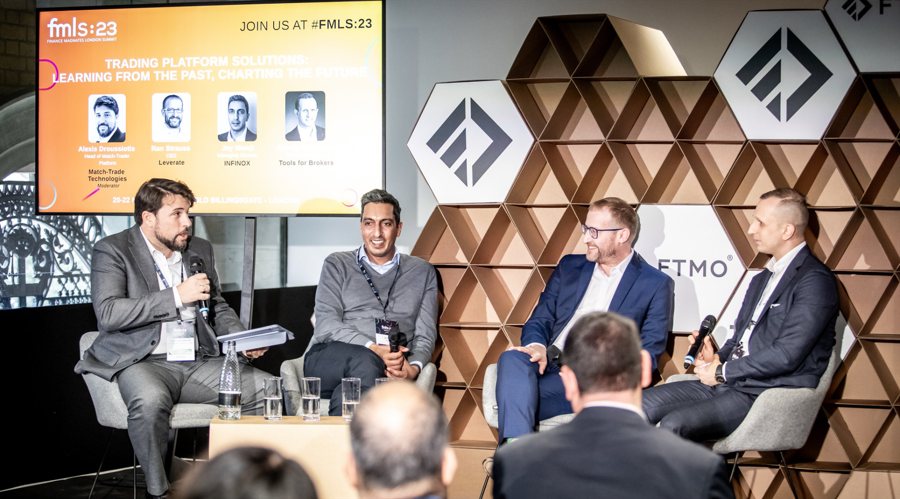
The FMLS panelists of “Learning from the Past, Charting the Future” explored the influence of AI and quantum computing, on the evolution of platforms.
Meeting the diverse demand for trading products challenges effective tailoring to varied clientele preferences.
Finance Magnates London Summit (FMLS:23)
In
a panel discussion at the Finance Magnates London Summit (FMLS:23), industry
experts discussed the challenges and evolution of trading platforms over the
years. The session, entitled: "Trading Platform Solutions: Learning from the
Past, Charting the Future," featured prominent figures in the industry.
The
panel, moderated by Alexis Droussiotis, the Head of Match-Trader Platform at
Match-Trade Technologies, featured insights from Jay Mawji, the Managing Director
at INFINOX, Ran Strauss, the CEO at Leverate, and Alexey Kutsenko, the CEO &
Founder at Tools for Brokers.
Operational
Challenges and User Feedback: Driving Platform Evolution
The discussion kicked
off by reflecting on the operational challenges faced by the industry in 2005.
Mawji highlighted the constant battle faced by brokerages in keeping up with
evolving technology and platform stacks. "In the current
scenario, many of the products used by individuals are not highly developed
trading platforms or systems. If we examine the popular apps today, they are
notably simplified trading applications, akin to what was available 13 years
ago,” he stated.
Jay Mawji, Managing Director at INFINOX
“This situation
introduces a divergence in the kind of demand for these products. Addressing
this diversity in clientele preferences is a challenge, as discussed earlier.
It becomes challenging for us to determine how to offer our product effectively
to cater to these varied client types."
Ran Strauss, CEO at Leverate
Strauss
noted the shift from desktop dominance to the current multi-device landscape,
while Kutsenko emphasized the need for a multi-asset
platform to align with the diverse preferences of modern traders.
When
discussing the role of user feedback in shaping trading platforms, Mawji
emphasized the importance of technology providers driving innovations rather
than solely relying on client demands. Strauss highlighted the mix of passive
and active feedback received from users, including operational suggestions and
revenue-boosting features. Kutsenko stressed the need to adopt trends swiftly,
staying ahead of brokerage companies as technology providers.
An insightful discussion “Trading Platform Solutions: Learning from the Past, Charting the Future” during #FMLS2023 was hosted by Alexis Droussiotis, Head of Match-Trader platform.
Trader Demographics,
Broker Expectations, and Empowering Front-Ends
The
panel delved into the challenges of catering to different trader demographics,
including the preferences of Generation Z. Mawji acknowledged the divergence in
demand based on trading demographics, while Strauss and Kutsenko emphasized the
importance of adapting to trends and simplifying interfaces for novice traders.
Alexey Kutsenko, CEO & Founder at Tools for Brokers
"Meeting broker
expectations is a significant challenge. It's tough; they want everything,
basically, and they want it as soon as possible. However, we're in the
business, and that's what we're dealing with. You mentioned a few things, such
as migration, which is typically urgent—needed today or tomorrow, or even
yesterday. In addressing migration challenges, we aim to handle it with a dedicated
team, and this aligns with our approach in Professional Services," added
Strauss.
Addressing
the demanding nature of brokers,
the panelists shared their experiences in meeting urgent requests, such as
migration and operational feedback. Mawji highlighted the importance of
focusing on a value proposition, and Kutsenko emphasized the need to balance
customization with industry trends to keep clients satisfied.
Discussing
the trend of allowing brokers to create their own front-ends, Kutsenko
acknowledged the logical appeal for larger companies with multiple brands.
Strauss suggested providing rich APIs and tools for easy
integration, while Mawji cautioned against complete rebranding, citing the
challenges of attracting clients to a new interface.
Mobile
Trading and the Future: Emerging Technologies in Platforms
With
mobile trading becoming increasingly prevalent, the panelists recognized its
significance for both traders and brokers. Strauss highlighted the importance
of a mobile-first approach for acquiring new clients, while Kutsenko emphasized
the trend toward automated trading
from mobile devices.
Kutsenko
noted: "From the client's point of view, I think manual trading is
becoming a thing of the past. Nowadays, most of the trading is automated,
especially through mobile devices. With mobile trading, you have control over
everything related to your trading strategies and portfolio at every moment of
your life. Our lives are fast-paced, and everyone is constantly on the move,
making it impractical to sit in front of a desktop all day.”
Looking
ahead, the panelists discussed the impact of emerging technologies such as AI
and quantum computing on trading platforms. Strauss emphasized the role of AI in improving client
communication and machine learning in enhancing trading strategies. Kutsenko
and Mawji highlighted the potential for AI to bring new opportunities and
analyze data more efficiently.
As
the panel concluded, it was evident that the evolution of trading platforms
would continue to be shaped by technological advancements, user feedback, and
the dynamic nature of the financial markets. The industry leaders encouraged a
proactive approach to stay ahead in a landscape that is constantly evolving.
In
a panel discussion at the Finance Magnates London Summit (FMLS:23), industry
experts discussed the challenges and evolution of trading platforms over the
years. The session, entitled: "Trading Platform Solutions: Learning from the
Past, Charting the Future," featured prominent figures in the industry.
The
panel, moderated by Alexis Droussiotis, the Head of Match-Trader Platform at
Match-Trade Technologies, featured insights from Jay Mawji, the Managing Director
at INFINOX, Ran Strauss, the CEO at Leverate, and Alexey Kutsenko, the CEO &
Founder at Tools for Brokers.
Operational
Challenges and User Feedback: Driving Platform Evolution
The discussion kicked
off by reflecting on the operational challenges faced by the industry in 2005.
Mawji highlighted the constant battle faced by brokerages in keeping up with
evolving technology and platform stacks. "In the current
scenario, many of the products used by individuals are not highly developed
trading platforms or systems. If we examine the popular apps today, they are
notably simplified trading applications, akin to what was available 13 years
ago,” he stated.
Jay Mawji, Managing Director at INFINOX
“This situation
introduces a divergence in the kind of demand for these products. Addressing
this diversity in clientele preferences is a challenge, as discussed earlier.
It becomes challenging for us to determine how to offer our product effectively
to cater to these varied client types."
Ran Strauss, CEO at Leverate
Strauss
noted the shift from desktop dominance to the current multi-device landscape,
while Kutsenko emphasized the need for a multi-asset
platform to align with the diverse preferences of modern traders.
When
discussing the role of user feedback in shaping trading platforms, Mawji
emphasized the importance of technology providers driving innovations rather
than solely relying on client demands. Strauss highlighted the mix of passive
and active feedback received from users, including operational suggestions and
revenue-boosting features. Kutsenko stressed the need to adopt trends swiftly,
staying ahead of brokerage companies as technology providers.
An insightful discussion “Trading Platform Solutions: Learning from the Past, Charting the Future” during #FMLS2023 was hosted by Alexis Droussiotis, Head of Match-Trader platform.
Trader Demographics,
Broker Expectations, and Empowering Front-Ends
The
panel delved into the challenges of catering to different trader demographics,
including the preferences of Generation Z. Mawji acknowledged the divergence in
demand based on trading demographics, while Strauss and Kutsenko emphasized the
importance of adapting to trends and simplifying interfaces for novice traders.
Alexey Kutsenko, CEO & Founder at Tools for Brokers
"Meeting broker
expectations is a significant challenge. It's tough; they want everything,
basically, and they want it as soon as possible. However, we're in the
business, and that's what we're dealing with. You mentioned a few things, such
as migration, which is typically urgent—needed today or tomorrow, or even
yesterday. In addressing migration challenges, we aim to handle it with a dedicated
team, and this aligns with our approach in Professional Services," added
Strauss.
Addressing
the demanding nature of brokers,
the panelists shared their experiences in meeting urgent requests, such as
migration and operational feedback. Mawji highlighted the importance of
focusing on a value proposition, and Kutsenko emphasized the need to balance
customization with industry trends to keep clients satisfied.
Discussing
the trend of allowing brokers to create their own front-ends, Kutsenko
acknowledged the logical appeal for larger companies with multiple brands.
Strauss suggested providing rich APIs and tools for easy
integration, while Mawji cautioned against complete rebranding, citing the
challenges of attracting clients to a new interface.
Mobile
Trading and the Future: Emerging Technologies in Platforms
With
mobile trading becoming increasingly prevalent, the panelists recognized its
significance for both traders and brokers. Strauss highlighted the importance
of a mobile-first approach for acquiring new clients, while Kutsenko emphasized
the trend toward automated trading
from mobile devices.
Kutsenko
noted: "From the client's point of view, I think manual trading is
becoming a thing of the past. Nowadays, most of the trading is automated,
especially through mobile devices. With mobile trading, you have control over
everything related to your trading strategies and portfolio at every moment of
your life. Our lives are fast-paced, and everyone is constantly on the move,
making it impractical to sit in front of a desktop all day.”
Looking
ahead, the panelists discussed the impact of emerging technologies such as AI
and quantum computing on trading platforms. Strauss emphasized the role of AI in improving client
communication and machine learning in enhancing trading strategies. Kutsenko
and Mawji highlighted the potential for AI to bring new opportunities and
analyze data more efficiently.
As
the panel concluded, it was evident that the evolution of trading platforms
would continue to be shaped by technological advancements, user feedback, and
the dynamic nature of the financial markets. The industry leaders encouraged a
proactive approach to stay ahead in a landscape that is constantly evolving.
Tareq is a financial writer with 15 years of experience covering global markets. His work spans technical analysis, forex broker reviews, and market sentiment, with a focus on topics relevant to retail traders. He joined Finance Magnates in 2023.
At Finance Magnates, he serves as News Editor, covering retail forex and CFD brokers, cryptocurrency exchanges, fintech firms, and regulatory developments shaping the trading industry. He holds an Honours degree in Information Technology from Anfell College, London.
Education:
Honours degree Information Technology, Anfell College, London
Cyprus Is the EU’s CFD Broker Hub, and Its Youth Are the Bloc’s Most Online
Featured Videos
FP Markets Winner Spotlight 🏆 | Global Broker of the Year 2025 #Trading #Broker #Innovation #Shorts
FP Markets Winner Spotlight 🏆 | Global Broker of the Year 2025 #Trading #Broker #Innovation #Shorts
FP Markets Winner Spotlight 🏆 | Global Broker of the Year 2025 #Trading #Broker #Innovation #Shorts
FP Markets Winner Spotlight 🏆 | Global Broker of the Year 2025 #Trading #Broker #Innovation #Shorts
FP Markets takes the spotlight as Global Broker of the Year 2025 at the Finance Magnates Awards.
Martin Stoilov, Head of Client Experience, shares that trust, innovation, and people played a key role in the company’s success, supported by a strong foundation of integrity and client-centricity.
Following this milestone, FP Markets continues to focus on growth, technology investment, and its core values of transparency and excellence.
👉 Be part of FM Awards 2026: https://awards.financemagnates.com/#nominate
FP Markets takes the spotlight as Global Broker of the Year 2025 at the Finance Magnates Awards.
Martin Stoilov, Head of Client Experience, shares that trust, innovation, and people played a key role in the company’s success, supported by a strong foundation of integrity and client-centricity.
Following this milestone, FP Markets continues to focus on growth, technology investment, and its core values of transparency and excellence.
👉 Be part of FM Awards 2026: https://awards.financemagnates.com/#nominate
FP Markets takes the spotlight as Global Broker of the Year 2025 at the Finance Magnates Awards.
Martin Stoilov, Head of Client Experience, shares that trust, innovation, and people played a key role in the company’s success, supported by a strong foundation of integrity and client-centricity.
Following this milestone, FP Markets continues to focus on growth, technology investment, and its core values of transparency and excellence.
👉 Be part of FM Awards 2026: https://awards.financemagnates.com/#nominate
FP Markets takes the spotlight as Global Broker of the Year 2025 at the Finance Magnates Awards.
Martin Stoilov, Head of Client Experience, shares that trust, innovation, and people played a key role in the company’s success, supported by a strong foundation of integrity and client-centricity.
Following this milestone, FP Markets continues to focus on growth, technology investment, and its core values of transparency and excellence.
👉 Be part of FM Awards 2026: https://awards.financemagnates.com/#nominate
In this video, we review @HolaPrimeMarketsOfficial, a multi-asset forex and CFDs broker offering different account types, trading platforms, and flexible trading conditions.
We cover the broker’s overall offering, including account options, trading environment, platforms like MT4 and MT5, and additional services such as managed accounts and fast withdrawals.
Watch the full video to see if Hola Prime Markets fits your trading needs.
📣 Stay up to date with the latest in finance and trading. Follow Finance Magnates for industry news, insights, and global event coverage.
Connect with us:
🔗 LinkedIn: /financemagnates
👍 Facebook: /financemagnates
📸 Instagram: https://www.instagram.com/financemagnates
🐦 X: https://x.com/financemagnates
🎥 TikTok: https://www.tiktok.com/tag/financemagnates
▶️ YouTube: /@financemagnates_official
#HolaPrime #ForexBroker #CFDTrading #FinanceMagnates #Trading #Forex #BrokerReview
In this video, we review @HolaPrimeMarketsOfficial, a multi-asset forex and CFDs broker offering different account types, trading platforms, and flexible trading conditions.
We cover the broker’s overall offering, including account options, trading environment, platforms like MT4 and MT5, and additional services such as managed accounts and fast withdrawals.
Watch the full video to see if Hola Prime Markets fits your trading needs.
📣 Stay up to date with the latest in finance and trading. Follow Finance Magnates for industry news, insights, and global event coverage.
Connect with us:
🔗 LinkedIn: /financemagnates
👍 Facebook: /financemagnates
📸 Instagram: https://www.instagram.com/financemagnates
🐦 X: https://x.com/financemagnates
🎥 TikTok: https://www.tiktok.com/tag/financemagnates
▶️ YouTube: /@financemagnates_official
#HolaPrime #ForexBroker #CFDTrading #FinanceMagnates #Trading #Forex #BrokerReview
In this video, we review @HolaPrimeMarketsOfficial, a multi-asset forex and CFDs broker offering different account types, trading platforms, and flexible trading conditions.
We cover the broker’s overall offering, including account options, trading environment, platforms like MT4 and MT5, and additional services such as managed accounts and fast withdrawals.
Watch the full video to see if Hola Prime Markets fits your trading needs.
📣 Stay up to date with the latest in finance and trading. Follow Finance Magnates for industry news, insights, and global event coverage.
Connect with us:
🔗 LinkedIn: /financemagnates
👍 Facebook: /financemagnates
📸 Instagram: https://www.instagram.com/financemagnates
🐦 X: https://x.com/financemagnates
🎥 TikTok: https://www.tiktok.com/tag/financemagnates
▶️ YouTube: /@financemagnates_official
#HolaPrime #ForexBroker #CFDTrading #FinanceMagnates #Trading #Forex #BrokerReview
In this video, we review @HolaPrimeMarketsOfficial, a multi-asset forex and CFDs broker offering different account types, trading platforms, and flexible trading conditions.
We cover the broker’s overall offering, including account options, trading environment, platforms like MT4 and MT5, and additional services such as managed accounts and fast withdrawals.
Watch the full video to see if Hola Prime Markets fits your trading needs.
📣 Stay up to date with the latest in finance and trading. Follow Finance Magnates for industry news, insights, and global event coverage.
Connect with us:
🔗 LinkedIn: /financemagnates
👍 Facebook: /financemagnates
📸 Instagram: https://www.instagram.com/financemagnates
🐦 X: https://x.com/financemagnates
🎥 TikTok: https://www.tiktok.com/tag/financemagnates
▶️ YouTube: /@financemagnates_official
#HolaPrime #ForexBroker #CFDTrading #FinanceMagnates #Trading #Forex #BrokerReview
In this video, we review @HolaPrimeMarketsOfficial, a multi-asset forex and CFDs broker offering different account types, trading platforms, and flexible trading conditions.
We cover the broker’s overall offering, including account options, trading environment, platforms like MT4 and MT5, and additional services such as managed accounts and fast withdrawals.
Watch the full video to see if Hola Prime Markets fits your trading needs.
📣 Stay up to date with the latest in finance and trading. Follow Finance Magnates for industry news, insights, and global event coverage.
Connect with us:
🔗 LinkedIn: /financemagnates
👍 Facebook: /financemagnates
📸 Instagram: https://www.instagram.com/financemagnates
🐦 X: https://x.com/financemagnates
🎥 TikTok: https://www.tiktok.com/tag/financemagnates
▶️ YouTube: /@financemagnates_official
#HolaPrime #ForexBroker #CFDTrading #FinanceMagnates #Trading #Forex #BrokerReview
In this video, we review @HolaPrimeMarketsOfficial, a multi-asset forex and CFDs broker offering different account types, trading platforms, and flexible trading conditions.
We cover the broker’s overall offering, including account options, trading environment, platforms like MT4 and MT5, and additional services such as managed accounts and fast withdrawals.
Watch the full video to see if Hola Prime Markets fits your trading needs.
📣 Stay up to date with the latest in finance and trading. Follow Finance Magnates for industry news, insights, and global event coverage.
Connect with us:
🔗 LinkedIn: /financemagnates
👍 Facebook: /financemagnates
📸 Instagram: https://www.instagram.com/financemagnates
🐦 X: https://x.com/financemagnates
🎥 TikTok: https://www.tiktok.com/tag/financemagnates
▶️ YouTube: /@financemagnates_official
#HolaPrime #ForexBroker #CFDTrading #FinanceMagnates #Trading #Forex #BrokerReview
Hola Prime Review: What You Need to Know | Full Breakdown by Finance Magnates
Hola Prime Review: What You Need to Know | Full Breakdown by Finance Magnates
Hola Prime Review: What You Need to Know | Full Breakdown by Finance Magnates
Hola Prime Review: What You Need to Know | Full Breakdown by Finance Magnates
Hola Prime Review: What You Need to Know | Full Breakdown by Finance Magnates
Hola Prime Review: What You Need to Know | Full Breakdown by Finance Magnates
In this video, we review @HolaPrime_Global, a proprietary trading firm offering evaluation programs and performance-based payouts in simulated market environments.
We cover how the challenge model works, including account types, profit splits (up to 95%), trading rules, and what it takes to reach a funded account. You’ll also learn about available platforms like MT4, MT5, cTrader, and more, along with insights into payouts, support, and trading conditions.
Watch the full video to see if Hola Prime fits your trading style.
📣 Stay up to date with the latest in finance and trading. Follow Finance Magnates for industry news, insights, and global event coverage.
Connect with us:
🔗 LinkedIn: /financemagnates
👍 Facebook: /financemagnates
📸 Instagram: https://www.instagram.com/financemagnates
🐦 X: https://x.com/financemagnates
🎥 TikTok: https://www.tiktok.com/tag/financemagnates
▶️ YouTube: /@financemagnates_official
#HolaPrime #PropFirm #Trading #FinanceMagnates #Forex #FuturesTrading #TradingReview #PropFirmReview
In this video, we review @HolaPrime_Global, a proprietary trading firm offering evaluation programs and performance-based payouts in simulated market environments.
We cover how the challenge model works, including account types, profit splits (up to 95%), trading rules, and what it takes to reach a funded account. You’ll also learn about available platforms like MT4, MT5, cTrader, and more, along with insights into payouts, support, and trading conditions.
Watch the full video to see if Hola Prime fits your trading style.
📣 Stay up to date with the latest in finance and trading. Follow Finance Magnates for industry news, insights, and global event coverage.
Connect with us:
🔗 LinkedIn: /financemagnates
👍 Facebook: /financemagnates
📸 Instagram: https://www.instagram.com/financemagnates
🐦 X: https://x.com/financemagnates
🎥 TikTok: https://www.tiktok.com/tag/financemagnates
▶️ YouTube: /@financemagnates_official
#HolaPrime #PropFirm #Trading #FinanceMagnates #Forex #FuturesTrading #TradingReview #PropFirmReview
In this video, we review @HolaPrime_Global, a proprietary trading firm offering evaluation programs and performance-based payouts in simulated market environments.
We cover how the challenge model works, including account types, profit splits (up to 95%), trading rules, and what it takes to reach a funded account. You’ll also learn about available platforms like MT4, MT5, cTrader, and more, along with insights into payouts, support, and trading conditions.
Watch the full video to see if Hola Prime fits your trading style.
📣 Stay up to date with the latest in finance and trading. Follow Finance Magnates for industry news, insights, and global event coverage.
Connect with us:
🔗 LinkedIn: /financemagnates
👍 Facebook: /financemagnates
📸 Instagram: https://www.instagram.com/financemagnates
🐦 X: https://x.com/financemagnates
🎥 TikTok: https://www.tiktok.com/tag/financemagnates
▶️ YouTube: /@financemagnates_official
#HolaPrime #PropFirm #Trading #FinanceMagnates #Forex #FuturesTrading #TradingReview #PropFirmReview
In this video, we review @HolaPrime_Global, a proprietary trading firm offering evaluation programs and performance-based payouts in simulated market environments.
We cover how the challenge model works, including account types, profit splits (up to 95%), trading rules, and what it takes to reach a funded account. You’ll also learn about available platforms like MT4, MT5, cTrader, and more, along with insights into payouts, support, and trading conditions.
Watch the full video to see if Hola Prime fits your trading style.
📣 Stay up to date with the latest in finance and trading. Follow Finance Magnates for industry news, insights, and global event coverage.
Connect with us:
🔗 LinkedIn: /financemagnates
👍 Facebook: /financemagnates
📸 Instagram: https://www.instagram.com/financemagnates
🐦 X: https://x.com/financemagnates
🎥 TikTok: https://www.tiktok.com/tag/financemagnates
▶️ YouTube: /@financemagnates_official
#HolaPrime #PropFirm #Trading #FinanceMagnates #Forex #FuturesTrading #TradingReview #PropFirmReview
In this video, we review @HolaPrime_Global, a proprietary trading firm offering evaluation programs and performance-based payouts in simulated market environments.
We cover how the challenge model works, including account types, profit splits (up to 95%), trading rules, and what it takes to reach a funded account. You’ll also learn about available platforms like MT4, MT5, cTrader, and more, along with insights into payouts, support, and trading conditions.
Watch the full video to see if Hola Prime fits your trading style.
📣 Stay up to date with the latest in finance and trading. Follow Finance Magnates for industry news, insights, and global event coverage.
Connect with us:
🔗 LinkedIn: /financemagnates
👍 Facebook: /financemagnates
📸 Instagram: https://www.instagram.com/financemagnates
🐦 X: https://x.com/financemagnates
🎥 TikTok: https://www.tiktok.com/tag/financemagnates
▶️ YouTube: /@financemagnates_official
#HolaPrime #PropFirm #Trading #FinanceMagnates #Forex #FuturesTrading #TradingReview #PropFirmReview
In this video, we review @HolaPrime_Global, a proprietary trading firm offering evaluation programs and performance-based payouts in simulated market environments.
We cover how the challenge model works, including account types, profit splits (up to 95%), trading rules, and what it takes to reach a funded account. You’ll also learn about available platforms like MT4, MT5, cTrader, and more, along with insights into payouts, support, and trading conditions.
Watch the full video to see if Hola Prime fits your trading style.
📣 Stay up to date with the latest in finance and trading. Follow Finance Magnates for industry news, insights, and global event coverage.
Connect with us:
🔗 LinkedIn: /financemagnates
👍 Facebook: /financemagnates
📸 Instagram: https://www.instagram.com/financemagnates
🐦 X: https://x.com/financemagnates
🎥 TikTok: https://www.tiktok.com/tag/financemagnates
▶️ YouTube: /@financemagnates_official
#HolaPrime #PropFirm #Trading #FinanceMagnates #Forex #FuturesTrading #TradingReview #PropFirmReview
Axi Winner Spotlight 🏆 | Global Most Innovative Broker 2025 #Innovation #Trading #Fintech #Broker
Axi Winner Spotlight 🏆 | Global Most Innovative Broker 2025 #Innovation #Trading #Fintech #Broker
Axi Winner Spotlight 🏆 | Global Most Innovative Broker 2025 #Innovation #Trading #Fintech #Broker
Axi Winner Spotlight 🏆 | Global Most Innovative Broker 2025 #Innovation #Trading #Fintech #Broker
Axi Winner Spotlight 🏆 | Global Most Innovative Broker 2025 #Innovation #Trading #Fintech #Broker
Axi Winner Spotlight 🏆 | Global Most Innovative Broker 2025 #Innovation #Trading #Fintech #Broker
Axi takes the spotlight at the Finance Magnates Awards, winning Global Most Innovative Broker 2025.
Olivia Xenofontos and Ivanna Openko share how the team will feel: proud, motivated, and ready to keep delivering.
They also describe the night as well-organized, focused, and enjoyable for all.
👉 Be part of FM Awards 2026.
Axi takes the spotlight at the Finance Magnates Awards, winning Global Most Innovative Broker 2025.
Olivia Xenofontos and Ivanna Openko share how the team will feel: proud, motivated, and ready to keep delivering.
They also describe the night as well-organized, focused, and enjoyable for all.
👉 Be part of FM Awards 2026.
Axi takes the spotlight at the Finance Magnates Awards, winning Global Most Innovative Broker 2025.
Olivia Xenofontos and Ivanna Openko share how the team will feel: proud, motivated, and ready to keep delivering.
They also describe the night as well-organized, focused, and enjoyable for all.
👉 Be part of FM Awards 2026.
Axi takes the spotlight at the Finance Magnates Awards, winning Global Most Innovative Broker 2025.
Olivia Xenofontos and Ivanna Openko share how the team will feel: proud, motivated, and ready to keep delivering.
They also describe the night as well-organized, focused, and enjoyable for all.
👉 Be part of FM Awards 2026.
Axi takes the spotlight at the Finance Magnates Awards, winning Global Most Innovative Broker 2025.
Olivia Xenofontos and Ivanna Openko share how the team will feel: proud, motivated, and ready to keep delivering.
They also describe the night as well-organized, focused, and enjoyable for all.
👉 Be part of FM Awards 2026.
Axi takes the spotlight at the Finance Magnates Awards, winning Global Most Innovative Broker 2025.
Olivia Xenofontos and Ivanna Openko share how the team will feel: proud, motivated, and ready to keep delivering.
They also describe the night as well-organized, focused, and enjoyable for all.
👉 Be part of FM Awards 2026.
Recognition that matters.
Built on transparency.
Driven by the industry.
The Finance Magnates Awards 2026.
Nominations are now open.
🔗 https://awards.financemagnates.com/?utm_source=SM&utm_medium=social&utm_campaign=recognition-matters
Recognition that matters.
Built on transparency.
Driven by the industry.
The Finance Magnates Awards 2026.
Nominations are now open.
🔗 https://awards.financemagnates.com/?utm_source=SM&utm_medium=social&utm_campaign=recognition-matters
Recognition that matters.
Built on transparency.
Driven by the industry.
The Finance Magnates Awards 2026.
Nominations are now open.
🔗 https://awards.financemagnates.com/?utm_source=SM&utm_medium=social&utm_campaign=recognition-matters
Recognition that matters.
Built on transparency.
Driven by the industry.
The Finance Magnates Awards 2026.
Nominations are now open.
🔗 https://awards.financemagnates.com/?utm_source=SM&utm_medium=social&utm_campaign=recognition-matters
Recognition that matters.
Built on transparency.
Driven by the industry.
The Finance Magnates Awards 2026.
Nominations are now open.
🔗 https://awards.financemagnates.com/?utm_source=SM&utm_medium=social&utm_campaign=recognition-matters
Recognition that matters.
Built on transparency.
Driven by the industry.
The Finance Magnates Awards 2026.
Nominations are now open.
🔗 https://awards.financemagnates.com/?utm_source=SM&utm_medium=social&utm_campaign=recognition-matters