84% of women surveyed expressed concerns about sharing personal information online compared to 78% of men.
Younger individuals are more likely to share their identity online.
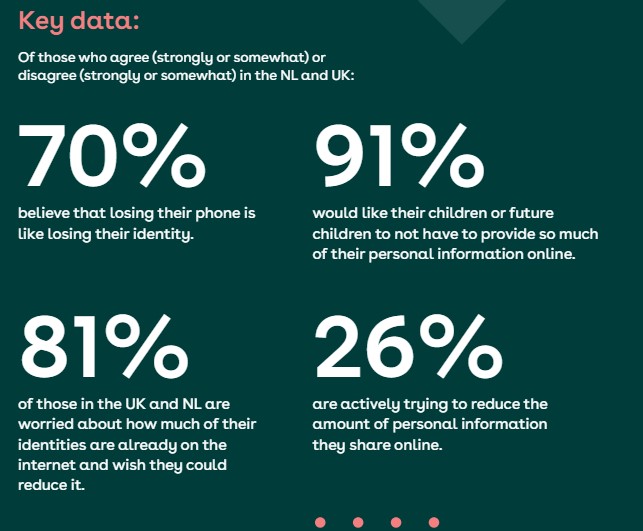
Women are more cautious than men about sharing personal information online, with 84% of those recently surveyed expressing
concerns compared to 78% of men. These findings were highlighted in a survey by Digidentity
that focused on digital platform users in
the UK and the Netherlands. The study found that gender, age, and
nationality play significant roles in shaping individuals' attitudes and
behaviors toward online privacy and security.
Online Identity Protection
While concerns about data breaches and identity theft
are prevalent across all demographics, there are notable differences in how
various groups approach and perceive these issues. 80% of respondents aged between 16 and 24
are worried about identity theft, while 90% of those aged 55 and
above care about identity theft.
There is a lower likelihood of women oversharing
personal details to reduce their vulnerability to identity theft. Additionally,
women are less inclined to trade personal data for expedited online
access than men, further highlighting their cautious approach to online privacy.
Source: Digidentity
Besides that, younger individuals, growing up in a digital-first
environment, are more accustomed to sharing their identity online. While they
express worries about the extent of their online footprint, they are also less
concerned about potential risks such as scams compared to older generations.
However, both younger and older age groups exhibit
significant levels of concern about data breaches and fraud, albeit with
differing degrees of intensity. 78% of the respondents aged 16 and 24 expressed concerns about data breaches, while 92% of those aged 55 years and
above care about this aspect.
Marcel Wendt, the Chief Technology Officer and Founder
at Digidentity, mentioned: "Gen Z have grown up in a digital-first world, so are used
to their identity existing online. This could explain why they are the least
likely age group to reduce their online presence."
"However, there is a clear disconnect between concern
and action amongst this generation. This could point to users' lack of control
over their digital identity, especially among younger generations. Not only
does work need to be done to ensure consumers are aware of the risks involved
with sharing too much personal data, but also to put users first and in
control of their data."
National Variances in Identity Anxiety
The research indicated notable differences in online
identity concerns between countries, with the UK exhibiting heightened
apprehension compared to the Netherlands. UK citizens expressed greater worries
about unauthorized access to online banking services, identity theft, and data
breaches, reflecting a more cautious approach to online privacy.
Despite widespread concerns about online privacy and
security, a significant proportion of individuals do not actively take steps to
minimize their online footprint. While the UK emphasizes data privacy, it lags behind
the EU in adopting digital identity wallets. Challenges include reconciling
convenience with privacy concerns and aligning with the emerging EU framework.
Women are more cautious than men about sharing personal information online, with 84% of those recently surveyed expressing
concerns compared to 78% of men. These findings were highlighted in a survey by Digidentity
that focused on digital platform users in
the UK and the Netherlands. The study found that gender, age, and
nationality play significant roles in shaping individuals' attitudes and
behaviors toward online privacy and security.
Online Identity Protection
While concerns about data breaches and identity theft
are prevalent across all demographics, there are notable differences in how
various groups approach and perceive these issues. 80% of respondents aged between 16 and 24
are worried about identity theft, while 90% of those aged 55 and
above care about identity theft.
There is a lower likelihood of women oversharing
personal details to reduce their vulnerability to identity theft. Additionally,
women are less inclined to trade personal data for expedited online
access than men, further highlighting their cautious approach to online privacy.
Source: Digidentity
Besides that, younger individuals, growing up in a digital-first
environment, are more accustomed to sharing their identity online. While they
express worries about the extent of their online footprint, they are also less
concerned about potential risks such as scams compared to older generations.
However, both younger and older age groups exhibit
significant levels of concern about data breaches and fraud, albeit with
differing degrees of intensity. 78% of the respondents aged 16 and 24 expressed concerns about data breaches, while 92% of those aged 55 years and
above care about this aspect.
Marcel Wendt, the Chief Technology Officer and Founder
at Digidentity, mentioned: "Gen Z have grown up in a digital-first world, so are used
to their identity existing online. This could explain why they are the least
likely age group to reduce their online presence."
"However, there is a clear disconnect between concern
and action amongst this generation. This could point to users' lack of control
over their digital identity, especially among younger generations. Not only
does work need to be done to ensure consumers are aware of the risks involved
with sharing too much personal data, but also to put users first and in
control of their data."
National Variances in Identity Anxiety
The research indicated notable differences in online
identity concerns between countries, with the UK exhibiting heightened
apprehension compared to the Netherlands. UK citizens expressed greater worries
about unauthorized access to online banking services, identity theft, and data
breaches, reflecting a more cautious approach to online privacy.
Despite widespread concerns about online privacy and
security, a significant proportion of individuals do not actively take steps to
minimize their online footprint. While the UK emphasizes data privacy, it lags behind
the EU in adopting digital identity wallets. Challenges include reconciling
convenience with privacy concerns and aligning with the emerging EU framework.
Jared Kirui is an Editor at Finance Magnates with more than five years of experience in financial journalism. He covers online trading, fintech, payments, and crypto industries with a focus on companies, regulation and compliance, executive moves, trading technology, and market analysis.
His work has been featured in other media outlets, including Benzinga, ZyCrypto, The Distributed, and The Daily Hodl.
Education:
Bachelor of Commerce degree (Finance option), University of Nairobi
Bitget Hits $6 Billion in CFDs as Investors Increase Activity Across Multi-Asset and Tokenized Products
Finance Magnates Awards 2026 – Nominations Now Open
Finance Magnates Awards 2026 – Nominations Now Open
The Finance Magnates Awards 2026 nominations are now open. 🏆
From fintech innovators to leading brokers, this is where the finance industry celebrates its biggest achievements.
Winners will be announced at the Cyprus Gala Dinner on November 6, 2026.
Nominate your brand now.
https://awards.financemagnates.com/?utm_source=linkedin&utm_medium=video&utm_campaign=nominations-open
#FMAwards #FinanceMagnates #FintechAwards #Fintech #FinanceIndustry
The Finance Magnates Awards 2026 nominations are now open. 🏆
From fintech innovators to leading brokers, this is where the finance industry celebrates its biggest achievements.
Winners will be announced at the Cyprus Gala Dinner on November 6, 2026.
Nominate your brand now.
https://awards.financemagnates.com/?utm_source=linkedin&utm_medium=video&utm_campaign=nominations-open
#FMAwards #FinanceMagnates #FintechAwards #Fintech #FinanceIndustry
Finance Magnates Awards 2026 | Nominations Now Open 🏆#Fintech #FMAwards #TradingIndustry
Finance Magnates Awards 2026 | Nominations Now Open 🏆#Fintech #FMAwards #TradingIndustry
Lights on. Cameras ready. 🎬
Finance Magnates Awards 2026 nominations are now open. 🏆
#FMAwards #FinanceMagnates #FintechAwards #Fintech
Lights on. Cameras ready. 🎬
Finance Magnates Awards 2026 nominations are now open. 🏆
#FMAwards #FinanceMagnates #FintechAwards #Fintech
Exness sees trust as the key theme for growth in MENA Trading Growth for 2026
Exness sees trust as the key theme for growth in MENA Trading Growth for 2026
Mohammad Amer, Regional Commercial Director at Exness, sits down to discuss the booming MENA financial trading market. Find out why Dubai is key to the company's growth strategy, how a mobile-first generation is changing expectations, and why trust will be the defining theme for traders in 2026.
In this interview, you'll learn:
* Why Dubai and the MENA region are critical growth markets for fintech and online trading.
* How Exness is addressing the demands of mobile-first, younger traders through engineering, platform stability, and transparent conditions.
* The essential role local talent plays in providing a culturally relevant and compliant user experience.
* Mohammad Amer's outlook on the future of the online trading industry and why stronger controls and systems are necessary.
* Why "trust" isn't just a brand value, but has commercial value—and why he predicts 2026 will be the "Year of Trust."
Key Takeaways:
➡️ The MENA region is rapidly shaping global financial markets.
➡️ New traders expect stability, precise execution, and transparency.
➡️ Local expertise is key to regulatory compliance and user experience.
➡️ Future success belongs to firms capable of meeting rising standards across regulation and platform consistency.
Read the full article at: https://www.financemagnates.com/thought-leadership/exness-sees-trust-as-the-key-theme-for-growth-in-mena-trading-growth-for-2026/
#Exness #MENA #Trading #FinTech #Dubai #OnlineTrading #FinanceMagnates #MohammadAmer #Trust #MobileTrading
Mohammad Amer, Regional Commercial Director at Exness, sits down to discuss the booming MENA financial trading market. Find out why Dubai is key to the company's growth strategy, how a mobile-first generation is changing expectations, and why trust will be the defining theme for traders in 2026.
In this interview, you'll learn:
* Why Dubai and the MENA region are critical growth markets for fintech and online trading.
* How Exness is addressing the demands of mobile-first, younger traders through engineering, platform stability, and transparent conditions.
* The essential role local talent plays in providing a culturally relevant and compliant user experience.
* Mohammad Amer's outlook on the future of the online trading industry and why stronger controls and systems are necessary.
* Why "trust" isn't just a brand value, but has commercial value—and why he predicts 2026 will be the "Year of Trust."
Key Takeaways:
➡️ The MENA region is rapidly shaping global financial markets.
➡️ New traders expect stability, precise execution, and transparency.
➡️ Local expertise is key to regulatory compliance and user experience.
➡️ Future success belongs to firms capable of meeting rising standards across regulation and platform consistency.
Read the full article at: https://www.financemagnates.com/thought-leadership/exness-sees-trust-as-the-key-theme-for-growth-in-mena-trading-growth-for-2026/
#Exness #MENA #Trading #FinTech #Dubai #OnlineTrading #FinanceMagnates #MohammadAmer #Trust #MobileTrading
Paytiko CEO Razi Salih on Why Payment Orchestration is a MUST-HAVE for Brokers in 2026
Paytiko CEO Razi Salih on Why Payment Orchestration is a MUST-HAVE for Brokers in 2026
At iFX Expo Dubai, Finance Magnates spoke with Razi Salih, CEO at Paytiko, about the evolution of the payments ecosystem and why payment orchestration has shifted from an option to a necessity for brokers, prop firms, and exchanges.
Mr. Salih explains how global expansion, the need for deep localisation, and the sheer number of new payment methods, from instant banking to stablecoins, are driving this critical infrastructure shift.
#PaymentOrchestration #Fintech #Brokerage #TradingPayments #RaziSalih #Paytiko #iFXExpoDubai #Stablecoins #AIinFintech
At iFX Expo Dubai, Finance Magnates spoke with Razi Salih, CEO at Paytiko, about the evolution of the payments ecosystem and why payment orchestration has shifted from an option to a necessity for brokers, prop firms, and exchanges.
Mr. Salih explains how global expansion, the need for deep localisation, and the sheer number of new payment methods, from instant banking to stablecoins, are driving this critical infrastructure shift.
#PaymentOrchestration #Fintech #Brokerage #TradingPayments #RaziSalih #Paytiko #iFXExpoDubai #Stablecoins #AIinFintech
Altima CTO Sunil Jadhav: Solving Data Fragmentation & Lag for Brokers & Prop Firms
Altima CTO Sunil Jadhav: Solving Data Fragmentation & Lag for Brokers & Prop Firms
Altima CTO Sunil Jadhav sits down with Finance Magnates to discuss the core technology challenges facing CFD brokers and proprietary trading firms today.
Jadhav explains how the industry's reliance on batch processing and fragmented systems (where CRMs, risk tools, and trading platforms operate with separate 'sources of truth') leads to delayed data and inconsistent operational decisions. He argues that real-time event processing is essential for managing fast-moving trading activity and risk.
Learn how Altima's unified, event-driven architecture, connecting Altima CRM, Altima Prop, IB systems, and risk management through a single backbone, is designed to provide synchronous data and better operational coordination for modern brokerage and prop firm stacks.
Key Topics:
- Broker and Prop Firm Data Challenges
- The problem of delayed data processing (batch processing vs. real-time events)
- Fragmented systems and conflicting data sources
- Altima's unified, event-driven solution architecture
- The concept of a "risk-aware CRM"
- Built-in risk management in Altima Prop
#Altima #financemagnates #iFXDubai #FinTech #BrokerTech #PropFirm #CFDBroker #TradingTechnology #RealTimeData #RiskManagement #CRM #FinancialMarkets #EventDrivenArchitecture
Altima CTO Sunil Jadhav sits down with Finance Magnates to discuss the core technology challenges facing CFD brokers and proprietary trading firms today.
Jadhav explains how the industry's reliance on batch processing and fragmented systems (where CRMs, risk tools, and trading platforms operate with separate 'sources of truth') leads to delayed data and inconsistent operational decisions. He argues that real-time event processing is essential for managing fast-moving trading activity and risk.
Learn how Altima's unified, event-driven architecture, connecting Altima CRM, Altima Prop, IB systems, and risk management through a single backbone, is designed to provide synchronous data and better operational coordination for modern brokerage and prop firm stacks.
Key Topics:
- Broker and Prop Firm Data Challenges
- The problem of delayed data processing (batch processing vs. real-time events)
- Fragmented systems and conflicting data sources
- Altima's unified, event-driven solution architecture
- The concept of a "risk-aware CRM"
- Built-in risk management in Altima Prop
#Altima #financemagnates #iFXDubai #FinTech #BrokerTech #PropFirm #CFDBroker #TradingTechnology #RealTimeData #RiskManagement #CRM #FinancialMarkets #EventDrivenArchitecture