When you take a step back and try to look at the ‘big picture’, the foreign exchange market is one of the few investment vessels that supports every trading style, including:
Day trader
Scalper
Algorithmic
Position
Swing
Event-Influenced
Additionally, trading forex is suitable for short, medium and long-term traders. While knowing some of the core advantages of forex trading is helpful, it will not help you with trading forex.
Leverage enables forex traders to increase their market exposure beyond an initial investment. For instance, let’s say that a trader had $1,000 in their account and had the leverage of 1:100; the maximum trade position that can be leveraged is $100,000 (or 100 times the investment sum). Forex brokers generally offer leverage of 1:100 or 1:200, although, for adverse risk concerns, leverage of 1:100 is most appropriate.
To determine leverage, brokers use the trade size and a margin percentage to calculate margin. Margin is the minimum sum of equity required to fund a leveraged trading position. Should leveraged trade positions move in opposite directions, traders may receive a margin call to deposit additional capital to satisfy margin requirements or have trading positions liquidated to meet minimum equity.
Standard Margin Requirements
Margin Requirement
Leverage
50%
1:2
3.33%
1:30
2.00%
1:50
1.00%
1:100
0.50%
1:200
Margin requirements move in relevance to trade size. The greater the trade size, the higher the margin requirement, and vice versa. Sometimes, margin requirements are increased for short periods during times of high volatility. To avoid high volatility trade windows, traders often use an economic calendar.
The main factor to remember about leverage would be that it has the potential to magnify your wins and losses. For this reason, traders should be mindful regarding how much leverage they choose to amplify their trade positions with, as losses can exceed beyond the deposit. To mitigate risk, use no more than 10% leverage or, better yet, only use 1% of your trading balance per trade.
Forex Order Types
Market Orders
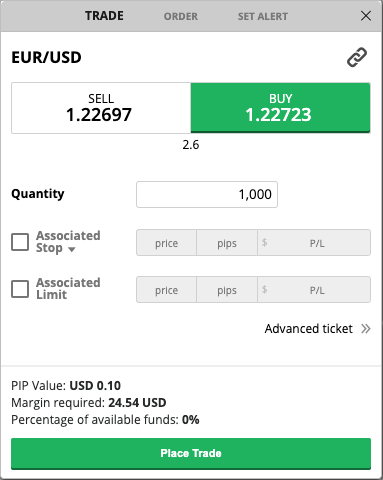
Market orders are the most widely traded forex order, and they are immediately entered into the market. Preferred by day traders and scalpers, market orders enable traders to enter and exit the forex market as deemed fit swiftly. In our market order example below, a buy order would execute your EUR/USD call at 1.22723 (or at 1.22697 for a sell).
Entry Orders
Entry orders are the second most popular forex order type, and they provide day traders with the option to deviate from real-time market prices. Meaning that traders are responsible for selecting the entry price beforehand. Once the price reaches that level, your entry order becomes executed. Entry orders are optimal for part-time traders or investors who do not want to be in front of the computer for long.
Stop Orders
Also known as a protective stop order, stop orders aim to reduce an investor’s risk by having a designated price level, where once hit, will automatically close your trade. Stop orders’ primary function is to limit losses, while stop orders can open and close trades. Utilizing a stop order to open a trade is similar to an entry trade; therefore, stop orders are frequently used in a close-trade situation.
For instance, let’s say that Trader A predicted that the price of the EUR/USD would rally above the 1.22700 level. Trader A would then place the buy stop entry to 1.22701, where the trade is opened upon reaching 1.22701. On the flip side, if Trader A predicted that the EUR/USD would depreciate once breaking below the 1.22600 price level, Trader A would place a sell stop for an order at the 1.22599 level. Once the market hits 1.22599, your sell stop becomes a market order.
To safeguard trading profits, traders execute buy or sell stop orders so their trading orders will exit the market once the price moves against the position for a specific amount or reaches a particular price level.
For example, let’s say Trader B bought the EUR/USD at 1.22700 and wished to mitigate risk to no more than 50 pips. Trader B would then set the protective sell to 50.0 pips, or in this case, to the price level of 1.22200. If the EUR/USD price depreciated to level 1.22200, that order automatically exits the market.
On the other hand, if Trader B sold the EUR/USD at 1.22600 and wished to reduce risk to 50 pips, Trader B would execute a buy stop 50 pips above the order price (so at price level 1.23100).
Limit Orders
Limit orders are a powerful tool for a forex trader’s arsenal and, like stop orders, can be used under a couple of different capacities. For instance, let’s say that the EUR/USD is trading at 1.22713, and you projected that price would climb down to level 1.22650 before rallying. You would then plan a limit order to buy the EUR/USD at 1.22650.
On the other hand, let’s say Trader C is interested in shorting the EUR/USD and projects that the EUR/USD will depreciate after reaching a certain price level. In this case, Trader C believes that a bearish reversal will take place at price level 1.22725 therefore setting the limit order to sell at 1.22725. Once the price reaches the limit order price, trade entry will occur.
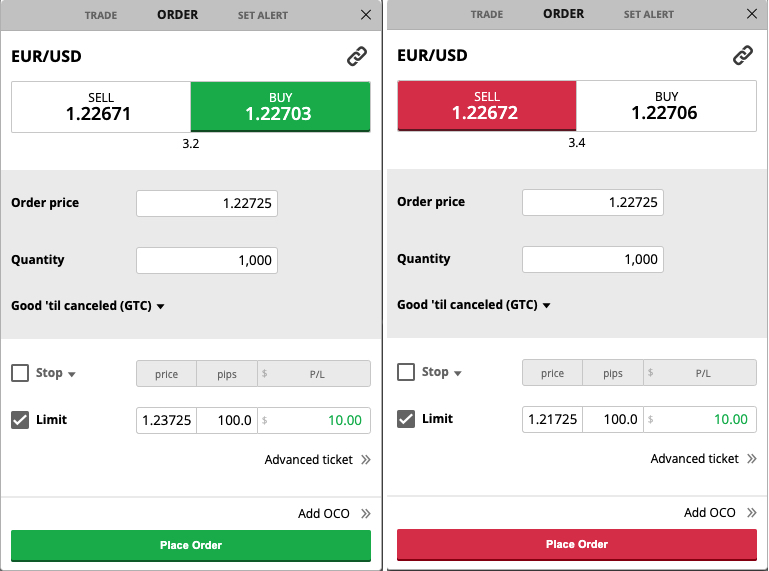
Lastly, limit orders can automatically close trades once the price has reached a fixed price level in your favor. For instance, let’s say that Trader D bought the EUR/USD at 1.22725 and, to reduce risk, wanted to exit the trade after a 100 pip profit. Trader D would place a sell limit order at 1.23725 (100 pips above entry rate).
In contrast, let’s say Trader D sold the EUR/USD at 1.22725 and also wished to exit the trade after a profit of 100 pips. Trader D would then execute a buy limit order 100 pips below 1.22725.
What is Slippage in Forex?
Slippage is an inevitable event in the foreign exchange market and occurs when a trade order is executed at a different price than requested. Generally, slippage is a byproduct of high volatility swings, or if the order prices cannot be met. As a whole, slippage is viewed negatively, although there are times where slippage can work to a trader’s advantage. In forex, there are positive and negative slippages.
Positive Slippage - Let’s say Trader E placed a market buy order for the EUR/USD at 1.22350, but the best available price drastically changes to 1.22337 (13 pips below the requested price). That order is then filled at 1.22337, giving you a 13 pip cushion.
Negative Slippage - Trader F executed a market sell order for the EUR/USD at 1.22400, but the best available price changes to 1.22394. Your sell order enters the forex market at a six pip deficit from your designated entry price.
To reduce slippage probability, forex traders focus on trading highly liquid currency pairs, such as the EUR/USD or USD/JPY. However, even major currency pairs can become susceptible to slippage during periods of high volatility. To avoid the possibility of slippage, use an economic calendar, and avoid trading currencies that are forecasted to be affected.
How to Trade Forex
Executing forex trades is straightforward after becoming familiar with the type of forex orders. While some forex brokers may differ, most use similar trade mechanisms that can be followed by the generic steps below:
Select the Order tab.
Specify if a Buy or Sell trade.
Choose an Entry Rate.
Employ Limits or Stops.
Place Order.
Before trading forex, it is wise to orientate yourself with a platform’s structure and trade mechanisms. Many trading brokers offer a free demo account, which is invaluable for risk-free strategy testing or tackling that platform’s learning curve. To strengthen your trading, you can learn about various trading styles to see which one suits you best in our free Building a Forex Trading Strategy.
When you take a step back and try to look at the ‘big picture’, the foreign exchange market is one of the few investment vessels that supports every trading style, including:
Day trader
Scalper
Algorithmic
Position
Swing
Event-Influenced
Additionally, trading forex is suitable for short, medium and long-term traders. While knowing some of the core advantages of forex trading is helpful, it will not help you with trading forex.
Leverage enables forex traders to increase their market exposure beyond an initial investment. For instance, let’s say that a trader had $1,000 in their account and had the leverage of 1:100; the maximum trade position that can be leveraged is $100,000 (or 100 times the investment sum). Forex brokers generally offer leverage of 1:100 or 1:200, although, for adverse risk concerns, leverage of 1:100 is most appropriate.
To determine leverage, brokers use the trade size and a margin percentage to calculate margin. Margin is the minimum sum of equity required to fund a leveraged trading position. Should leveraged trade positions move in opposite directions, traders may receive a margin call to deposit additional capital to satisfy margin requirements or have trading positions liquidated to meet minimum equity.
Standard Margin Requirements
Margin Requirement
Leverage
50%
1:2
3.33%
1:30
2.00%
1:50
1.00%
1:100
0.50%
1:200
Margin requirements move in relevance to trade size. The greater the trade size, the higher the margin requirement, and vice versa. Sometimes, margin requirements are increased for short periods during times of high volatility. To avoid high volatility trade windows, traders often use an economic calendar.
The main factor to remember about leverage would be that it has the potential to magnify your wins and losses. For this reason, traders should be mindful regarding how much leverage they choose to amplify their trade positions with, as losses can exceed beyond the deposit. To mitigate risk, use no more than 10% leverage or, better yet, only use 1% of your trading balance per trade.
Forex Order Types
Market Orders
Market orders are the most widely traded forex order, and they are immediately entered into the market. Preferred by day traders and scalpers, market orders enable traders to enter and exit the forex market as deemed fit swiftly. In our market order example below, a buy order would execute your EUR/USD call at 1.22723 (or at 1.22697 for a sell).
Entry Orders
Entry orders are the second most popular forex order type, and they provide day traders with the option to deviate from real-time market prices. Meaning that traders are responsible for selecting the entry price beforehand. Once the price reaches that level, your entry order becomes executed. Entry orders are optimal for part-time traders or investors who do not want to be in front of the computer for long.
Stop Orders
Also known as a protective stop order, stop orders aim to reduce an investor’s risk by having a designated price level, where once hit, will automatically close your trade. Stop orders’ primary function is to limit losses, while stop orders can open and close trades. Utilizing a stop order to open a trade is similar to an entry trade; therefore, stop orders are frequently used in a close-trade situation.
For instance, let’s say that Trader A predicted that the price of the EUR/USD would rally above the 1.22700 level. Trader A would then place the buy stop entry to 1.22701, where the trade is opened upon reaching 1.22701. On the flip side, if Trader A predicted that the EUR/USD would depreciate once breaking below the 1.22600 price level, Trader A would place a sell stop for an order at the 1.22599 level. Once the market hits 1.22599, your sell stop becomes a market order.
To safeguard trading profits, traders execute buy or sell stop orders so their trading orders will exit the market once the price moves against the position for a specific amount or reaches a particular price level.
For example, let’s say Trader B bought the EUR/USD at 1.22700 and wished to mitigate risk to no more than 50 pips. Trader B would then set the protective sell to 50.0 pips, or in this case, to the price level of 1.22200. If the EUR/USD price depreciated to level 1.22200, that order automatically exits the market.
On the other hand, if Trader B sold the EUR/USD at 1.22600 and wished to reduce risk to 50 pips, Trader B would execute a buy stop 50 pips above the order price (so at price level 1.23100).
Limit Orders
Limit orders are a powerful tool for a forex trader’s arsenal and, like stop orders, can be used under a couple of different capacities. For instance, let’s say that the EUR/USD is trading at 1.22713, and you projected that price would climb down to level 1.22650 before rallying. You would then plan a limit order to buy the EUR/USD at 1.22650.
On the other hand, let’s say Trader C is interested in shorting the EUR/USD and projects that the EUR/USD will depreciate after reaching a certain price level. In this case, Trader C believes that a bearish reversal will take place at price level 1.22725 therefore setting the limit order to sell at 1.22725. Once the price reaches the limit order price, trade entry will occur.
Lastly, limit orders can automatically close trades once the price has reached a fixed price level in your favor. For instance, let’s say that Trader D bought the EUR/USD at 1.22725 and, to reduce risk, wanted to exit the trade after a 100 pip profit. Trader D would place a sell limit order at 1.23725 (100 pips above entry rate).
In contrast, let’s say Trader D sold the EUR/USD at 1.22725 and also wished to exit the trade after a profit of 100 pips. Trader D would then execute a buy limit order 100 pips below 1.22725.
What is Slippage in Forex?
Slippage is an inevitable event in the foreign exchange market and occurs when a trade order is executed at a different price than requested. Generally, slippage is a byproduct of high volatility swings, or if the order prices cannot be met. As a whole, slippage is viewed negatively, although there are times where slippage can work to a trader’s advantage. In forex, there are positive and negative slippages.
Positive Slippage - Let’s say Trader E placed a market buy order for the EUR/USD at 1.22350, but the best available price drastically changes to 1.22337 (13 pips below the requested price). That order is then filled at 1.22337, giving you a 13 pip cushion.
Negative Slippage - Trader F executed a market sell order for the EUR/USD at 1.22400, but the best available price changes to 1.22394. Your sell order enters the forex market at a six pip deficit from your designated entry price.
To reduce slippage probability, forex traders focus on trading highly liquid currency pairs, such as the EUR/USD or USD/JPY. However, even major currency pairs can become susceptible to slippage during periods of high volatility. To avoid the possibility of slippage, use an economic calendar, and avoid trading currencies that are forecasted to be affected.
How to Trade Forex
Executing forex trades is straightforward after becoming familiar with the type of forex orders. While some forex brokers may differ, most use similar trade mechanisms that can be followed by the generic steps below:
Select the Order tab.
Specify if a Buy or Sell trade.
Choose an Entry Rate.
Employ Limits or Stops.
Place Order.
Before trading forex, it is wise to orientate yourself with a platform’s structure and trade mechanisms. Many trading brokers offer a free demo account, which is invaluable for risk-free strategy testing or tackling that platform’s learning curve. To strengthen your trading, you can learn about various trading styles to see which one suits you best in our free Building a Forex Trading Strategy.
Italy’s Consob Tightens Net on AI-Fueled Scams With Fresh Website Bans
Featured Videos
FP Markets Winner Spotlight 🏆 | Global Broker of the Year 2025 #Trading #Broker #Innovation #Shorts
FP Markets Winner Spotlight 🏆 | Global Broker of the Year 2025 #Trading #Broker #Innovation #Shorts
FP Markets Winner Spotlight 🏆 | Global Broker of the Year 2025 #Trading #Broker #Innovation #Shorts
FP Markets Winner Spotlight 🏆 | Global Broker of the Year 2025 #Trading #Broker #Innovation #Shorts
FP Markets takes the spotlight as Global Broker of the Year 2025 at the Finance Magnates Awards.
Martin Stoilov, Head of Client Experience, shares that trust, innovation, and people played a key role in the company’s success, supported by a strong foundation of integrity and client-centricity.
Following this milestone, FP Markets continues to focus on growth, technology investment, and its core values of transparency and excellence.
👉 Be part of FM Awards 2026: https://awards.financemagnates.com/#nominate
FP Markets takes the spotlight as Global Broker of the Year 2025 at the Finance Magnates Awards.
Martin Stoilov, Head of Client Experience, shares that trust, innovation, and people played a key role in the company’s success, supported by a strong foundation of integrity and client-centricity.
Following this milestone, FP Markets continues to focus on growth, technology investment, and its core values of transparency and excellence.
👉 Be part of FM Awards 2026: https://awards.financemagnates.com/#nominate
FP Markets takes the spotlight as Global Broker of the Year 2025 at the Finance Magnates Awards.
Martin Stoilov, Head of Client Experience, shares that trust, innovation, and people played a key role in the company’s success, supported by a strong foundation of integrity and client-centricity.
Following this milestone, FP Markets continues to focus on growth, technology investment, and its core values of transparency and excellence.
👉 Be part of FM Awards 2026: https://awards.financemagnates.com/#nominate
FP Markets takes the spotlight as Global Broker of the Year 2025 at the Finance Magnates Awards.
Martin Stoilov, Head of Client Experience, shares that trust, innovation, and people played a key role in the company’s success, supported by a strong foundation of integrity and client-centricity.
Following this milestone, FP Markets continues to focus on growth, technology investment, and its core values of transparency and excellence.
👉 Be part of FM Awards 2026: https://awards.financemagnates.com/#nominate
In this video, we review @HolaPrimeMarketsOfficial, a multi-asset forex and CFDs broker offering different account types, trading platforms, and flexible trading conditions.
We cover the broker’s overall offering, including account options, trading environment, platforms like MT4 and MT5, and additional services such as managed accounts and fast withdrawals.
Watch the full video to see if Hola Prime Markets fits your trading needs.
📣 Stay up to date with the latest in finance and trading. Follow Finance Magnates for industry news, insights, and global event coverage.
Connect with us:
🔗 LinkedIn: /financemagnates
👍 Facebook: /financemagnates
📸 Instagram: https://www.instagram.com/financemagnates
🐦 X: https://x.com/financemagnates
🎥 TikTok: https://www.tiktok.com/tag/financemagnates
▶️ YouTube: /@financemagnates_official
#HolaPrime #ForexBroker #CFDTrading #FinanceMagnates #Trading #Forex #BrokerReview
In this video, we review @HolaPrimeMarketsOfficial, a multi-asset forex and CFDs broker offering different account types, trading platforms, and flexible trading conditions.
We cover the broker’s overall offering, including account options, trading environment, platforms like MT4 and MT5, and additional services such as managed accounts and fast withdrawals.
Watch the full video to see if Hola Prime Markets fits your trading needs.
📣 Stay up to date with the latest in finance and trading. Follow Finance Magnates for industry news, insights, and global event coverage.
Connect with us:
🔗 LinkedIn: /financemagnates
👍 Facebook: /financemagnates
📸 Instagram: https://www.instagram.com/financemagnates
🐦 X: https://x.com/financemagnates
🎥 TikTok: https://www.tiktok.com/tag/financemagnates
▶️ YouTube: /@financemagnates_official
#HolaPrime #ForexBroker #CFDTrading #FinanceMagnates #Trading #Forex #BrokerReview
In this video, we review @HolaPrimeMarketsOfficial, a multi-asset forex and CFDs broker offering different account types, trading platforms, and flexible trading conditions.
We cover the broker’s overall offering, including account options, trading environment, platforms like MT4 and MT5, and additional services such as managed accounts and fast withdrawals.
Watch the full video to see if Hola Prime Markets fits your trading needs.
📣 Stay up to date with the latest in finance and trading. Follow Finance Magnates for industry news, insights, and global event coverage.
Connect with us:
🔗 LinkedIn: /financemagnates
👍 Facebook: /financemagnates
📸 Instagram: https://www.instagram.com/financemagnates
🐦 X: https://x.com/financemagnates
🎥 TikTok: https://www.tiktok.com/tag/financemagnates
▶️ YouTube: /@financemagnates_official
#HolaPrime #ForexBroker #CFDTrading #FinanceMagnates #Trading #Forex #BrokerReview
In this video, we review @HolaPrimeMarketsOfficial, a multi-asset forex and CFDs broker offering different account types, trading platforms, and flexible trading conditions.
We cover the broker’s overall offering, including account options, trading environment, platforms like MT4 and MT5, and additional services such as managed accounts and fast withdrawals.
Watch the full video to see if Hola Prime Markets fits your trading needs.
📣 Stay up to date with the latest in finance and trading. Follow Finance Magnates for industry news, insights, and global event coverage.
Connect with us:
🔗 LinkedIn: /financemagnates
👍 Facebook: /financemagnates
📸 Instagram: https://www.instagram.com/financemagnates
🐦 X: https://x.com/financemagnates
🎥 TikTok: https://www.tiktok.com/tag/financemagnates
▶️ YouTube: /@financemagnates_official
#HolaPrime #ForexBroker #CFDTrading #FinanceMagnates #Trading #Forex #BrokerReview
In this video, we review @HolaPrimeMarketsOfficial, a multi-asset forex and CFDs broker offering different account types, trading platforms, and flexible trading conditions.
We cover the broker’s overall offering, including account options, trading environment, platforms like MT4 and MT5, and additional services such as managed accounts and fast withdrawals.
Watch the full video to see if Hola Prime Markets fits your trading needs.
📣 Stay up to date with the latest in finance and trading. Follow Finance Magnates for industry news, insights, and global event coverage.
Connect with us:
🔗 LinkedIn: /financemagnates
👍 Facebook: /financemagnates
📸 Instagram: https://www.instagram.com/financemagnates
🐦 X: https://x.com/financemagnates
🎥 TikTok: https://www.tiktok.com/tag/financemagnates
▶️ YouTube: /@financemagnates_official
#HolaPrime #ForexBroker #CFDTrading #FinanceMagnates #Trading #Forex #BrokerReview
In this video, we review @HolaPrimeMarketsOfficial, a multi-asset forex and CFDs broker offering different account types, trading platforms, and flexible trading conditions.
We cover the broker’s overall offering, including account options, trading environment, platforms like MT4 and MT5, and additional services such as managed accounts and fast withdrawals.
Watch the full video to see if Hola Prime Markets fits your trading needs.
📣 Stay up to date with the latest in finance and trading. Follow Finance Magnates for industry news, insights, and global event coverage.
Connect with us:
🔗 LinkedIn: /financemagnates
👍 Facebook: /financemagnates
📸 Instagram: https://www.instagram.com/financemagnates
🐦 X: https://x.com/financemagnates
🎥 TikTok: https://www.tiktok.com/tag/financemagnates
▶️ YouTube: /@financemagnates_official
#HolaPrime #ForexBroker #CFDTrading #FinanceMagnates #Trading #Forex #BrokerReview
Hola Prime Review: What You Need to Know | Full Breakdown by Finance Magnates
Hola Prime Review: What You Need to Know | Full Breakdown by Finance Magnates
Hola Prime Review: What You Need to Know | Full Breakdown by Finance Magnates
Hola Prime Review: What You Need to Know | Full Breakdown by Finance Magnates
Hola Prime Review: What You Need to Know | Full Breakdown by Finance Magnates
Hola Prime Review: What You Need to Know | Full Breakdown by Finance Magnates
In this video, we review @HolaPrime_Global, a proprietary trading firm offering evaluation programs and performance-based payouts in simulated market environments.
We cover how the challenge model works, including account types, profit splits (up to 95%), trading rules, and what it takes to reach a funded account. You’ll also learn about available platforms like MT4, MT5, cTrader, and more, along with insights into payouts, support, and trading conditions.
Watch the full video to see if Hola Prime fits your trading style.
📣 Stay up to date with the latest in finance and trading. Follow Finance Magnates for industry news, insights, and global event coverage.
Connect with us:
🔗 LinkedIn: /financemagnates
👍 Facebook: /financemagnates
📸 Instagram: https://www.instagram.com/financemagnates
🐦 X: https://x.com/financemagnates
🎥 TikTok: https://www.tiktok.com/tag/financemagnates
▶️ YouTube: /@financemagnates_official
#HolaPrime #PropFirm #Trading #FinanceMagnates #Forex #FuturesTrading #TradingReview #PropFirmReview
In this video, we review @HolaPrime_Global, a proprietary trading firm offering evaluation programs and performance-based payouts in simulated market environments.
We cover how the challenge model works, including account types, profit splits (up to 95%), trading rules, and what it takes to reach a funded account. You’ll also learn about available platforms like MT4, MT5, cTrader, and more, along with insights into payouts, support, and trading conditions.
Watch the full video to see if Hola Prime fits your trading style.
📣 Stay up to date with the latest in finance and trading. Follow Finance Magnates for industry news, insights, and global event coverage.
Connect with us:
🔗 LinkedIn: /financemagnates
👍 Facebook: /financemagnates
📸 Instagram: https://www.instagram.com/financemagnates
🐦 X: https://x.com/financemagnates
🎥 TikTok: https://www.tiktok.com/tag/financemagnates
▶️ YouTube: /@financemagnates_official
#HolaPrime #PropFirm #Trading #FinanceMagnates #Forex #FuturesTrading #TradingReview #PropFirmReview
In this video, we review @HolaPrime_Global, a proprietary trading firm offering evaluation programs and performance-based payouts in simulated market environments.
We cover how the challenge model works, including account types, profit splits (up to 95%), trading rules, and what it takes to reach a funded account. You’ll also learn about available platforms like MT4, MT5, cTrader, and more, along with insights into payouts, support, and trading conditions.
Watch the full video to see if Hola Prime fits your trading style.
📣 Stay up to date with the latest in finance and trading. Follow Finance Magnates for industry news, insights, and global event coverage.
Connect with us:
🔗 LinkedIn: /financemagnates
👍 Facebook: /financemagnates
📸 Instagram: https://www.instagram.com/financemagnates
🐦 X: https://x.com/financemagnates
🎥 TikTok: https://www.tiktok.com/tag/financemagnates
▶️ YouTube: /@financemagnates_official
#HolaPrime #PropFirm #Trading #FinanceMagnates #Forex #FuturesTrading #TradingReview #PropFirmReview
In this video, we review @HolaPrime_Global, a proprietary trading firm offering evaluation programs and performance-based payouts in simulated market environments.
We cover how the challenge model works, including account types, profit splits (up to 95%), trading rules, and what it takes to reach a funded account. You’ll also learn about available platforms like MT4, MT5, cTrader, and more, along with insights into payouts, support, and trading conditions.
Watch the full video to see if Hola Prime fits your trading style.
📣 Stay up to date with the latest in finance and trading. Follow Finance Magnates for industry news, insights, and global event coverage.
Connect with us:
🔗 LinkedIn: /financemagnates
👍 Facebook: /financemagnates
📸 Instagram: https://www.instagram.com/financemagnates
🐦 X: https://x.com/financemagnates
🎥 TikTok: https://www.tiktok.com/tag/financemagnates
▶️ YouTube: /@financemagnates_official
#HolaPrime #PropFirm #Trading #FinanceMagnates #Forex #FuturesTrading #TradingReview #PropFirmReview
In this video, we review @HolaPrime_Global, a proprietary trading firm offering evaluation programs and performance-based payouts in simulated market environments.
We cover how the challenge model works, including account types, profit splits (up to 95%), trading rules, and what it takes to reach a funded account. You’ll also learn about available platforms like MT4, MT5, cTrader, and more, along with insights into payouts, support, and trading conditions.
Watch the full video to see if Hola Prime fits your trading style.
📣 Stay up to date with the latest in finance and trading. Follow Finance Magnates for industry news, insights, and global event coverage.
Connect with us:
🔗 LinkedIn: /financemagnates
👍 Facebook: /financemagnates
📸 Instagram: https://www.instagram.com/financemagnates
🐦 X: https://x.com/financemagnates
🎥 TikTok: https://www.tiktok.com/tag/financemagnates
▶️ YouTube: /@financemagnates_official
#HolaPrime #PropFirm #Trading #FinanceMagnates #Forex #FuturesTrading #TradingReview #PropFirmReview
In this video, we review @HolaPrime_Global, a proprietary trading firm offering evaluation programs and performance-based payouts in simulated market environments.
We cover how the challenge model works, including account types, profit splits (up to 95%), trading rules, and what it takes to reach a funded account. You’ll also learn about available platforms like MT4, MT5, cTrader, and more, along with insights into payouts, support, and trading conditions.
Watch the full video to see if Hola Prime fits your trading style.
📣 Stay up to date with the latest in finance and trading. Follow Finance Magnates for industry news, insights, and global event coverage.
Connect with us:
🔗 LinkedIn: /financemagnates
👍 Facebook: /financemagnates
📸 Instagram: https://www.instagram.com/financemagnates
🐦 X: https://x.com/financemagnates
🎥 TikTok: https://www.tiktok.com/tag/financemagnates
▶️ YouTube: /@financemagnates_official
#HolaPrime #PropFirm #Trading #FinanceMagnates #Forex #FuturesTrading #TradingReview #PropFirmReview
Axi Winner Spotlight 🏆 | Global Most Innovative Broker 2025 #Innovation #Trading #Fintech #Broker
Axi Winner Spotlight 🏆 | Global Most Innovative Broker 2025 #Innovation #Trading #Fintech #Broker
Axi Winner Spotlight 🏆 | Global Most Innovative Broker 2025 #Innovation #Trading #Fintech #Broker
Axi Winner Spotlight 🏆 | Global Most Innovative Broker 2025 #Innovation #Trading #Fintech #Broker
Axi Winner Spotlight 🏆 | Global Most Innovative Broker 2025 #Innovation #Trading #Fintech #Broker
Axi Winner Spotlight 🏆 | Global Most Innovative Broker 2025 #Innovation #Trading #Fintech #Broker
Axi takes the spotlight at the Finance Magnates Awards, winning Global Most Innovative Broker 2025.
Olivia Xenofontos and Ivanna Openko share how the team will feel: proud, motivated, and ready to keep delivering.
They also describe the night as well-organized, focused, and enjoyable for all.
👉 Be part of FM Awards 2026.
Axi takes the spotlight at the Finance Magnates Awards, winning Global Most Innovative Broker 2025.
Olivia Xenofontos and Ivanna Openko share how the team will feel: proud, motivated, and ready to keep delivering.
They also describe the night as well-organized, focused, and enjoyable for all.
👉 Be part of FM Awards 2026.
Axi takes the spotlight at the Finance Magnates Awards, winning Global Most Innovative Broker 2025.
Olivia Xenofontos and Ivanna Openko share how the team will feel: proud, motivated, and ready to keep delivering.
They also describe the night as well-organized, focused, and enjoyable for all.
👉 Be part of FM Awards 2026.
Axi takes the spotlight at the Finance Magnates Awards, winning Global Most Innovative Broker 2025.
Olivia Xenofontos and Ivanna Openko share how the team will feel: proud, motivated, and ready to keep delivering.
They also describe the night as well-organized, focused, and enjoyable for all.
👉 Be part of FM Awards 2026.
Axi takes the spotlight at the Finance Magnates Awards, winning Global Most Innovative Broker 2025.
Olivia Xenofontos and Ivanna Openko share how the team will feel: proud, motivated, and ready to keep delivering.
They also describe the night as well-organized, focused, and enjoyable for all.
👉 Be part of FM Awards 2026.
Axi takes the spotlight at the Finance Magnates Awards, winning Global Most Innovative Broker 2025.
Olivia Xenofontos and Ivanna Openko share how the team will feel: proud, motivated, and ready to keep delivering.
They also describe the night as well-organized, focused, and enjoyable for all.
👉 Be part of FM Awards 2026.
Recognition that matters.
Built on transparency.
Driven by the industry.
The Finance Magnates Awards 2026.
Nominations are now open.
🔗 https://awards.financemagnates.com/?utm_source=SM&utm_medium=social&utm_campaign=recognition-matters
Recognition that matters.
Built on transparency.
Driven by the industry.
The Finance Magnates Awards 2026.
Nominations are now open.
🔗 https://awards.financemagnates.com/?utm_source=SM&utm_medium=social&utm_campaign=recognition-matters
Recognition that matters.
Built on transparency.
Driven by the industry.
The Finance Magnates Awards 2026.
Nominations are now open.
🔗 https://awards.financemagnates.com/?utm_source=SM&utm_medium=social&utm_campaign=recognition-matters
Recognition that matters.
Built on transparency.
Driven by the industry.
The Finance Magnates Awards 2026.
Nominations are now open.
🔗 https://awards.financemagnates.com/?utm_source=SM&utm_medium=social&utm_campaign=recognition-matters
Recognition that matters.
Built on transparency.
Driven by the industry.
The Finance Magnates Awards 2026.
Nominations are now open.
🔗 https://awards.financemagnates.com/?utm_source=SM&utm_medium=social&utm_campaign=recognition-matters
Recognition that matters.
Built on transparency.
Driven by the industry.
The Finance Magnates Awards 2026.
Nominations are now open.
🔗 https://awards.financemagnates.com/?utm_source=SM&utm_medium=social&utm_campaign=recognition-matters