So far today, IG Group Holdings plc shares have fallen by as much as 4.5 percent.
FM
IG Group has published its preliminary financial results for its fiscal 2019 year, ended on May 31st, 2019, this Tuesday. Despite a reduction across the majority of the firm’s key metrics, the Group remains positive that it will return to growth in its 2020 fiscal year.
The product intervention measures implemented by the European Securities and Markets Authority (ESMA) hurt a lot of brokers operating in the United Kingdom and Europe, and IG was no exception. In fact, the online trading provider attributes almost all of its declining figures to ESMA.
For the 12 months ended on the 31st of May 2019, IG Group achieved a net trading revenue of £476.9 million. When measured against the 2018 fiscal year, which had a net trading revenue of £569.0 million, 2019’s figure has fallen by 16 percent.
ESMA’s measures, coupled with lower levels of market volatility and financial market activity throughout the majority of fiscal 2019 dragged down the firm’s net revenues across all geographic segments.
Operating profit also plunged during the 2019 fiscal year, falling by 31 percent from the £281.1 million reported in fiscal 2018 down to an operating profit of £192.9 million in fiscal 2019.
During the year, IG did manage to reduce its total operating costs by 2 percent year-on-year, coming in at £284.3 million in 2019.
OTC revenue falls in fiscal 2019
Over-the-counter (OTC) leveraged derivatives contributed to 95 percent of IG Group’s revenues during the year. This segment noted revenue of £454.2 million, 17 percent lower than in the prior year. The number of active OTC leveraged clients fell by 10 percent, and the average revenue per client was down by 8 percent.
According to the report, from the OTC leverage revenue, 55 percent of it was generated from clients who have been trading with the UK-based firm for more than three years.
Equity indices and single name equities generated the largest revenue from client trading, accounting for 66 percent of the Group's OTC leveraged revenue in 2019, as compared with 58 percent in 2018.
For foreign exchange (forex), the revenue from clients trading was 13% lower than in the prior year, coming in at £82.4 million. FX revenues represent 18 percent of the Group's OTC leveraged revenue in the year.
Breaking OTC revenues into geographies, the ESMA-affected region (Europe and UK) reported total revenue of £263.4 million in fiscal 2019, which is lower by 3o percent year-over-year.
In its emerging markets, the UK-based broker saw a yearly uptick of 36 percent in OTC revenues, coming in at £17.6 million for the year. In Japan, the firm also saw a 29 percent growth in OTC revenues.
So far today, IG Group Holdings plc shares have fallen by as much as 4.5 percent, reaching a low of 558.80 pence per share, having started the session at 584.00 pence per share. As of the time of publishing, however, IG's share price has managed to make a slight recovery.
Breakdown of IG clients
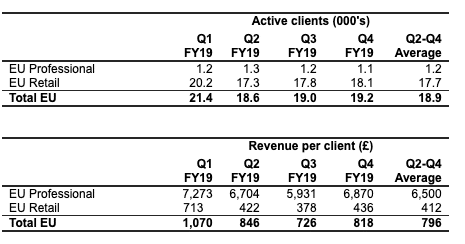
In the European Union, the number of active Retail clients in the second quarter of 2019 reduced by 10 percent when compared with Q1. However, it has remained stable in the subsequent quarters.
In Q2 of fiscal 2019, the average revenue per Retail client (RPC) fell by more than 40 percent quarter-on-quarter. Following the second quarter, the average retail RPC remained fairly stable. However, the RPC for professional clients was more sensitive to market volatility.
IG Group’s plan to return to revenue growth
Despite the sluggish 2019 fiscal results, IG Group remains confident that it can return to revenue growth in fiscal 2020. The London-headquartered firm plans to do this by capitalizing on the “substantial” opportunities still available to it in the geographies it operates in.
In the European Union (EU), IG sees there is a large opportunity to launch new leverage products. Through its multilateral trading facility (MTF), Spectrum, the company plans to take a meaningful share of the on-venue turbo market, by launching turbos on equity indices, currencies, and commodities.
In the United States, the broker believes that due to the fact that it is one of only a few players in the market, it will be able to capture a significant share in the OTC FX market through competitive pricing and its client service offering.
IG Group has published its preliminary financial results for its fiscal 2019 year, ended on May 31st, 2019, this Tuesday. Despite a reduction across the majority of the firm’s key metrics, the Group remains positive that it will return to growth in its 2020 fiscal year.
The product intervention measures implemented by the European Securities and Markets Authority (ESMA) hurt a lot of brokers operating in the United Kingdom and Europe, and IG was no exception. In fact, the online trading provider attributes almost all of its declining figures to ESMA.
For the 12 months ended on the 31st of May 2019, IG Group achieved a net trading revenue of £476.9 million. When measured against the 2018 fiscal year, which had a net trading revenue of £569.0 million, 2019’s figure has fallen by 16 percent.
ESMA’s measures, coupled with lower levels of market volatility and financial market activity throughout the majority of fiscal 2019 dragged down the firm’s net revenues across all geographic segments.
Operating profit also plunged during the 2019 fiscal year, falling by 31 percent from the £281.1 million reported in fiscal 2018 down to an operating profit of £192.9 million in fiscal 2019.
During the year, IG did manage to reduce its total operating costs by 2 percent year-on-year, coming in at £284.3 million in 2019.
OTC revenue falls in fiscal 2019
Over-the-counter (OTC) leveraged derivatives contributed to 95 percent of IG Group’s revenues during the year. This segment noted revenue of £454.2 million, 17 percent lower than in the prior year. The number of active OTC leveraged clients fell by 10 percent, and the average revenue per client was down by 8 percent.
According to the report, from the OTC leverage revenue, 55 percent of it was generated from clients who have been trading with the UK-based firm for more than three years.
Equity indices and single name equities generated the largest revenue from client trading, accounting for 66 percent of the Group's OTC leveraged revenue in 2019, as compared with 58 percent in 2018.
For foreign exchange (forex), the revenue from clients trading was 13% lower than in the prior year, coming in at £82.4 million. FX revenues represent 18 percent of the Group's OTC leveraged revenue in the year.
Breaking OTC revenues into geographies, the ESMA-affected region (Europe and UK) reported total revenue of £263.4 million in fiscal 2019, which is lower by 3o percent year-over-year.
In its emerging markets, the UK-based broker saw a yearly uptick of 36 percent in OTC revenues, coming in at £17.6 million for the year. In Japan, the firm also saw a 29 percent growth in OTC revenues.
So far today, IG Group Holdings plc shares have fallen by as much as 4.5 percent, reaching a low of 558.80 pence per share, having started the session at 584.00 pence per share. As of the time of publishing, however, IG's share price has managed to make a slight recovery.
Breakdown of IG clients
In the European Union, the number of active Retail clients in the second quarter of 2019 reduced by 10 percent when compared with Q1. However, it has remained stable in the subsequent quarters.
In Q2 of fiscal 2019, the average revenue per Retail client (RPC) fell by more than 40 percent quarter-on-quarter. Following the second quarter, the average retail RPC remained fairly stable. However, the RPC for professional clients was more sensitive to market volatility.
IG Group’s plan to return to revenue growth
Despite the sluggish 2019 fiscal results, IG Group remains confident that it can return to revenue growth in fiscal 2020. The London-headquartered firm plans to do this by capitalizing on the “substantial” opportunities still available to it in the geographies it operates in.
In the European Union (EU), IG sees there is a large opportunity to launch new leverage products. Through its multilateral trading facility (MTF), Spectrum, the company plans to take a meaningful share of the on-venue turbo market, by launching turbos on equity indices, currencies, and commodities.
In the United States, the broker believes that due to the fact that it is one of only a few players in the market, it will be able to capture a significant share in the OTC FX market through competitive pricing and its client service offering.
FTMO Says Monthly Rewards Near $15 Million in September
Featured Videos
AvaTrade to Acquire Most of FXCM; NAGA Raises $8M
AvaTrade to Acquire Most of FXCM; NAGA Raises $8M
AvaTrade to Acquire Most of FXCM; NAGA Raises $8M
AvaTrade to Acquire Most of FXCM; NAGA Raises $8M
Today’s financial news recap covers AvaTrade agrees to acquire most of FXCM, NAGA secures eight million dollars in new financing, and Wise seeks a tax settlement in the UK.
Finance Magnates Daily Recap brings you the latest news from forex and CFD brokers, fintech, payments, cryptocurrency, digital assets, trading platforms, financial regulation and global markets.
Get the key company news, executive moves, deals, regulatory updates and market developments of the day, in just a few minutes. New episodes published every weekday.
Read more: https://www.financemagnates.com
#FinanceMagnates #ForexNews #FintechNews
Today’s financial news recap covers AvaTrade agrees to acquire most of FXCM, NAGA secures eight million dollars in new financing, and Wise seeks a tax settlement in the UK.
Finance Magnates Daily Recap brings you the latest news from forex and CFD brokers, fintech, payments, cryptocurrency, digital assets, trading platforms, financial regulation and global markets.
Get the key company news, executive moves, deals, regulatory updates and market developments of the day, in just a few minutes. New episodes published every weekday.
Read more: https://www.financemagnates.com
#FinanceMagnates #ForexNews #FintechNews
Today’s financial news recap covers AvaTrade agrees to acquire most of FXCM, NAGA secures eight million dollars in new financing, and Wise seeks a tax settlement in the UK.
Finance Magnates Daily Recap brings you the latest news from forex and CFD brokers, fintech, payments, cryptocurrency, digital assets, trading platforms, financial regulation and global markets.
Get the key company news, executive moves, deals, regulatory updates and market developments of the day, in just a few minutes. New episodes published every weekday.
Read more: https://www.financemagnates.com
#FinanceMagnates #ForexNews #FintechNews
Today’s financial news recap covers AvaTrade agrees to acquire most of FXCM, NAGA secures eight million dollars in new financing, and Wise seeks a tax settlement in the UK.
Finance Magnates Daily Recap brings you the latest news from forex and CFD brokers, fintech, payments, cryptocurrency, digital assets, trading platforms, financial regulation and global markets.
Get the key company news, executive moves, deals, regulatory updates and market developments of the day, in just a few minutes. New episodes published every weekday.
Read more: https://www.financemagnates.com
#FinanceMagnates #ForexNews #FintechNews
XTB Adds Overnight US Stock Trading; Nasdaq Ventures Invests in One Trading
XTB Adds Overnight US Stock Trading; Nasdaq Ventures Invests in One Trading
XTB Adds Overnight US Stock Trading; Nasdaq Ventures Invests in One Trading
XTB Adds Overnight US Stock Trading; Nasdaq Ventures Invests in One Trading
XTB Adds Overnight US Stock Trading; Nasdaq Ventures Invests in One Trading
XTB Adds Overnight US Stock Trading; Nasdaq Ventures Invests in One Trading
Today’s financial news recap covers XTB expands overnight US stock trading, Fortrade reports higher revenue, Nasdaq backs One Trading, and Vest Labs raises 13 million dollars.
Finance Magnates Daily Recap brings you the latest news from forex and CFD brokers, fintech, payments, cryptocurrency, digital assets, trading platforms, financial regulation and global markets.
Get the key company news, executive moves, deals, regulatory updates and market developments of the day, in just a few minutes. New episodes published every weekday.
Read more: https://www.financemagnates.com
#FinanceMagnates #ForexNews #FintechNews
Today’s financial news recap covers XTB expands overnight US stock trading, Fortrade reports higher revenue, Nasdaq backs One Trading, and Vest Labs raises 13 million dollars.
Finance Magnates Daily Recap brings you the latest news from forex and CFD brokers, fintech, payments, cryptocurrency, digital assets, trading platforms, financial regulation and global markets.
Get the key company news, executive moves, deals, regulatory updates and market developments of the day, in just a few minutes. New episodes published every weekday.
Read more: https://www.financemagnates.com
#FinanceMagnates #ForexNews #FintechNews
Today’s financial news recap covers XTB expands overnight US stock trading, Fortrade reports higher revenue, Nasdaq backs One Trading, and Vest Labs raises 13 million dollars.
Finance Magnates Daily Recap brings you the latest news from forex and CFD brokers, fintech, payments, cryptocurrency, digital assets, trading platforms, financial regulation and global markets.
Get the key company news, executive moves, deals, regulatory updates and market developments of the day, in just a few minutes. New episodes published every weekday.
Read more: https://www.financemagnates.com
#FinanceMagnates #ForexNews #FintechNews
Today’s financial news recap covers XTB expands overnight US stock trading, Fortrade reports higher revenue, Nasdaq backs One Trading, and Vest Labs raises 13 million dollars.
Finance Magnates Daily Recap brings you the latest news from forex and CFD brokers, fintech, payments, cryptocurrency, digital assets, trading platforms, financial regulation and global markets.
Get the key company news, executive moves, deals, regulatory updates and market developments of the day, in just a few minutes. New episodes published every weekday.
Read more: https://www.financemagnates.com
#FinanceMagnates #ForexNews #FintechNews
Today’s financial news recap covers XTB expands overnight US stock trading, Fortrade reports higher revenue, Nasdaq backs One Trading, and Vest Labs raises 13 million dollars.
Finance Magnates Daily Recap brings you the latest news from forex and CFD brokers, fintech, payments, cryptocurrency, digital assets, trading platforms, financial regulation and global markets.
Get the key company news, executive moves, deals, regulatory updates and market developments of the day, in just a few minutes. New episodes published every weekday.
Read more: https://www.financemagnates.com
#FinanceMagnates #ForexNews #FintechNews
Today’s financial news recap covers XTB expands overnight US stock trading, Fortrade reports higher revenue, Nasdaq backs One Trading, and Vest Labs raises 13 million dollars.
Finance Magnates Daily Recap brings you the latest news from forex and CFD brokers, fintech, payments, cryptocurrency, digital assets, trading platforms, financial regulation and global markets.
Get the key company news, executive moves, deals, regulatory updates and market developments of the day, in just a few minutes. New episodes published every weekday.
Read more: https://www.financemagnates.com
#FinanceMagnates #ForexNews #FintechNews
CMC Founder Downplays Volatility Hit; Devexperts Names CEO
CMC Founder Downplays Volatility Hit; Devexperts Names CEO
CMC Founder Downplays Volatility Hit; Devexperts Names CEO
CMC Founder Downplays Volatility Hit; Devexperts Names CEO
CMC Founder Downplays Volatility Hit; Devexperts Names CEO
CMC Founder Downplays Volatility Hit; Devexperts Names CEO
Today’s financial news recap covers low volatility pressures brokers, Devexperts names a new CEO, Saxo cuts onboarding time, and OKX reaches a 25 billion dollar valuation.
Finance Magnates Daily Recap brings you the latest news from forex and CFD brokers, fintech, payments, cryptocurrency, digital assets, trading platforms, financial regulation and global markets.
Get the key company news, executive moves, deals, regulatory updates and market developments of the day, in just a few minutes. New episodes published every weekday.
Read more: https://www.financemagnates.com
#FinanceMagnates #ForexNews #FintechNews
Today’s financial news recap covers low volatility pressures brokers, Devexperts names a new CEO, Saxo cuts onboarding time, and OKX reaches a 25 billion dollar valuation.
Finance Magnates Daily Recap brings you the latest news from forex and CFD brokers, fintech, payments, cryptocurrency, digital assets, trading platforms, financial regulation and global markets.
Get the key company news, executive moves, deals, regulatory updates and market developments of the day, in just a few minutes. New episodes published every weekday.
Read more: https://www.financemagnates.com
#FinanceMagnates #ForexNews #FintechNews
Today’s financial news recap covers low volatility pressures brokers, Devexperts names a new CEO, Saxo cuts onboarding time, and OKX reaches a 25 billion dollar valuation.
Finance Magnates Daily Recap brings you the latest news from forex and CFD brokers, fintech, payments, cryptocurrency, digital assets, trading platforms, financial regulation and global markets.
Get the key company news, executive moves, deals, regulatory updates and market developments of the day, in just a few minutes. New episodes published every weekday.
Read more: https://www.financemagnates.com
#FinanceMagnates #ForexNews #FintechNews
Today’s financial news recap covers low volatility pressures brokers, Devexperts names a new CEO, Saxo cuts onboarding time, and OKX reaches a 25 billion dollar valuation.
Finance Magnates Daily Recap brings you the latest news from forex and CFD brokers, fintech, payments, cryptocurrency, digital assets, trading platforms, financial regulation and global markets.
Get the key company news, executive moves, deals, regulatory updates and market developments of the day, in just a few minutes. New episodes published every weekday.
Read more: https://www.financemagnates.com
#FinanceMagnates #ForexNews #FintechNews
Today’s financial news recap covers low volatility pressures brokers, Devexperts names a new CEO, Saxo cuts onboarding time, and OKX reaches a 25 billion dollar valuation.
Finance Magnates Daily Recap brings you the latest news from forex and CFD brokers, fintech, payments, cryptocurrency, digital assets, trading platforms, financial regulation and global markets.
Get the key company news, executive moves, deals, regulatory updates and market developments of the day, in just a few minutes. New episodes published every weekday.
Read more: https://www.financemagnates.com
#FinanceMagnates #ForexNews #FintechNews
Today’s financial news recap covers low volatility pressures brokers, Devexperts names a new CEO, Saxo cuts onboarding time, and OKX reaches a 25 billion dollar valuation.
Finance Magnates Daily Recap brings you the latest news from forex and CFD brokers, fintech, payments, cryptocurrency, digital assets, trading platforms, financial regulation and global markets.
Get the key company news, executive moves, deals, regulatory updates and market developments of the day, in just a few minutes. New episodes published every weekday.
Read more: https://www.financemagnates.com
#FinanceMagnates #ForexNews #FintechNews
Today’s financial news recap covers Trade Nation buys FXCM's UK client book, Trading 212 reports higher revenue, the CFTC's move to allow perpetual index futures.
Finance Magnates Daily Recap brings you the latest news from forex and CFD brokers, fintech, payments, cryptocurrency, digital assets, trading platforms, financial regulation and global markets.
Get the key company news, executive moves, deals, regulatory updates and market developments of the day, in just a few minutes. New episodes published every weekday.
Read more: https://www.financemagnates.com
#FinanceMagnates #ForexNews #FintechNews
Today’s financial news recap covers Trade Nation buys FXCM's UK client book, Trading 212 reports higher revenue, the CFTC's move to allow perpetual index futures.
Finance Magnates Daily Recap brings you the latest news from forex and CFD brokers, fintech, payments, cryptocurrency, digital assets, trading platforms, financial regulation and global markets.
Get the key company news, executive moves, deals, regulatory updates and market developments of the day, in just a few minutes. New episodes published every weekday.
Read more: https://www.financemagnates.com
#FinanceMagnates #ForexNews #FintechNews
Today’s financial news recap covers Trade Nation buys FXCM's UK client book, Trading 212 reports higher revenue, the CFTC's move to allow perpetual index futures.
Finance Magnates Daily Recap brings you the latest news from forex and CFD brokers, fintech, payments, cryptocurrency, digital assets, trading platforms, financial regulation and global markets.
Get the key company news, executive moves, deals, regulatory updates and market developments of the day, in just a few minutes. New episodes published every weekday.
Read more: https://www.financemagnates.com
#FinanceMagnates #ForexNews #FintechNews
Today’s financial news recap covers Trade Nation buys FXCM's UK client book, Trading 212 reports higher revenue, the CFTC's move to allow perpetual index futures.
Finance Magnates Daily Recap brings you the latest news from forex and CFD brokers, fintech, payments, cryptocurrency, digital assets, trading platforms, financial regulation and global markets.
Get the key company news, executive moves, deals, regulatory updates and market developments of the day, in just a few minutes. New episodes published every weekday.
Read more: https://www.financemagnates.com
#FinanceMagnates #ForexNews #FintechNews
Today’s financial news recap covers Trade Nation buys FXCM's UK client book, Trading 212 reports higher revenue, the CFTC's move to allow perpetual index futures.
Finance Magnates Daily Recap brings you the latest news from forex and CFD brokers, fintech, payments, cryptocurrency, digital assets, trading platforms, financial regulation and global markets.
Get the key company news, executive moves, deals, regulatory updates and market developments of the day, in just a few minutes. New episodes published every weekday.
Read more: https://www.financemagnates.com
#FinanceMagnates #ForexNews #FintechNews
Today’s financial news recap covers Trade Nation buys FXCM's UK client book, Trading 212 reports higher revenue, the CFTC's move to allow perpetual index futures.
Finance Magnates Daily Recap brings you the latest news from forex and CFD brokers, fintech, payments, cryptocurrency, digital assets, trading platforms, financial regulation and global markets.
Get the key company news, executive moves, deals, regulatory updates and market developments of the day, in just a few minutes. New episodes published every weekday.
Read more: https://www.financemagnates.com
#FinanceMagnates #ForexNews #FintechNews
Your career isn’t a linear path.
Your career isn’t a linear path.
Your career isn’t a linear path.
Your career isn’t a linear path.
Your career isn’t a linear path.
Your career isn’t a linear path.
Roles change. Career goals change. Sometimes you want a completely new challenge.
But the skills and knowledge you build along the way can stay with you and give you something to build on.
For Jeff Patterson, that continued growth is key to long-term career development.
You bring the skills. FM Academy helps you build the knowledge.
#FMAcademy #FinanceMagnates #FinanceCareers #ProfessionalDevelopment #Fintech
Roles change. Career goals change. Sometimes you want a completely new challenge.
But the skills and knowledge you build along the way can stay with you and give you something to build on.
For Jeff Patterson, that continued growth is key to long-term career development.
You bring the skills. FM Academy helps you build the knowledge.
#FMAcademy #FinanceMagnates #FinanceCareers #ProfessionalDevelopment #Fintech
Roles change. Career goals change. Sometimes you want a completely new challenge.
But the skills and knowledge you build along the way can stay with you and give you something to build on.
For Jeff Patterson, that continued growth is key to long-term career development.
You bring the skills. FM Academy helps you build the knowledge.
#FMAcademy #FinanceMagnates #FinanceCareers #ProfessionalDevelopment #Fintech
Roles change. Career goals change. Sometimes you want a completely new challenge.
But the skills and knowledge you build along the way can stay with you and give you something to build on.
For Jeff Patterson, that continued growth is key to long-term career development.
You bring the skills. FM Academy helps you build the knowledge.
#FMAcademy #FinanceMagnates #FinanceCareers #ProfessionalDevelopment #Fintech
Roles change. Career goals change. Sometimes you want a completely new challenge.
But the skills and knowledge you build along the way can stay with you and give you something to build on.
For Jeff Patterson, that continued growth is key to long-term career development.
You bring the skills. FM Academy helps you build the knowledge.
#FMAcademy #FinanceMagnates #FinanceCareers #ProfessionalDevelopment #Fintech
Roles change. Career goals change. Sometimes you want a completely new challenge.
But the skills and knowledge you build along the way can stay with you and give you something to build on.
For Jeff Patterson, that continued growth is key to long-term career development.
You bring the skills. FM Academy helps you build the knowledge.
#FMAcademy #FinanceMagnates #FinanceCareers #ProfessionalDevelopment #Fintech