FXCM Prime part of revamped FXCMPro site for wholesale and PoP liquidity.
Finance Magnates
FXCM has announced the relaunch of its FXCMPro.com website, building on its institutional business originally launched in 2004 and still growing.
The company offers firms access to prime brokerage services via FXCM Prime, a business that the company had announced it was getting involved with just a few years ago with regard to the prime brokerage space. The firm recently reported a surge in its institutional volumes, as both its prime brokerage and wholesale businesses are doing very well within the FXCMPro division.
Ahead of the news, Finance Magnates reporters met with Brandon Mulvihill, Global Head of Sales for FXCM PRO, at the company's New York headquarters last Thursday to gather more information about the firm's institutional offering nearly a year after its website was taken offline following the SNB event.
Prime of prime and wholesale
The FXCM PRO division is driving the company’s institutional volumes, and those volumes consist of the division's prime of prime (PoP) and wholesale offering, whereas agency business conducted on FastMatch, which used to be the core product within PRO, has since been separated out into its own company as of last July.
PoP is an array of Liquidity providers that FXCM offers to firms along with the ability for FXCM to settle on their behalf (i.e. as their prime broker for the trades) when firms trade from among those designated liquidity sources.
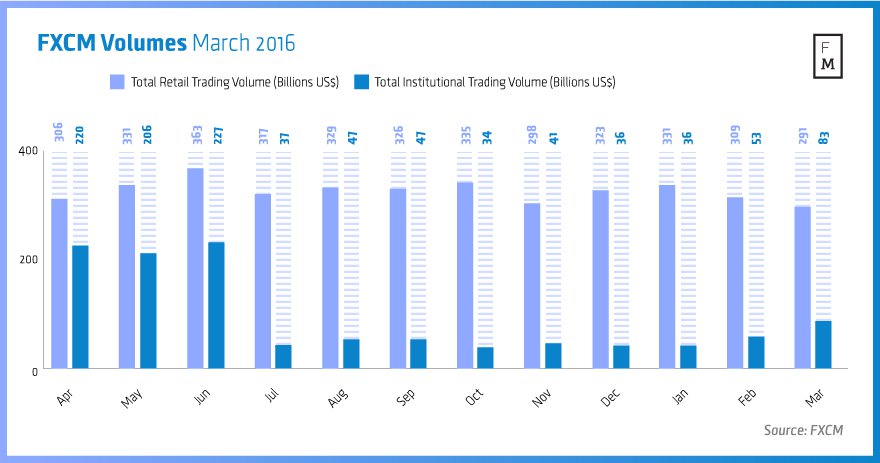
For example, FXCM Prime currently offers direct access to Bloomberg Tradebook, Currenex, EBS Direct, EBS Markets, EBS Select, FXall, FastMatch, and Hotspot (BATS). Single bank access is available to BNP, Deutsche Bank, Citi, Goldman Sachs, Nomura, UBS, and RBS. A chart below depicts how institutional volumes have picked up since the FastMatch business was separated out from the reported results, resulting in what looks like a steep drop in July.
Source: FXCM
One year after SNB
The wholesale division offers an execution/liquidity relationship that caters to institutional clients including brokers via an omnibus account structure where - for example - firms that have A-book business will push those flows straight to their omnibus account at FXCM for the execution, and where they hold the required margin for the trades.
It’s been just over a year since the Swiss National Bank (SNB) wreaked havoc for FX brokers and nearly put FXCM out of business, causing it to make drastic changes to stay afloat including a last minute emergency loan from Leucadia, that helped it survive and that FXCM is focused on repaying.
Institutional redefined
Around that time last year after the SNB event, FXCM announced that it was planning to sell FastMatch (which was previously the main offering of FXCMPro), and other non-core assets, and had taken the FXCMPro website offline, yet, since then, the company's institutional offering shifted, with the two core products gaining momentum including the PoP and wholesale solution.
Brandon Mulvhill Picture by James Clarke. Source: FXCM
Fast-forward to today, and with FastMatch already a separate company since last July and one that FXCM only owns 35% of, we can look back at how FXCM is redefining their institutional offering again and adding emphasis to it with today's announcement.
Commenting in the company’s press release, Brandon Mulvihill, Global Head of Sales at FXCM Pro, said: “We are thrilled to unveil our clearing solution within our new website. FXCM Prime provides clients access to multiple trading venues, allowing for direct relationships between traders and liquidity management experts at each ECN provider. FXCM Prime fills the void of settling trades done across all platforms, with over 15 platforms available to clients. This agnostic approach is exactly what tier one prime brokers provide, and this is a rare service found in the secondary prime market.”
To put in perspective how the institutional volumes have grown when measuring from last July, after the discontinued operations were excluded from the company's report totals, the average monthly volume was just over $40 billion by end of last year, and including the year-to-date totals for 2016, that average has risen to $46 billion including the March total of $83 billion as reported early last week.
FXCM has announced the relaunch of its FXCMPro.com website, building on its institutional business originally launched in 2004 and still growing.
The company offers firms access to prime brokerage services via FXCM Prime, a business that the company had announced it was getting involved with just a few years ago with regard to the prime brokerage space. The firm recently reported a surge in its institutional volumes, as both its prime brokerage and wholesale businesses are doing very well within the FXCMPro division.
Ahead of the news, Finance Magnates reporters met with Brandon Mulvihill, Global Head of Sales for FXCM PRO, at the company's New York headquarters last Thursday to gather more information about the firm's institutional offering nearly a year after its website was taken offline following the SNB event.
Prime of prime and wholesale
The FXCM PRO division is driving the company’s institutional volumes, and those volumes consist of the division's prime of prime (PoP) and wholesale offering, whereas agency business conducted on FastMatch, which used to be the core product within PRO, has since been separated out into its own company as of last July.
PoP is an array of Liquidity providers that FXCM offers to firms along with the ability for FXCM to settle on their behalf (i.e. as their prime broker for the trades) when firms trade from among those designated liquidity sources.
For example, FXCM Prime currently offers direct access to Bloomberg Tradebook, Currenex, EBS Direct, EBS Markets, EBS Select, FXall, FastMatch, and Hotspot (BATS). Single bank access is available to BNP, Deutsche Bank, Citi, Goldman Sachs, Nomura, UBS, and RBS. A chart below depicts how institutional volumes have picked up since the FastMatch business was separated out from the reported results, resulting in what looks like a steep drop in July.
Source: FXCM
One year after SNB
The wholesale division offers an execution/liquidity relationship that caters to institutional clients including brokers via an omnibus account structure where - for example - firms that have A-book business will push those flows straight to their omnibus account at FXCM for the execution, and where they hold the required margin for the trades.
It’s been just over a year since the Swiss National Bank (SNB) wreaked havoc for FX brokers and nearly put FXCM out of business, causing it to make drastic changes to stay afloat including a last minute emergency loan from Leucadia, that helped it survive and that FXCM is focused on repaying.
Institutional redefined
Around that time last year after the SNB event, FXCM announced that it was planning to sell FastMatch (which was previously the main offering of FXCMPro), and other non-core assets, and had taken the FXCMPro website offline, yet, since then, the company's institutional offering shifted, with the two core products gaining momentum including the PoP and wholesale solution.
Brandon Mulvhill Picture by James Clarke. Source: FXCM
Fast-forward to today, and with FastMatch already a separate company since last July and one that FXCM only owns 35% of, we can look back at how FXCM is redefining their institutional offering again and adding emphasis to it with today's announcement.
Commenting in the company’s press release, Brandon Mulvihill, Global Head of Sales at FXCM Pro, said: “We are thrilled to unveil our clearing solution within our new website. FXCM Prime provides clients access to multiple trading venues, allowing for direct relationships between traders and liquidity management experts at each ECN provider. FXCM Prime fills the void of settling trades done across all platforms, with over 15 platforms available to clients. This agnostic approach is exactly what tier one prime brokers provide, and this is a rare service found in the secondary prime market.”
To put in perspective how the institutional volumes have grown when measuring from last July, after the discontinued operations were excluded from the company's report totals, the average monthly volume was just over $40 billion by end of last year, and including the year-to-date totals for 2016, that average has risen to $46 billion including the March total of $83 billion as reported early last week.
Italy’s Consob Tightens Net on AI-Fueled Scams With Fresh Website Bans
FP Markets Winner Spotlight 🏆 | Global Broker of the Year 2025 #Trading #Broker #Innovation #Shorts
FP Markets Winner Spotlight 🏆 | Global Broker of the Year 2025 #Trading #Broker #Innovation #Shorts
FP Markets takes the spotlight as Global Broker of the Year 2025 at the Finance Magnates Awards.
Martin Stoilov, Head of Client Experience, shares that trust, innovation, and people played a key role in the company’s success, supported by a strong foundation of integrity and client-centricity.
Following this milestone, FP Markets continues to focus on growth, technology investment, and its core values of transparency and excellence.
👉 Be part of FM Awards 2026: https://awards.financemagnates.com/#nominate
FP Markets takes the spotlight as Global Broker of the Year 2025 at the Finance Magnates Awards.
Martin Stoilov, Head of Client Experience, shares that trust, innovation, and people played a key role in the company’s success, supported by a strong foundation of integrity and client-centricity.
Following this milestone, FP Markets continues to focus on growth, technology investment, and its core values of transparency and excellence.
👉 Be part of FM Awards 2026: https://awards.financemagnates.com/#nominate
In this video, we review @HolaPrimeMarketsOfficial, a multi-asset forex and CFDs broker offering different account types, trading platforms, and flexible trading conditions.
We cover the broker’s overall offering, including account options, trading environment, platforms like MT4 and MT5, and additional services such as managed accounts and fast withdrawals.
Watch the full video to see if Hola Prime Markets fits your trading needs.
📣 Stay up to date with the latest in finance and trading. Follow Finance Magnates for industry news, insights, and global event coverage.
Connect with us:
🔗 LinkedIn: /financemagnates
👍 Facebook: /financemagnates
📸 Instagram: https://www.instagram.com/financemagnates
🐦 X: https://x.com/financemagnates
🎥 TikTok: https://www.tiktok.com/tag/financemagnates
▶️ YouTube: /@financemagnates_official
#HolaPrime #ForexBroker #CFDTrading #FinanceMagnates #Trading #Forex #BrokerReview
In this video, we review @HolaPrimeMarketsOfficial, a multi-asset forex and CFDs broker offering different account types, trading platforms, and flexible trading conditions.
We cover the broker’s overall offering, including account options, trading environment, platforms like MT4 and MT5, and additional services such as managed accounts and fast withdrawals.
Watch the full video to see if Hola Prime Markets fits your trading needs.
📣 Stay up to date with the latest in finance and trading. Follow Finance Magnates for industry news, insights, and global event coverage.
Connect with us:
🔗 LinkedIn: /financemagnates
👍 Facebook: /financemagnates
📸 Instagram: https://www.instagram.com/financemagnates
🐦 X: https://x.com/financemagnates
🎥 TikTok: https://www.tiktok.com/tag/financemagnates
▶️ YouTube: /@financemagnates_official
#HolaPrime #ForexBroker #CFDTrading #FinanceMagnates #Trading #Forex #BrokerReview
Hola Prime Review: What You Need to Know | Full Breakdown by Finance Magnates
Hola Prime Review: What You Need to Know | Full Breakdown by Finance Magnates
In this video, we review @HolaPrime_Global, a proprietary trading firm offering evaluation programs and performance-based payouts in simulated market environments.
We cover how the challenge model works, including account types, profit splits (up to 95%), trading rules, and what it takes to reach a funded account. You’ll also learn about available platforms like MT4, MT5, cTrader, and more, along with insights into payouts, support, and trading conditions.
Watch the full video to see if Hola Prime fits your trading style.
📣 Stay up to date with the latest in finance and trading. Follow Finance Magnates for industry news, insights, and global event coverage.
Connect with us:
🔗 LinkedIn: /financemagnates
👍 Facebook: /financemagnates
📸 Instagram: https://www.instagram.com/financemagnates
🐦 X: https://x.com/financemagnates
🎥 TikTok: https://www.tiktok.com/tag/financemagnates
▶️ YouTube: /@financemagnates_official
#HolaPrime #PropFirm #Trading #FinanceMagnates #Forex #FuturesTrading #TradingReview #PropFirmReview
In this video, we review @HolaPrime_Global, a proprietary trading firm offering evaluation programs and performance-based payouts in simulated market environments.
We cover how the challenge model works, including account types, profit splits (up to 95%), trading rules, and what it takes to reach a funded account. You’ll also learn about available platforms like MT4, MT5, cTrader, and more, along with insights into payouts, support, and trading conditions.
Watch the full video to see if Hola Prime fits your trading style.
📣 Stay up to date with the latest in finance and trading. Follow Finance Magnates for industry news, insights, and global event coverage.
Connect with us:
🔗 LinkedIn: /financemagnates
👍 Facebook: /financemagnates
📸 Instagram: https://www.instagram.com/financemagnates
🐦 X: https://x.com/financemagnates
🎥 TikTok: https://www.tiktok.com/tag/financemagnates
▶️ YouTube: /@financemagnates_official
#HolaPrime #PropFirm #Trading #FinanceMagnates #Forex #FuturesTrading #TradingReview #PropFirmReview
Axi Winner Spotlight 🏆 | Global Most Innovative Broker 2025 #Innovation #Trading #Fintech #Broker
Axi Winner Spotlight 🏆 | Global Most Innovative Broker 2025 #Innovation #Trading #Fintech #Broker
Axi takes the spotlight at the Finance Magnates Awards, winning Global Most Innovative Broker 2025.
Olivia Xenofontos and Ivanna Openko share how the team will feel: proud, motivated, and ready to keep delivering.
They also describe the night as well-organized, focused, and enjoyable for all.
👉 Be part of FM Awards 2026.
Axi takes the spotlight at the Finance Magnates Awards, winning Global Most Innovative Broker 2025.
Olivia Xenofontos and Ivanna Openko share how the team will feel: proud, motivated, and ready to keep delivering.
They also describe the night as well-organized, focused, and enjoyable for all.
👉 Be part of FM Awards 2026.
Recognition that matters.
Built on transparency.
Driven by the industry.
The Finance Magnates Awards 2026.
Nominations are now open.
🔗 https://awards.financemagnates.com/?utm_source=SM&utm_medium=social&utm_campaign=recognition-matters
Recognition that matters.
Built on transparency.
Driven by the industry.
The Finance Magnates Awards 2026.
Nominations are now open.
🔗 https://awards.financemagnates.com/?utm_source=SM&utm_medium=social&utm_campaign=recognition-matters