Following the release of record revenues, today we take a deeper look into figures from GAIN Capital's Q4 2014 report, analyst presentation and conference call: as GFT synergies are met, retail growth remains minimal.
Gain Capital posted record quarterly and full-year revenues last week, as top-line Q4 revenues grew 37% from 2013's Q4 to $114.7 million. Net income was 309% higher at $17.6 million. Driving revenue was a mix of growth in the broker’s retail FX and CFD brokering, its commission-based institutional and futures businesses, as well as the closing of its Acquisition of GFT. Today we take a closer look at the firm’s results and analysts conference call.
Post GFT Merger Synergies
With their acquisition of GFT in 2013 being finalized at the end of that year, GAIN Capital’s 2014 financials rose as they reflected results from the merged companies. The bottom line benefits though came from cost saving synergies achieved following the deal. As a result, fixed operating expenses of the combined companies fell from $181.7 million for 2012, the last full year before the merger, to $128.6 million. The $53.1 million decline in fixed expenses was attributed by GAIN to be synergy related and above their $35-$45 million target.
But, EBITDA % Decline
While exceeding synergy expectations, where GAIN underperformed was in its EBITDA as a percentage of revenues. For the full year 2014, EBITDA was 20.2% of revenues. This figure was below 2013’s 22.7% results, and more importantly, below the 26% rate GAIN achieved in the first nine months of 2013 before GFT was acquired. However, the broker did achieve a 31.3% rate for Q4 2014. As a comparable quarter with similar Volatility, during Q2 2013, GAIN achieved a 36.8% EBITDA-to-revenue rate. Overall, 2014’s figures illustrate that despite achieving cost reductions from the merger, profit margins are lower for the combined brokers than before GAIN had acquired GFT. However, the profit rates are well above what GFT had earning previous to the merger.
GFT’s Sales Trader unit
While GAIN doesn’t break down its retail revenues based on brand, they did publish that revenues from GFT’s Sales Trader division rose to $54 million in 2014 from $10.4 million in 2013. The product is GFT’s institutional trading offering and is included within GAIN’s commission-generating units. The growth illustrates that GAIN has successfully been able to increase its institutional market share.
Retail growth slowing
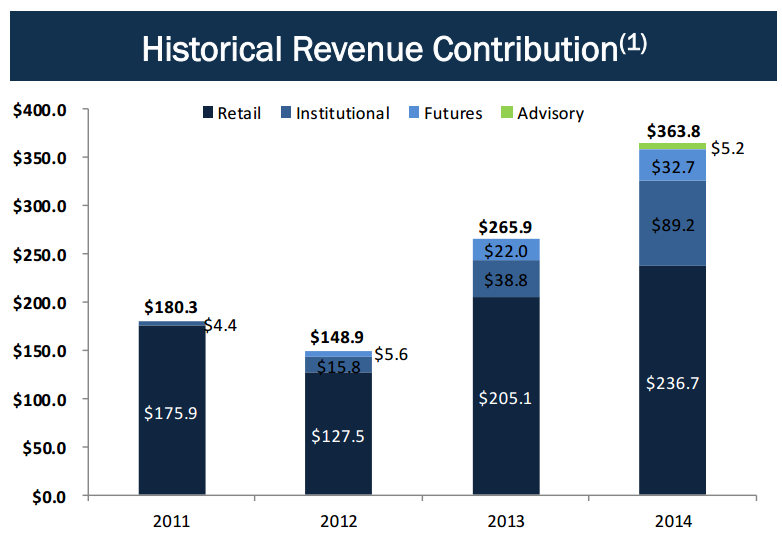
However, with over $40 million in 2014 revenues coming from Sales Trader, GAIN Capital may not be achieving any growth from GFT’s retail trading division. For the first nine months of 2013, GFT recorded $77.8 million in revenues, of which approximately $68 million were from retail trading. During 2014, GAIN reported retail revenues rising to $236.7 million from $205.1 million in 2013. As such, retail revenues rose $31.6 million in 2014, despite GFT’s retail division accounting for well above that amount in 2013.
City Index merger
The lack of much retail growth is important to consider as GAIN announced last October that it is acquiring City Index. Similar to the GFT acquisition, GAIN expects to achieve $45-$55 million in synergies from expense costs. The deal is still pending regulatory and shareholder approval, with an expected closing in Q2. Nonetheless, with City Index’s revenues primarily retail based, the success of the deal comes down to whether GAIN will be able to hold onto existing customers and marketing partners. If the GFT deal is any indication, retaining partners and clients does become more difficult when a large brand is acquired and no longer operates as a standalone entity with its own image.
Other tidbits
RPM – Retail revenues per million (RPM) dollars traded increased to $116 during the volatile quarter and was a high for the year. The figure compared to $120 in Q4 2013, when overall RPM exceeded that of 2013. While related to volatility, the overall lower trend in RPM may also be a result of GFT’s client base being less profitable than that of GFT.
Swiss franc – Overall GAIN Capital CEO Glenn Stevens related that the firm had little exposure to the Swiss franc’s volatility in January. They had already reported that they had a profitable day on the January 15th Black Thursday and forgave customer negative balances. During the conference call they added that they are benefiting from the event with new client figures rising. In terms of negative balances, Stevens said that 90% of the negative balances came from a few accounts that “you could count on two hands.” Overall negative balances were around $2.5 to $3 million.
Gain Capital posted record quarterly and full-year revenues last week, as top-line Q4 revenues grew 37% from 2013's Q4 to $114.7 million. Net income was 309% higher at $17.6 million. Driving revenue was a mix of growth in the broker’s retail FX and CFD brokering, its commission-based institutional and futures businesses, as well as the closing of its Acquisition of GFT. Today we take a closer look at the firm’s results and analysts conference call.
Post GFT Merger Synergies
With their acquisition of GFT in 2013 being finalized at the end of that year, GAIN Capital’s 2014 financials rose as they reflected results from the merged companies. The bottom line benefits though came from cost saving synergies achieved following the deal. As a result, fixed operating expenses of the combined companies fell from $181.7 million for 2012, the last full year before the merger, to $128.6 million. The $53.1 million decline in fixed expenses was attributed by GAIN to be synergy related and above their $35-$45 million target.
But, EBITDA % Decline
While exceeding synergy expectations, where GAIN underperformed was in its EBITDA as a percentage of revenues. For the full year 2014, EBITDA was 20.2% of revenues. This figure was below 2013’s 22.7% results, and more importantly, below the 26% rate GAIN achieved in the first nine months of 2013 before GFT was acquired. However, the broker did achieve a 31.3% rate for Q4 2014. As a comparable quarter with similar Volatility, during Q2 2013, GAIN achieved a 36.8% EBITDA-to-revenue rate. Overall, 2014’s figures illustrate that despite achieving cost reductions from the merger, profit margins are lower for the combined brokers than before GAIN had acquired GFT. However, the profit rates are well above what GFT had earning previous to the merger.
GFT’s Sales Trader unit
While GAIN doesn’t break down its retail revenues based on brand, they did publish that revenues from GFT’s Sales Trader division rose to $54 million in 2014 from $10.4 million in 2013. The product is GFT’s institutional trading offering and is included within GAIN’s commission-generating units. The growth illustrates that GAIN has successfully been able to increase its institutional market share.
Retail growth slowing
However, with over $40 million in 2014 revenues coming from Sales Trader, GAIN Capital may not be achieving any growth from GFT’s retail trading division. For the first nine months of 2013, GFT recorded $77.8 million in revenues, of which approximately $68 million were from retail trading. During 2014, GAIN reported retail revenues rising to $236.7 million from $205.1 million in 2013. As such, retail revenues rose $31.6 million in 2014, despite GFT’s retail division accounting for well above that amount in 2013.
City Index merger
The lack of much retail growth is important to consider as GAIN announced last October that it is acquiring City Index. Similar to the GFT acquisition, GAIN expects to achieve $45-$55 million in synergies from expense costs. The deal is still pending regulatory and shareholder approval, with an expected closing in Q2. Nonetheless, with City Index’s revenues primarily retail based, the success of the deal comes down to whether GAIN will be able to hold onto existing customers and marketing partners. If the GFT deal is any indication, retaining partners and clients does become more difficult when a large brand is acquired and no longer operates as a standalone entity with its own image.
Other tidbits
RPM – Retail revenues per million (RPM) dollars traded increased to $116 during the volatile quarter and was a high for the year. The figure compared to $120 in Q4 2013, when overall RPM exceeded that of 2013. While related to volatility, the overall lower trend in RPM may also be a result of GFT’s client base being less profitable than that of GFT.
Swiss franc – Overall GAIN Capital CEO Glenn Stevens related that the firm had little exposure to the Swiss franc’s volatility in January. They had already reported that they had a profitable day on the January 15th Black Thursday and forgave customer negative balances. During the conference call they added that they are benefiting from the event with new client figures rising. In terms of negative balances, Stevens said that 90% of the negative balances came from a few accounts that “you could count on two hands.” Overall negative balances were around $2.5 to $3 million.
Italy’s Consob Tightens Net on AI-Fueled Scams With Fresh Website Bans
FP Markets Winner Spotlight 🏆 | Global Broker of the Year 2025 #Trading #Broker #Innovation #Shorts
FP Markets Winner Spotlight 🏆 | Global Broker of the Year 2025 #Trading #Broker #Innovation #Shorts
FP Markets takes the spotlight as Global Broker of the Year 2025 at the Finance Magnates Awards.
Martin Stoilov, Head of Client Experience, shares that trust, innovation, and people played a key role in the company’s success, supported by a strong foundation of integrity and client-centricity.
Following this milestone, FP Markets continues to focus on growth, technology investment, and its core values of transparency and excellence.
👉 Be part of FM Awards 2026: https://awards.financemagnates.com/#nominate
FP Markets takes the spotlight as Global Broker of the Year 2025 at the Finance Magnates Awards.
Martin Stoilov, Head of Client Experience, shares that trust, innovation, and people played a key role in the company’s success, supported by a strong foundation of integrity and client-centricity.
Following this milestone, FP Markets continues to focus on growth, technology investment, and its core values of transparency and excellence.
👉 Be part of FM Awards 2026: https://awards.financemagnates.com/#nominate
In this video, we review @HolaPrimeMarketsOfficial, a multi-asset forex and CFDs broker offering different account types, trading platforms, and flexible trading conditions.
We cover the broker’s overall offering, including account options, trading environment, platforms like MT4 and MT5, and additional services such as managed accounts and fast withdrawals.
Watch the full video to see if Hola Prime Markets fits your trading needs.
📣 Stay up to date with the latest in finance and trading. Follow Finance Magnates for industry news, insights, and global event coverage.
Connect with us:
🔗 LinkedIn: /financemagnates
👍 Facebook: /financemagnates
📸 Instagram: https://www.instagram.com/financemagnates
🐦 X: https://x.com/financemagnates
🎥 TikTok: https://www.tiktok.com/tag/financemagnates
▶️ YouTube: /@financemagnates_official
#HolaPrime #ForexBroker #CFDTrading #FinanceMagnates #Trading #Forex #BrokerReview
In this video, we review @HolaPrimeMarketsOfficial, a multi-asset forex and CFDs broker offering different account types, trading platforms, and flexible trading conditions.
We cover the broker’s overall offering, including account options, trading environment, platforms like MT4 and MT5, and additional services such as managed accounts and fast withdrawals.
Watch the full video to see if Hola Prime Markets fits your trading needs.
📣 Stay up to date with the latest in finance and trading. Follow Finance Magnates for industry news, insights, and global event coverage.
Connect with us:
🔗 LinkedIn: /financemagnates
👍 Facebook: /financemagnates
📸 Instagram: https://www.instagram.com/financemagnates
🐦 X: https://x.com/financemagnates
🎥 TikTok: https://www.tiktok.com/tag/financemagnates
▶️ YouTube: /@financemagnates_official
#HolaPrime #ForexBroker #CFDTrading #FinanceMagnates #Trading #Forex #BrokerReview
Hola Prime Review: What You Need to Know | Full Breakdown by Finance Magnates
Hola Prime Review: What You Need to Know | Full Breakdown by Finance Magnates
In this video, we review @HolaPrime_Global, a proprietary trading firm offering evaluation programs and performance-based payouts in simulated market environments.
We cover how the challenge model works, including account types, profit splits (up to 95%), trading rules, and what it takes to reach a funded account. You’ll also learn about available platforms like MT4, MT5, cTrader, and more, along with insights into payouts, support, and trading conditions.
Watch the full video to see if Hola Prime fits your trading style.
📣 Stay up to date with the latest in finance and trading. Follow Finance Magnates for industry news, insights, and global event coverage.
Connect with us:
🔗 LinkedIn: /financemagnates
👍 Facebook: /financemagnates
📸 Instagram: https://www.instagram.com/financemagnates
🐦 X: https://x.com/financemagnates
🎥 TikTok: https://www.tiktok.com/tag/financemagnates
▶️ YouTube: /@financemagnates_official
#HolaPrime #PropFirm #Trading #FinanceMagnates #Forex #FuturesTrading #TradingReview #PropFirmReview
In this video, we review @HolaPrime_Global, a proprietary trading firm offering evaluation programs and performance-based payouts in simulated market environments.
We cover how the challenge model works, including account types, profit splits (up to 95%), trading rules, and what it takes to reach a funded account. You’ll also learn about available platforms like MT4, MT5, cTrader, and more, along with insights into payouts, support, and trading conditions.
Watch the full video to see if Hola Prime fits your trading style.
📣 Stay up to date with the latest in finance and trading. Follow Finance Magnates for industry news, insights, and global event coverage.
Connect with us:
🔗 LinkedIn: /financemagnates
👍 Facebook: /financemagnates
📸 Instagram: https://www.instagram.com/financemagnates
🐦 X: https://x.com/financemagnates
🎥 TikTok: https://www.tiktok.com/tag/financemagnates
▶️ YouTube: /@financemagnates_official
#HolaPrime #PropFirm #Trading #FinanceMagnates #Forex #FuturesTrading #TradingReview #PropFirmReview
Axi Winner Spotlight 🏆 | Global Most Innovative Broker 2025 #Innovation #Trading #Fintech #Broker
Axi Winner Spotlight 🏆 | Global Most Innovative Broker 2025 #Innovation #Trading #Fintech #Broker
Axi takes the spotlight at the Finance Magnates Awards, winning Global Most Innovative Broker 2025.
Olivia Xenofontos and Ivanna Openko share how the team will feel: proud, motivated, and ready to keep delivering.
They also describe the night as well-organized, focused, and enjoyable for all.
👉 Be part of FM Awards 2026.
Axi takes the spotlight at the Finance Magnates Awards, winning Global Most Innovative Broker 2025.
Olivia Xenofontos and Ivanna Openko share how the team will feel: proud, motivated, and ready to keep delivering.
They also describe the night as well-organized, focused, and enjoyable for all.
👉 Be part of FM Awards 2026.
Recognition that matters.
Built on transparency.
Driven by the industry.
The Finance Magnates Awards 2026.
Nominations are now open.
🔗 https://awards.financemagnates.com/?utm_source=SM&utm_medium=social&utm_campaign=recognition-matters
Recognition that matters.
Built on transparency.
Driven by the industry.
The Finance Magnates Awards 2026.
Nominations are now open.
🔗 https://awards.financemagnates.com/?utm_source=SM&utm_medium=social&utm_campaign=recognition-matters