Options empower traders to jump into an expansive hub of ideas, no longer solely tied to the ups and downs of the market
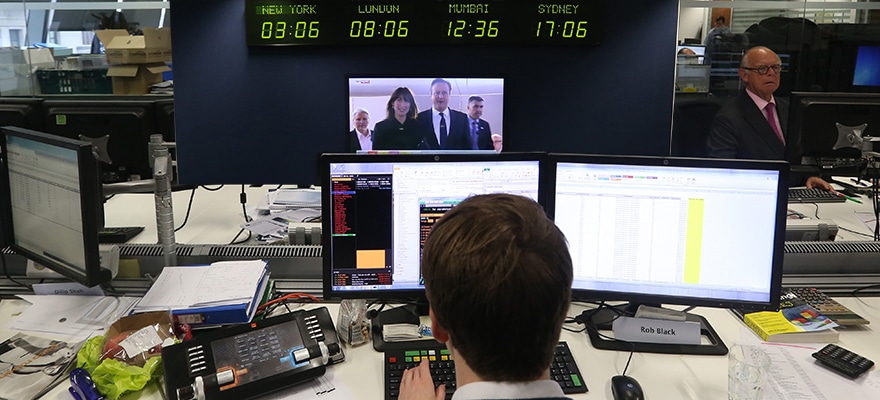
Bloomberg
What makes options unique is that their value not only depends on how far the market moves in a certain direction, but also on other important trading factors. Whilst movement of market price relative to the option’s strike does affect the option’s value, there are two other major elements to consider. These are, time left until expiry and implied Volatility.
Every option contract is assigned an expiry date, this could be one day or it could a year, the date will depend on your outlook. Options with a longer expiry cost more. This makes sense because with more time comes a higher chance of a favorable move for the option buyer. You could describe this as ‘buying more time’.
For each day that an option is open, as it moves towards expiry, its value declines. This happens regardless of market activity; if the underlying market price were to stay still for a day the options value would still decline. This effect is called ‘time decay’.
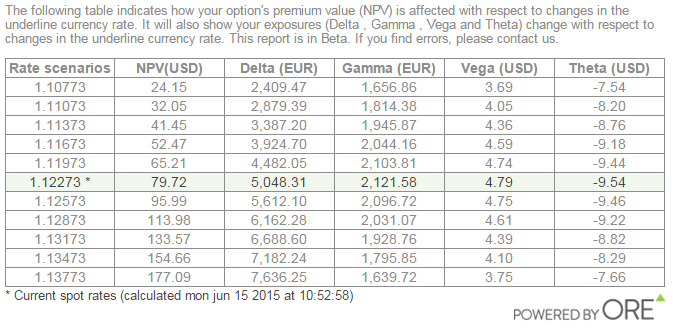
Time decay is good for an option seller who wants option price (premium) to fall, and bad for an option buyer. The amount of time decay that may be gained or lost each day, depending on your position, is indicated in a Sensitivity report. The value to assess is called ‘Theta’. The table below shows an indication of Theta for a long EUR/USD Call position, over a range of rates. In this example, Theta is negative since this is a long (through buying) option position.
The next important factor is implied volatility or IV for short. IV is a measure of the marketplace’s expectation of volatility over the time left in the option. If the market expects higher volatility the option’s value will rise. This makes sense because the more volatility in the underlying asset, the more likely the market will move in the option buyer’s favor. A recent example was before the UK government elections in May, GBP/USD options expiring on the day of the result were extremely expensive due to the marketplace expecting very high volatility in that pair at that time.
Volatility is in fact important for any trader, no matter if you are day-trading, forward or futures trading, or options trading, volatility affects you all. The difference with options trading is that the trader is given the ability to trade their volatility outlook for the duration of the option. We will discuss this in more detail in the next article.
Now let’s finish with some financial jargon. All factors that affect option price (or premium) can be wrapped up into two portions; intrinsic value and time value. Where, Premium = Intrinsic Value + Time Value
Intrinsic value is the portion that depends on the difference (and direction) between the underlying market price and the strike price. Only in-the-money (ITM) options have intrinsic value. To learn more on this read Calculating Option Payouts and The Moneyness of an Option
Time value, also known as extrinsic value, is determined by external factors. The two main factors are, time left until expiry and implied volatility, as described above. At an options expiry, time value equals zero (because there is no time left) and therefore the option's premium value equals intrinsic value only.
The progression of online option trading platforms allows you to easily monitor all factors and trade in-and-out of the market before an options expiry (if desirable). This has opened the door to trading a multitude of opportunities from simple limited risk directional trades to benefitting from an increase in volatility. When trading options, the sky's the limit!
What makes options unique is that their value not only depends on how far the market moves in a certain direction, but also on other important trading factors. Whilst movement of market price relative to the option’s strike does affect the option’s value, there are two other major elements to consider. These are, time left until expiry and implied Volatility.
Every option contract is assigned an expiry date, this could be one day or it could a year, the date will depend on your outlook. Options with a longer expiry cost more. This makes sense because with more time comes a higher chance of a favorable move for the option buyer. You could describe this as ‘buying more time’.
For each day that an option is open, as it moves towards expiry, its value declines. This happens regardless of market activity; if the underlying market price were to stay still for a day the options value would still decline. This effect is called ‘time decay’.
Time decay is good for an option seller who wants option price (premium) to fall, and bad for an option buyer. The amount of time decay that may be gained or lost each day, depending on your position, is indicated in a Sensitivity report. The value to assess is called ‘Theta’. The table below shows an indication of Theta for a long EUR/USD Call position, over a range of rates. In this example, Theta is negative since this is a long (through buying) option position.
The next important factor is implied volatility or IV for short. IV is a measure of the marketplace’s expectation of volatility over the time left in the option. If the market expects higher volatility the option’s value will rise. This makes sense because the more volatility in the underlying asset, the more likely the market will move in the option buyer’s favor. A recent example was before the UK government elections in May, GBP/USD options expiring on the day of the result were extremely expensive due to the marketplace expecting very high volatility in that pair at that time.
Volatility is in fact important for any trader, no matter if you are day-trading, forward or futures trading, or options trading, volatility affects you all. The difference with options trading is that the trader is given the ability to trade their volatility outlook for the duration of the option. We will discuss this in more detail in the next article.
Now let’s finish with some financial jargon. All factors that affect option price (or premium) can be wrapped up into two portions; intrinsic value and time value. Where, Premium = Intrinsic Value + Time Value
Intrinsic value is the portion that depends on the difference (and direction) between the underlying market price and the strike price. Only in-the-money (ITM) options have intrinsic value. To learn more on this read Calculating Option Payouts and The Moneyness of an Option
Time value, also known as extrinsic value, is determined by external factors. The two main factors are, time left until expiry and implied volatility, as described above. At an options expiry, time value equals zero (because there is no time left) and therefore the option's premium value equals intrinsic value only.
The progression of online option trading platforms allows you to easily monitor all factors and trade in-and-out of the market before an options expiry (if desirable). This has opened the door to trading a multitude of opportunities from simple limited risk directional trades to benefitting from an increase in volatility. When trading options, the sky's the limit!
Tradition Posts Record CHF 1.2 Billion Revenue as UAE Business Rises 55%
CMC Markets’ Artur Delijergijevs on Metals Demand, Volatility, & Stable Execution
CMC Markets’ Artur Delijergijevs on Metals Demand, Volatility, & Stable Execution
In this exclusive Executive Interview, Finance Magnates speaks with Artur Delijergijevs, Head of Systematic Market Making at CMC Markets, about the current state of metals demand and market volatility.
Delijergijevs offers a desk-level view on:
- Metals Demand: Why metals are seeing the strongest demand from both retail and institutional clients right now.
- The Safe-Haven Debate: Questioning whether gold still fits the classic safe-haven definition given large daily price movements.
- Volatile Market Prep: How a market-making desk prepares its systems and pricing for stressed market conditions and high-impact economic events.
- Hybrid Execution: Why the best execution model combines electronic speed with human relationship support, especially during volatility.
- AI in Workflow: Where CMC Markets is integrating machine learning for risk management and pricing, and the limitations of AI during stressed markets.
- Dubai's Role: The strategic importance of Dubai’s location for covering global trading sessions across Asia, Europe, and the US.
Watch to understand how CMC Markets maintains stable pricing and reliable execution quality in high-volatility environments.
#CMCmarkets #forex #metals #gold #trading #volatility #MarketMaking #iFXDubai #FinanceMagnates #Finance #Fintech #Execution #AlgorithmicTrading #RiskManagement
In this exclusive Executive Interview, Finance Magnates speaks with Artur Delijergijevs, Head of Systematic Market Making at CMC Markets, about the current state of metals demand and market volatility.
Delijergijevs offers a desk-level view on:
- Metals Demand: Why metals are seeing the strongest demand from both retail and institutional clients right now.
- The Safe-Haven Debate: Questioning whether gold still fits the classic safe-haven definition given large daily price movements.
- Volatile Market Prep: How a market-making desk prepares its systems and pricing for stressed market conditions and high-impact economic events.
- Hybrid Execution: Why the best execution model combines electronic speed with human relationship support, especially during volatility.
- AI in Workflow: Where CMC Markets is integrating machine learning for risk management and pricing, and the limitations of AI during stressed markets.
- Dubai's Role: The strategic importance of Dubai’s location for covering global trading sessions across Asia, Europe, and the US.
Watch to understand how CMC Markets maintains stable pricing and reliable execution quality in high-volatility environments.
#CMCmarkets #forex #metals #gold #trading #volatility #MarketMaking #iFXDubai #FinanceMagnates #Finance #Fintech #Execution #AlgorithmicTrading #RiskManagement
Finance Magnates Awards 2026 – Nominations Now Open
Finance Magnates Awards 2026 – Nominations Now Open
The Finance Magnates Awards 2026 nominations are now open. 🏆
From fintech innovators to leading brokers, this is where the finance industry celebrates its biggest achievements.
Winners will be announced at the Cyprus Gala Dinner on November 6, 2026.
Nominate your brand now.
https://awards.financemagnates.com/?utm_source=linkedin&utm_medium=video&utm_campaign=nominations-open
#FMAwards #FinanceMagnates #FintechAwards #Fintech #FinanceIndustry
The Finance Magnates Awards 2026 nominations are now open. 🏆
From fintech innovators to leading brokers, this is where the finance industry celebrates its biggest achievements.
Winners will be announced at the Cyprus Gala Dinner on November 6, 2026.
Nominate your brand now.
https://awards.financemagnates.com/?utm_source=linkedin&utm_medium=video&utm_campaign=nominations-open
#FMAwards #FinanceMagnates #FintechAwards #Fintech #FinanceIndustry
Finance Magnates Awards 2026 | Nominations Now Open 🏆#Fintech #FMAwards #TradingIndustry
Finance Magnates Awards 2026 | Nominations Now Open 🏆#Fintech #FMAwards #TradingIndustry
Lights on. Cameras ready. 🎬
Finance Magnates Awards 2026 nominations are now open. 🏆
#FMAwards #FinanceMagnates #FintechAwards #Fintech
Lights on. Cameras ready. 🎬
Finance Magnates Awards 2026 nominations are now open. 🏆
#FMAwards #FinanceMagnates #FintechAwards #Fintech
Exness sees trust as the key theme for growth in MENA Trading Growth for 2026
Exness sees trust as the key theme for growth in MENA Trading Growth for 2026
Mohammad Amer, Regional Commercial Director at Exness, sits down to discuss the booming MENA financial trading market. Find out why Dubai is key to the company's growth strategy, how a mobile-first generation is changing expectations, and why trust will be the defining theme for traders in 2026.
In this interview, you'll learn:
* Why Dubai and the MENA region are critical growth markets for fintech and online trading.
* How Exness is addressing the demands of mobile-first, younger traders through engineering, platform stability, and transparent conditions.
* The essential role local talent plays in providing a culturally relevant and compliant user experience.
* Mohammad Amer's outlook on the future of the online trading industry and why stronger controls and systems are necessary.
* Why "trust" isn't just a brand value, but has commercial value—and why he predicts 2026 will be the "Year of Trust."
Key Takeaways:
➡️ The MENA region is rapidly shaping global financial markets.
➡️ New traders expect stability, precise execution, and transparency.
➡️ Local expertise is key to regulatory compliance and user experience.
➡️ Future success belongs to firms capable of meeting rising standards across regulation and platform consistency.
Read the full article at: https://www.financemagnates.com/thought-leadership/exness-sees-trust-as-the-key-theme-for-growth-in-mena-trading-growth-for-2026/
#Exness #MENA #Trading #FinTech #Dubai #OnlineTrading #FinanceMagnates #MohammadAmer #Trust #MobileTrading
Mohammad Amer, Regional Commercial Director at Exness, sits down to discuss the booming MENA financial trading market. Find out why Dubai is key to the company's growth strategy, how a mobile-first generation is changing expectations, and why trust will be the defining theme for traders in 2026.
In this interview, you'll learn:
* Why Dubai and the MENA region are critical growth markets for fintech and online trading.
* How Exness is addressing the demands of mobile-first, younger traders through engineering, platform stability, and transparent conditions.
* The essential role local talent plays in providing a culturally relevant and compliant user experience.
* Mohammad Amer's outlook on the future of the online trading industry and why stronger controls and systems are necessary.
* Why "trust" isn't just a brand value, but has commercial value—and why he predicts 2026 will be the "Year of Trust."
Key Takeaways:
➡️ The MENA region is rapidly shaping global financial markets.
➡️ New traders expect stability, precise execution, and transparency.
➡️ Local expertise is key to regulatory compliance and user experience.
➡️ Future success belongs to firms capable of meeting rising standards across regulation and platform consistency.
Read the full article at: https://www.financemagnates.com/thought-leadership/exness-sees-trust-as-the-key-theme-for-growth-in-mena-trading-growth-for-2026/
#Exness #MENA #Trading #FinTech #Dubai #OnlineTrading #FinanceMagnates #MohammadAmer #Trust #MobileTrading
Paytiko CEO Razi Salih on Why Payment Orchestration is a MUST-HAVE for Brokers in 2026
Paytiko CEO Razi Salih on Why Payment Orchestration is a MUST-HAVE for Brokers in 2026
At iFX Expo Dubai, Finance Magnates spoke with Razi Salih, CEO at Paytiko, about the evolution of the payments ecosystem and why payment orchestration has shifted from an option to a necessity for brokers, prop firms, and exchanges.
Mr. Salih explains how global expansion, the need for deep localisation, and the sheer number of new payment methods, from instant banking to stablecoins, are driving this critical infrastructure shift.
#PaymentOrchestration #Fintech #Brokerage #TradingPayments #RaziSalih #Paytiko #iFXExpoDubai #Stablecoins #AIinFintech
At iFX Expo Dubai, Finance Magnates spoke with Razi Salih, CEO at Paytiko, about the evolution of the payments ecosystem and why payment orchestration has shifted from an option to a necessity for brokers, prop firms, and exchanges.
Mr. Salih explains how global expansion, the need for deep localisation, and the sheer number of new payment methods, from instant banking to stablecoins, are driving this critical infrastructure shift.
#PaymentOrchestration #Fintech #Brokerage #TradingPayments #RaziSalih #Paytiko #iFXExpoDubai #Stablecoins #AIinFintech