Reasons Why New Zealand Dollar May Keep Rising Against the US Dollar
Friday,09/09/2016|09:32GMTby
Aayush Jindal
An examination of the key reasons which drove the NZD higher against the USD and whether this trend will continue.
Bloomberg
This article was written by Aayush Jindal, currency analyst at Titan FX.
The New Zealand dollar enjoyed back to back weekly gains against the US dollar, as the NZD/USD pair traded above a couple of crucial resistance levels including 0.6900 and 0.7200.
Let us try to find out the key factors driving the Kiwi higher and whether it could continue to move higher versus the US dollar.
Below are a few reasons why the NZD did well during the past few weeks:
Gain in dairy prices prompted buying in the New Zealand dollar, as a rebound in dairy prices helps the currency to recover from the bearish sentiment.
There was help from a weaker US dollar. The recent economic data in the US missed the forecast. One example the Institute for Supply Management (ISM) Manufacturing Index in August failing to post an expansion and coming in at 49.4. The US nonfarm payrolls released by the US Department of Labor came below the forecast of 180,000 with a reading of 151,000.
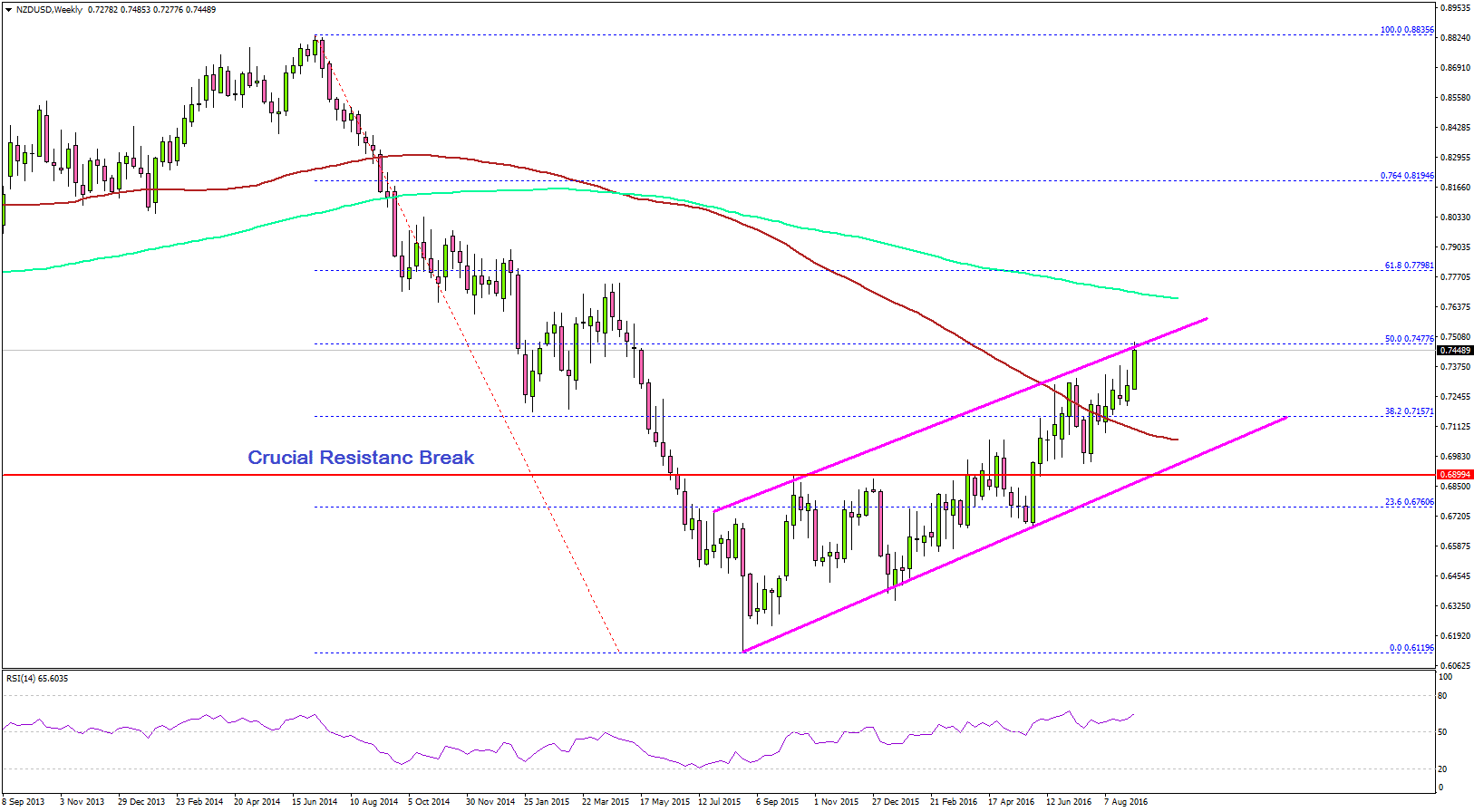
Technically, there was a major break noted on the weekly chart of the NZD/USD, which triggered a rally in the pair.
In August 2015, the New Zealand dollar traded as low as 0.6120 versus the US dollar, where somehow the buyers managed to protect any additional losses. Since then, the NZD/USD pair has been in recovery mode.
The pair has created an ascending channel pattern on the weekly chart, and has followed it over the past few months as market sentiment recovered slowly and steadily in favour of the Kiwi dollar.
There are a few important points to note regarding the recent upside drift. First, the pair managed to close above the 100-week simple moving average. Second, there was a close above a couple of crucial resistance levels including 0.6900 and 0.7200.
Lastly, the pair also broke the 38.2% Fib retracement level of the last drop from the 0.8835 high to 0.6120 low. So, there were enough reasons for the bulls to take the pair higher.
Can Kiwi Dollar Continue Higher?
I am pretty much sure that the current strength in the Kiwi dollar may not go down well with the Reserve Bank of New Zealand. So there is a high possibility that the central bank may opt to cut interest rates in the upcoming meeting since it is the best option currently available to tackle a strong currency.
In that case, the NZD/USD pair may definitely come under pressure. Technically, the pair is also heading towards a major technical resistance area in the form of the 50% Fib retracement level of the last drop from the 0.8835 high to 0.6120 low.
If the central bank fails to deliver in terms of easing, it could prompt further upsides in NZD/USD.
This article was written by Aayush Jindal, currency analyst at Titan FX.
The New Zealand dollar enjoyed back to back weekly gains against the US dollar, as the NZD/USD pair traded above a couple of crucial resistance levels including 0.6900 and 0.7200.
Let us try to find out the key factors driving the Kiwi higher and whether it could continue to move higher versus the US dollar.
Below are a few reasons why the NZD did well during the past few weeks:
Gain in dairy prices prompted buying in the New Zealand dollar, as a rebound in dairy prices helps the currency to recover from the bearish sentiment.
There was help from a weaker US dollar. The recent economic data in the US missed the forecast. One example the Institute for Supply Management (ISM) Manufacturing Index in August failing to post an expansion and coming in at 49.4. The US nonfarm payrolls released by the US Department of Labor came below the forecast of 180,000 with a reading of 151,000.
Technically, there was a major break noted on the weekly chart of the NZD/USD, which triggered a rally in the pair.
In August 2015, the New Zealand dollar traded as low as 0.6120 versus the US dollar, where somehow the buyers managed to protect any additional losses. Since then, the NZD/USD pair has been in recovery mode.
The pair has created an ascending channel pattern on the weekly chart, and has followed it over the past few months as market sentiment recovered slowly and steadily in favour of the Kiwi dollar.
There are a few important points to note regarding the recent upside drift. First, the pair managed to close above the 100-week simple moving average. Second, there was a close above a couple of crucial resistance levels including 0.6900 and 0.7200.
Lastly, the pair also broke the 38.2% Fib retracement level of the last drop from the 0.8835 high to 0.6120 low. So, there were enough reasons for the bulls to take the pair higher.
Can Kiwi Dollar Continue Higher?
I am pretty much sure that the current strength in the Kiwi dollar may not go down well with the Reserve Bank of New Zealand. So there is a high possibility that the central bank may opt to cut interest rates in the upcoming meeting since it is the best option currently available to tackle a strong currency.
In that case, the NZD/USD pair may definitely come under pressure. Technically, the pair is also heading towards a major technical resistance area in the form of the 50% Fib retracement level of the last drop from the 0.8835 high to 0.6120 low.
If the central bank fails to deliver in terms of easing, it could prompt further upsides in NZD/USD.
Italy’s Consob Tightens Net on AI-Fueled Scams With Fresh Website Bans
FP Markets Winner Spotlight 🏆 | Global Broker of the Year 2025 #Trading #Broker #Innovation #Shorts
FP Markets Winner Spotlight 🏆 | Global Broker of the Year 2025 #Trading #Broker #Innovation #Shorts
FP Markets takes the spotlight as Global Broker of the Year 2025 at the Finance Magnates Awards.
Martin Stoilov, Head of Client Experience, shares that trust, innovation, and people played a key role in the company’s success, supported by a strong foundation of integrity and client-centricity.
Following this milestone, FP Markets continues to focus on growth, technology investment, and its core values of transparency and excellence.
👉 Be part of FM Awards 2026: https://awards.financemagnates.com/#nominate
FP Markets takes the spotlight as Global Broker of the Year 2025 at the Finance Magnates Awards.
Martin Stoilov, Head of Client Experience, shares that trust, innovation, and people played a key role in the company’s success, supported by a strong foundation of integrity and client-centricity.
Following this milestone, FP Markets continues to focus on growth, technology investment, and its core values of transparency and excellence.
👉 Be part of FM Awards 2026: https://awards.financemagnates.com/#nominate
In this video, we review @HolaPrimeMarketsOfficial, a multi-asset forex and CFDs broker offering different account types, trading platforms, and flexible trading conditions.
We cover the broker’s overall offering, including account options, trading environment, platforms like MT4 and MT5, and additional services such as managed accounts and fast withdrawals.
Watch the full video to see if Hola Prime Markets fits your trading needs.
📣 Stay up to date with the latest in finance and trading. Follow Finance Magnates for industry news, insights, and global event coverage.
Connect with us:
🔗 LinkedIn: /financemagnates
👍 Facebook: /financemagnates
📸 Instagram: https://www.instagram.com/financemagnates
🐦 X: https://x.com/financemagnates
🎥 TikTok: https://www.tiktok.com/tag/financemagnates
▶️ YouTube: /@financemagnates_official
#HolaPrime #ForexBroker #CFDTrading #FinanceMagnates #Trading #Forex #BrokerReview
In this video, we review @HolaPrimeMarketsOfficial, a multi-asset forex and CFDs broker offering different account types, trading platforms, and flexible trading conditions.
We cover the broker’s overall offering, including account options, trading environment, platforms like MT4 and MT5, and additional services such as managed accounts and fast withdrawals.
Watch the full video to see if Hola Prime Markets fits your trading needs.
📣 Stay up to date with the latest in finance and trading. Follow Finance Magnates for industry news, insights, and global event coverage.
Connect with us:
🔗 LinkedIn: /financemagnates
👍 Facebook: /financemagnates
📸 Instagram: https://www.instagram.com/financemagnates
🐦 X: https://x.com/financemagnates
🎥 TikTok: https://www.tiktok.com/tag/financemagnates
▶️ YouTube: /@financemagnates_official
#HolaPrime #ForexBroker #CFDTrading #FinanceMagnates #Trading #Forex #BrokerReview
Hola Prime Review: What You Need to Know | Full Breakdown by Finance Magnates
Hola Prime Review: What You Need to Know | Full Breakdown by Finance Magnates
In this video, we review @HolaPrime_Global, a proprietary trading firm offering evaluation programs and performance-based payouts in simulated market environments.
We cover how the challenge model works, including account types, profit splits (up to 95%), trading rules, and what it takes to reach a funded account. You’ll also learn about available platforms like MT4, MT5, cTrader, and more, along with insights into payouts, support, and trading conditions.
Watch the full video to see if Hola Prime fits your trading style.
📣 Stay up to date with the latest in finance and trading. Follow Finance Magnates for industry news, insights, and global event coverage.
Connect with us:
🔗 LinkedIn: /financemagnates
👍 Facebook: /financemagnates
📸 Instagram: https://www.instagram.com/financemagnates
🐦 X: https://x.com/financemagnates
🎥 TikTok: https://www.tiktok.com/tag/financemagnates
▶️ YouTube: /@financemagnates_official
#HolaPrime #PropFirm #Trading #FinanceMagnates #Forex #FuturesTrading #TradingReview #PropFirmReview
In this video, we review @HolaPrime_Global, a proprietary trading firm offering evaluation programs and performance-based payouts in simulated market environments.
We cover how the challenge model works, including account types, profit splits (up to 95%), trading rules, and what it takes to reach a funded account. You’ll also learn about available platforms like MT4, MT5, cTrader, and more, along with insights into payouts, support, and trading conditions.
Watch the full video to see if Hola Prime fits your trading style.
📣 Stay up to date with the latest in finance and trading. Follow Finance Magnates for industry news, insights, and global event coverage.
Connect with us:
🔗 LinkedIn: /financemagnates
👍 Facebook: /financemagnates
📸 Instagram: https://www.instagram.com/financemagnates
🐦 X: https://x.com/financemagnates
🎥 TikTok: https://www.tiktok.com/tag/financemagnates
▶️ YouTube: /@financemagnates_official
#HolaPrime #PropFirm #Trading #FinanceMagnates #Forex #FuturesTrading #TradingReview #PropFirmReview
Axi Winner Spotlight 🏆 | Global Most Innovative Broker 2025 #Innovation #Trading #Fintech #Broker
Axi Winner Spotlight 🏆 | Global Most Innovative Broker 2025 #Innovation #Trading #Fintech #Broker
Axi takes the spotlight at the Finance Magnates Awards, winning Global Most Innovative Broker 2025.
Olivia Xenofontos and Ivanna Openko share how the team will feel: proud, motivated, and ready to keep delivering.
They also describe the night as well-organized, focused, and enjoyable for all.
👉 Be part of FM Awards 2026.
Axi takes the spotlight at the Finance Magnates Awards, winning Global Most Innovative Broker 2025.
Olivia Xenofontos and Ivanna Openko share how the team will feel: proud, motivated, and ready to keep delivering.
They also describe the night as well-organized, focused, and enjoyable for all.
👉 Be part of FM Awards 2026.
Recognition that matters.
Built on transparency.
Driven by the industry.
The Finance Magnates Awards 2026.
Nominations are now open.
🔗 https://awards.financemagnates.com/?utm_source=SM&utm_medium=social&utm_campaign=recognition-matters
Recognition that matters.
Built on transparency.
Driven by the industry.
The Finance Magnates Awards 2026.
Nominations are now open.
🔗 https://awards.financemagnates.com/?utm_source=SM&utm_medium=social&utm_campaign=recognition-matters